Testamentary Provisions for Charitable Remainder Annuity Trust for Term of Years
What is this form?
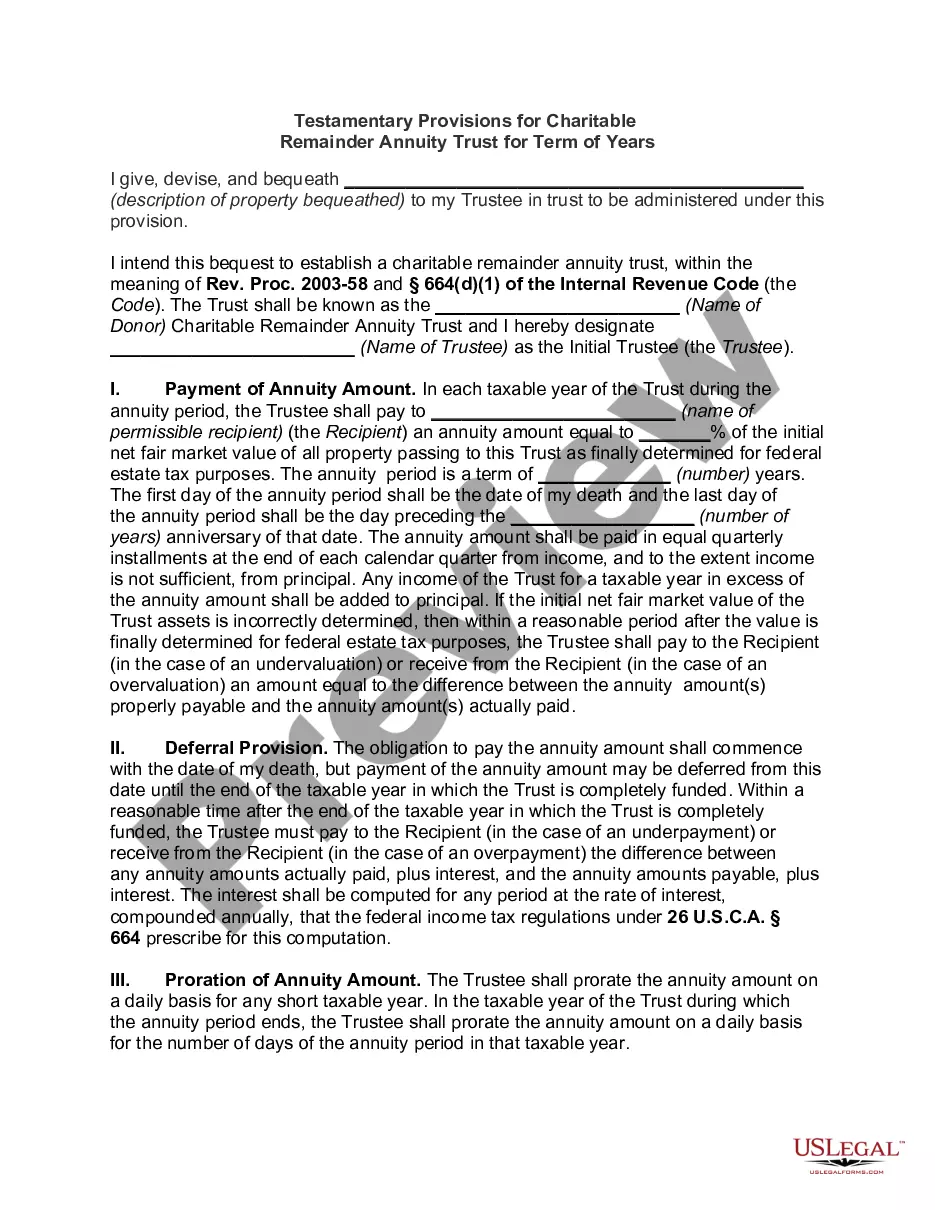
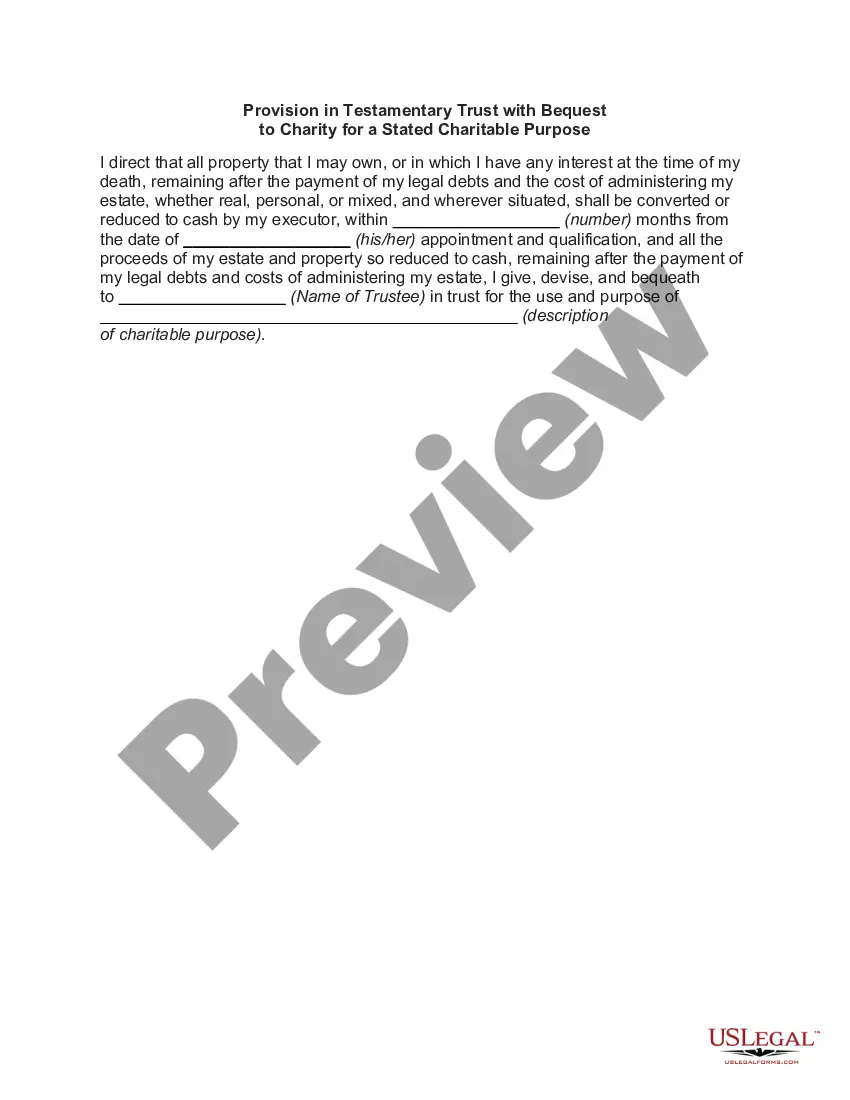
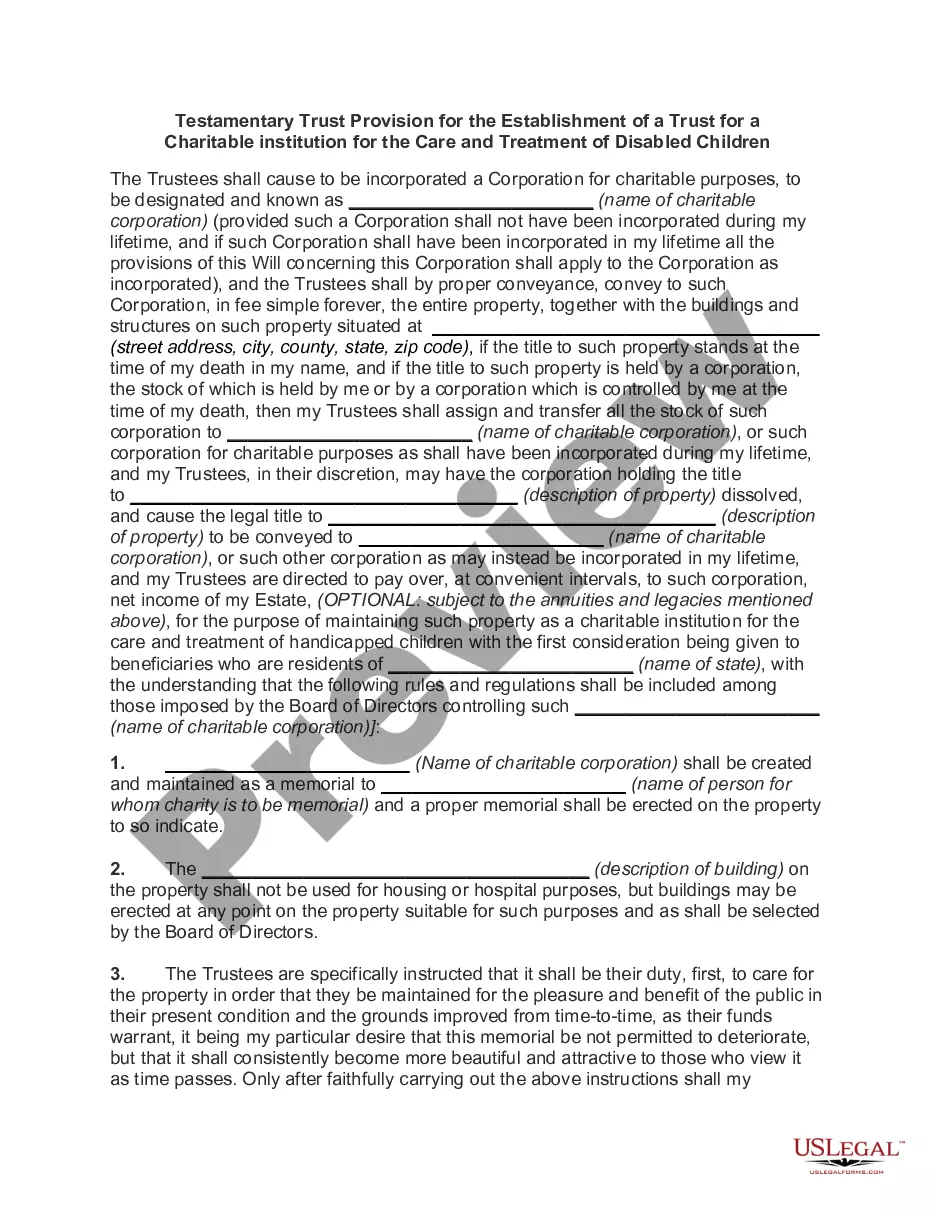
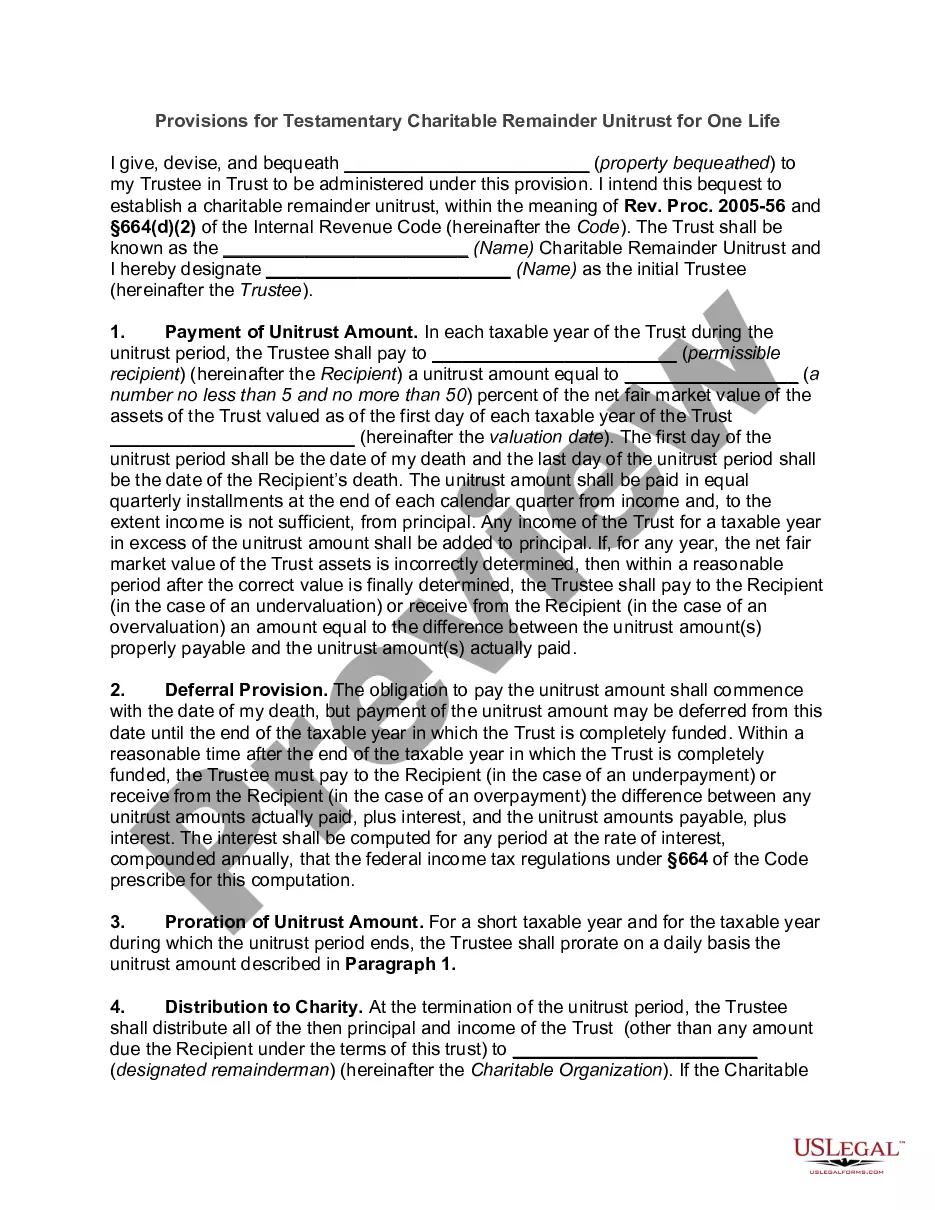
The Testamentary Provisions for Charitable Remainder Annuity Trust for Term of Years is a legal document that establishes a tax-exempt irrevocable trust designed to provide income to designated beneficiaries for a specified period. After this period, the remaining assets are donated to a chosen charitable organization. This form specifically connects the annuity payments to the trust's value, distinguishing it from other charitable trust formats by focusing on a set term for income distributions.
Key parts of this document
- Description of the property bequeathed to the trust.
- Designation of the initial trustee who will manage the trust.
- Specific annuity payment details, including amount and frequency.
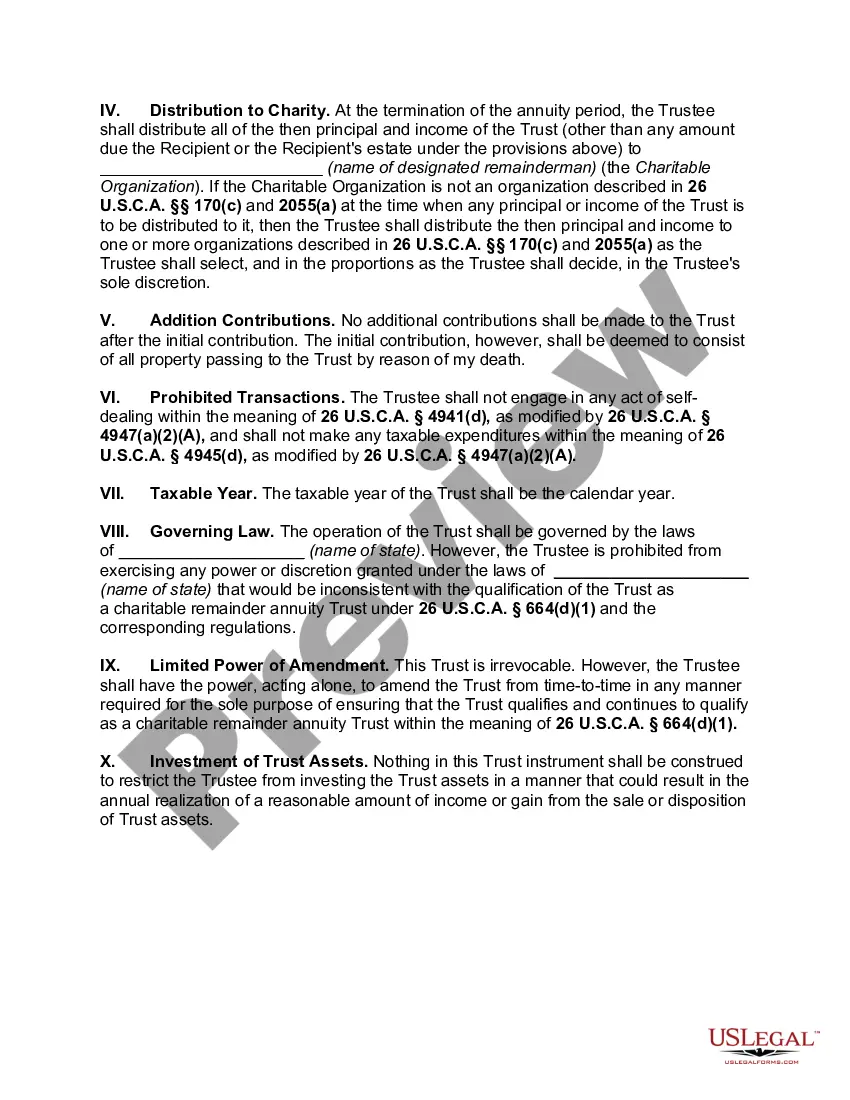
- Provision for distributing assets to a charitable organization after the annuity period.
- Settings for proration and deferral of annuity amounts.
- Governing laws and conditions for potential amendments to the trust.
Common use cases
This form is typically used when an individual wishes to establish a charitable remainder annuity trust through their will. It is suitable for those looking to provide financial support to a beneficiary while also planning for a charitable donation. You may consider using this form if you want to leave a meaningful gift to charity after a designated income distribution period and wish to receive tax benefits as a result.
Who should use this form
This form is intended for individuals who:
- Wish to create a charitable remainder annuity trust as part of their estate plan.
- Would like to provide for beneficiaries while planning for future charitable contributions.
- Are familiar with the associated tax benefits and regulations surrounding such trusts.
- Have specific property or assets they want to include in the trust.
Steps to complete this form
- Identify and describe the property you intend to bequeath to the trust.
- Name the trustee responsible for managing the trust.
- Specify the annuity amount and payment schedule.
- Define the term of the annuity period.
- Designate the charitable organization that will receive the remaining trust assets after the annuity period.
- Include any relevant state laws that may affect the trust operation.
Notarization requirements for this form
Notarization is not commonly needed for this form. However, certain documents or local rules may make it necessary. Our notarization service, powered by Notarize, allows you to finalize it securely online anytime, day or night.
Get your form ready online
Our built-in tools help you complete, sign, share, and store your documents in one place.
Make edits, fill in missing information, and update formatting in US Legal Forms—just like you would in MS Word.
Download a copy, print it, send it by email, or mail it via USPS—whatever works best for your next step.
Sign and collect signatures with our SignNow integration. Send to multiple recipients, set reminders, and more. Go Premium to unlock E-Sign.
If this form requires notarization, complete it online through a secure video call—no need to meet a notary in person or wait for an appointment.
We protect your documents and personal data by following strict security and privacy standards.

Make edits, fill in missing information, and update formatting in US Legal Forms—just like you would in MS Word.

Download a copy, print it, send it by email, or mail it via USPS—whatever works best for your next step.

Sign and collect signatures with our SignNow integration. Send to multiple recipients, set reminders, and more. Go Premium to unlock E-Sign.

If this form requires notarization, complete it online through a secure video call—no need to meet a notary in person or wait for an appointment.

We protect your documents and personal data by following strict security and privacy standards.
Common mistakes to avoid
- Failing to clearly define the property to be included in the trust.
- Not specifying the annuity amount or payment frequency correctly.
- Overlooking the necessary state-specific legal requirements.
- Neglecting to name a successor trustee in case the initial trustee cannot fulfill their duties.
- Ignoring the potential tax implications of the trust's beneficiaries and charitable distributions.
Why complete this form online
- Convenience of accessing and completing the form from home.
- Editability allows for easy updates and modifications to the trust as needed.
- Reliability of using templates drafted by licensed attorneys.
- Streamlined preparation process helps to reduce anxiety around legal documentation.
Legal use & context
- This form is legally binding and designed to meet IRS requirements for charitable remainder annuity trusts.
- By properly executing the form, you may gain tax advantages for your estate.
- Consulting an attorney for guidance on proper execution and regulation compliance is recommended.
Quick recap
- This form establishes a charitable remainder annuity trust to provide income and a future charitable donation.
- Be specific in defining the property and beneficiaries involved.
- Consult local laws to ensure compliance with trust regulations in your state.
- Using this form online offers convenience and supports peace of mind when planning your estate.
Looking for another form?



Form popularity
FAQ
What are the differences between a CGA and a CRT? CGAs offer the security of fixed payments to one or two annuitants, guaranteed by the University. CRTs provide variable payments to beneficiaries but can offer a greater return with income for a lifetime, a term of years, or a combination of the two.
The CRT is a good option if you want an immediate charitable deduction, but also have a need for an income stream to yourself or another person. It is also a good option if you want to establish one by will to provide for heirs, with the remainder going to charities of your choosing.
How long can the CRT last? A CRT may last for the Lead Beneficiaries' joint lives or for a term of years (the term may not exceed 20 years). In addition, the actuarial value of the CRT remainder left to charity must be least 10% of the initial CRT value, determined at time of funding.
Currently, a trust is required to file income tax returns if, during a taxable year it has gross income of $600 or more, or any amount of taxable income.Because a charitable remainder trust is ordinarily tax-exempt, the trust will calculate net income at the trust level, but will pay no tax.
The income interest can last for one or more lifetimes, for a fixed term that does not exceed 20 years, or for a combination of one or more lifetimes in a minimum fixed term. A longer term results in a smaller charitable deduction and a shorter term results in a larger charitable deduction.
At the end of the trust's term, the asset (that is, the remainder) goes to charity.When a charitable trust goes bad, the payouts start cutting into principal; each year, then, the donor will receive a smaller payout amount as the principal shrinks.
Charitable remainder annuity trusts (CRATs) distribute a fixed annuity amount each year, and additional contributions are not allowed. Charitable remainder unitrusts (CRUTs) distribute a fixed percentage based on the balance of the trust assets (revalued annually), and additional contributions can be made.
A charitable gift annuity is a contract between you and your alma mater. You donate cash, securities or other assets to the school and get a charitable tax deduction up front. The institution invests the money and returns some of it to you in fixed payments for the rest of your life.
Generally, if a trust beneficiary is the owner of all interests in a trust (both the income and remainder interests), the trust terminates, and the beneficiary has access to the trust principal. If the merger doctrine doesn't apply under governing state law, a court order may be required to terminate the trust.