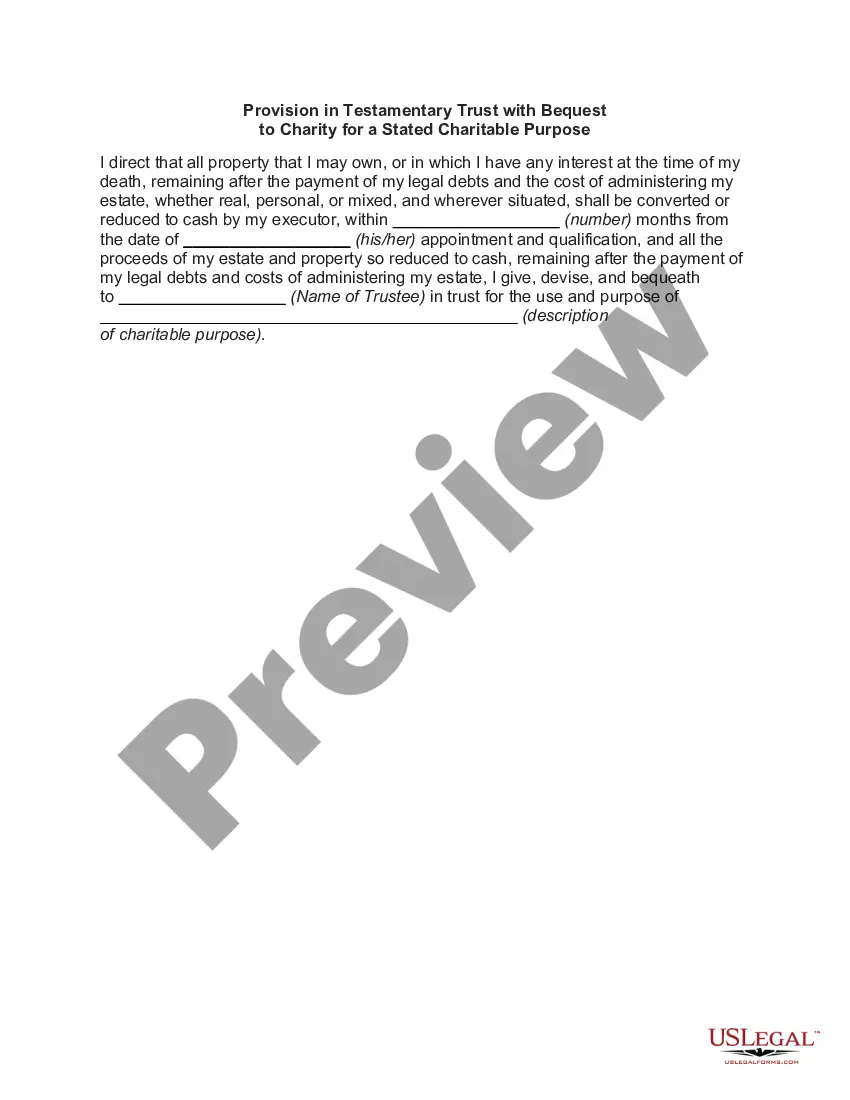
Provision in Testamentary Trust with Bequest to Charity for a Stated Charitable Purpose
Overview of this form
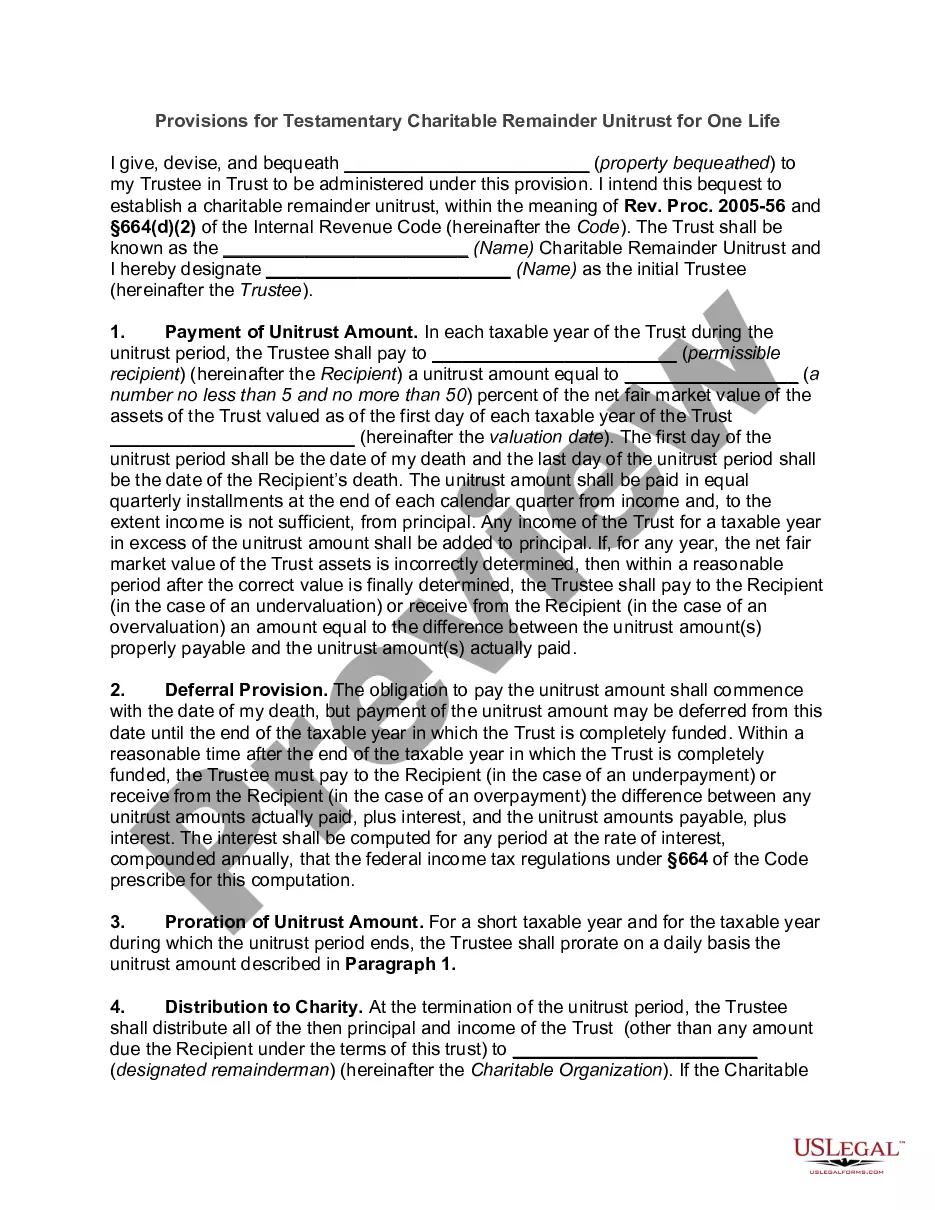
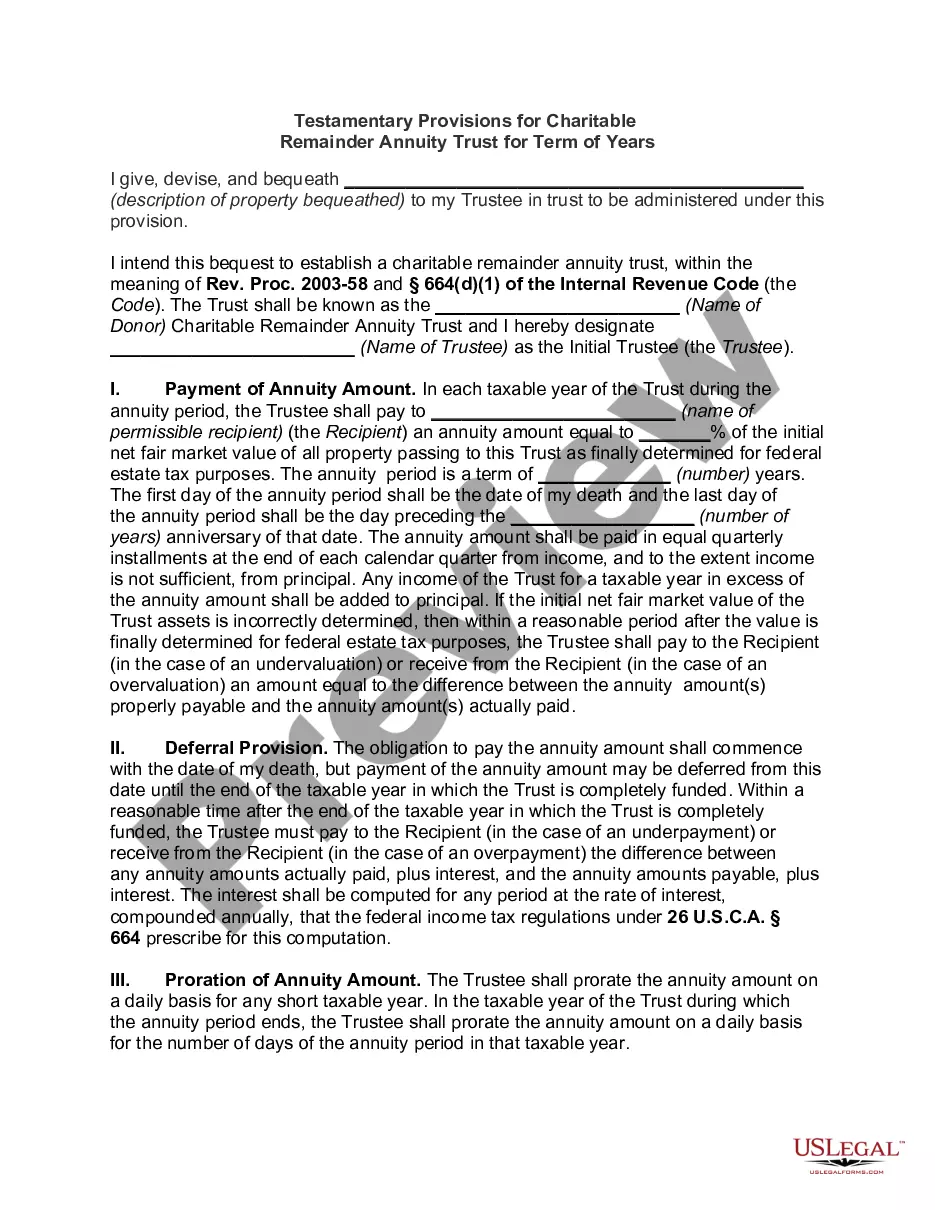
This form is a provision in a testamentary trust that allows you to bequeath property to a charitable organization for a specific purpose. It ensures that after settling legal debts and estate administration costs, your assets are directed toward charitable objectives, creating a meaningful legacy. Unlike standard wills, this form incorporates a trust structure, which may offer tax benefits and enhanced privacy for your estate plans.
Form components explained
- Direction to convert assets to cash within a specified number of months
- Name of the Trustee who will manage the charitable bequest
- Description of the intended charitable purpose for the bequest
- Provisions for the payment of legal debts and costs before distributing the assets
When this form is needed
This form is useful when you want to make a charity the beneficiary of your trust after your death. You may use it if you have specific charitable intentions and wish to ensure that your assets are used for those purposes. It is applicable in estate planning when creating a testamentary trust that includes charitable donations, allowing for a direct impact on causes you care about.
Who this form is for
- Individuals preparing their estate plans who wish to include charitable allocations
- Those with specific charitable goals who want to ensure funds are used correctly
- Testators looking to create lasting legacies for their favorite causes
- Anyone establishing a testamentary trust that requires clear instructions for asset distribution
How to prepare this document
- Identify the property you wish to bequeath and state its location.
- Decide on the length of time (in months) for the conversion of assets to cash.
- Name the Trustee who will manage the trust funds.
- Clearly describe the charitable purpose for which the funds are allocated.
- Review the entire document to ensure all information is accurate before signing.
Notarization guidance
This form usually doesn’t need to be notarized. However, local laws or specific transactions may require it. Our online notarization service, powered by Notarize, lets you complete it remotely through a secure video session, available 24/7.
Get your form ready online
Our built-in tools help you complete, sign, share, and store your documents in one place.
Make edits, fill in missing information, and update formatting in US Legal Forms—just like you would in MS Word.
Download a copy, print it, send it by email, or mail it via USPS—whatever works best for your next step.
Sign and collect signatures with our SignNow integration. Send to multiple recipients, set reminders, and more. Go Premium to unlock E-Sign.
If this form requires notarization, complete it online through a secure video call—no need to meet a notary in person or wait for an appointment.
We protect your documents and personal data by following strict security and privacy standards.

Make edits, fill in missing information, and update formatting in US Legal Forms—just like you would in MS Word.

Download a copy, print it, send it by email, or mail it via USPS—whatever works best for your next step.

Sign and collect signatures with our SignNow integration. Send to multiple recipients, set reminders, and more. Go Premium to unlock E-Sign.

If this form requires notarization, complete it online through a secure video call—no need to meet a notary in person or wait for an appointment.

We protect your documents and personal data by following strict security and privacy standards.
Avoid these common issues
- Failing to specify a timeframe for converting assets to cash.
- Not providing a detailed explanation of the charitable purpose, leading to ambiguity.
- Leaving fields blank, which can invalidate the trust provisions.
Why complete this form online
- Convenience of accessing and completing the form from any location.
- Editability allows you to make changes easily before finalizing your document.
- Reliability, with templates drafted by licensed attorneys ensuring legal compliance.
Key takeaways
- A testamentary trust provision with a charitable bequest ensures your philanthropic intentions are honored after your death.
- It is important to clearly outline your charitable goals and designate a responsible trustee.
- Review state-specific laws to ensure compliance and enforceability of the document.
Looking for another form?
Form popularity
FAQ
A specific bequest or devise is a gift of a specific item of property that can be easily identified and distinguished from all other property in the testator's estate.
Make certain you have a will. If you don't have a will or trust, your children will inherit according to the laws of your state. Use clear language to describe your intention to disinherit. Most states allow a parent to disinherit a child for any reason they choose. Check the rules. Consider alternatives.
As nouns the difference between gift and bequest is that gift is something given to another voluntarily, without charge while bequest is the act of bequeathing or leaving by will.
Make bequests of money. However, if there's no money in the account when you die, the money will come from your estate's general assets. To make the bequest in your will, you can write, I bequeath $5,000 to my sister, Ella, to be paid out of the proceeds from the sale of my stock in Amazon, Inc.
Choose an organization to receive your bequest. Decide what type of bequest you will give. Decide what you will give in your bequest. Add the bequest to your will and tell people about it. Pat yourself on the back while you think about the benefits of making a charitable bequest.
In general, there is an unlimited deduction of charitable bequests against the value of an estate, making it a powerful tool for reducing estate tax. It is possible for an estate to deduct charitable bequests of not only cash, but also property such as real estate, stock, IRAs, autos and other assets.
Charitable bequests from your will combine philanthropy and tax benefits. Bequests are gifts that are made as part of a will or trust. A bequest can be to a person, or it can be a charitable bequest to a nonprofit organization, trust or foundation. Anyone can make a bequestin any amountto an individual or charity.
Put Strings on the Money One way to do this is by leaving the money in a trust, and appointing someone as trustee (the person who controls trust assets) you think will do a good job of doling out the money on behalf of, or to, the beneficiary.
A charity can be the beneficiary of a relatively simple revocable trust or irrevocable trust.If you have substantially appreciated assets (such as real estate or stocks), you can reduce current capital gains tax on the assets by contributing the assets to a charitable remainder trust.