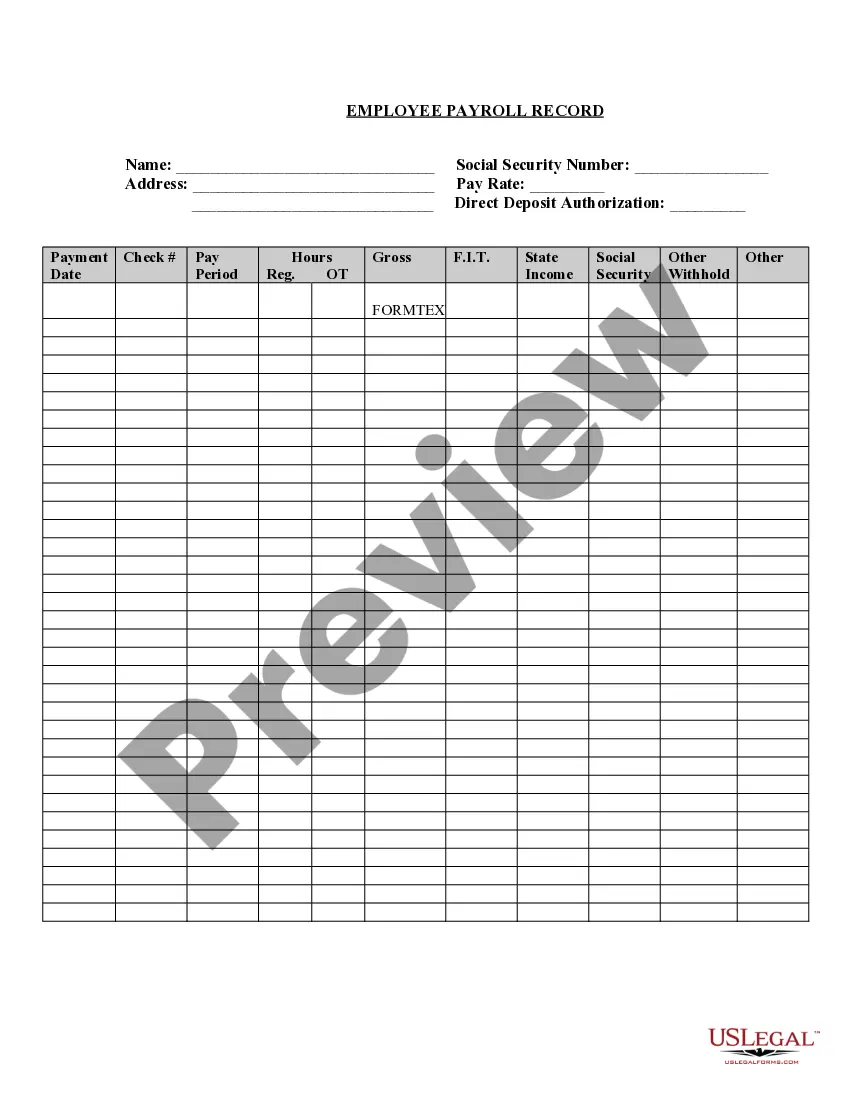
Employee Payroll Record
Understanding this form
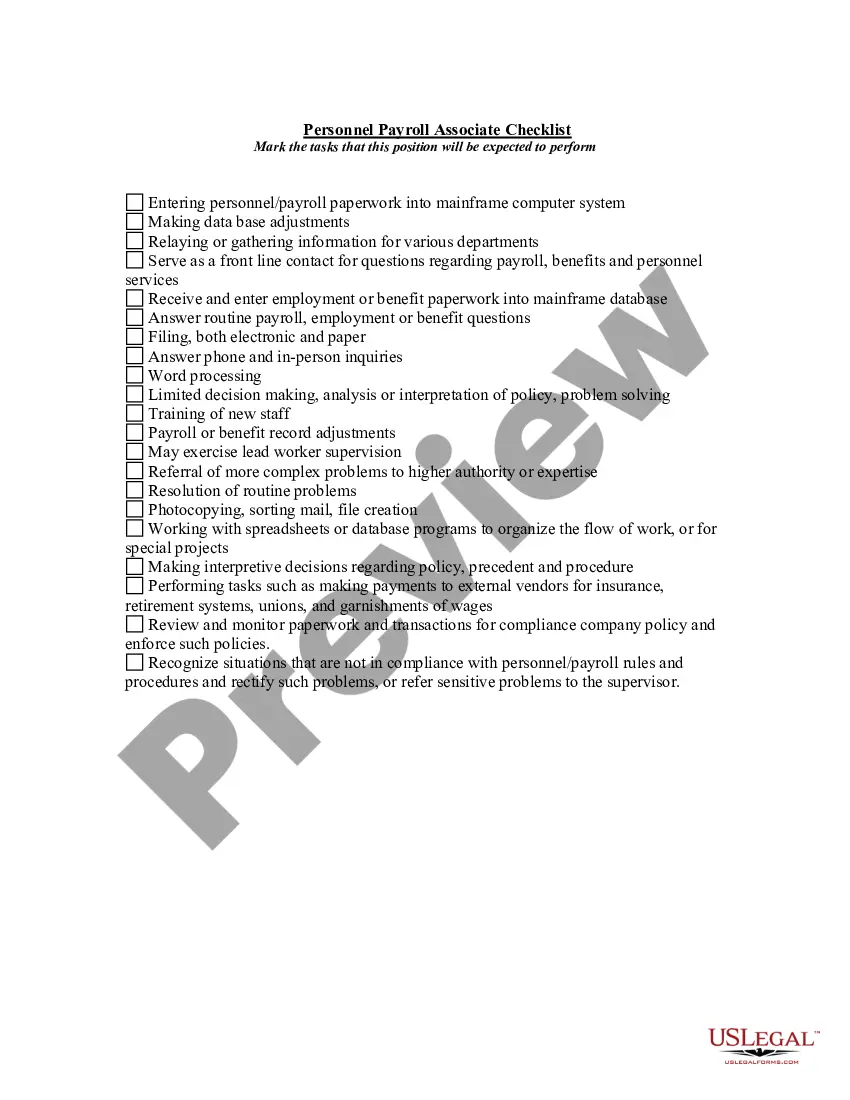
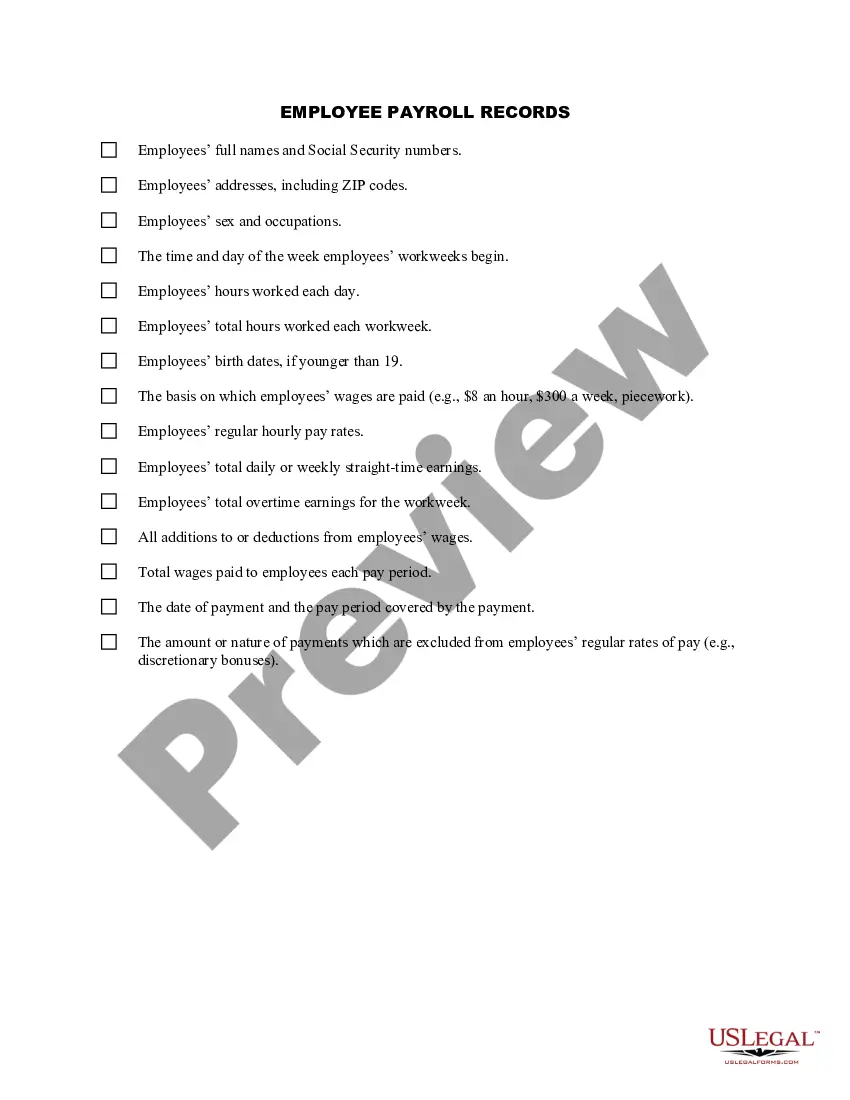
The Employee Payroll Record is a vital document for employers of all sizes to track employee wages and payment details. Unlike other employment forms, it focuses specifically on payroll records, providing a structured format to ensure compliance with wage laws and keep accurate financial records. This form enables employers to efficiently manage payroll information, maintain transparency, and facilitate direct deposit processes.
Key parts of this document
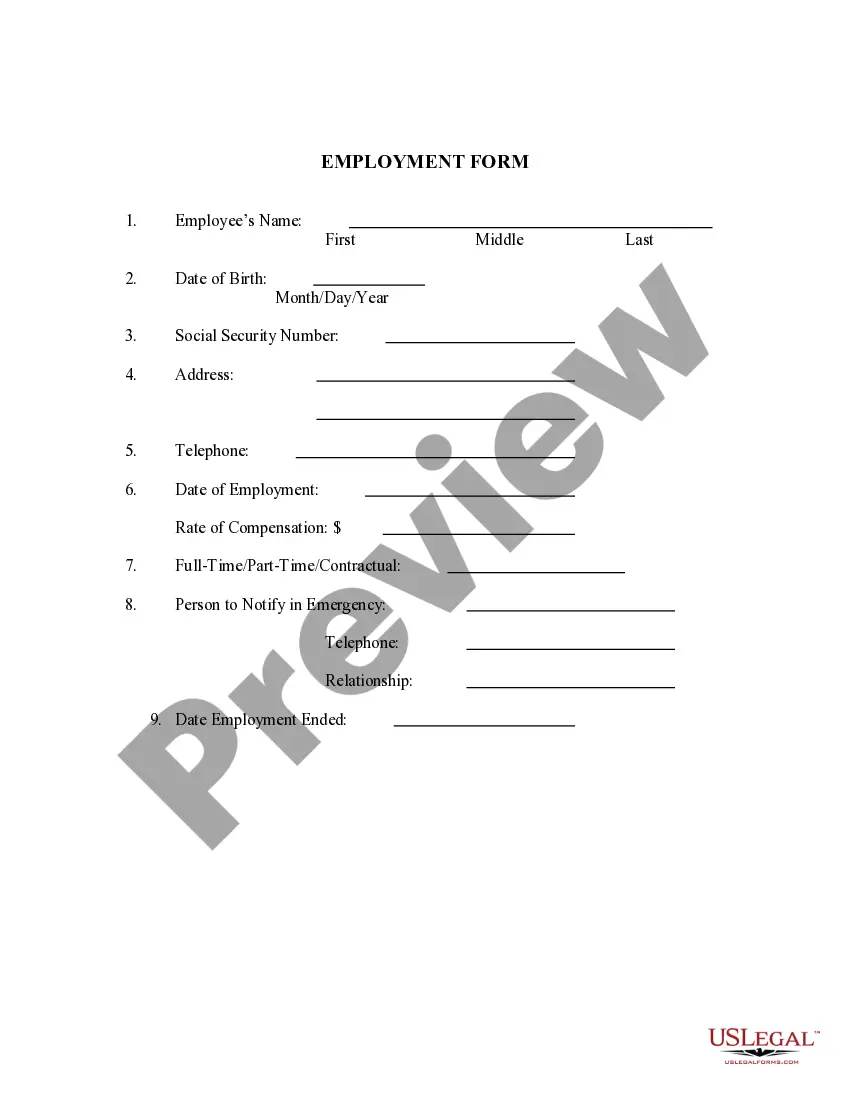
- Employee name and Social Security number for identification
- Employee address to maintain accurate records
- Pay rate section to document compensation details
- Direct deposit authorization for seamless payment processing
- Payment date and check pay period for tracking payroll cycles
- Breakdown of regular and overtime hours, along with gross pay
- Tax deductions including Federal Income Tax, state income tax, and Social Security
When to use this document
This form should be utilized by employers each time they process payroll for employees. It is particularly helpful for maintaining consistent records when onboarding new employees, during tax season, or when conducting payroll audits. By completing this form, employers can ensure they meet IRS recordkeeping requirements and provide employees with clear information regarding their compensation and deductions.
Intended users of this form
- Small and large businesses looking to manage payroll effectively
- Human resources and payroll departments responsible for employee compensation
- Employers who wish to document payroll information systematically
- Business owners who handle payroll without dedicated staff
Instructions for completing this form
- Enter the employee's name and Social Security number at the top of the form.
- Fill in the employee's address and pay rate to ensure proper recordkeeping.
- Complete the direct deposit authorization section if applicable.
- Document the payment date and check pay period for each payroll cycle.
- Enter the number of regular and overtime hours worked, along with the corresponding gross pay.
- Include all applicable tax deductions for clarity and compliance.
Notarization guidance
In most cases, this form does not require notarization. However, some jurisdictions or signing circumstances might. US Legal Forms offers online notarization powered by Notarize, accessible 24/7 for a quick, remote process.
Get your form ready online
Our built-in tools help you complete, sign, share, and store your documents in one place.
Make edits, fill in missing information, and update formatting in US Legal Forms—just like you would in MS Word.
Download a copy, print it, send it by email, or mail it via USPS—whatever works best for your next step.
Sign and collect signatures with our SignNow integration. Send to multiple recipients, set reminders, and more. Go Premium to unlock E-Sign.
If this form requires notarization, complete it online through a secure video call—no need to meet a notary in person or wait for an appointment.
We protect your documents and personal data by following strict security and privacy standards.

Make edits, fill in missing information, and update formatting in US Legal Forms—just like you would in MS Word.

Download a copy, print it, send it by email, or mail it via USPS—whatever works best for your next step.

Sign and collect signatures with our SignNow integration. Send to multiple recipients, set reminders, and more. Go Premium to unlock E-Sign.

If this form requires notarization, complete it online through a secure video call—no need to meet a notary in person or wait for an appointment.

We protect your documents and personal data by following strict security and privacy standards.
Mistakes to watch out for
- Failing to update pay rates when salary changes occur.
- Omitting employee signatures on direct deposit authorizations.
- Forgetting to include overtime hours and corresponding pay.
- Not verifying the accuracy of tax deduction information.
Why use this form online
- Convenience of immediate access and download from any device.
- Editability allows users to customize for specific payroll needs.
- Reliability of professionally drafted content by licensed attorneys.
Key takeaways
- The Employee Payroll Record is essential for tracking employee wages and payroll details.
- It is designed for use by various employers and HR professionals.
- This form ensures compliance and accuracy in payroll processing.
- Keep careful records to prevent common mistakes in payroll documentation.
Looking for another form?

Form popularity
FAQ
Payroll records are a form of documentation which must be maintained by an employer for all individuals in the workplace. This includes the number of hours worked, average pay rates, and deductions for each employee.
Go to the Reports menu. Find the Payroll section, then Payroll Summary by Employee. Set a date range from the dropdown. Select the single employee or group of employees. Choose how you'd like your columns to be viewed by (by employee, weekly, bi-weekly, etc).
Step 1: Have all employees complete a W-4 form. Step 2: Find or sign up for Employer Identification Numbers. Step 3: Choose your payroll schedule. Step 4: Calculate and withhold income taxes. Step 5: Pay payroll taxes. Step 6: File tax forms & employee W-2s.
Step 1: Have all employees complete a W-4 form. Step 2: Find or sign up for Employer Identification Numbers. Step 3: Choose your payroll schedule. Step 4: Calculate and withhold income taxes. Step 5: Pay payroll taxes. Step 6: File tax forms & employee W-2s.
Whether you use paper, electronic files or both, consistency is the key to effective recordkeeping. For example, if your hiring records are sorted by employee name, organize payroll records the same way. Keep the same system across all types of records, and make sure your file folders have accurate, uniform names.
What is a payroll report? A payroll report is a form you use to notify governments of employment tax liabilities.You must report both the taxes you withhold from employee wages and the taxes you contribute to. And, you'll need to submit payroll reports for both federal and state taxes.
These records include records of wages paid, bonuses, and payments made to benefit accounts. Keep records that wage computations are based on for at least two years. These records include time cards, work and time schedules, and records of additions to or deductions from wages.
Total wages paid each pay period. 14. Date of payment and the pay period covered by the payment. How Long Should Records Be Retained: Each employer shall preserve for at least three years payroll records, collective bargaining agreements, sales and purchase records.