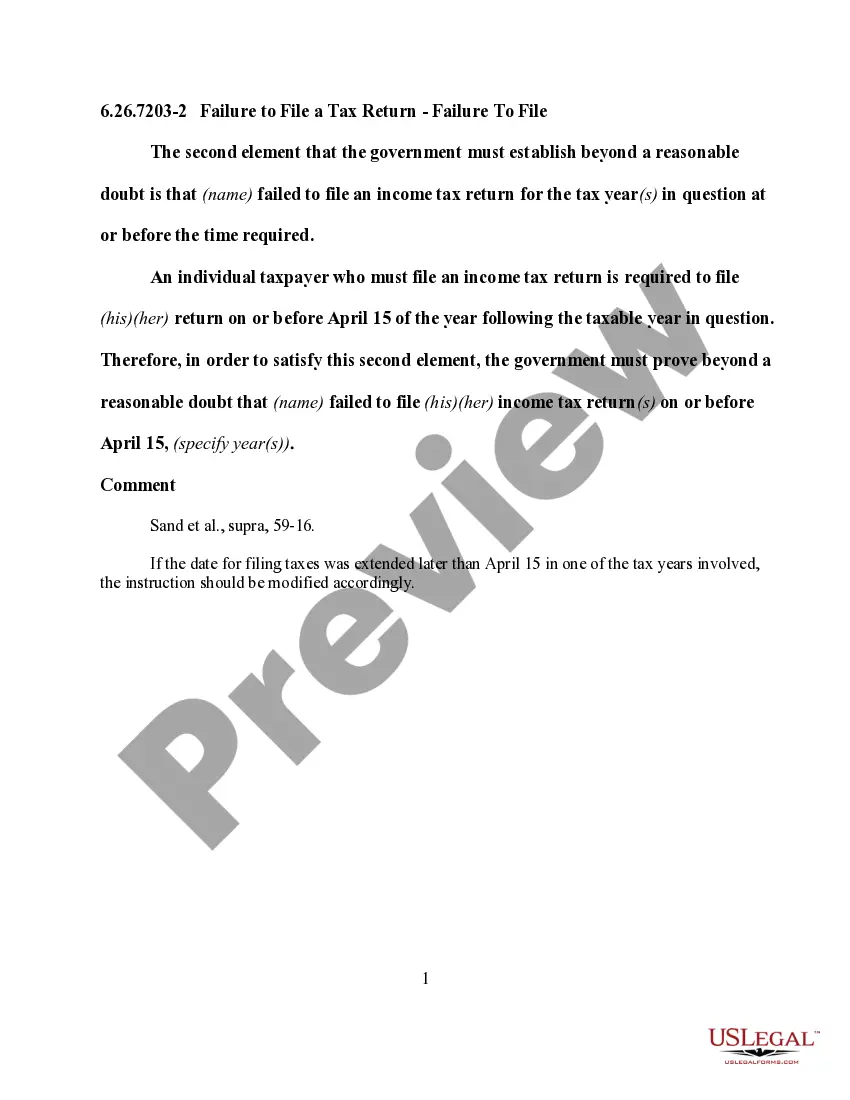
Failure to File a Tax Return - Failure To File
What this document covers
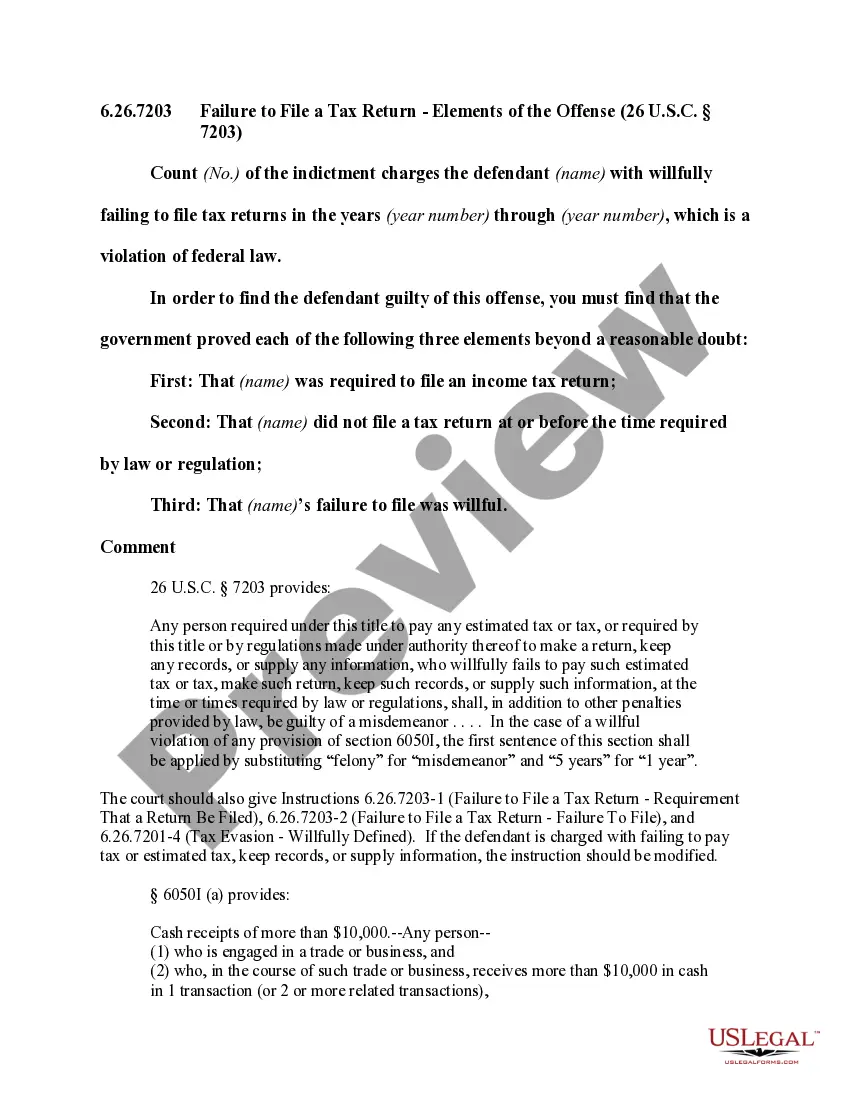
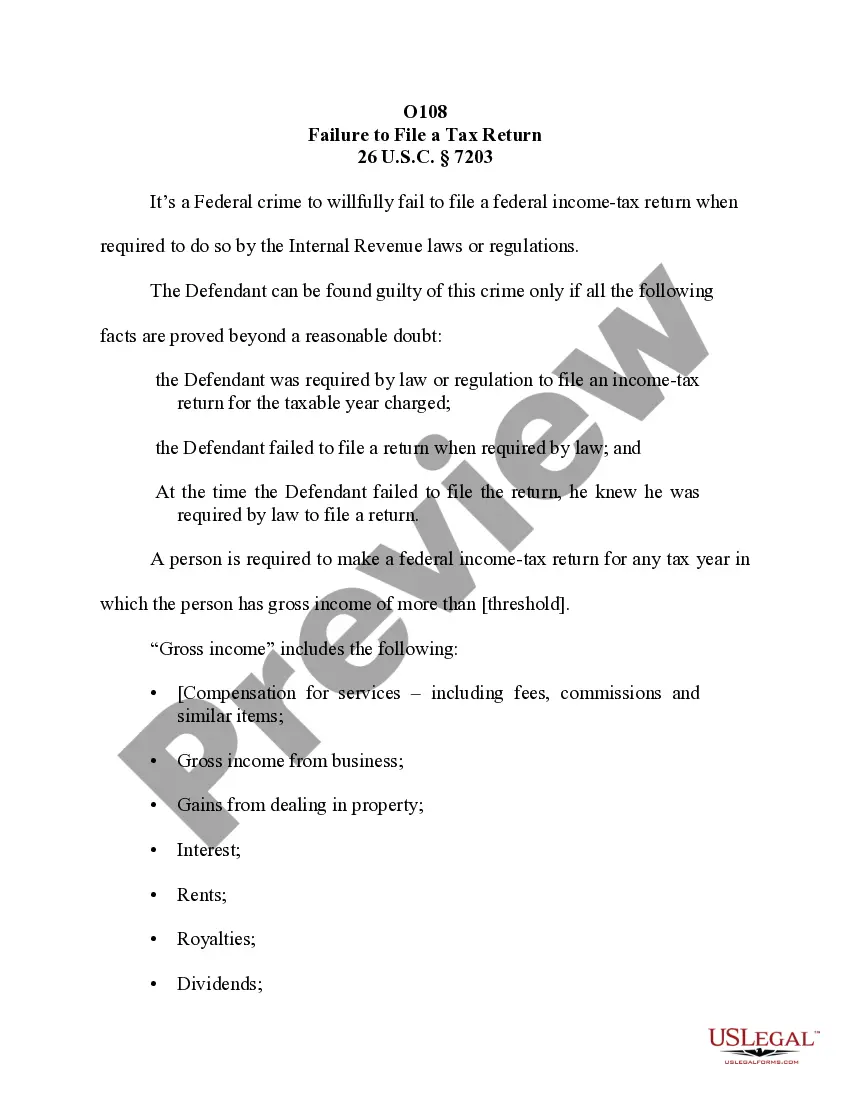
The Failure to File a Tax Return form is a legal document used to address instances when an individual has not submitted their income tax return by the required deadline. This form specifically outlines the government's need to prove that a taxpayer failed to file their return on or before April 15 of the following year. Distinct from other tax-related forms, this document focuses on the obligation of the taxpayer to report income and pay taxes owed to the government, which is crucial for compliance with tax laws.
What’s included in this form
- Identification of the individual taxpayer (name).
- Specification of the tax year(s) in question.
- Deadline details indicating April 15 as the filing deadline.
- A notice of any extensions for submission if applicable.
Common use cases
This form should be used when an individual has failed to file their income tax return by the legally mandated deadline. It is especially relevant in scenarios where the IRS or state tax authority is pursuing action against the taxpayer for their non-compliance, allowing the taxpayer to formally acknowledge and address the issue.
Who needs this form
This form is intended for:
- Individuals who have not filed their income tax returns on time.
- Taxpayers facing penalties or legal action due to failure to file.
- Tax professionals assisting clients in addressing tax compliance issues.
Instructions for completing this form
- Identify the name of the taxpayer who failed to file.
- Specify the tax year(s) where the failure to file occurred.
- Confirm the filing deadline as April 15 of the year following the taxable year.
- Indicate whether any extensions to file were granted for the relevant year(s).
- Submit the completed form to the appropriate tax authority as directed.
Does this document require notarization?
In most cases, this form does not require notarization. However, some jurisdictions or signing circumstances might. US Legal Forms offers online notarization powered by Notarize, accessible 24/7 for a quick, remote process.
Get your form ready online
Our built-in tools help you complete, sign, share, and store your documents in one place.
Make edits, fill in missing information, and update formatting in US Legal Forms—just like you would in MS Word.
Download a copy, print it, send it by email, or mail it via USPS—whatever works best for your next step.
Sign and collect signatures with our SignNow integration. Send to multiple recipients, set reminders, and more. Go Premium to unlock E-Sign.
If this form requires notarization, complete it online through a secure video call—no need to meet a notary in person or wait for an appointment.
We protect your documents and personal data by following strict security and privacy standards.

Make edits, fill in missing information, and update formatting in US Legal Forms—just like you would in MS Word.

Download a copy, print it, send it by email, or mail it via USPS—whatever works best for your next step.

Sign and collect signatures with our SignNow integration. Send to multiple recipients, set reminders, and more. Go Premium to unlock E-Sign.

If this form requires notarization, complete it online through a secure video call—no need to meet a notary in person or wait for an appointment.

We protect your documents and personal data by following strict security and privacy standards.
Common mistakes
- Failing to include the tax year(s) for which the return was not filed.
- Not specifying if an extension was applied and granted.
- Submitting the form after the relevant penalties have already been initiated by tax authorities.
Advantages of online completion
- Convenient access to the form from any device.
- Ability to edit and customize the form as needed for specific situations.
- Reliable source of legally drafted language by licensed attorneys.
Legal use & context
- Failure to file a tax return can lead to penalties, interest, and potential legal action by tax authorities.
- This form serves as an acknowledgment of the failure to file and may help mitigate penalties if filed promptly.
Main things to remember
- The Failure to File a Tax Return form is essential for addressing non-compliance with tax filing requirements.
- It is important to complete the form accurately and submit it timely to avoid additional penalties.
- Utilizing the form online enhances convenience and ensures the use of reliable legal language.
Looking for another form?



Form popularity
FAQ
Tax evasion is an illegal activity in which a person or entity deliberately avoids paying a true tax liability. Those caught evading taxes are generally subject to criminal charges and substantial penalties. To willfully fail to pay taxes is a federal offense under the Internal Revenue Service (IRS) tax code.
You have to bring your bank statements, receipts and any sort of documents that reveals your financial information and with your consent. We can lodge all your previous years tax returns be it 2 years or 10 years. We have quick turn around times for urgent matters.
This can result in a garnishment of wages or other income. The IRS may also file a notice of a federal tax lien, which can impact your financial options in the future. A tax lien by the IRS can limit your ability to take out loans or use your credit.
The most common forms of tax evasion include: Individuals deliberately failing to declare some or all of their business or personal income, or dishonestly over-stating their business or personal expenses.
Examples of tax evasion include claiming tax deductions or tax credits you're not entitled to, intentionally underreporting or failing to report income, and concealing taxable assets. Internal Revenue Service.
You can file your federal taxes from a previous year for up to three years after the original due date (usually around April 15). States may have different time frames for their acceptance of late tax returns.
Tax evasion in California is punishable by up to one year in county jail or state prison, as well as fines of up to $20,000. The state can also require you to pay your back taxes, and it will place a lien on your property as a security until you pay taxes.
Failing to file a tax return can be classified as a federal crime punishable as a misdemeanor or a felony. Willful failure to file a tax return is a misdemeanor pursuant to IRC 7203. In cases where an overt act of evasion occurred, willful failure to file may be elevated to a felony under IRC 7201.