Audio/Video Recordings - Consensual
Understanding this form
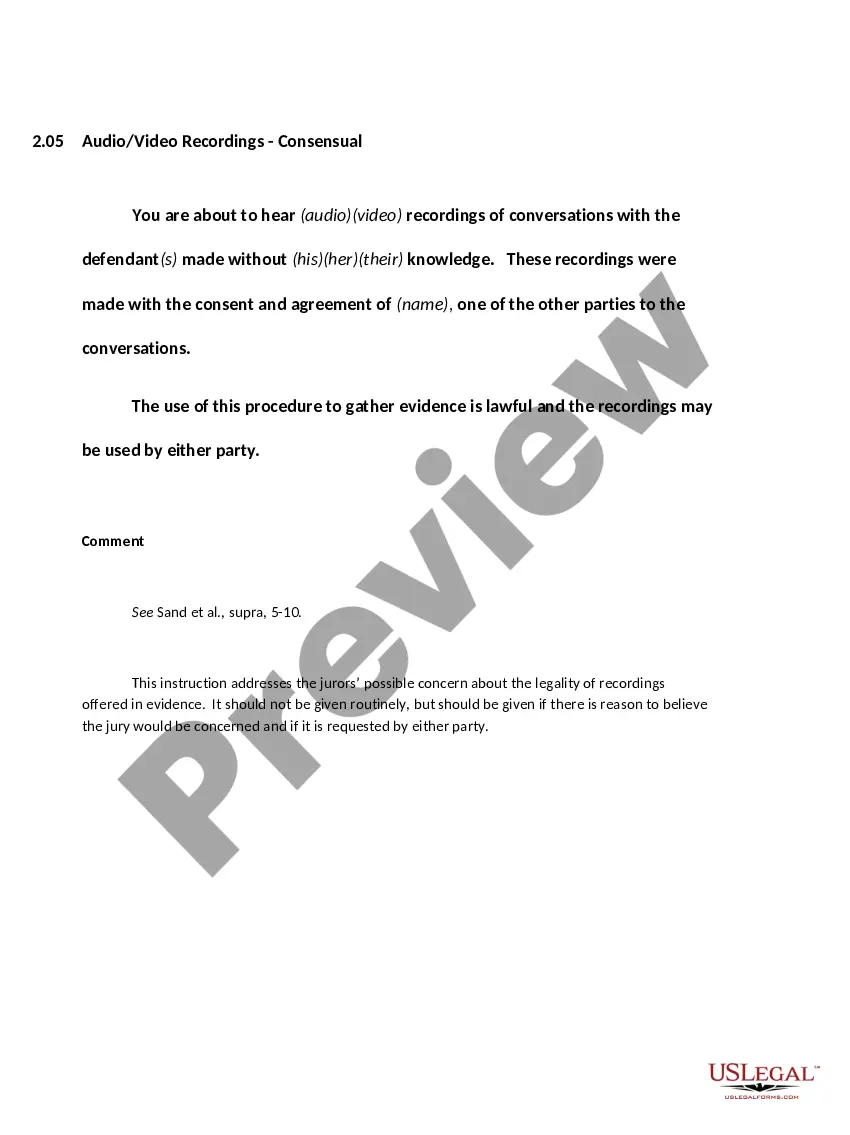
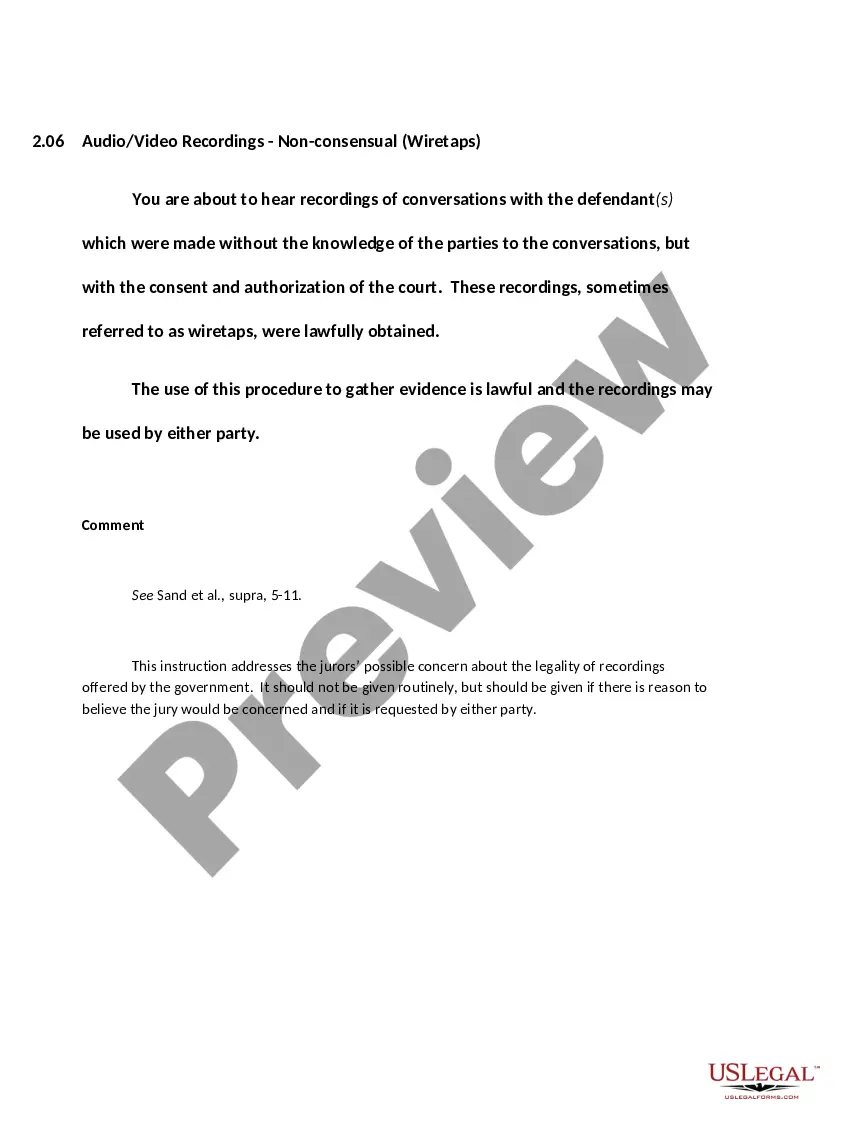
The Audio/Video Recordings - Consensual form is a legal document that outlines the admissibility of audio or video recordings made with the consent of one party involved in a conversation. This form helps clarify the legal standing of such evidence, distinguishing it from recordings made without consent, which may not be admissible in court. It serves as a guideline for jurors regarding the legality of using consensual recordings in a criminal trial.
What’s included in this form
- Identification of the parties involved in the recorded conversation.
- Explanation that the recordings were made with the consent of at least one party.
- Details regarding the lawful use of these recordings as evidence in legal proceedings.
- Comments to address juror concerns about the legality of the recordings.


When to use this form
This form is essential in legal contexts where audio or video evidence from consensually recorded conversations may be introduced in a trial. Use this form when you need to clarify the legality of such evidence, especially if there is a potential concern from jurors regarding its admissibility. It is particularly relevant in criminal cases where conversations with the defendant are recorded lawfully.
Who needs this form
- Prosecutors presenting cases where consensually recorded evidence is available.
- Defense attorneys wishing to challenge or clarify the use of such recordings in trials.
- Judges needing a framework to instruct jurors about the legal use of recorded conversations.
Completing this form step by step
- Identify the parties involved in the recorded conversation.
- Specify the name of the party who consented to the recording.
- Explain the circumstances under which the recording was made.
- Provide any relevant facts that demonstrate the legality of the recordings.
- Include any requests for jury instructions regarding the use of the recordings.
Does this form need to be notarized?
Notarization is not commonly needed for this form. However, certain documents or local rules may make it necessary. Our notarization service, powered by Notarize, allows you to finalize it securely online anytime, day or night.
Get your form ready online
Our built-in tools help you complete, sign, share, and store your documents in one place.
Make edits, fill in missing information, and update formatting in US Legal Forms—just like you would in MS Word.
Download a copy, print it, send it by email, or mail it via USPS—whatever works best for your next step.
Sign and collect signatures with our SignNow integration. Send to multiple recipients, set reminders, and more. Go Premium to unlock E-Sign.
If this form requires notarization, complete it online through a secure video call—no need to meet a notary in person or wait for an appointment.
We protect your documents and personal data by following strict security and privacy standards.

Make edits, fill in missing information, and update formatting in US Legal Forms—just like you would in MS Word.

Download a copy, print it, send it by email, or mail it via USPS—whatever works best for your next step.

Sign and collect signatures with our SignNow integration. Send to multiple recipients, set reminders, and more. Go Premium to unlock E-Sign.

If this form requires notarization, complete it online through a secure video call—no need to meet a notary in person or wait for an appointment.

We protect your documents and personal data by following strict security and privacy standards.
Typical mistakes to avoid
- Failing to clearly identify all parties involved in the conversation.
- Neglecting to specify the consent provided by the involved party.
- Not addressing potential juror concerns about the legality of the recordings.
Benefits of completing this form online
- Convenient access to legally sound and professionally drafted templates.
- Ease of editing to ensure the document meets specific legal needs.
- Secure download options that facilitate immediate use in legal scenarios.
What to keep in mind
- The Audio/Video Recordings - Consensual form is crucial for clarifying the legal status of consensually recorded evidence.
- This form is relevant for use in both prosecution and defense scenarios in criminal trials.
- Ensure compliance with local consent laws when utilizing this form.
Looking for another form?



Form popularity
FAQ
The main idea & purpose behind AV recording of the consent process is to ensure that the clinical trial participants are adequately informed about all aspects of the clinical trial including risks and benefits and chances of failure of the Investigational Medicinal Product (IMP) to give intended therapeutic effect and
In a legal context, consent is the most significant factor in determining whether the video recording you have made could land you in hot water. California is a two-party consent state, which means you must get permission from all involved parties before making your recording.
The main idea & purpose behind AV recording of the consent process is to ensure that the clinical trial participants are adequately informed about all aspects of the clinical trial including risks and benefits and chances of failure of the Investigational Medicinal Product (IMP) to give intended therapeutic effect and
The 16 states that require two-party consent are California, Connecticut, Delaware, Florida, Hawaii, Illinois, Kansas, Maryland, Massachusetts, Michigan, Montana, Nevada, New Hampshire, Pennsylvania, Utah, and Washington. Laws change constantly. Please check your state's current laws before engaging in recording.
Audiovisual records include motion picture film, still photographs, filmstrips, sound and video recordings, posters and other graphic works, and multimedia productions with related finding aids and production files.
Federal law requires one-party consent, enabling you to record a conversation in person or over the phone, but only if you are participating in the conversation. If you are not part of the conversation but you are recording it, then you are engaging in illegal eavesdropping or wiretapping.
I, (recorded person's full name), do hereby consent to the use by (entrant's full name) of my image, video, voice, or all three of them, in the item described above. In addition, I waive any right to inspect or approve the finished video recording.