Audio/Video Recordings - Non-consensual (Wiretaps)
About this form
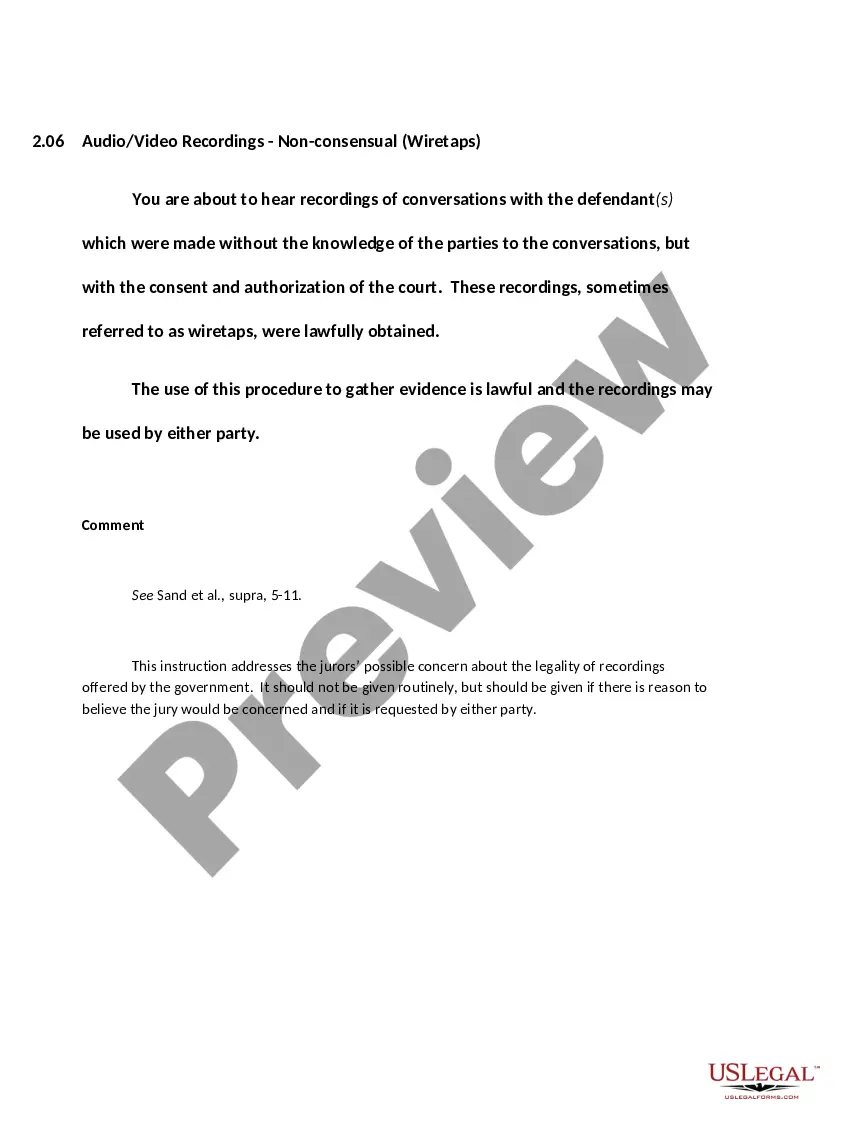
The Audio/Video Recordings - Non-consensual (Wiretaps) form is designed to facilitate the legal use of audio or video recordings made without the knowledge of the individuals involved in those recordings. These recordings are typically collected under court authorization, thereby ensuring their legality for use as evidence in criminal proceedings. This form is essential for parties involved in legal cases where such wiretaps are presented as part of the evidence, distinct from other types of consent-based recordings.
Key parts of this document
- Identification of the parties involved in the conversations.
- Explanation of the context relating to the court's authorization for the recordings.
- Clarification regarding the legality and admissibility of the wiretap recordings in court proceedings.
- Instructions for the jurors on how to consider the evidence presented.


Common use cases
This form is used during legal proceedings where evidence obtained through non-consensual audio or video recordings, also known as wiretaps, is presented. It is relevant in cases involving criminal activities such as drug trafficking, organized crime, or any illegal conduct that may have been documented without the consent of those recorded. It becomes particularly important if there is potential concern among jurors regarding the legality of the recordings being utilized as evidence.
Who needs this form
- Prosecutors presenting evidence obtained through wiretaps in a criminal case.
- Defense attorneys defending clients against allegations supported by such recordings.
- Judges who need to provide jurors with necessary instructions regarding the use of wiretap evidence.
How to prepare this document
- Identify all parties involved in the recorded conversations.
- Include the specific court authorization details relevant to the recordings.
- Provide context for the recordings and explain their relevance to the case.
- Clarify any legal terms or usage instructions for jurors.
Does this form need to be notarized?
This form usually doesn’t need to be notarized. However, local laws or specific transactions may require it. Our online notarization service, powered by Notarize, lets you complete it remotely through a secure video session, available 24/7.
Get your form ready online
Our built-in tools help you complete, sign, share, and store your documents in one place.
Make edits, fill in missing information, and update formatting in US Legal Forms—just like you would in MS Word.
Download a copy, print it, send it by email, or mail it via USPS—whatever works best for your next step.
Sign and collect signatures with our SignNow integration. Send to multiple recipients, set reminders, and more. Go Premium to unlock E-Sign.
If this form requires notarization, complete it online through a secure video call—no need to meet a notary in person or wait for an appointment.
We protect your documents and personal data by following strict security and privacy standards.

Make edits, fill in missing information, and update formatting in US Legal Forms—just like you would in MS Word.

Download a copy, print it, send it by email, or mail it via USPS—whatever works best for your next step.

Sign and collect signatures with our SignNow integration. Send to multiple recipients, set reminders, and more. Go Premium to unlock E-Sign.

If this form requires notarization, complete it online through a secure video call—no need to meet a notary in person or wait for an appointment.

We protect your documents and personal data by following strict security and privacy standards.
Mistakes to watch out for
- Failing to include complete authorization details for the wiretap.
- Not clearly identifying the parties involved in the conversations.
- Omitting context that helps clarify the relevance of the recordings to the case.
Why complete this form online
- Immediate access to a professionally drafted legal form unique to wiretap evidence.
- Convenience of downloading and completing the form at your own pace.
- Easy editing features allow users to tailor the form to specific legal situations.
Legal use & context
- Wiretaps must be authorized by a court to be admissible as evidence.
- The use of non-consensual recordings is subject to specific legal standards and requirements.
- Parties should be aware of the potential legal challenges regarding the implementation and use of wiretap evidence.
Looking for another form?
Form popularity
FAQ
Eleven (11) states require the consent of everybody involved in a conversation or phone call before the conversation can be recorded. Those states are: California, Delaware, Florida, Illinois, Maryland, Massachusetts, Montana, Nevada, New Hampshire, Pennsylvania and Washington.
The 16 states that require two-party consent are California, Connecticut, Delaware, Florida, Hawaii, Illinois, Kansas, Maryland, Massachusetts, Michigan, Montana, Nevada, New Hampshire, Pennsylvania, Utah, and Washington. Laws change constantly. Please check your state's current laws before engaging in recording.
Federal law requires one-party consent, enabling you to record a conversation in person or over the phone, but only if you are participating in the conversation. If you are not part of the conversation but you are recording it, then you are engaging in illegal eavesdropping or wiretapping.
In a legal context, consent is the most significant factor in determining whether the video recording you have made could land you in hot water. California is a two-party consent state, which means you must get permission from all involved parties before making your recording.
Eleven (11) states require the consent of everybody involved in a conversation or phone call before the conversation can be recorded. Those states are: California, Delaware, Florida, Illinois, Maryland, Massachusetts, Montana, Nevada, New Hampshire, Pennsylvania and Washington.
The states that are one party consent include: Alabama. Alaska. Arizona. Arkansas. District of Columbia. Georgia. Hawaii. Idaho.
Eleven states require two-party consent, however. In other words, everyone involved in a conversation must agree to be recorded. Those states are California, Delaware, Florida, Illinois, Maryland, Massachusetts, Montana, Nevada, New Hampshire, Pennsylvania, and Washington. (Don't let the phrase ?two-party? throw you.
Not all these situations are legal. The law involved with recording is commonly called "wiretapping law," which covers all forms of electronic communication, including cellphones, emails, and cameras.