Audio/Video Recordings - Non-consensual
What this document covers
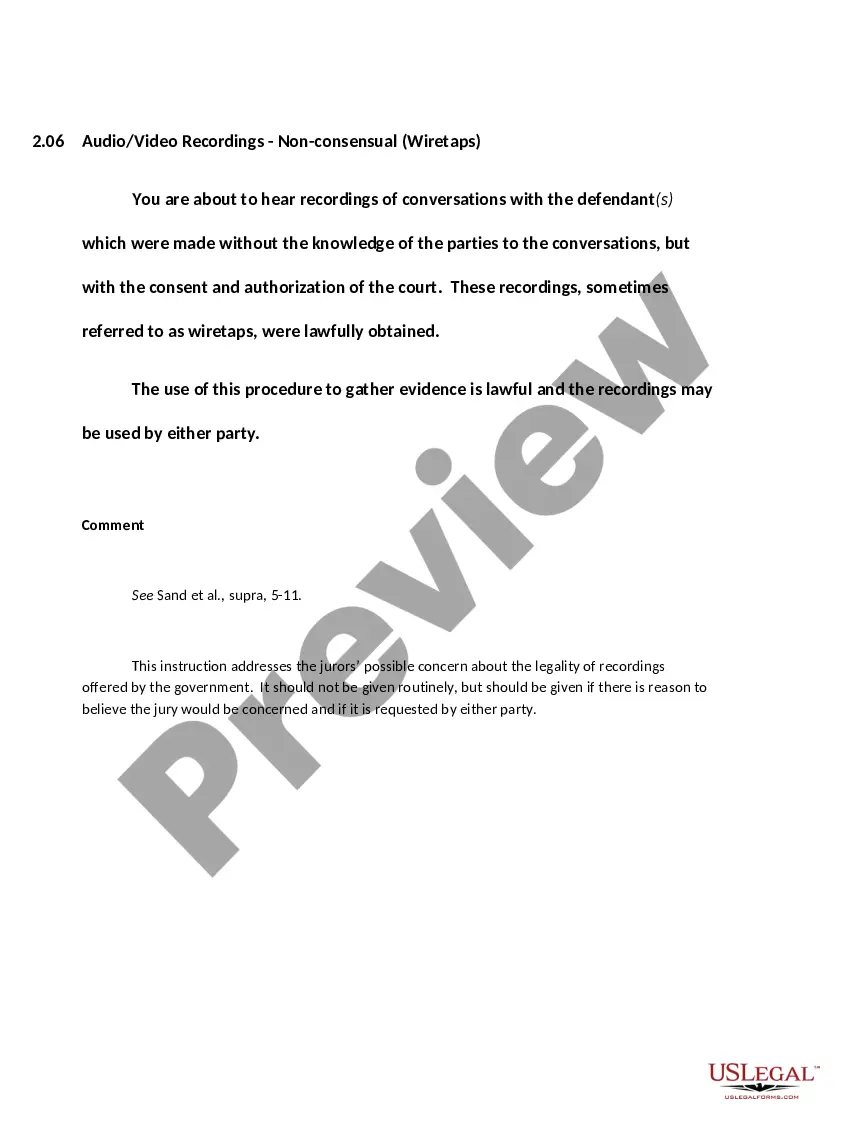
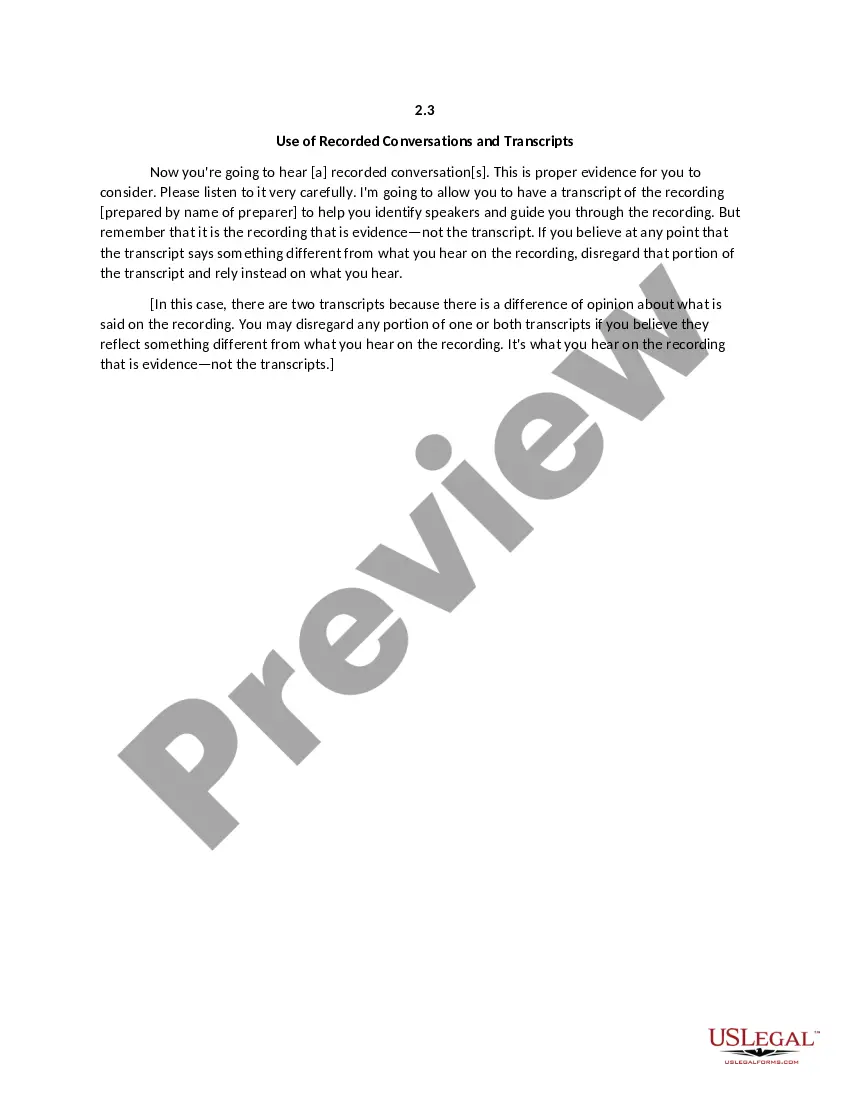
The Audio/Video Recordings - Non-consensual form is a legal document that outlines the rules and implications of using audio and video recordings made without the consent of the parties involved. This form is often relevant in legal proceedings where recorded conversations, often referred to as wiretaps, are presented as evidence. It clarifies that these recordings can be used lawfully in court, addressing common concerns about their legality and how they differ from consensual recordings.
What’s included in this form
- Introduction to the validity of non-consensual recordings in legal settings.
- Explanation of the court's role in authorizing the recordings.
- Clarification that both parties can utilize these recordings during a trial.
- Guidance for jurors regarding their potential concerns about legality.
- Provision for when to issue this instruction to jurors based on their concerns.

When to use this document
This form is essential when a court case involves the introduction of audio or video recordings obtained without the consent of all parties in the conversation. It is typically used in criminal trials, where evidence obtained through wiretaps or similar means come into play. This form helps clarify the legal framework under which such recordings can be accepted and utilized as evidence.
Who needs this form
- Legal professionals representing clients involved in cases with non-consensual recordings.
- Judges who need to instruct juries on the legal status of presented recordings.
- Prosecutors and defense attorneys who intend to present or challenge the admissibility of such recordings in court.
Instructions for completing this form
- Identify the specific case in which the recording will be used.
- Specify the details of the non-consensual recordings, including dates and relevant parties involved.
- Ensure the courtâs authorization for the recordings is documented.
- Provide necessary context for the jury regarding the use and legality of the recordings.
- Submit the form to the court for official inclusion in the case files.
Does this document require notarization?
In most cases, this form does not require notarization. However, some jurisdictions or signing circumstances might. US Legal Forms offers online notarization powered by Notarize, accessible 24/7 for a quick, remote process.
Get your form ready online
Our built-in tools help you complete, sign, share, and store your documents in one place.
Make edits, fill in missing information, and update formatting in US Legal Forms—just like you would in MS Word.
Download a copy, print it, send it by email, or mail it via USPS—whatever works best for your next step.
Sign and collect signatures with our SignNow integration. Send to multiple recipients, set reminders, and more. Go Premium to unlock E-Sign.
If this form requires notarization, complete it online through a secure video call—no need to meet a notary in person or wait for an appointment.
We protect your documents and personal data by following strict security and privacy standards.

Make edits, fill in missing information, and update formatting in US Legal Forms—just like you would in MS Word.

Download a copy, print it, send it by email, or mail it via USPS—whatever works best for your next step.

Sign and collect signatures with our SignNow integration. Send to multiple recipients, set reminders, and more. Go Premium to unlock E-Sign.

If this form requires notarization, complete it online through a secure video call—no need to meet a notary in person or wait for an appointment.

We protect your documents and personal data by following strict security and privacy standards.
Typical mistakes to avoid
- Failing to obtain prior court authorization for recording usage.
- Not properly documenting details related to the recordings.
- Ignoring local laws regarding the admissibility of non-consensual recordings.
- Overlooking the need to explain the recordings' legality to jurors.
Why complete this form online
- Immediate access to important legal documents prepared by licensed attorneys.
- Easy download and customization for specific case needs.
- Time-saving compared to traditional legal services.
- Access to updated legal forms reflecting the latest regulations.
Legal use & context
- Non-consensual recordings can serve as critical evidence in criminal trials when handled properly.
- Legislation regarding wiretaps and non-consensual recordings varies by state and must be adhered to.
- This form provides a framework for courts to assess the legality of such evidence.
Looking for another form?

Form popularity
FAQ
It is not illegal to record someone without their consent in a public place if they are visible and audible, especially if they don't have reasonable expectations of privacy. But in a private setting, such as a bathroom or changing area, recording someone without their knowledge is illegal.
California State Law Unlike New York and New Jersey, California is a ?two-party consent? state. This makes it illegal to record a private conversation unless all parties consent to the recording.
Eleven (11) states require the consent of everybody involved in a conversation or phone call before the conversation can be recorded. Those states are: California, Delaware, Florida, Illinois, Maryland, Massachusetts, Montana, Nevada, New Hampshire, Pennsylvania and Washington.
If you realize someone is recording you without your permission in a public setting, there isn't much you can do but ask them to stop or leave. If this is a recurring occurrence with a certain individual, you can call the police or choose to sue if you have legal grounds for it.
Under Section 934.03 of the Florida Statutes, wiretapping, audio recording of communications, or taking videos of others is illegal unless all parties consent. This is a serious offense that could result in third-degree felony criminal charges.
The 16 states that require two-party consent are California, Connecticut, Delaware, Florida, Hawaii, Illinois, Kansas, Maryland, Massachusetts, Michigan, Montana, Nevada, New Hampshire, Pennsylvania, Utah, and Washington. Laws change constantly. Please check your state's current laws before engaging in recording.
California Wiretapping Law California's wiretapping law is a "two-party consent" law. California makes it a crime to record or eavesdrop on any confidential communication, including a private conversation or telephone call, without the consent of all parties to the conversation.
Not all these situations are legal. The law involved with recording is commonly called "wiretapping law," which covers all forms of electronic communication, including cellphones, emails, and cameras.