Compensation for Change Orders and Builder Allowance Underages
Understanding this form
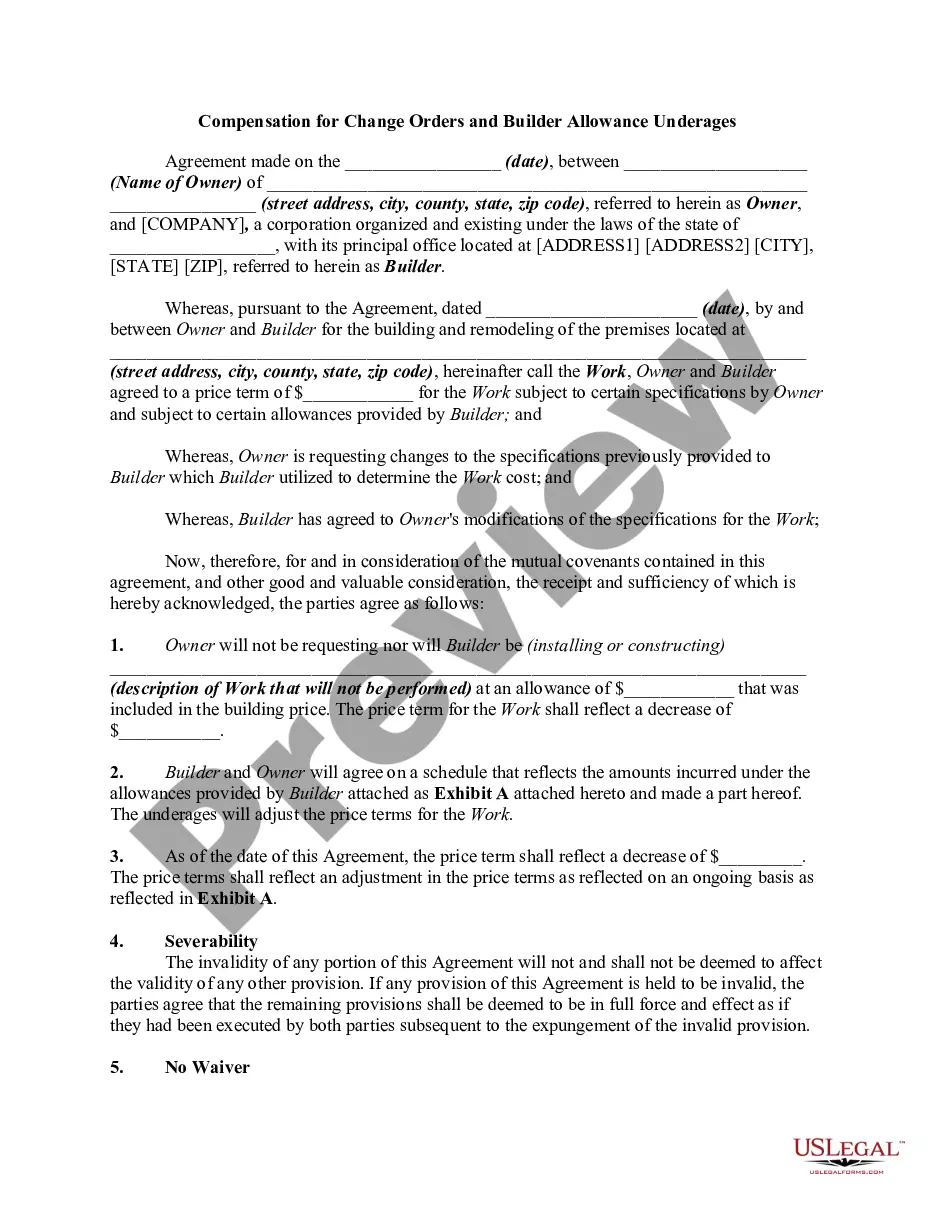
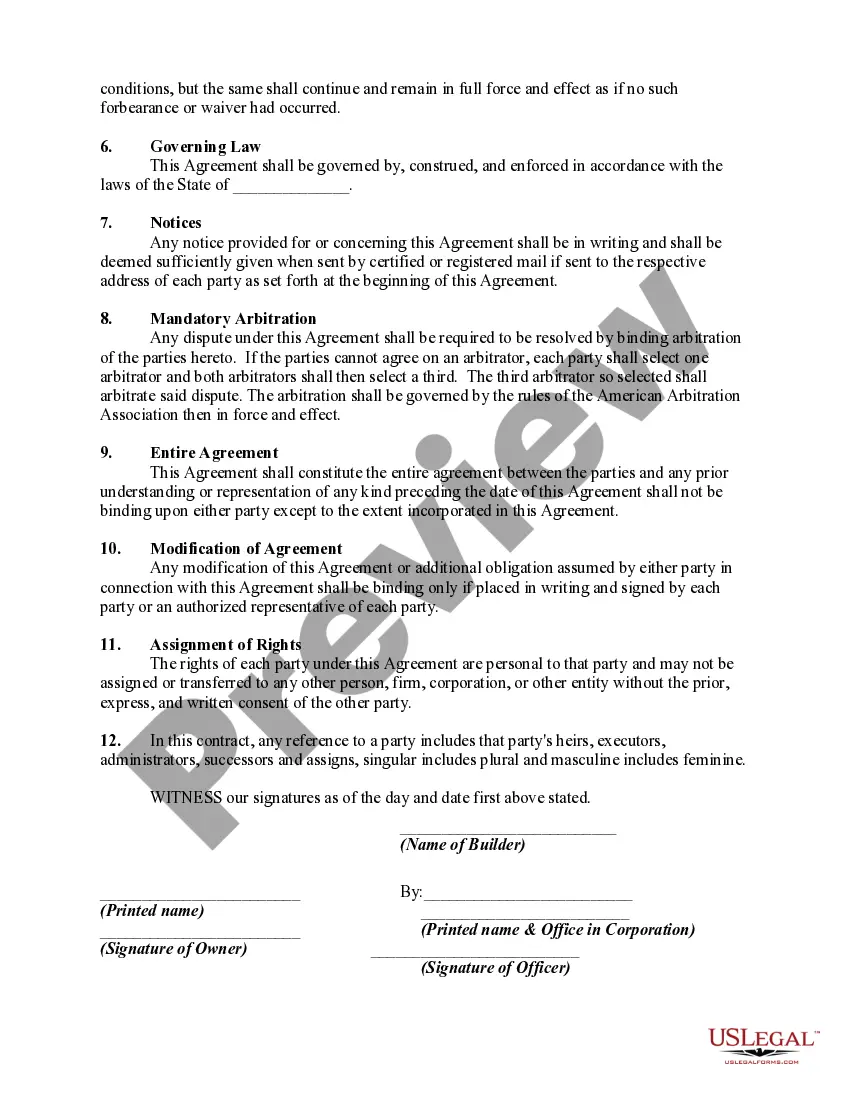
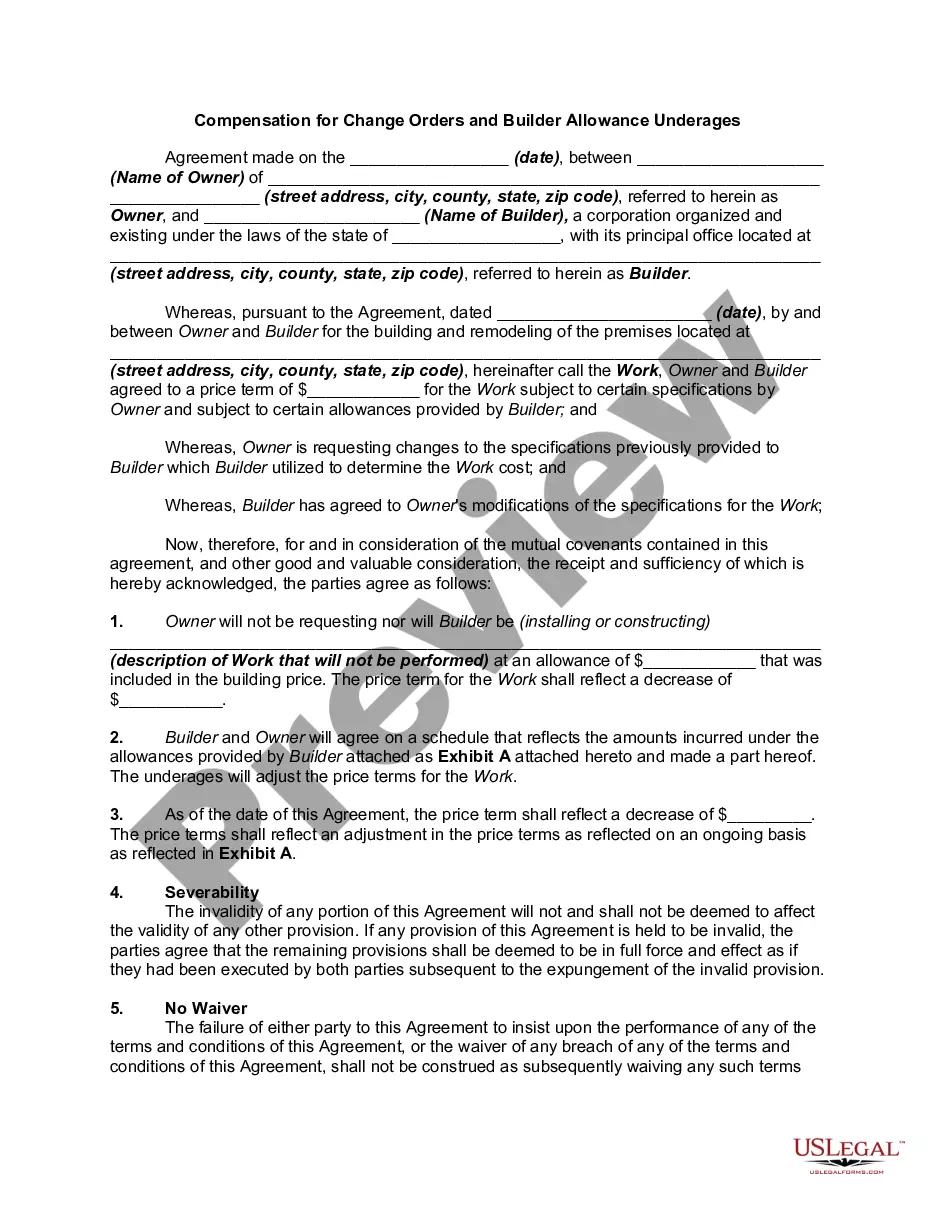
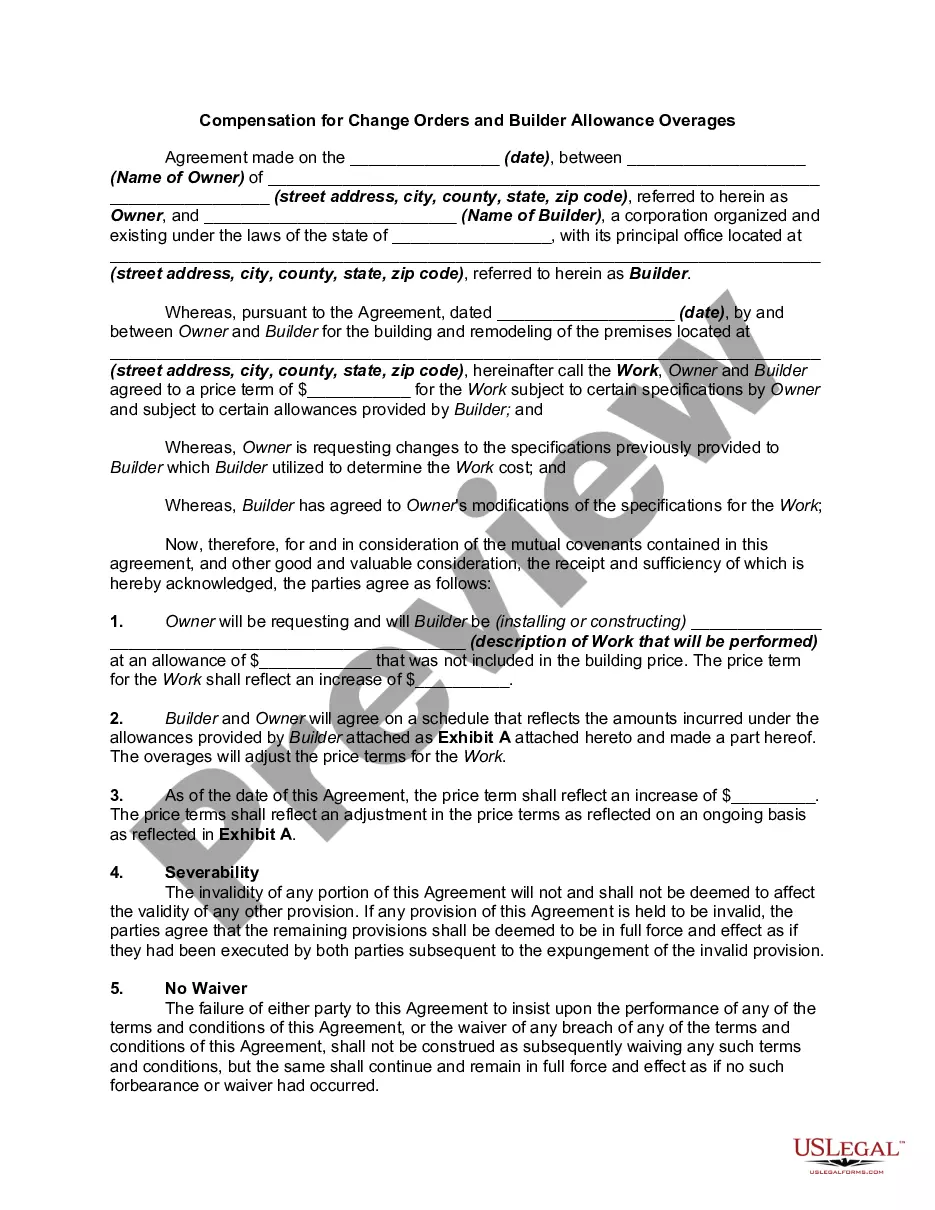
The Compensation for Change Orders and Builder Allowance Underages form is a legal document used in construction projects to formalize adjustments to the original building contract. It addresses changes in construction specifications that may alter the cost, allowing both the owner and builder to agree on price adjustments and allowances. This form is essential for ensuring transparency and accountability in project modifications, distinguishing it from more general construction contract templates.
Key components of this form
- Date of agreement and identification of parties involved (Owner and Builder).
- Details of the original construction agreement, including location and project specifications.
- Clauses outlining specific work that will not be performed and associated cost adjustments.
- Schedule of allowances provided by the builder, with a mechanism for ongoing price adjustments.
- Legal clauses regarding severability, waiver, governing law, notices, arbitration, and modifications.

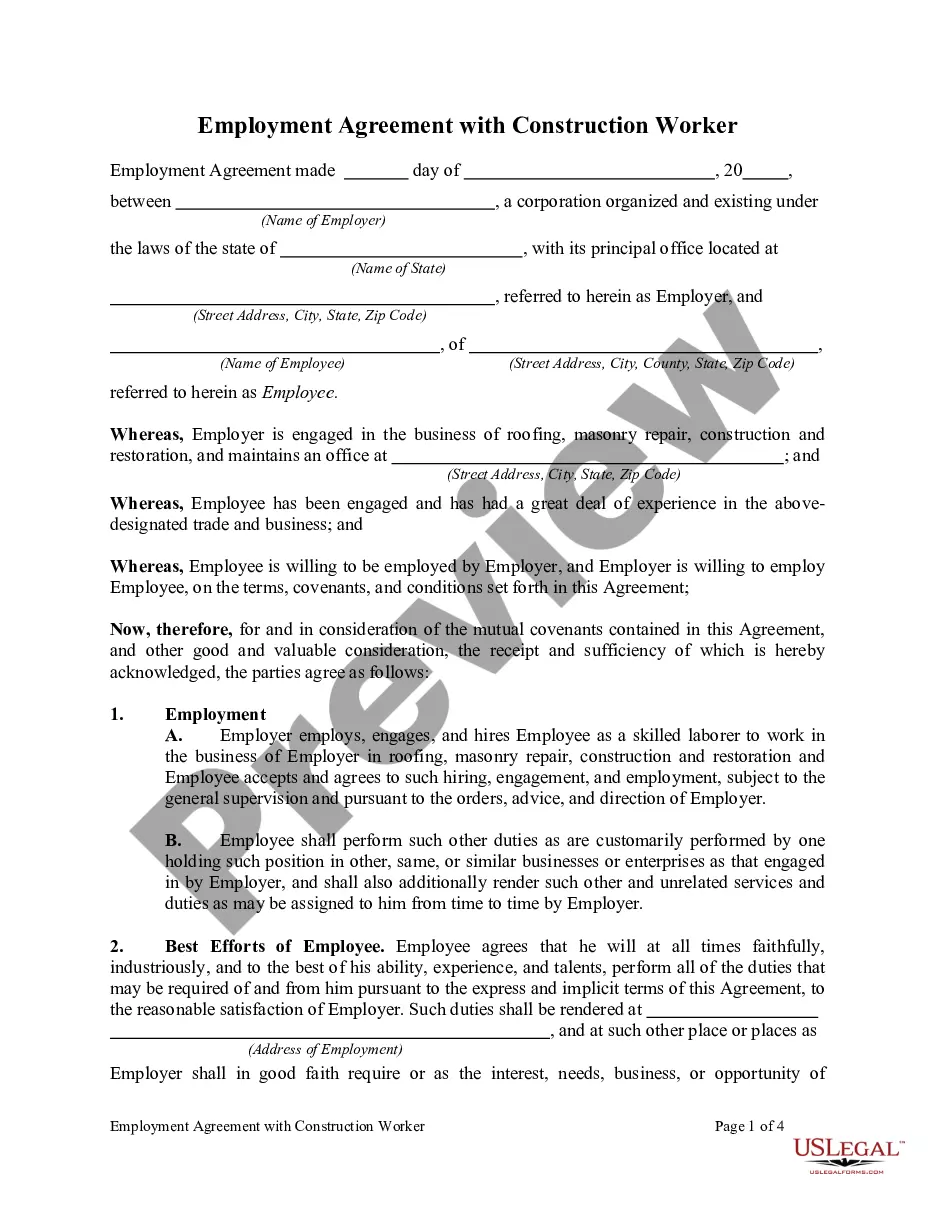
When to use this form
This form should be used whenever a construction project requires changes to the original plans after the agreement has been made. Common scenarios include alterations requested by the owner that affect the initial scope of work, as well as adjustments due to builder allowances not being fully utilized. Using this form helps ensure that all parties are clear about the modifications and how they impact the overall project cost.
Who this form is for
- Homeowners or property owners making changes to construction plans.
- Builders or contractors needing to document changes and price adjustments.
- Project managers overseeing large construction projects that require formal change orders.
- Legal professionals involved in construction law requiring structured documentation for changes.
Steps to complete this form
- Identify the parties by filling in the names and addresses of the Owner and Builder.
- Enter the date of the original agreement and the specifics of the project location.
- Detail the changes requested by the Owner and specify any work that will not be performed.
- Agree on the price adjustments and reflect them in designated fields and attachments.
- Ensure all parties sign and date the agreement to complete the documentation.
Does this document require notarization?
This form usually doesn’t need to be notarized. However, local laws or specific transactions may require it. Our online notarization service, powered by Notarize, lets you complete it remotely through a secure video session, available 24/7.
Get your form ready online
Our built-in tools help you complete, sign, share, and store your documents in one place.
Make edits, fill in missing information, and update formatting in US Legal Forms—just like you would in MS Word.
Download a copy, print it, send it by email, or mail it via USPS—whatever works best for your next step.
Sign and collect signatures with our SignNow integration. Send to multiple recipients, set reminders, and more. Go Premium to unlock E-Sign.
If this form requires notarization, complete it online through a secure video call—no need to meet a notary in person or wait for an appointment.
We protect your documents and personal data by following strict security and privacy standards.

Make edits, fill in missing information, and update formatting in US Legal Forms—just like you would in MS Word.

Download a copy, print it, send it by email, or mail it via USPS—whatever works best for your next step.

Sign and collect signatures with our SignNow integration. Send to multiple recipients, set reminders, and more. Go Premium to unlock E-Sign.

If this form requires notarization, complete it online through a secure video call—no need to meet a notary in person or wait for an appointment.

We protect your documents and personal data by following strict security and privacy standards.
Common mistakes
- Failing to specify all changes clearly, which can lead to misunderstandings later.
- Not updating the price adjustments accurately based on the agreed allowances.
- Neglecting to have all parties sign and date the document, rendering it invalid.
- Using vague language that does not accurately reflect the agreed-upon modifications.
Benefits of using this form online
- Convenient access to legally vetted templates anytime, anywhere.
- Editability that allows users to customize the form to suit specific needs.
- Immediate availability for download, saving time compared to traditional methods.
- Reduces errors with clearly structured fields and straightforward language.
Looking for another form?


Form popularity
FAQ
A Change Order is the mechanism used to modify any Purchase Order (PO) that has been sent to. a vendor, including amendments to term contracts.
The purpose of a change order It acts as an extension of the contract and ensures that all parties understand their new duties and expectations. It codifies the specific changes the client wants, and provides legal notice of any adjustments to the price and timeline that the client should expect.
The issuance of a Variation Order, must conform to the following: That there will not be any short changes in the original design; That it will not affect the structural integrity and usefulness of the structure; and. That it is covered by a CAF. Variation Orders coa.gov.ph ? ABC-Help ? section4-8 coa.gov.ph ? ABC-Help ? section4-8
Because of these changes to budget and schedule, change orders are not acted upon until both the owner of the project and the contractor responsible for the change agree on terms and conditions. There are two types of change orders: additive and deductive.
Generally, there are four types of change orders. These are Time and Material, Lump Sum, Zero Cost, and Unitary Cost change orders. A lump sum change order is used when the defined change in the work scope is quantifiable, and a definite price developed.
So there you have it: a Change Order is the way to modify scope of the Project, and a PO Revision is the way to modify the scope of a specific contract or purchase order.
Classic examples of change orders include the owner's desire to move the location of a wall to accommodate some other design element, adding a window where there was none in the original plans, or changing the finish of the floors from tile to terrazzo.
At a minimum, all change order forms should identify the following: The name and address of the project. The owner's name. The name and phone number of the person requesting the change. A complete description of the planned work. The price of the change (including a breakdown of the costs as well as the total) Construction Change Order Process & Tips Smartsheet smartsheet.com ? content ? construction-cha... smartsheet.com ? content ? construction-cha...