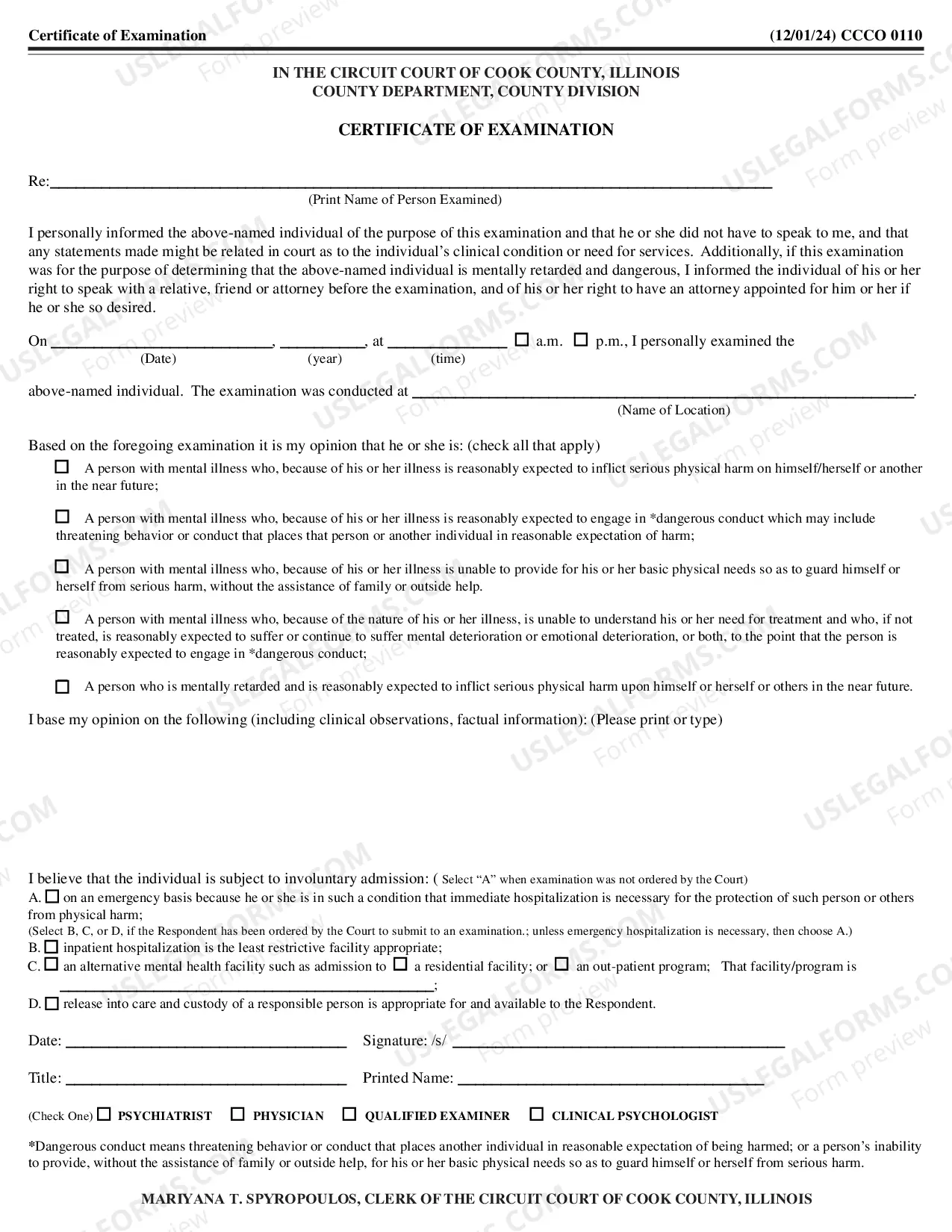
Prenuptial Property Agreement Designating Status of Separate and Community Property
Overview of this form
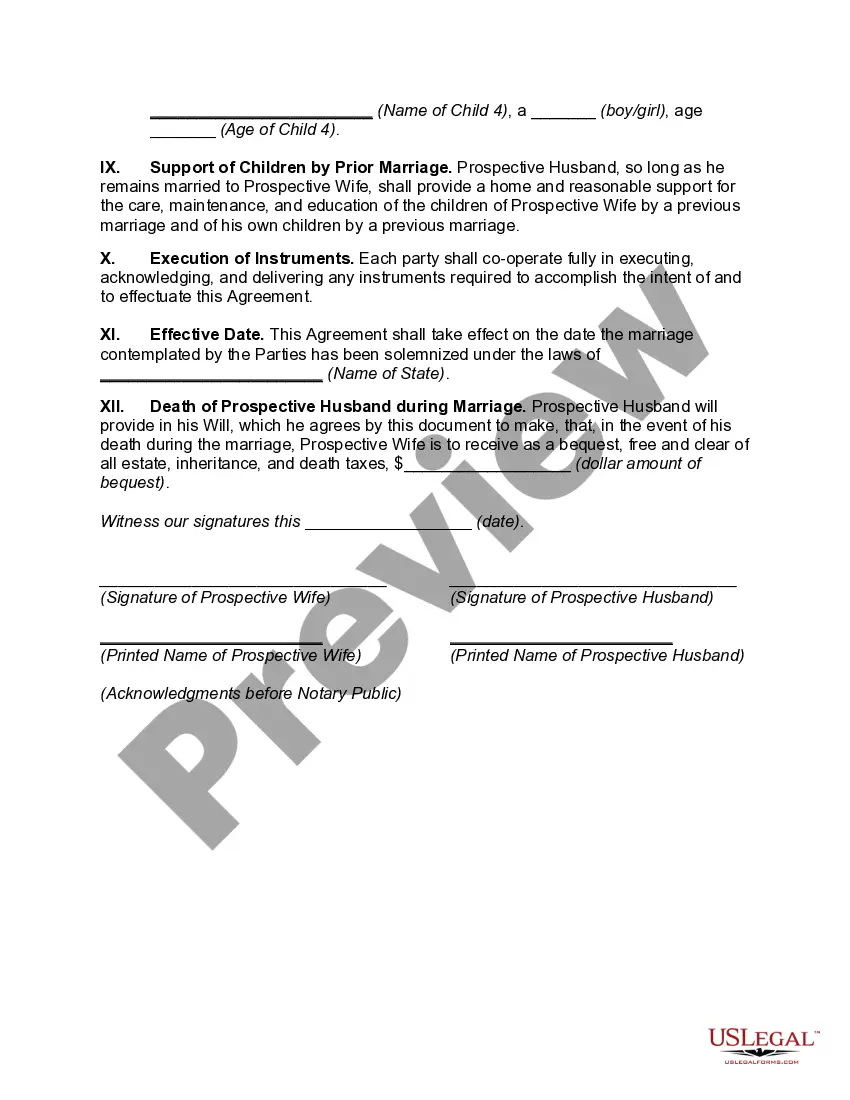
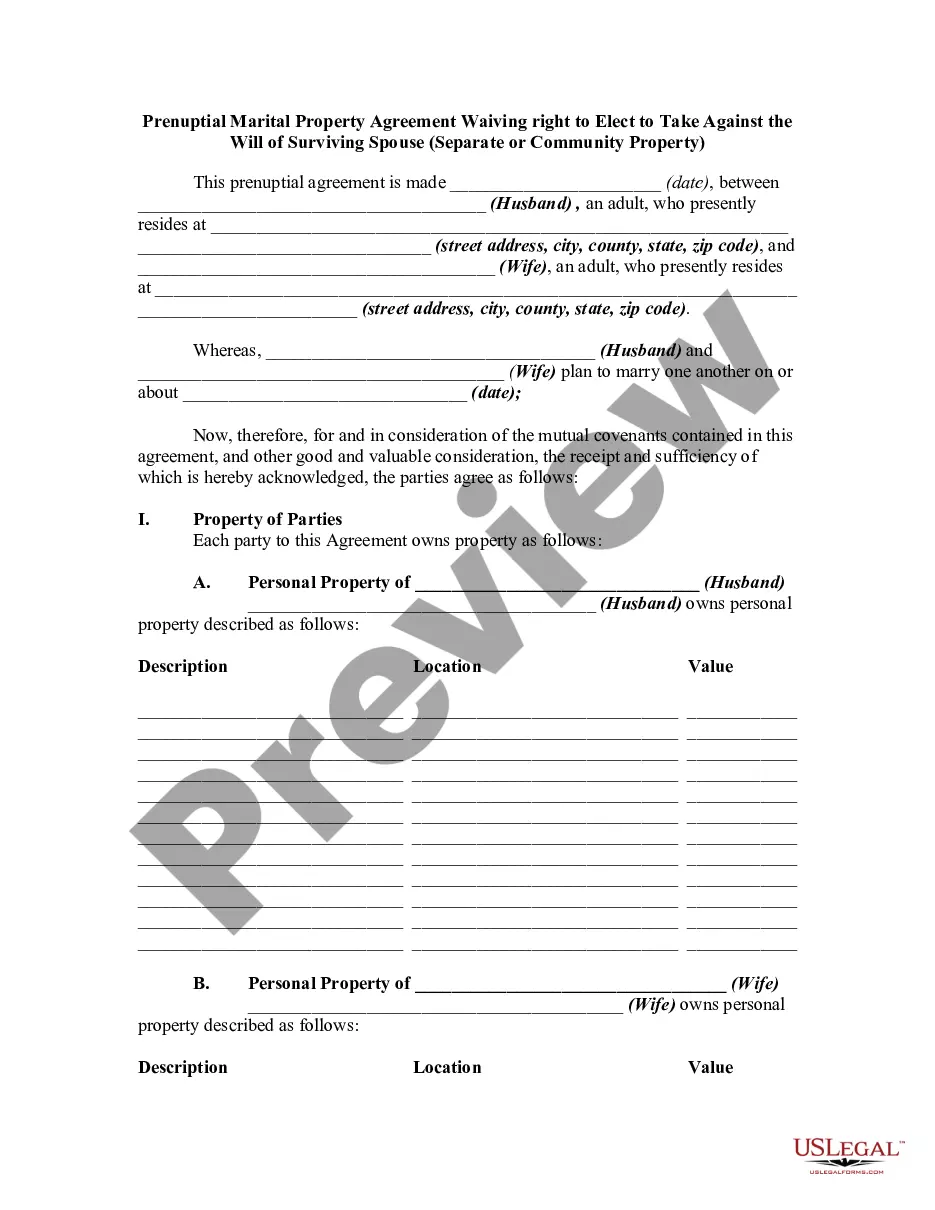
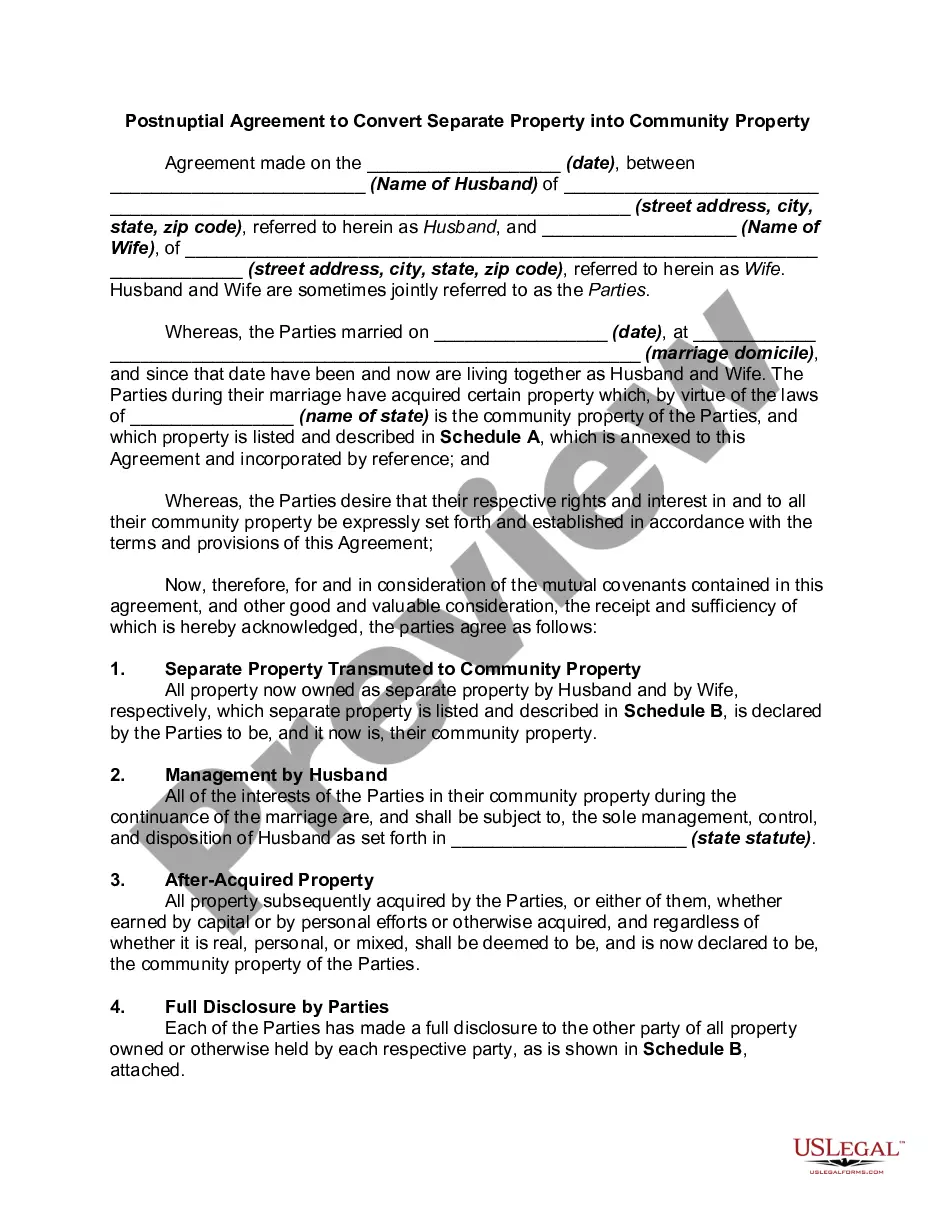
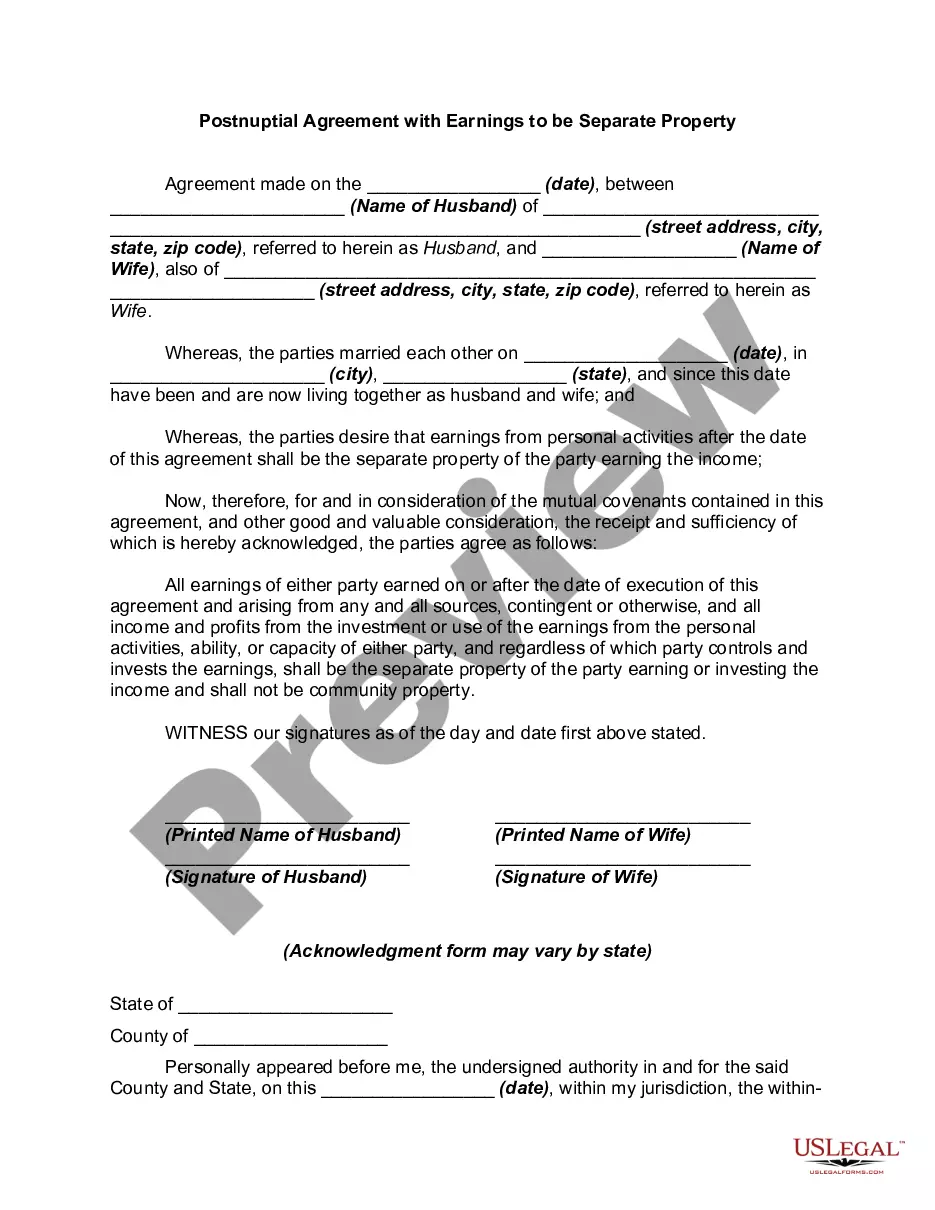
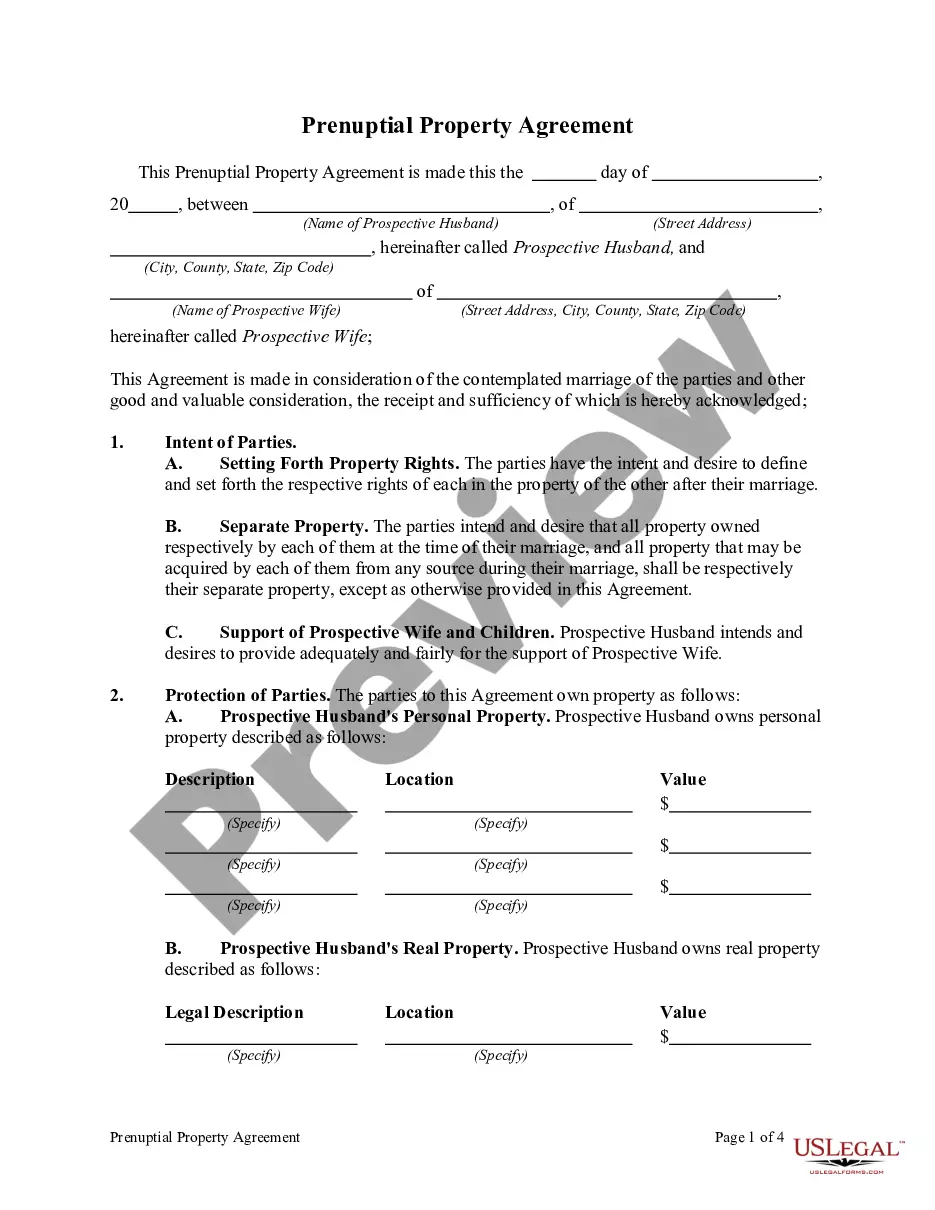
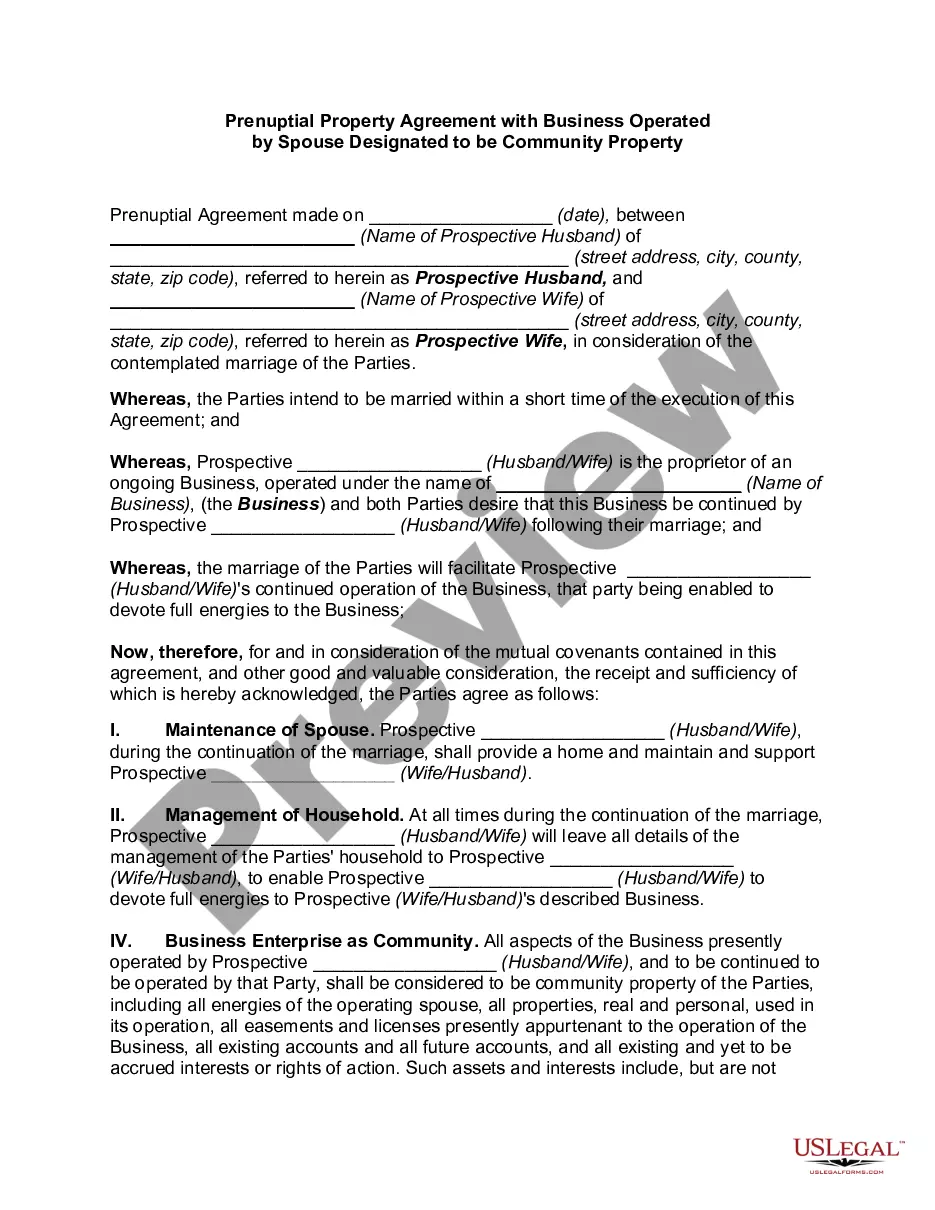
The Prenuptial Property Agreement Designating Status of Separate and Community Property is a legal document that establishes the property rights of each spouse before marriage. This form is essential for couples to define what will be considered separate property and what will be community property, in the event of a divorce or the death of one spouse. Unlike other prenuptial agreements, this form explicitly addresses the designation of property as separate or community, providing clarity and security for both parties.
Key components of this form
- Intent of the parties regarding the definition of separate and community property.
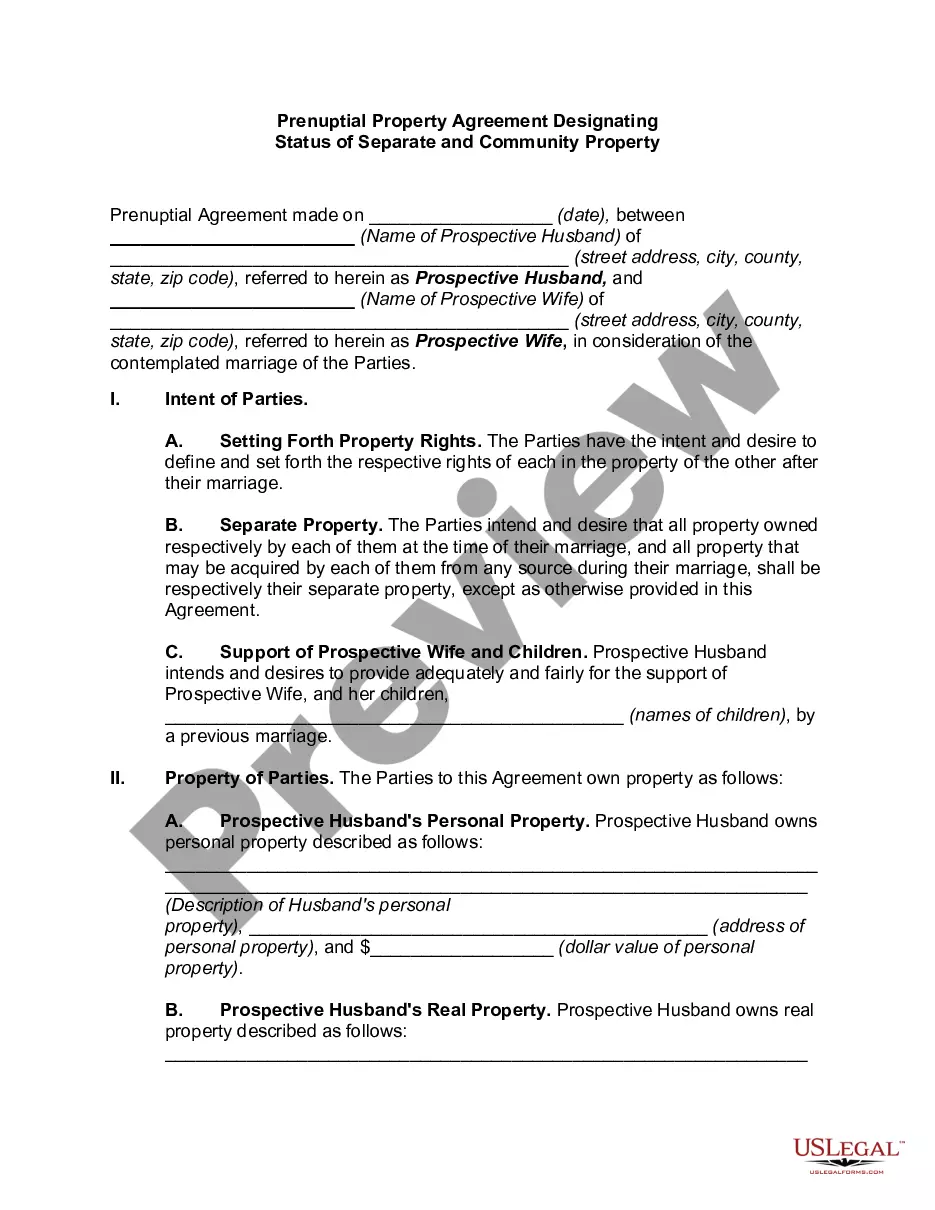
- Detailed description of each party's personal and real property.
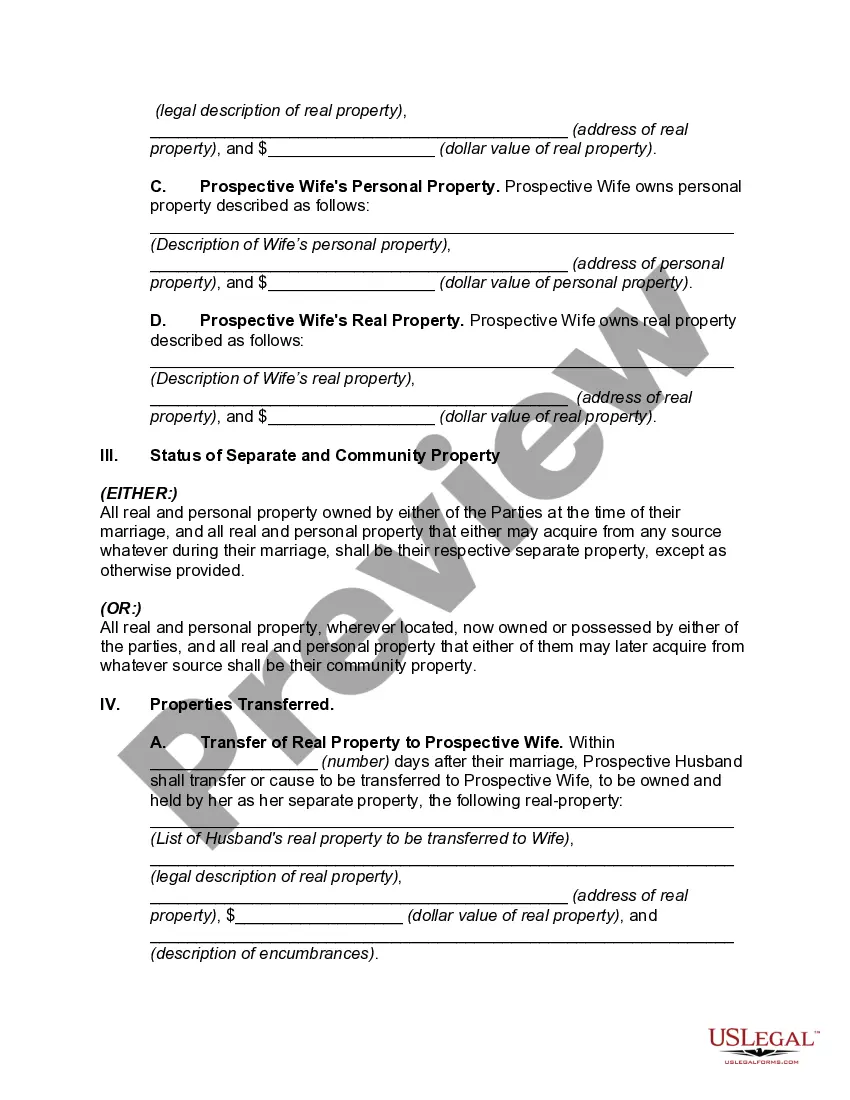
- Clauses specifying the transfer of property between parties.
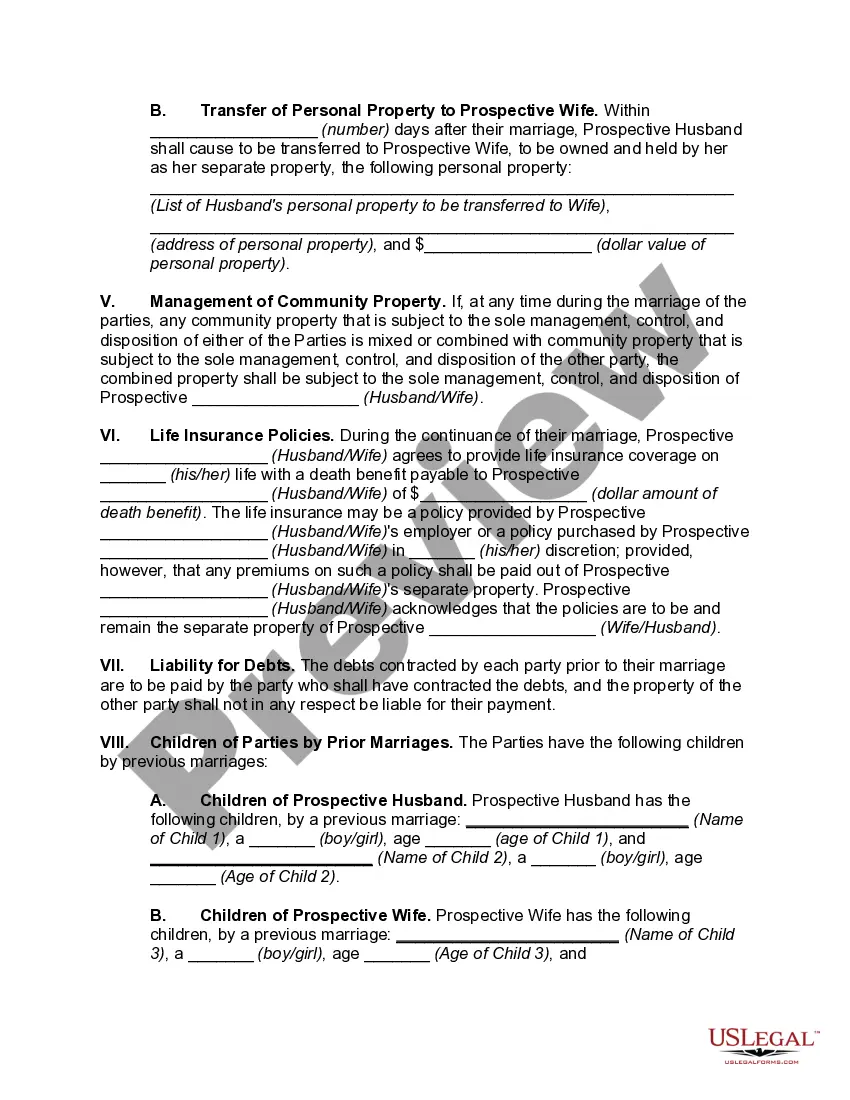
- Management of community property within the marriage.
- Provisions for supporting children from prior marriages.
Situations where this form applies
This form is useful for couples planning to marry who want to protect their individual assets and clearly define the property rights within their marriage. It is particularly important for individuals with significant assets, those entering a second marriage, or couples with children from previous relationships, as it helps prevent potential disputes regarding property division in the future.
Who needs this form
- Couples planning to marry who wish to clarify property rights.
- Individuals with substantial assets or debts prior to marriage.
- Those entering a second marriage or blending families.
- Prospective spouses wanting to avoid disputes over property should the marriage end.
How to prepare this document
- Identify and enter the full names and addresses of both parties.
- Specify the date of marriage planned and provide a detailed list of each party's property.
- Define the status of property as separate or community in the agreement.
- Complete the sections regarding the transfer of property and obligations for child support.
- Both parties must sign the agreement and include acknowledgment before a notary public if required by state law.
Does this form need to be notarized?
This form does not typically require notarization unless specified by local law. However, having the agreement notarized can provide additional legal validation and ensure authenticity.
Get your form ready online
Our built-in tools help you complete, sign, share, and store your documents in one place.
Make edits, fill in missing information, and update formatting in US Legal Forms—just like you would in MS Word.
Download a copy, print it, send it by email, or mail it via USPS—whatever works best for your next step.
Sign and collect signatures with our SignNow integration. Send to multiple recipients, set reminders, and more. Go Premium to unlock E-Sign.
If this form requires notarization, complete it online through a secure video call—no need to meet a notary in person or wait for an appointment.
We protect your documents and personal data by following strict security and privacy standards.

Make edits, fill in missing information, and update formatting in US Legal Forms—just like you would in MS Word.

Download a copy, print it, send it by email, or mail it via USPS—whatever works best for your next step.

Sign and collect signatures with our SignNow integration. Send to multiple recipients, set reminders, and more. Go Premium to unlock E-Sign.

If this form requires notarization, complete it online through a secure video call—no need to meet a notary in person or wait for an appointment.

We protect your documents and personal data by following strict security and privacy standards.
Common mistakes to avoid
- Failing to include complete descriptions of property.
- Not specifying debts associated with each party.
- Omitting signatures or failing to notarize the document when required.
- Using vague language that may lead to confusion in the future.
Benefits of using this form online
- Convenience of filling out the form from home at your own pace.
- Editability allows for easy adjustments before finalizing.
- Access to reliable templates drafted by licensed attorneys.
Key takeaways
- This form establishes clear property rights before marriage, protecting both partnersâ interests.
- It is essential for defining which assets will be separate and which will be community property.
- Couples should review the form carefully and consider legal advice to ensure enforceability.
Looking for another form?


Form popularity
FAQ
Community property states as of 2020 include Arizona, California, Idaho, Louisiana, Nevada, New Mexico, Texas, Washington and Wisconsin.That means spouses can divide their property by community property standards, but they don't have to.
Regardless of your state's property division laws, a prenuptial agreement lets you decide how marital property will be divided in the event of a divorce.In this sense, a prenuptial agreement can "override" community property or equitable distribution laws.
What Is Community Property? Community property refers to a U.S. state-level legal distinction that designates a married individual's assets. Any income and any real or personal property acquired by either spouse during a marriage are considered community property and thus belong to both partners of the marriage.
Transmutation means to change form, and in the context of California, Orange County divorce cases, transmutation means that property has changed form or character in one of the following ways: Property changed from community property to separate property. Property changed from separate property to community property;
Agreement; Jointly titling property in the name of both spouses; and/or.
Here are the top 10 reasons why a prenup could be invalid: There Isn't A Written Agreement: Premarital agreements are required to be in writing to be enforced. Not Correctly Executed: Each party is required to sign a premarital agreement prior to the wedding for the agreement to be deemed valid.
There's no restriction on being married and filing jointly with different state residences. As long as you and your spouse are married on the last day of the year, the IRS counts you as married for all 12 months. If, say, your divorce becomes final December 31, you file as single for the entire year.
At divorce, community property is generally divided equally between the spouses, while each spouse keeps his or her separate property. Equitable distribution. In all other states, assets and earnings accumulated during marriage are divided equitably (fairly), but not necessarily equally.
California is a community property state.In fact, California law expressly prohibits a spouse from giving away community property for less than fair and reasonable value without the written consent of the other spouse. Failure to follow this rule can lead to complicated litigation after a spouse's death.
Why a Prenup May be Right for You Some of the benefits of a prenuptial agreement include the following: Documenting each spouse's separate property to protect it as separate property. Supporting your estate plan and avoiding court involvement to decide property distribution.