Letter to Judgment Debtor Demanding Satisfaction of Judgment
Understanding this form
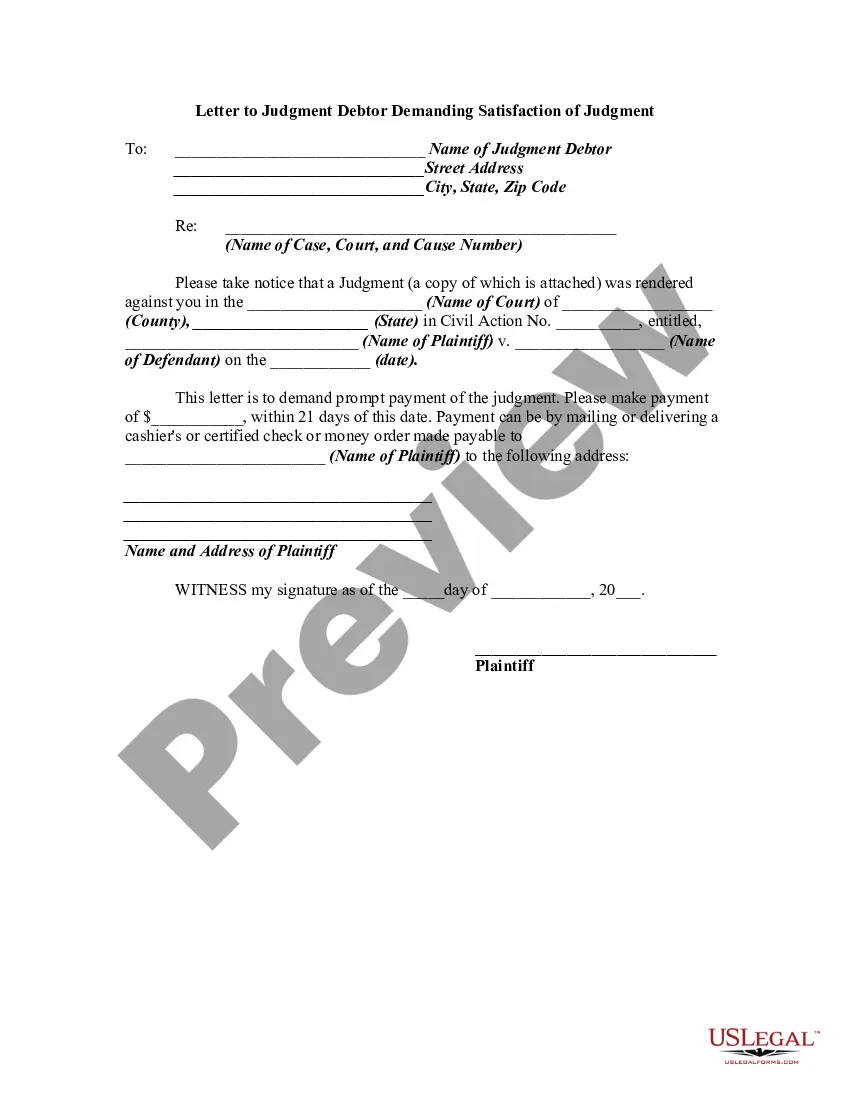
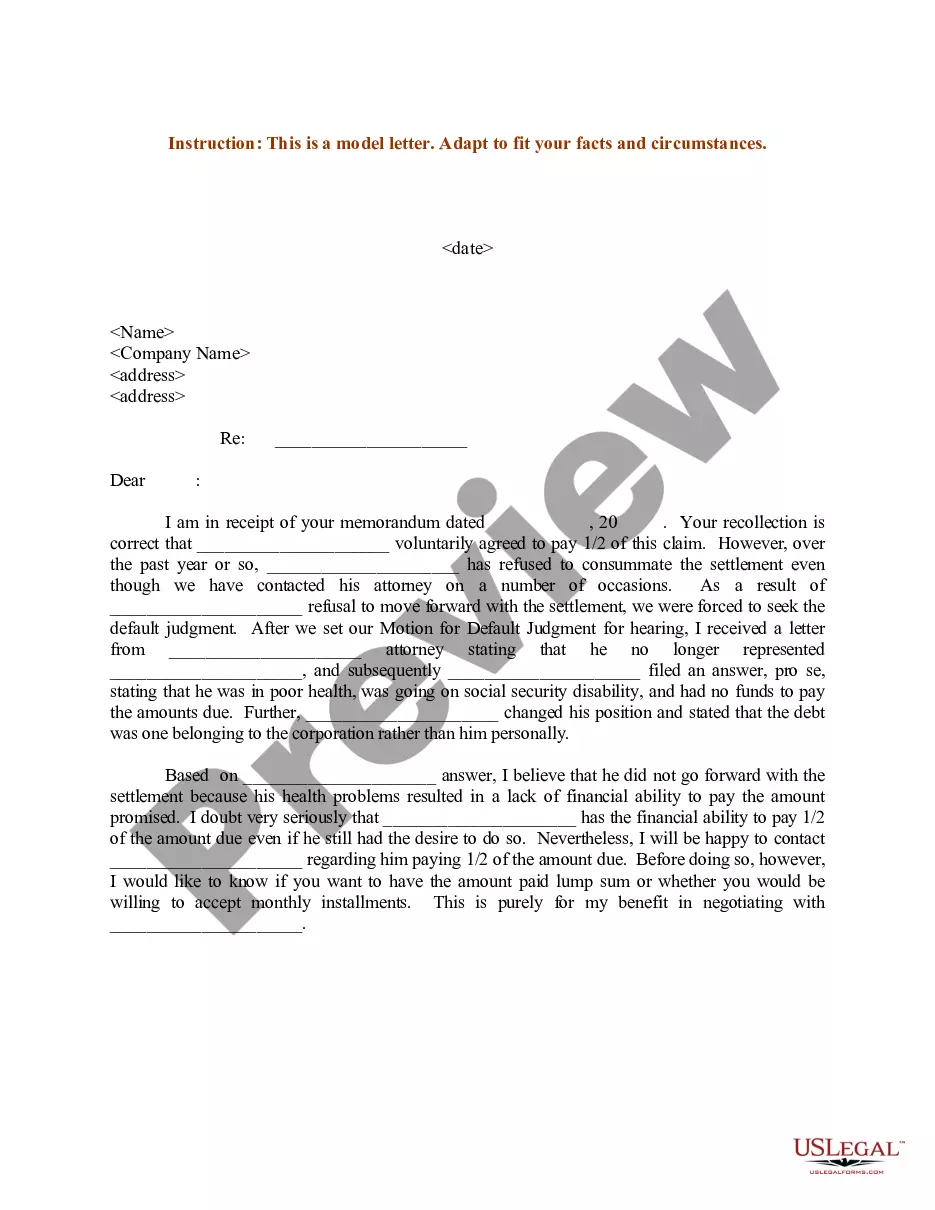
The Letter to Judgment Debtor Demanding Satisfaction of Judgment is a formal document used by a plaintiff to request payment of a judgment awarded by the court. This form serves as a request for the debtor to fulfill their financial obligation following a successful court judgment. It is distinct from other forms in that it specifies the amount owed and provides instructions for payment, streamlining communication between the plaintiff and the judgment debtor.
Main sections of this form
- The name and address of the judgment debtor.
- The case name, court details, and cause number related to the judgment.
- The amount of the judgment being demanded for payment.
- The deadline for payment, typically set at 21 days from the letter date.
- The name and address of the plaintiff where payment should be sent.
- A signature line for the plaintiff to validate the document date.




When this form is needed
This letter should be used when a plaintiff has received a judgment against a defendant and is seeking to enforce this judgment by demanding payment. Ideal scenarios include situations where prior informal requests for payment have failed, or when the plaintiff wishes to formally document the demand for legal and record-keeping purposes.
Who should use this form
- Individuals or businesses that have won a judgment in court and need to collect the owed amount.
- Attorneys representing plaintiffs who must communicate formally with the defendant's legal counsel.
- Creditors who wish to ensure they have documentation of their attempts to collect on a judgment.
Completing this form step by step
- Enter the name and address of the judgment debtor at the top of the letter.
- Fill out the case name, court details, and cause number to identify the judgment.
- Specify the amount of the judgment that is being demanded.
- Indicate the deadline for payment, typically set at 21 days from the letter's date.
- Provide the name and mailing address of the plaintiff for payment delivery.
- Sign and date the letter to validate the demand.
Notarization guidance
This form does not typically require notarization to be legally valid. However, some jurisdictions or document types may still require it. US Legal Forms provides secure online notarization powered by Notarize, available 24/7 for added convenience.
Get your form ready online
Our built-in tools help you complete, sign, share, and store your documents in one place.
Make edits, fill in missing information, and update formatting in US Legal Forms—just like you would in MS Word.
Download a copy, print it, send it by email, or mail it via USPS—whatever works best for your next step.
Sign and collect signatures with our SignNow integration. Send to multiple recipients, set reminders, and more. Go Premium to unlock E-Sign.
If this form requires notarization, complete it online through a secure video call—no need to meet a notary in person or wait for an appointment.
We protect your documents and personal data by following strict security and privacy standards.

Make edits, fill in missing information, and update formatting in US Legal Forms—just like you would in MS Word.

Download a copy, print it, send it by email, or mail it via USPS—whatever works best for your next step.

Sign and collect signatures with our SignNow integration. Send to multiple recipients, set reminders, and more. Go Premium to unlock E-Sign.

If this form requires notarization, complete it online through a secure video call—no need to meet a notary in person or wait for an appointment.

We protect your documents and personal data by following strict security and privacy standards.
Typical mistakes to avoid
- Failing to include the correct case information, leading to confusion.
- Omitting the deadline for payment, which can weaken the demand.
- Not signing the letter, which undermines its legitimacy.
- Sending the letter directly to the debtor instead of through their attorney, when applicable.
Why complete this form online
- Convenience of downloading and filling out the form at your pace.
- Editable templates that allow customization to meet specific case needs.
- Access to forms reviewed by licensed attorneys, ensuring reliability and accuracy.
Legal use & context
- The letter serves as a formal demand for payment in accordance with a court judgment.
- Properly drafted demands can prevent further legal actions or complications.
- Courts generally require evidence of efforts to collect the judgment amount before approving further legal remedies.
Main things to remember
- This form is a formal demand for payment from a judgment debtor.
- It includes essential details like case information, the amount owed, and instructions for payment.
- Using the form correctly can expedite collection efforts and clarify the debtor's obligations.
Looking for another form?
Form popularity
FAQ
If the judgment creditor does not immediately file an Acknowledgement of Satisfaction of Judgment (EJ-100) when the judgment is satisfied, the judgment debtor may make a formal written demand for the creditor to do so. The judgment creditor has 15 days after receiving the debtor's request to serve the acknowledgement.
The defendant should ask for a letter confirming that the entire amount of the judgment has been paid. He or she may do so by sending a demand letter to the plaintiff. The release and satisfaction form is filed with the court clerk and entered into the case record.
A Satisfaction of Judgment is a document signed by one party acknowledge receipt of the payment. The Satisfaction of Judgment is then filed with the court. This is beneficial to the paying party for multiple reasons. One, the court is put on notice that the debt has been satisfied.
There are a few ways you can satisfy or avoid a lien altogether. The firstand most obviousoption is to repay the debt. If you pay off your obligation, the creditor will remove the lien. This is done by filing a release through the same place the lien was recordedthe county or state.
You will need one original, notarized copy for the judgment debtor. If you recorded an abstract of judgment to place a lien against the debtor's real property, you will need an original, notarized copy of your Acknowledgment of Satisfaction of Judgment (EJ-100) for each county where you placed a lien.
Satisfaction by Levy A judgment creditor's obligation to give or file an acknowledgement of satisfaction arises only when the judgment creditor received the full amount required to satisfy the judgment from the levying officer.
A document signed by the party who is owed money under a court judgment (called the judgment creditor) stating that the full amount due on the judgment has been paid.
Once a judgment is paid, whether in installments or a lump sum, a judgment creditor (the person who won the case) must acknowledge that the judgment has been paid by filing a Satisfaction of Judgment form with the court clerk.