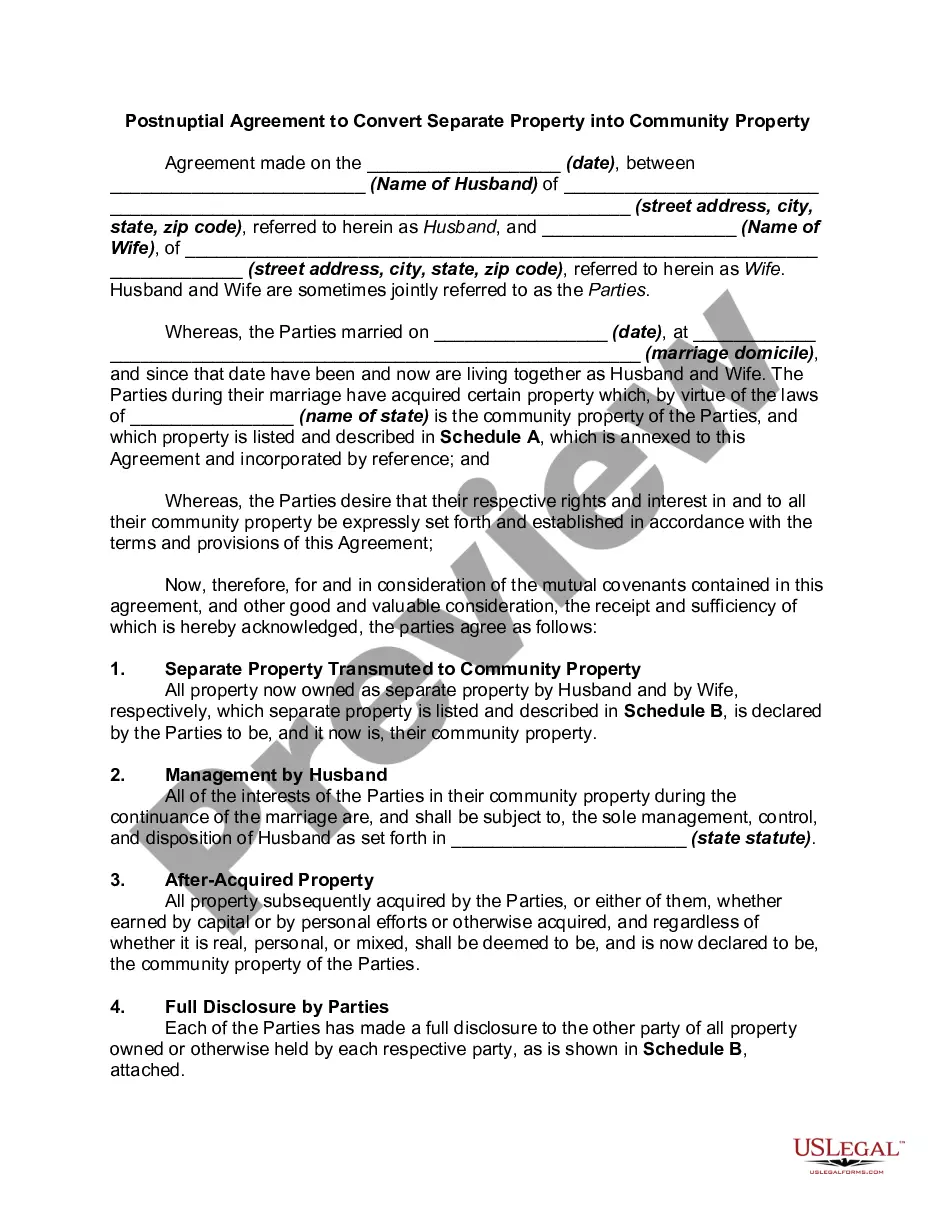
Postnuptial Agreement to Convert Separate Property into Community Property
Understanding this form
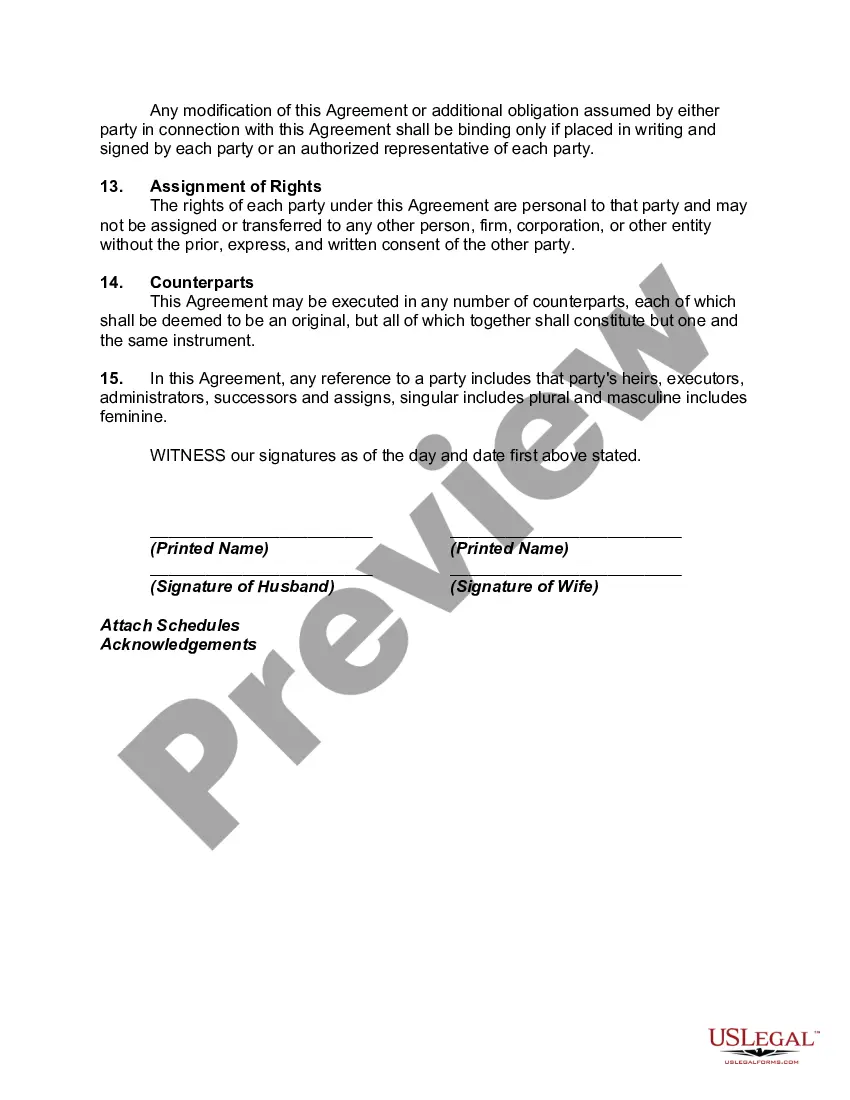
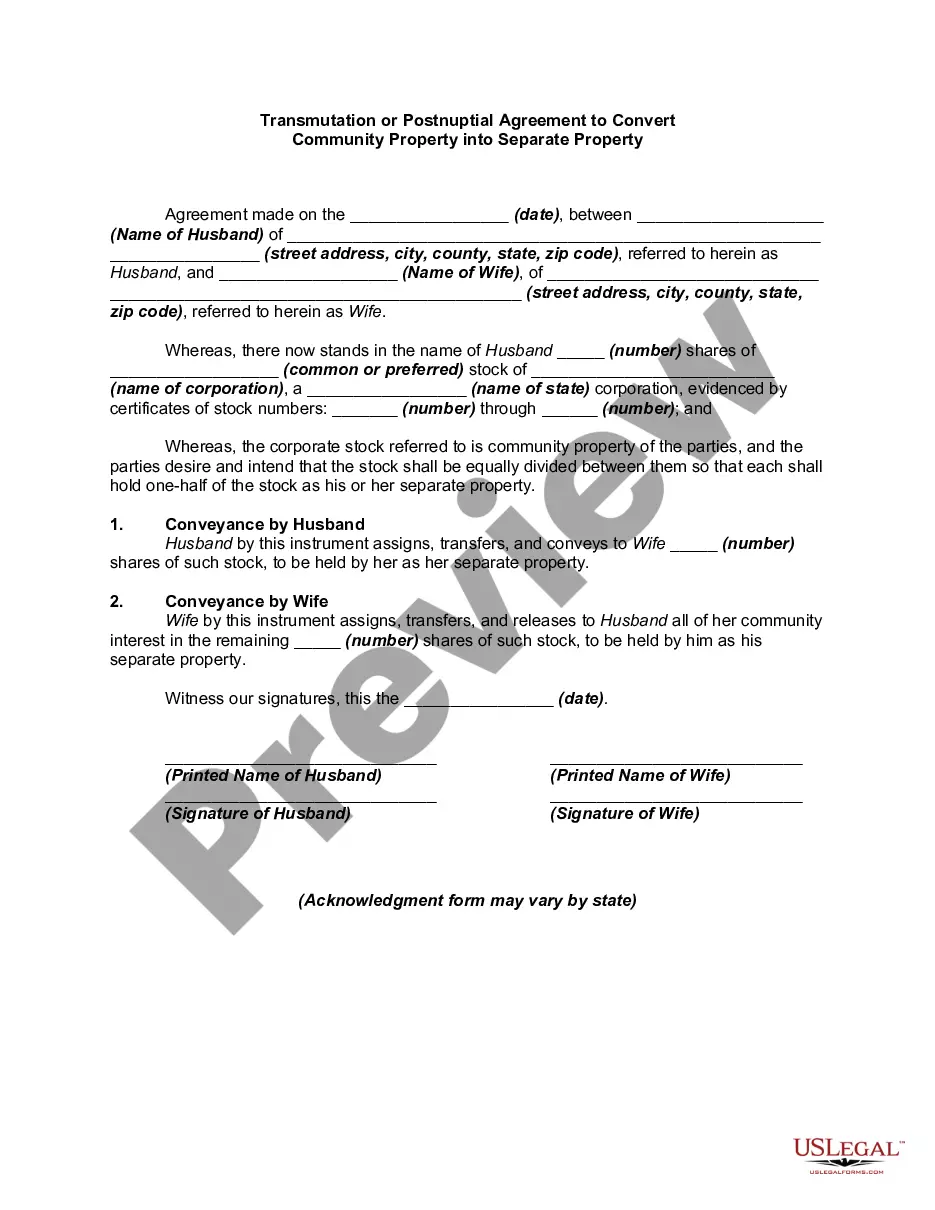
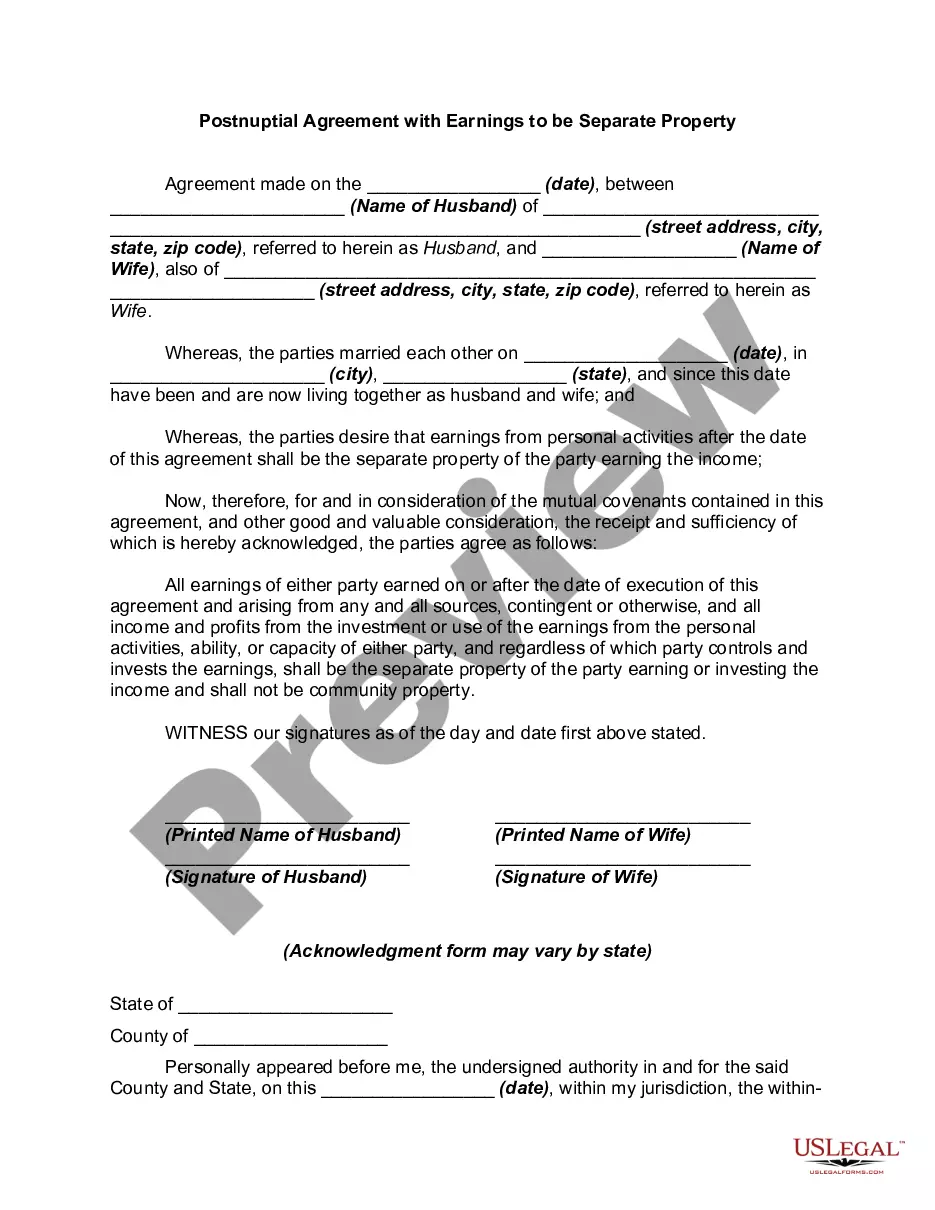
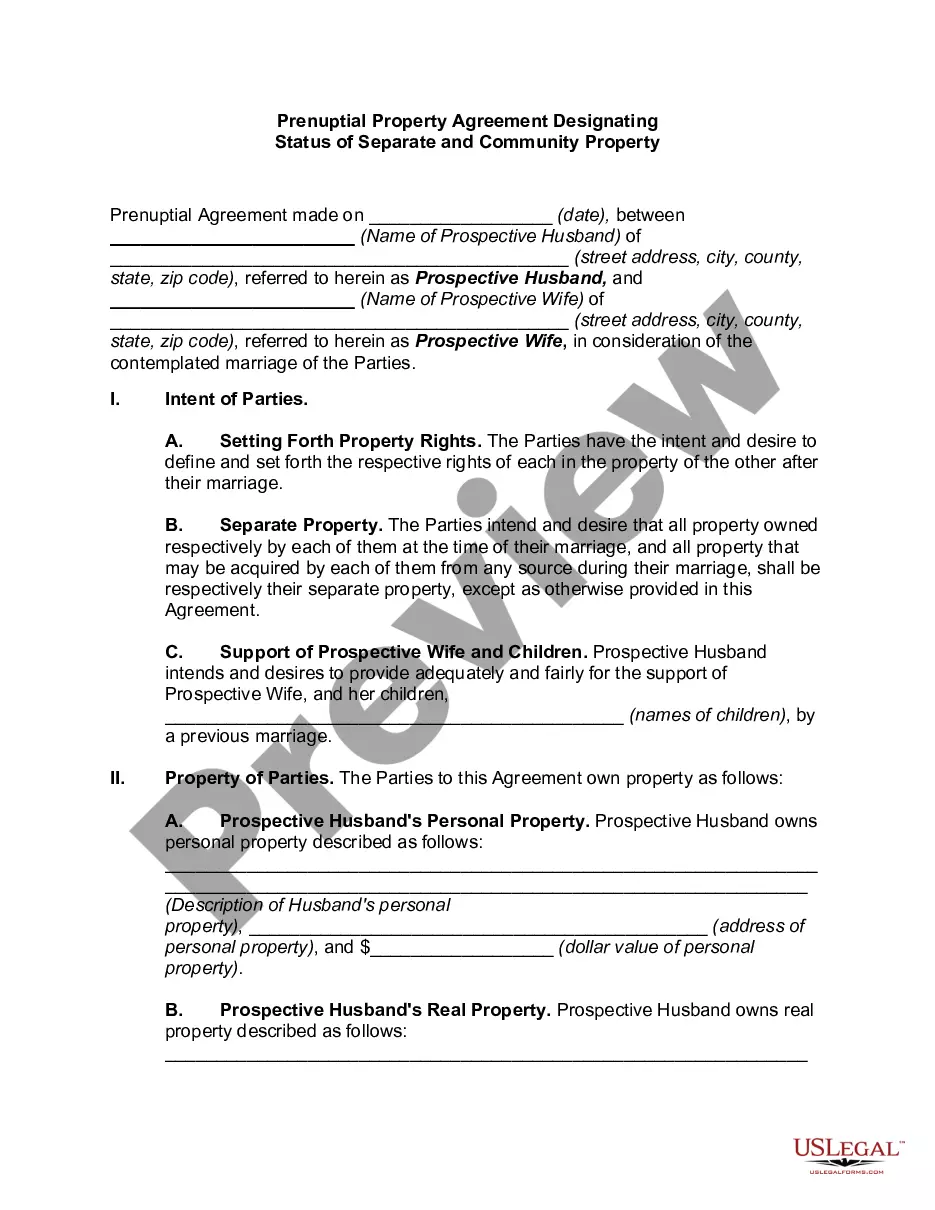
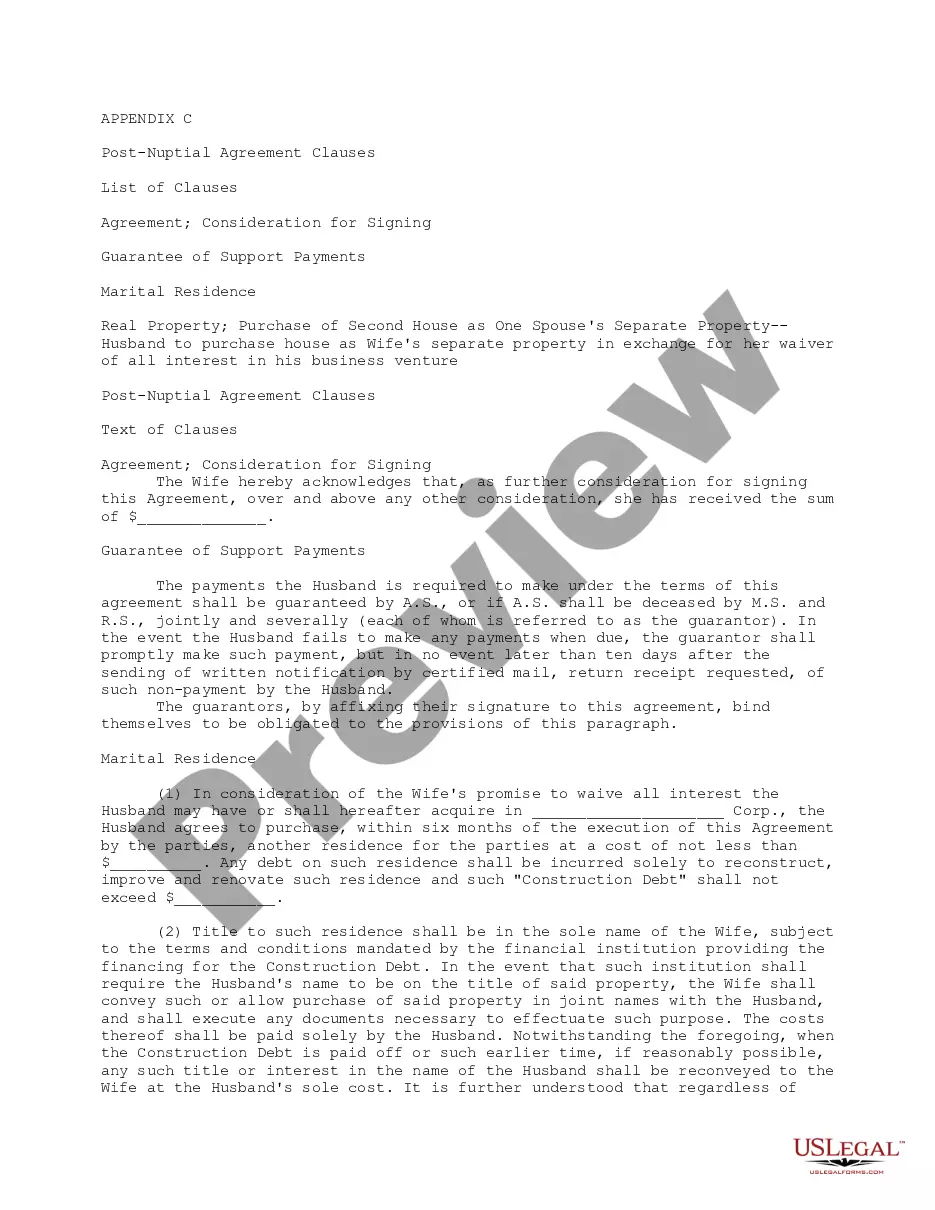
The Postnuptial Agreement to Convert Separate Property into Community Property is a legal document that allows married couples to agree on converting their separate property into community property after marriage. This agreement outlines how property will be managed and divided in the event of a divorce or the death of one spouse. Unlike a prenuptial agreement, which is established before marriage, this document is created during the marriage to address financial and property matters as per mutual consent.
Form components explained
- Date and identification of the parties involved.
- Definition and listing of separate property being converted to community property.
- Management provisions detailing who will control the community property.
- Sections for full disclosure of assets between the parties.
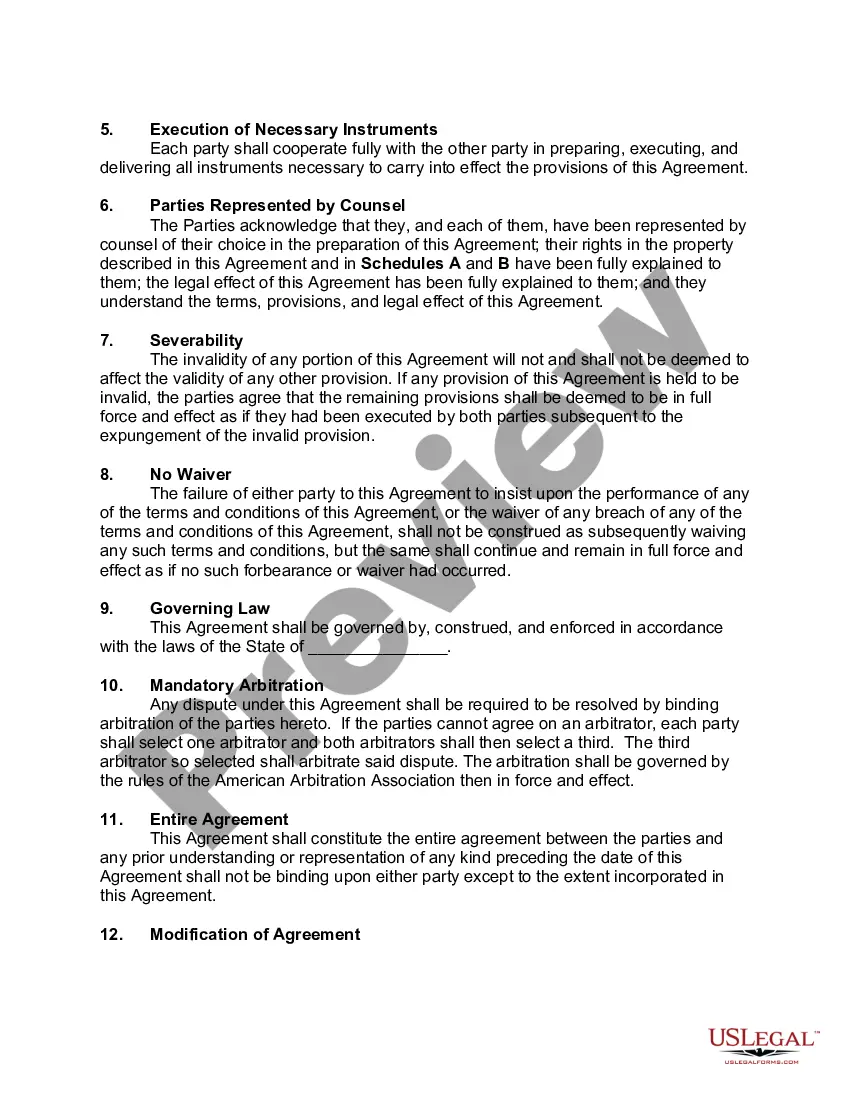
- Provisions for arbitration in case of disputes arising from the agreement.
- Statements regarding representation by legal counsel and understanding of the agreement.

Common use cases
This form should be used in situations where a married couple wishes to clearly establish how their individual separate properties will be treated as community property. It is beneficial when couples want to ensure a fair division of assets in case of a separation, divorce, or death. Additionally, it can be useful to clarify rights and responsibilities regarding property management during the marriage.
Who this form is for
- Married couples who own separate property and wish to combine it with community property.
- Spouses wanting to establish clear guidelines for property division in the event of divorce or separation.
- Couples seeking to formalize their financial arrangements relative to property ownership.
How to prepare this document
- Identify the date of the agreement and names of both spouses.
- Specify the separate properties being converted to community property in Schedule B.
- Indicate any community property management instructions according to state laws.
- Ensure full disclosure of assets by completing Schedule B.
- Sign the agreement in the presence of witnesses if required, ensuring both parties have legal representation to validate understanding.
Does this form need to be notarized?
Notarization is not commonly needed for this form. However, certain documents or local rules may make it necessary. Our notarization service, powered by Notarize, allows you to finalize it securely online anytime, day or night.
Get your form ready online
Our built-in tools help you complete, sign, share, and store your documents in one place.
Make edits, fill in missing information, and update formatting in US Legal Forms—just like you would in MS Word.
Download a copy, print it, send it by email, or mail it via USPS—whatever works best for your next step.
Sign and collect signatures with our SignNow integration. Send to multiple recipients, set reminders, and more. Go Premium to unlock E-Sign.
If this form requires notarization, complete it online through a secure video call—no need to meet a notary in person or wait for an appointment.
We protect your documents and personal data by following strict security and privacy standards.

Make edits, fill in missing information, and update formatting in US Legal Forms—just like you would in MS Word.

Download a copy, print it, send it by email, or mail it via USPS—whatever works best for your next step.

Sign and collect signatures with our SignNow integration. Send to multiple recipients, set reminders, and more. Go Premium to unlock E-Sign.

If this form requires notarization, complete it online through a secure video call—no need to meet a notary in person or wait for an appointment.

We protect your documents and personal data by following strict security and privacy standards.
Common mistakes to avoid
- Failing to fully disclose all assets and debts, which can invalidate the agreement.
- Not having both parties represented by legal counsel, as this can lead to disputes later.
- Incorrectly assuming that verbal agreements about property changes are sufficient.
Advantages of online completion
- Easy access to a well-drafted legal document tailored to your specific needs.
- Ability to personalize the agreement according to your circumstances.
- Convenience of downloading and printing the form anytime without the need for an appointment.
Legal use & context
- Enforceability of the agreement may vary by state, so it's crucial to ensure compliance with local laws.
- It is generally considered a binding contract as long as the parties agree and complete the form properly.
- Postnuptial agreements can offer protection and clarity about property ownership and responsibilities.
Quick recap
- A postnuptial agreement is crucial for defining ownership of property acquired before or during marriage.
- It allows couples to convert separate property into community property legally.
- Understanding local laws is essential for effective use of the agreement.
Looking for another form?
Form popularity
FAQ
In general, one spouse's inheritance (as well as gifts given to one spouse) will remain separate property during a marriage in California.For example, if you receive a home as an inheritance, sell it and purchase another property with your spouse using the money from the sale, the home will become community property.
California's separate property laws apply to a house owned before marriage.(b) A married person may, without the consent of the person's spouse, convey the person's separate property." Therefore, you should have a separate property interest during the divorce in that premarital asset which is your house.
Wives : A wife is entitled to an equal share of her husband's property like other entitled heirs. If there are no sharers, she has full right to the entire property.She is also entitled to maintenance, support and shelter from husband, and if staying in a joint family, from the family.
It needs to be in writing. An oral contract is often difficult to enforce legally in any case. It needs to be signed and notarized. It needs to be fair and reasonable. There must be full disclosure of assets by both spouses. Both parties agree to the terms of the postnuptial agreement.
Marital property includes real estate and other property a couple buys together during their marriage, such as a home or investment property, cars, boats, furniture, or artwork, when not acquired by either as separate property.
Separate property can become marital property if it is mixed with marital property. For example, if one of the spouses uses money they had before the marriage to buy a house for the couple, that money might become marital property.
Separate property belongs to the spouse who owns it and is not generally divided in a divorce. California law also provides that property spouses acquire before a divorce, but after the date of separation, is separate property.
As long as both parties are in agreement to the terms of the post nuptial contract, and have the ability to put those terms into a legal document, most states don't make it a legal requirement to have an attorney.