Prenuptial Property Agreement with Business Operated by Spouse Designated to be Community Property
Understanding this form
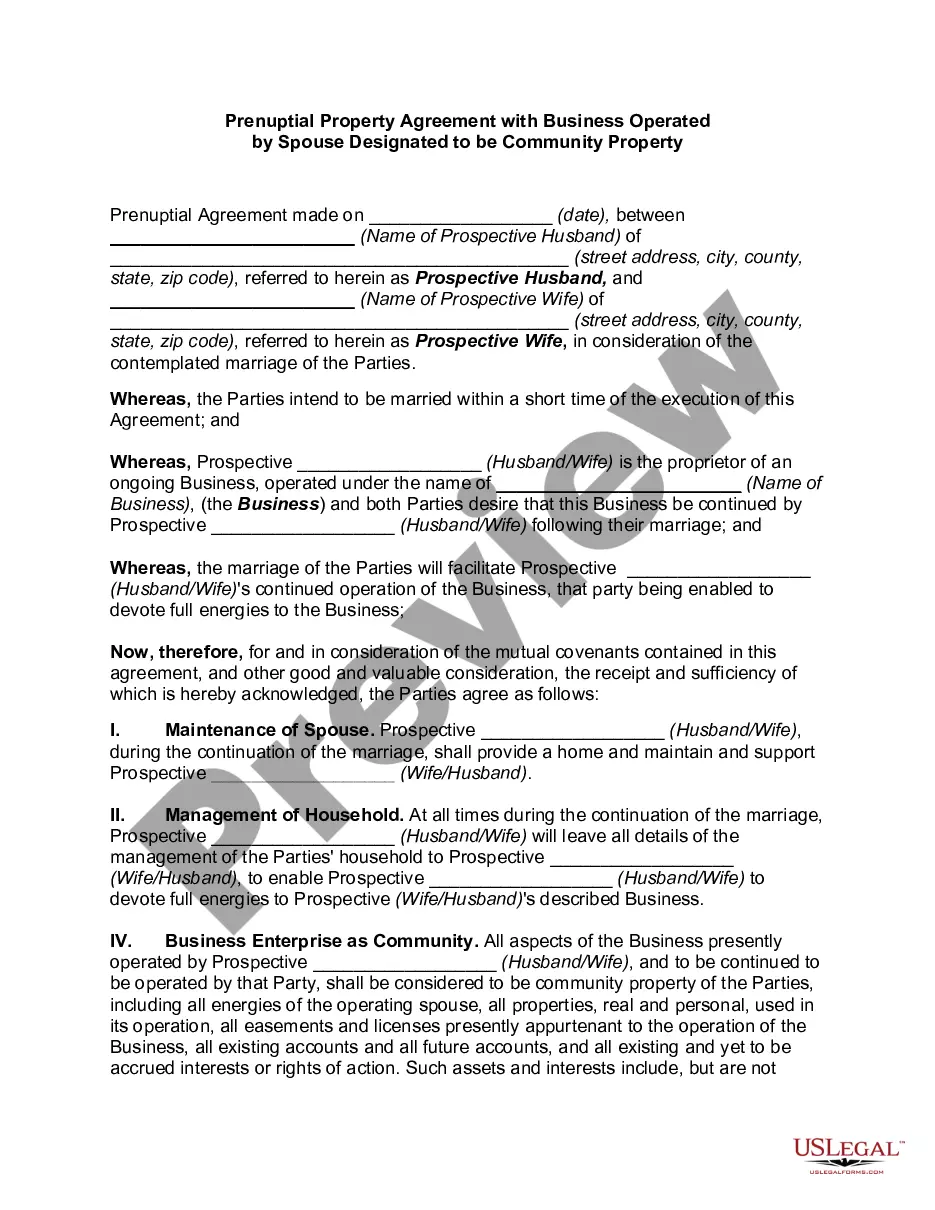
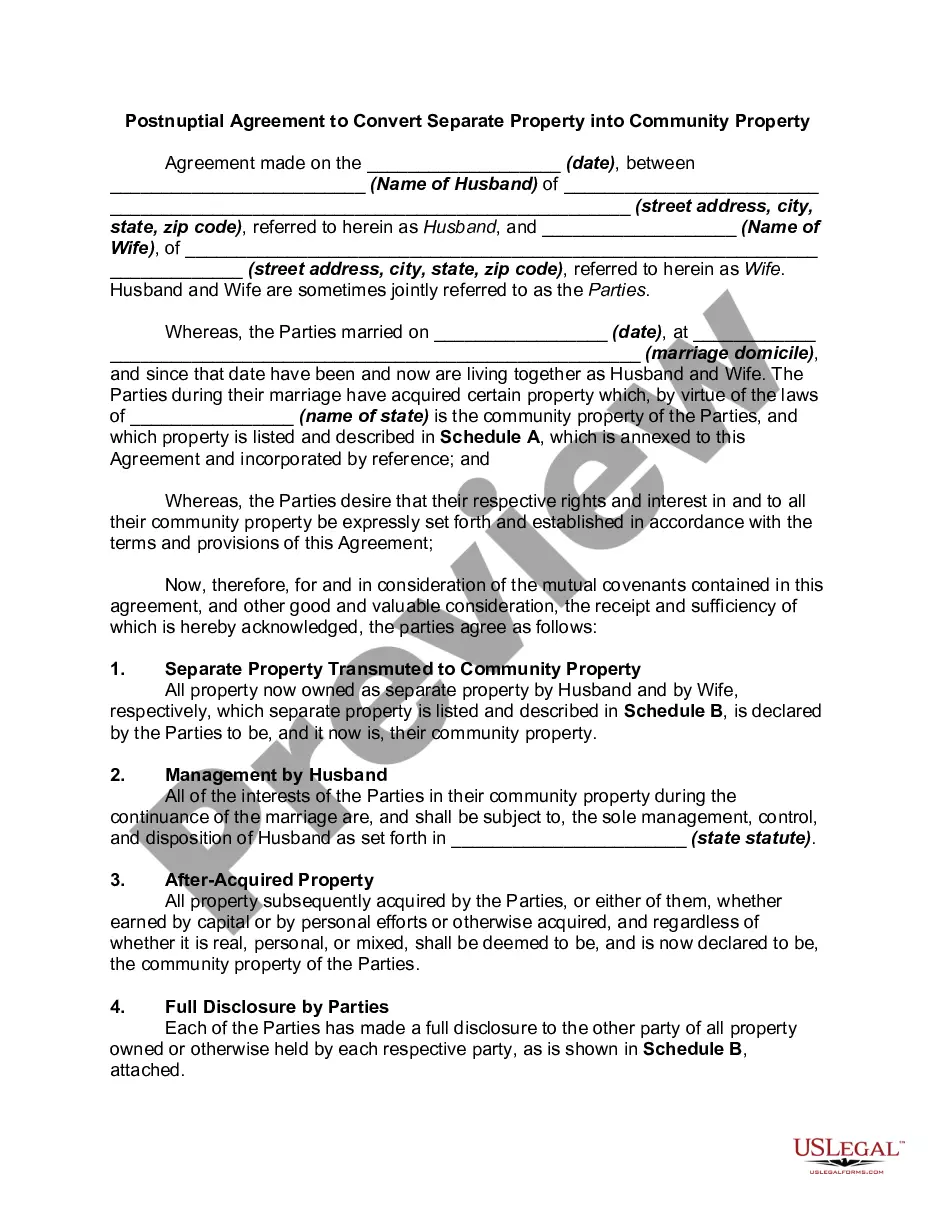
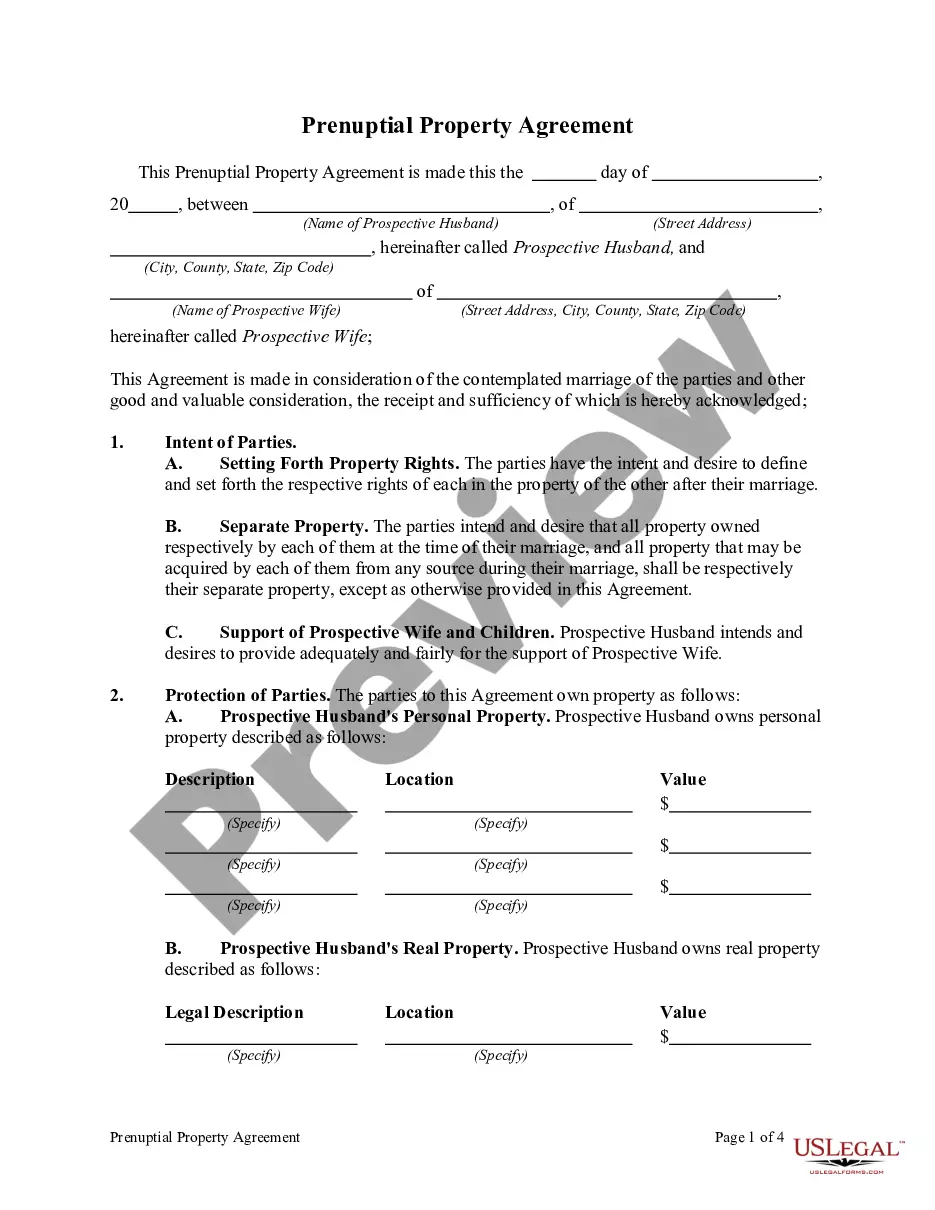
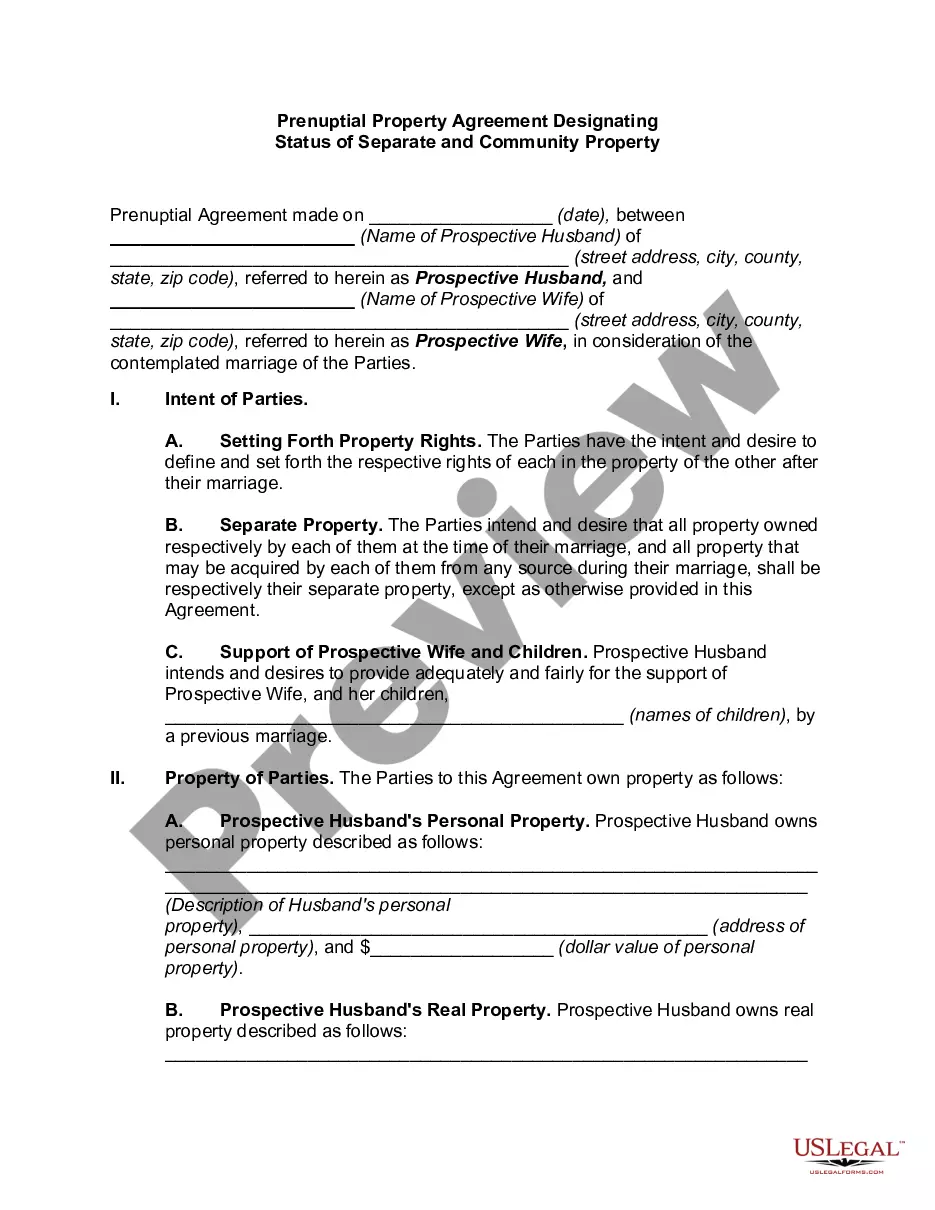
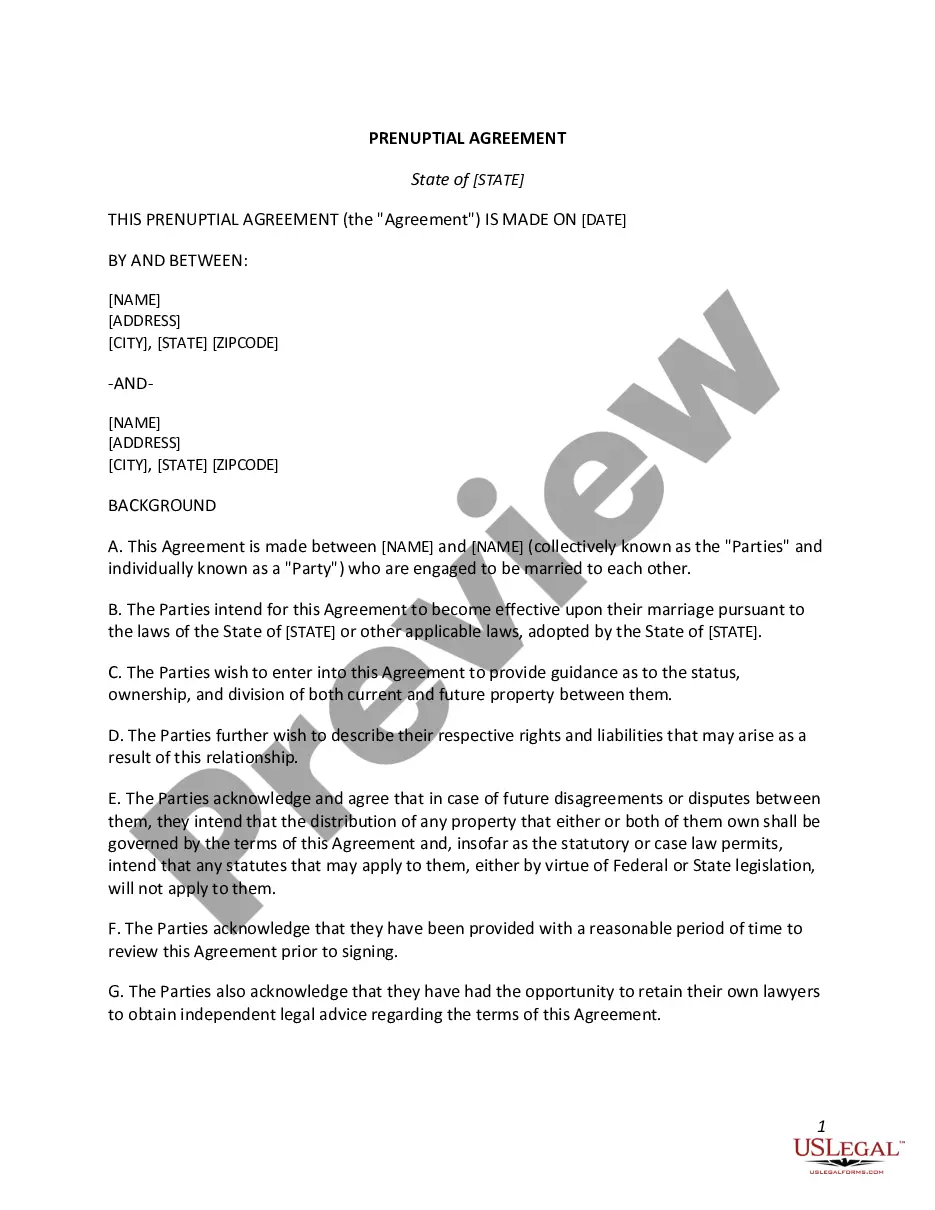
The Prenuptial Property Agreement with Business Operated by Spouse Designated to be Community Property is a legal document that outlines how property and assets will be managed and divided between spouses in the event of divorce or death. This form is specifically useful for couples where one spouse owns a business, ensuring that the business is treated as community property while allowing the owner spouse to manage it freely without interference from the other spouse. This agreement provides clarity and security for both parties regarding their financial interests before entering into marriage.
Key parts of this document
- Identification of the parties involved, including their names and addresses.
- Clarification of the business operated by one spouse, including its name.
- Provisions for maintenance and support of the non-operating spouse.
- Designation of business operations as community property.
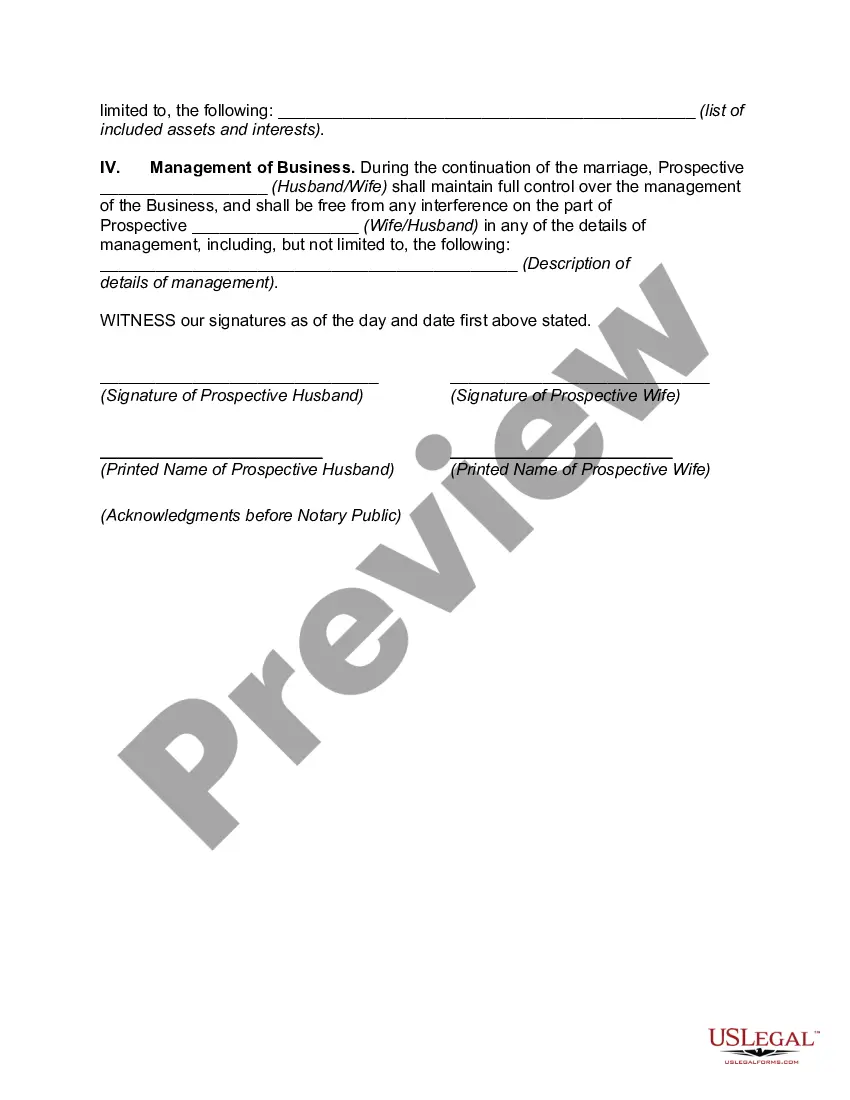
- Details on the management and control of the business by the operating spouse.
- Signature lines for both parties, along with notarization requirements.
Common use cases
This form is necessary for couples who are planning to marry and want to define ownership rights regarding their assets, particularly when one spouse owns a business. It is advisable to use this form when the couple recognizes the importance of protecting the business as community property and wishes to ensure that it can continue to be operated without conflict in the future. Additionally, it can be beneficial in situations where one party has significant personal assets or debts that they wish to keep separate from the marriage's community property.
Who this form is for
- Couples preparing for marriage, especially when one partner owns a business.
- Individuals seeking to protect their business interests in a marriage.
- Spouses who want to clearly outline financial responsibilities and management roles.
- Couples with existing property or financial assets that may impact their marriage.
Instructions for completing this form
- Identify the parties by entering the names and addresses of the prospective husband and wife.
- Specify the date on which the agreement is made.
- Clearly describe the business operated by one spouse and designate it as community property.
- Detail the management structure and responsibilities associated with the household and business.
- Ensure both parties sign the agreement, with appropriate space for notarization if required.
Does this form need to be notarized?
Yes, this form must be notarized to be legally valid. Having a notary public verify the signatures on the agreement enhances its enforceability and may be necessary to meet state requirements. US Legal Forms offers integrated online notarization, making this process easy and secure through a video call at your convenience.
Get your form ready online
Our built-in tools help you complete, sign, share, and store your documents in one place.
Make edits, fill in missing information, and update formatting in US Legal Forms—just like you would in MS Word.
Download a copy, print it, send it by email, or mail it via USPS—whatever works best for your next step.
Sign and collect signatures with our SignNow integration. Send to multiple recipients, set reminders, and more. Go Premium to unlock E-Sign.
If this form requires notarization, complete it online through a secure video call—no need to meet a notary in person or wait for an appointment.
We protect your documents and personal data by following strict security and privacy standards.

Make edits, fill in missing information, and update formatting in US Legal Forms—just like you would in MS Word.

Download a copy, print it, send it by email, or mail it via USPS—whatever works best for your next step.

Sign and collect signatures with our SignNow integration. Send to multiple recipients, set reminders, and more. Go Premium to unlock E-Sign.

If this form requires notarization, complete it online through a secure video call—no need to meet a notary in person or wait for an appointment.

We protect your documents and personal data by following strict security and privacy standards.
Common mistakes
- Failing to include all assets associated with the business in the agreement.
- Not properly identifying both parties with complete names and addresses.
- Overlooking the need for notarization or failing to follow local laws regarding prenuptial agreements.
- Not discussing or clarifying responsibilities regarding the business operations.
Advantages of online completion
- Convenience of accessing and downloading the form from anywhere.
- Editability allows you to customize the agreement to fit your specific needs.
- Reliability, as the forms are drafted by licensed attorneys ensuring legal compliance.
- Saves time and money compared to hiring an attorney for basic agreement setups.
Looking for another form?
Form popularity
FAQ
Regardless of your state's property division laws, a prenuptial agreement lets you decide how marital property will be divided in the event of a divorce.In this sense, a prenuptial agreement can "override" community property or equitable distribution laws.
There's no restriction on being married and filing jointly with different state residences. As long as you and your spouse are married on the last day of the year, the IRS counts you as married for all 12 months. If, say, your divorce becomes final December 31, you file as single for the entire year.
In California, property acquired during the course of a marriage is considered community property.If you acquired your business prior to your marriage and your ownership has not required any efforts on your part, your business would be considered separate property.
Community property states as of 2020 include Arizona, California, Idaho, Louisiana, Nevada, New Mexico, Texas, Washington and Wisconsin.That means spouses can divide their property by community property standards, but they don't have to.
California is a community property state.In fact, California law expressly prohibits a spouse from giving away community property for less than fair and reasonable value without the written consent of the other spouse. Failure to follow this rule can lead to complicated litigation after a spouse's death.
What Is Community Property? Community property refers to a U.S. state-level legal distinction that designates a married individual's assets. Any income and any real or personal property acquired by either spouse during a marriage are considered community property and thus belong to both partners of the marriage.
In California, property acquired during the course of a marriage is considered community property.If you acquired your business prior to your marriage and your ownership has not required any efforts on your part, your business would be considered separate property.
Community Property Laws At the death of one spouse, his or her half of the community property goes to the surviving spouse unless there is a valid will that directs otherwise. Married people can still own separate property. For example, property inherited by just one spouse belongs to that spouse alone.
A prenuptial agreement can state that the income earned by a spouse is that spouse's separate property, nullifying the default rule in community property states.