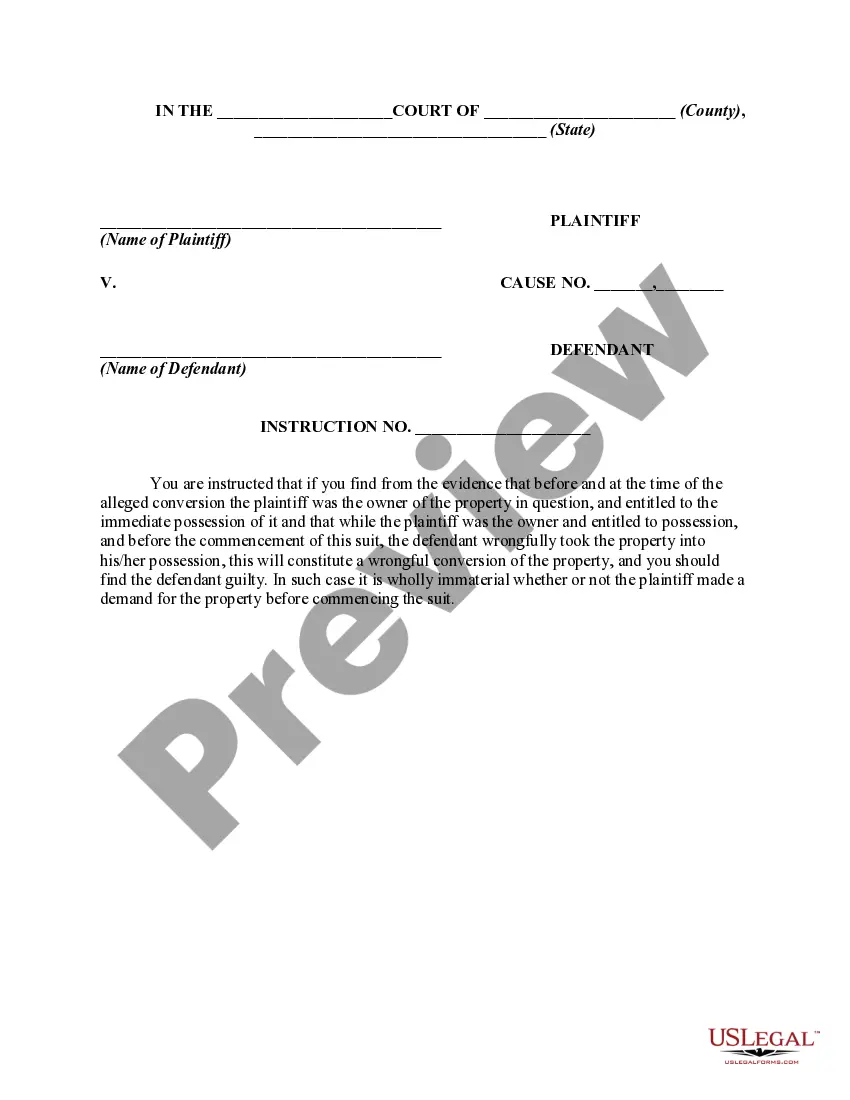
Instruction to Jury Regarding Goods Wrongfully Taken From Plaintiff as Conversion
Understanding this form
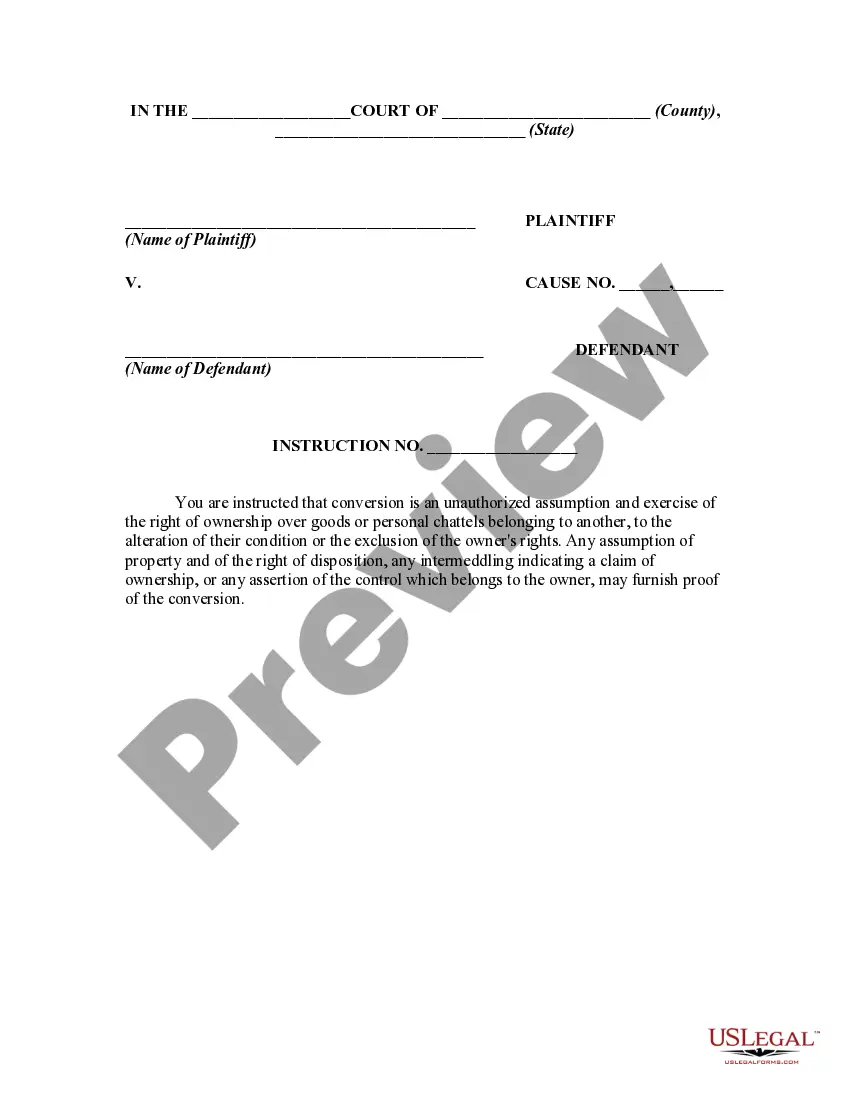
The Instruction to Jury Regarding Goods Wrongfully Taken From Plaintiff as Conversion is a legal document used to guide a jury on the applicable law in cases of wrongful conversion. This form explains the circumstances under which a defendant may be found guilty of unlawfully taking property from its rightful owner. Unlike other jury instructions, this specific form addresses issues related to conversion of goods, providing clarity on ownership rights and possession without requiring a demand for property before legal action is initiated.
What’s included in this form
- Identification of the plaintiff and defendant in the case.
- Instruction regarding ownership and entitlement to possession of the property.
- Clarification that wrongful taking constitutes conversion, irrespective of a demand.
- Directive to the jury on evaluating evidence related to the conversion claim.
Common use cases
This form should be used during jury trials involving claims of conversion, where a plaintiff asserts that the defendant has wrongfully taken personal property. You will find it applicable in scenarios where the ownership of the property is clear, and it is necessary to establish that the defendant's actions meet the legal definition of conversion.
Intended users of this form
- Judges presiding over civil cases involving claims of wrongful conversion.
- Legal practitioners involved in crafting jury instructions in such cases.
- Attorneys representing plaintiffs or defendants in conversion actions.
How to complete this form
- Identify and clearly state the names of the plaintiff and defendant involved in the case.
- Enter the cause number corresponding to the legal action.
- Provide the instruction number for clarity and reference during the trial.
- Ensure that all legal terms align with the definitions of ownership and conversion as specified in this instruction.
- Review the content for accuracy before submission to the judge for approval.
Does this document require notarization?
Notarization is not commonly needed for this form. However, certain documents or local rules may make it necessary. Our notarization service, powered by Notarize, allows you to finalize it securely online anytime, day or night.
Get your form ready online
Our built-in tools help you complete, sign, share, and store your documents in one place.
Make edits, fill in missing information, and update formatting in US Legal Forms—just like you would in MS Word.
Download a copy, print it, send it by email, or mail it via USPS—whatever works best for your next step.
Sign and collect signatures with our SignNow integration. Send to multiple recipients, set reminders, and more. Go Premium to unlock E-Sign.
If this form requires notarization, complete it online through a secure video call—no need to meet a notary in person or wait for an appointment.
We protect your documents and personal data by following strict security and privacy standards.

Make edits, fill in missing information, and update formatting in US Legal Forms—just like you would in MS Word.

Download a copy, print it, send it by email, or mail it via USPS—whatever works best for your next step.

Sign and collect signatures with our SignNow integration. Send to multiple recipients, set reminders, and more. Go Premium to unlock E-Sign.

If this form requires notarization, complete it online through a secure video call—no need to meet a notary in person or wait for an appointment.

We protect your documents and personal data by following strict security and privacy standards.
Mistakes to watch out for
- Failing to accurately identify parties involved can lead to confusion.
- Overlooking the necessity to clearly establish ownership may weaken the instruction.
- Neglecting to follow state-specific guidelines for jury instructions may affect the verdict.
Benefits of completing this form online
- Convenient access to legally drafted jury instructions anytime.
- Editable templates allow for customization to fit specific case needs.
- Reliability of using forms prepared by licensed attorneys.
Legal use & context
- This instruction guides jurors on legal standards for conversion in property disputes.
- It reinforces the principle that unlawful possession of an owner's property is a violation of rights.
- The form serves as an essential tool for ensuring justice is upheld in civil cases involving wrongful taking.
Looking for another form?

Form popularity
FAQ
Conversion is an intentional tort and involves one party taking away the other party's property by using it, or by altering the property in a way that is inconsistent with the rights of the owner.
Conversion is a tort that exposes you to liability for damages in a civil lawsuit. It applies when someone intentionally interferes with personal property belonging to another person.
Conversion can occur when someone, acting without your consent, does any of the following with your property: Takes and fails to return your property. Sells your property. Substantially changes your property, like cutting down trees to use the wood in construction.
Wrongful conversion is to protect you against loss following the purchase of a vehicle from someone who is not the true owner. Personal Accident and Assault. Personal Accident and Assault covers bodily injury to you or your employees as a result of an accident caused by theft or attempted theft.
When you want to reclaim the value of your personal property that was damaged or altered by some else's unauthorized use, you can file a lawsuit for conversion. This intentional tort is the civil law equivalent of a criminal theft charge.
The usual type of theft involves the taking of another's property. Theft by conversion occurs through the lawful taking of property and then converting it into income generated by some form of sale or trade. The crime of theft may be prosecuted in either or both criminal and civil court.
Conversion is the deprivation of another's right to use or possess personal property. A conversion occurs when a person without authority or permission intentionally takes the personal property of another or deprives another of possession of personal property.
In California, a plaintiff may seek both civil relief and criminal prosecution of an individual who has converted their property. However, since it is up to the local prosecutor to decide whether or not to press charges and file a criminal lawsuit, the plaintiff can only sue for damages using the civil court system.