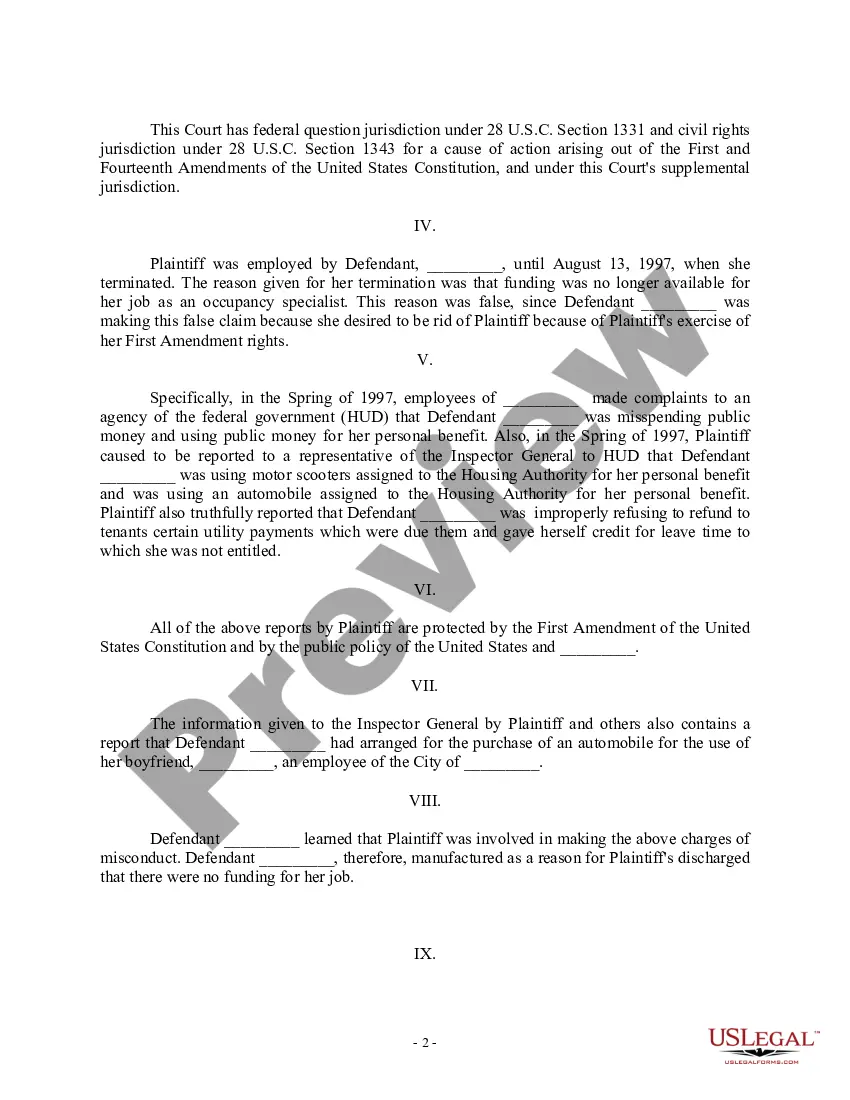
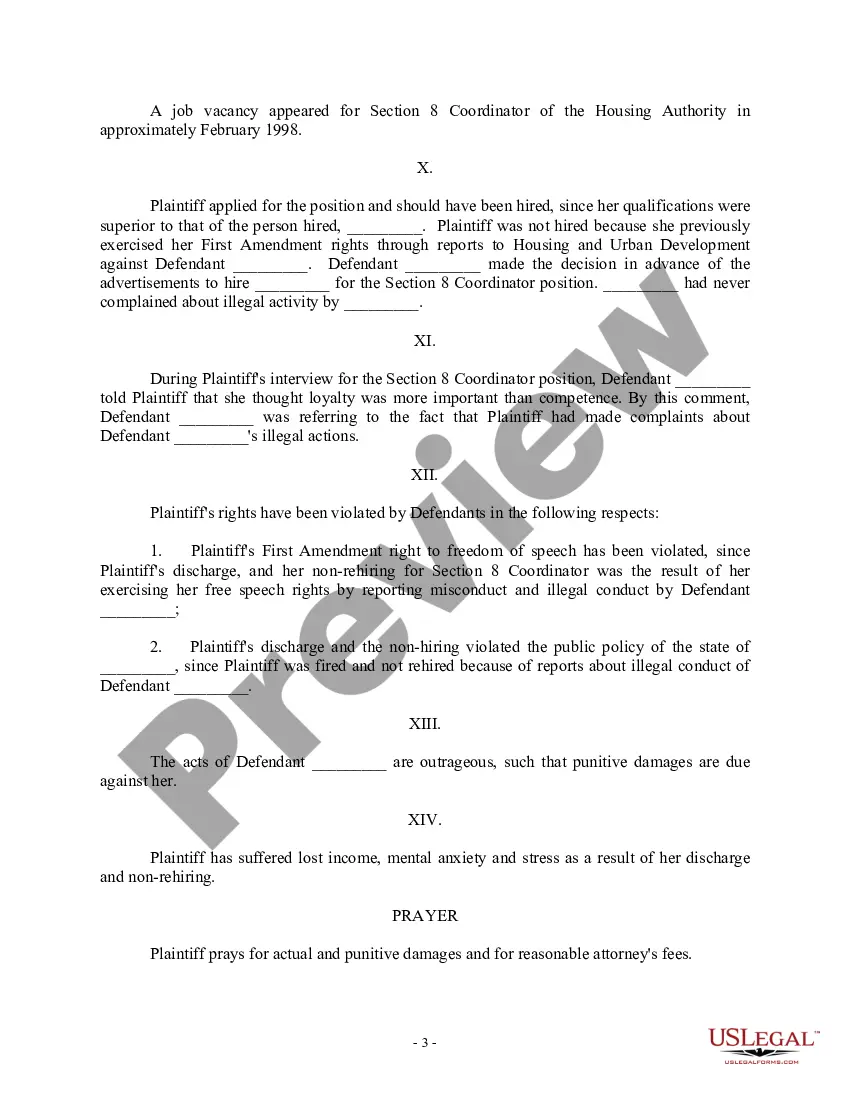
This form is a Complaint. This action is to recover damages for a violation of the First Amendment of the United States Constitution. The plaintiff is seeking punitive damages and reasonable attorney's fees.
Complaint for Violation of Civil Rights and for Wrongful Discharge and Failure To Rehire - 1st, 14th Amendments, US Constitution - Jury Trial Demand
Category:
State:
Multi-State
Control #:
US-000285
Format:
Word;
Rich Text
Instant download
Description
Free preview






How to fill out Complaint For Violation Of Civil Rights And For Wrongful Discharge And Failure To Rehire - 1st, 14th Amendments, US Constitution - Jury Trial Demand?
Get access to quality Complaint for Violation of Civil Rights and for Wrongful Discharge and Failure To Rehire - 1st, 14th Amendments, US Constitution - Jury Trial Demand templates online with US Legal Forms. Steer clear of hours of misused time looking the internet and lost money on files that aren’t updated. US Legal Forms gives you a solution to exactly that. Find around 85,000 state-specific legal and tax templates you can save and fill out in clicks in the Forms library.
To find the example, log in to your account and click on Download button. The document will be saved in two places: on your device and in the My Forms folder.
For those who don’t have a subscription yet, look at our how-guide below to make getting started easier:
- Verify that the Complaint for Violation of Civil Rights and for Wrongful Discharge and Failure To Rehire - 1st, 14th Amendments, US Constitution - Jury Trial Demand you’re considering is appropriate for your state.
- Look at the sample using the Preview function and read its description.
- Go to the subscription page by clicking Buy Now.
- Choose the subscription plan to go on to sign up.
- Pay out by credit card or PayPal to finish making an account.
- Pick a favored format to save the document (.pdf or .docx).
Now you can open the Complaint for Violation of Civil Rights and for Wrongful Discharge and Failure To Rehire - 1st, 14th Amendments, US Constitution - Jury Trial Demand example and fill it out online or print it and do it yourself. Take into account sending the file to your legal counsel to make sure things are completed properly. If you make a mistake, print out and fill sample once again (once you’ve created an account every document you download is reusable). Make your US Legal Forms account now and get much more samples.
Form popularity
FAQ
No Person shall be a Senator or Representative in Congress, or elector of President and Vice-President, or hold any office, civil or military, under the United States, or under any State, who, having previously taken an oath, as a member of Congress, or as an officer of the United States, or as a member of any State
Amendment XIV, Section 3 prohibits any person who had gone to war against the union or given aid and comfort to the nation's enemies from running for federal or state office, unless Congress by a two-thirds vote specifically permitted it.
No State shall make or enforce any law which shall abridge the privileges or immunities of citizens of the United States; nor shall any State deprive any person of life, liberty, or property, without due process of law; nor deny to any person within its jurisdiction the equal protection of the laws.
Passed by the Senate on June 8, 1866, and ratified two years later, on July 9, 1868, the Fourteenth Amendment granted citizenship to all persons "born or naturalized in the United States," including formerly enslaved people, and provided all citizens with equal protection under the laws, extending the provisions of
The 14th Amendment to the U.S. Constitution, ratified in 1868, granted citizenship to all persons born or naturalized in the United Statesincluding former enslaved peopleand guaranteed all citizens equal protection of the laws. One of three amendments passed during the Reconstruction era to abolish slavery and
The 14th Amendment to the U.S. Constitution, ratified in 1868, granted citizenship to all persons born or naturalized in the United Statesincluding former enslaved peopleand guaranteed all citizens equal protection of the laws. One of three amendments passed during the Reconstruction era to abolish slavery and
The 14th Amendment contained three major provisions: The Citizenship Clause granted citizenship to All persons born or naturalized in the United States. The Due Process Clause declared that states may not deny any person "life, liberty or property, without due process of law."
The Constitution confers on the U.S. Senate legislative, executive, and judicial powers.Finally, Article I, Section 3 also gives the Senate the exclusive judicial power to try all cases of impeachment of the President, the Vice President, or any other civil officer of the United States.