Declare None - Resolution Form - Corporate Resolutions
Overview of this form
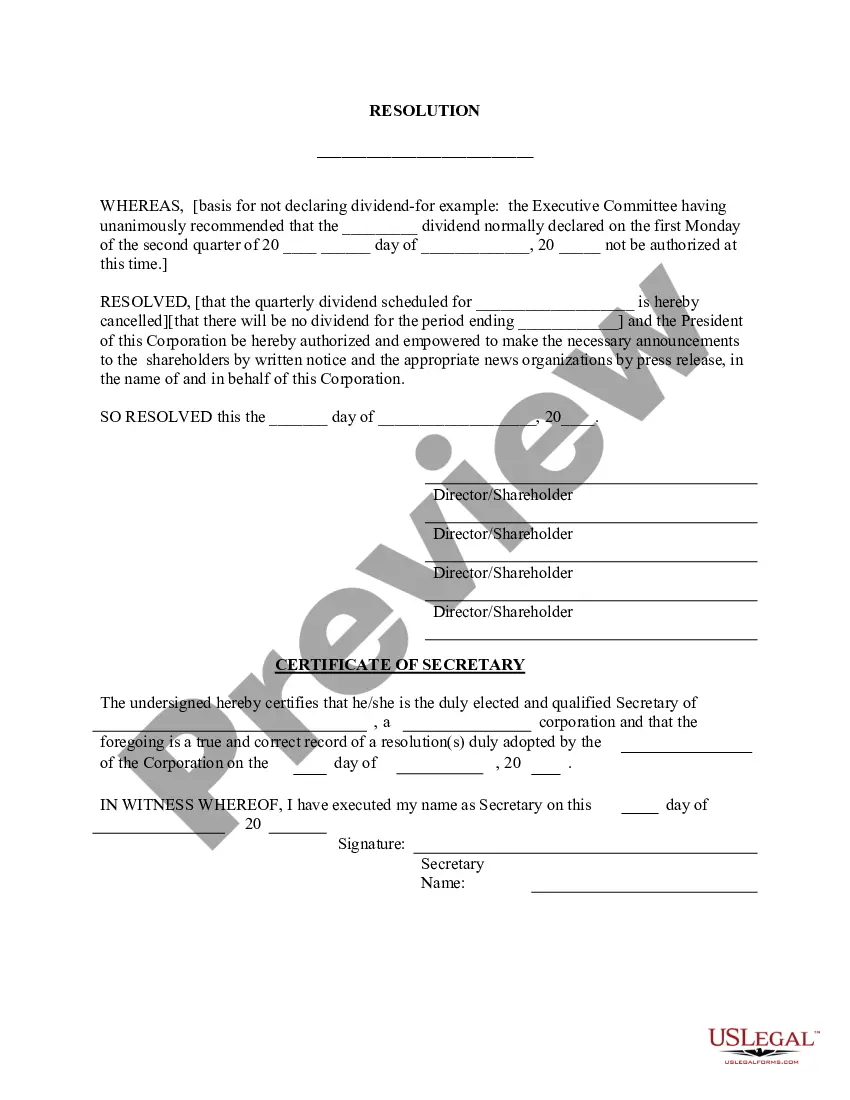
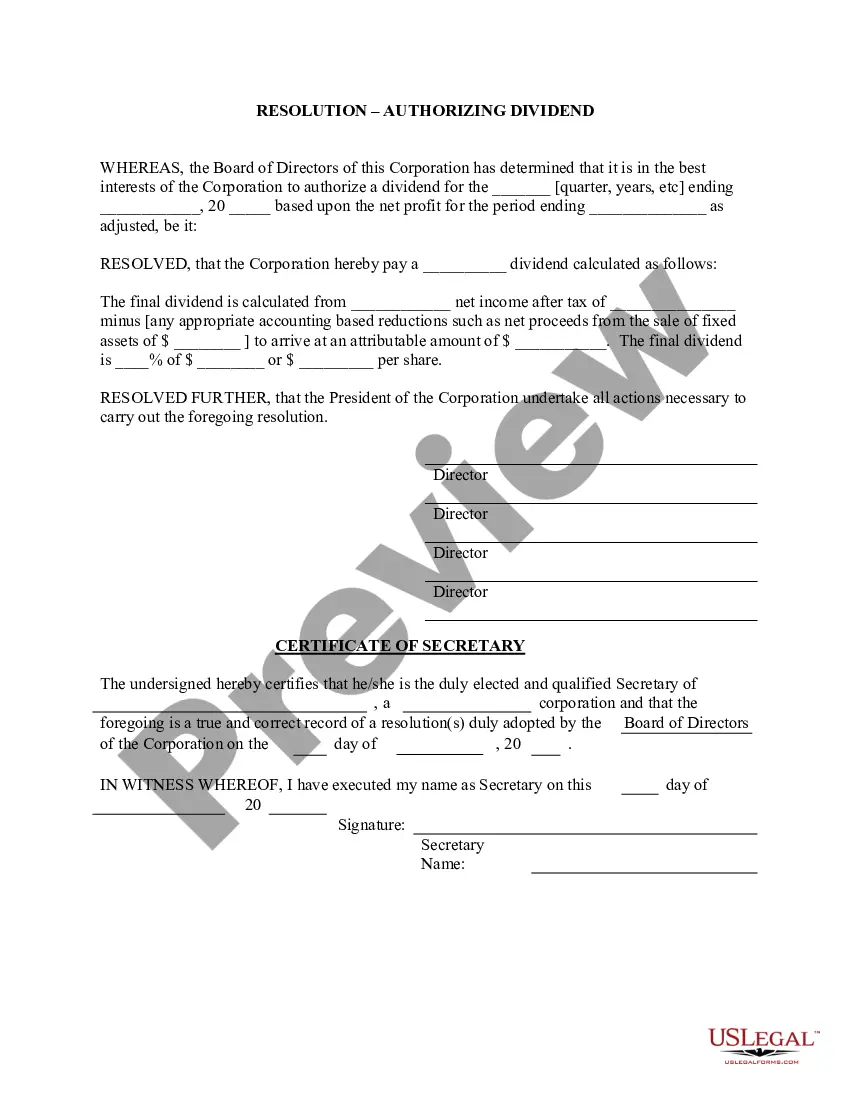
The Declare None - Resolution Form, also known as the Corporate Resolutions form, is a legal document that allows the directors of a corporation to officially authorize the decision not to pay a dividend to shareholders. This form is essential for maintaining clear records of corporate decisions and differs from other financial resolutions by specifically addressing the cancellation of dividend payments rather than their approval or distribution.
Key parts of this document
- WHEREAS clause explaining the reason for not declaring a dividend.
- Resolution statement confirming the cancellation of the scheduled dividend.
- Authorization for the President of the corporation to notify shareholders and press.
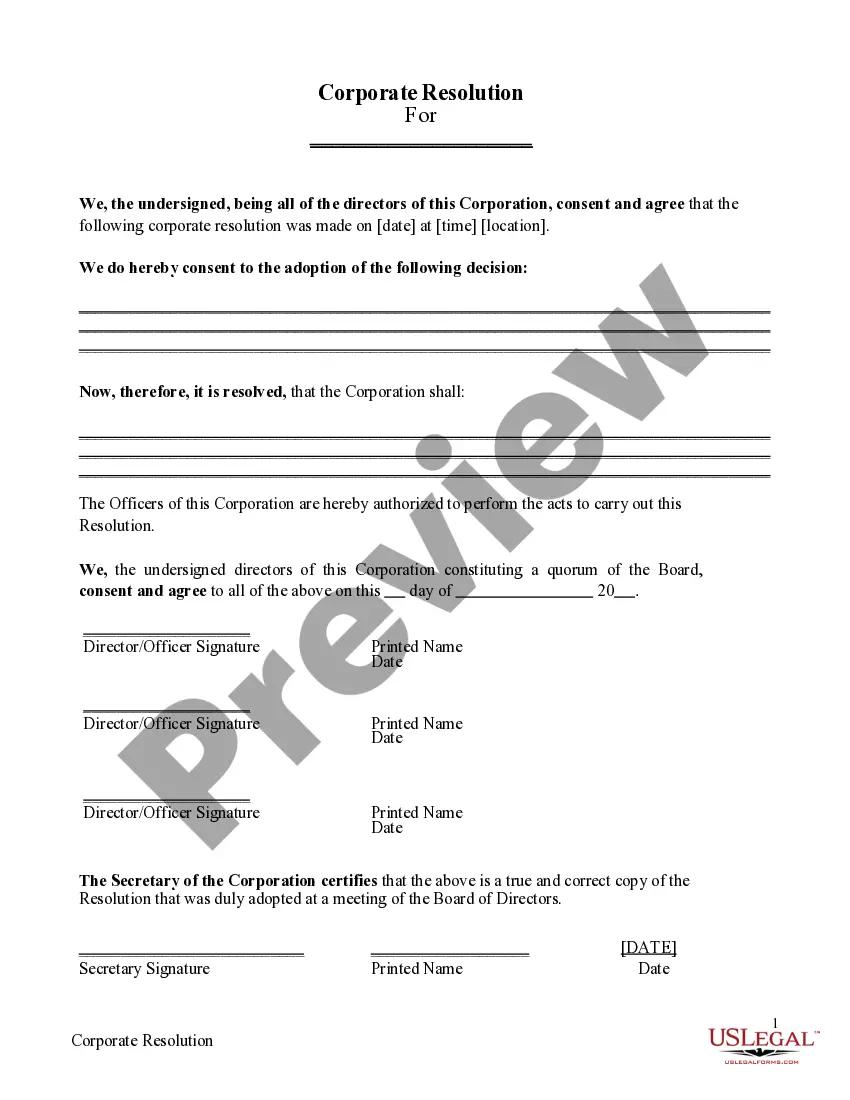
- Signature lines for directors or shareholders involved in the resolution.
- Certification section for the Secretary to verify the resolution's adoption.

When to use this form
This form should be used when a corporation's directors determine that it is not in the company's best interest to pay dividends during a specific period. It is particularly useful in scenarios where economic conditions, corporate strategy, or cash flow considerations warrant the suspension of dividend payments.
Who can use this document
- Corporate directors looking to officially document a resolution on dividend payments.
- Corporations managing financial decisions and maintaining legal compliance.
- Officers of a corporation responsible for communicating with shareholders.
Steps to complete this form
- Identify the reasons for not declaring a dividend and include them in the WHEREAS clause.
- Specify the date of the cancelled quarterly dividend in the resolution statement.
- Have the directors or shareholders sign the document to approve the resolution.
- Ensure the President is authorized to communicate this decision to shareholders and media.
- The Secretary should complete and sign the certificate section to verify the resolution's adoption.
Does this document require notarization?
This form does not typically require notarization unless specified by local law. It is recommended to check any additional state requirements that may apply.
Get your form ready online
Our built-in tools help you complete, sign, share, and store your documents in one place.
Make edits, fill in missing information, and update formatting in US Legal Forms—just like you would in MS Word.
Download a copy, print it, send it by email, or mail it via USPS—whatever works best for your next step.
Sign and collect signatures with our SignNow integration. Send to multiple recipients, set reminders, and more. Go Premium to unlock E-Sign.
If this form requires notarization, complete it online through a secure video call—no need to meet a notary in person or wait for an appointment.
We protect your documents and personal data by following strict security and privacy standards.

Make edits, fill in missing information, and update formatting in US Legal Forms—just like you would in MS Word.

Download a copy, print it, send it by email, or mail it via USPS—whatever works best for your next step.

Sign and collect signatures with our SignNow integration. Send to multiple recipients, set reminders, and more. Go Premium to unlock E-Sign.

If this form requires notarization, complete it online through a secure video call—no need to meet a notary in person or wait for an appointment.

We protect your documents and personal data by following strict security and privacy standards.
Common mistakes to avoid
- Failing to include a clear reason in the WHEREAS clause.
- Not obtaining necessary signatures from all directors or shareholders.
- Neglecting to date the resolution properly.
Advantages of online completion
- Convenience of immediate access and download without the need to visit a lawyer.
- Editability allows customization to fit specific corporate needs.
- Reliability of having a professionally drafted document that adheres to legal standards.
Legal use & context
- This resolution is an official document that is necessary for reflecting corporate decisions in financial records.
- It provides legal protection by documenting the non-payment of dividends and justifications in case of future disputes.
Key takeaways
- The Declare None - Resolution Form is essential for officially documenting the decision to withhold dividends.
- It requires signatures from the corporationâs directors and must include a rationale for the decision.
- Using this form provides both clarity and legal protection regarding corporate financial decisions.
Looking for another form?

Form popularity
FAQ
The name of the organization; The maximum and minimum loan amounts; The names, titles, and signatures of four officers referred to this Resolution; The place of the meeting during which the Resolution was adopted; The exact date of that meeting;
Format the resolution by putting the date and resolution number at the top. Form a title of the resolution that speaks to the issue that you want to document. Use formal language in the body of the resolution, beginning each new paragraph with the word, whereas.
A corporate resolution is generally required to document actions taken by the corporation, but when it comes to LLCs, resolutions are not mandated. Because of this, there is no specific or required way to draft an LLC resolution.
A corporate resolution form is used by a board of directors. Its purpose is to provide written documentation that a business is authorized to take specific action. This form is most often used by limited liability companies, s-corps, c-corps, and limited liability partnerships.
Format the resolution by putting the date and resolution number at the top. Form a title of the resolution that speaks to the issue that you want to document. Use formal language in the body of the resolution, beginning each new paragraph with the word, whereas.
No need to notarize a corporate resolution.
A corporate resolution is a written document created by the board of directors of a company detailing a binding corporate action. A corporate resolution is the legal document that provides the rules and framework as to how the board can act under various circumstances.
A corporate resolution is a document that formally records the important binding decisions into which a company enters. These decisions are made by such stakeholders as the corporation's managers, directors, officers or owners.