Texas Storage Business Package
What is this form package?
The Texas Storage Business Package is a comprehensive collection of legal forms specifically tailored for storage business owners in Texas. This package includes essential agreements and notices designed to help manage storage services effectively while minimizing potential litigation risks. Unlike generic legal form packages, this package focuses on the unique needs of storage businesses, encompassing various property types and addressing customer defaults.
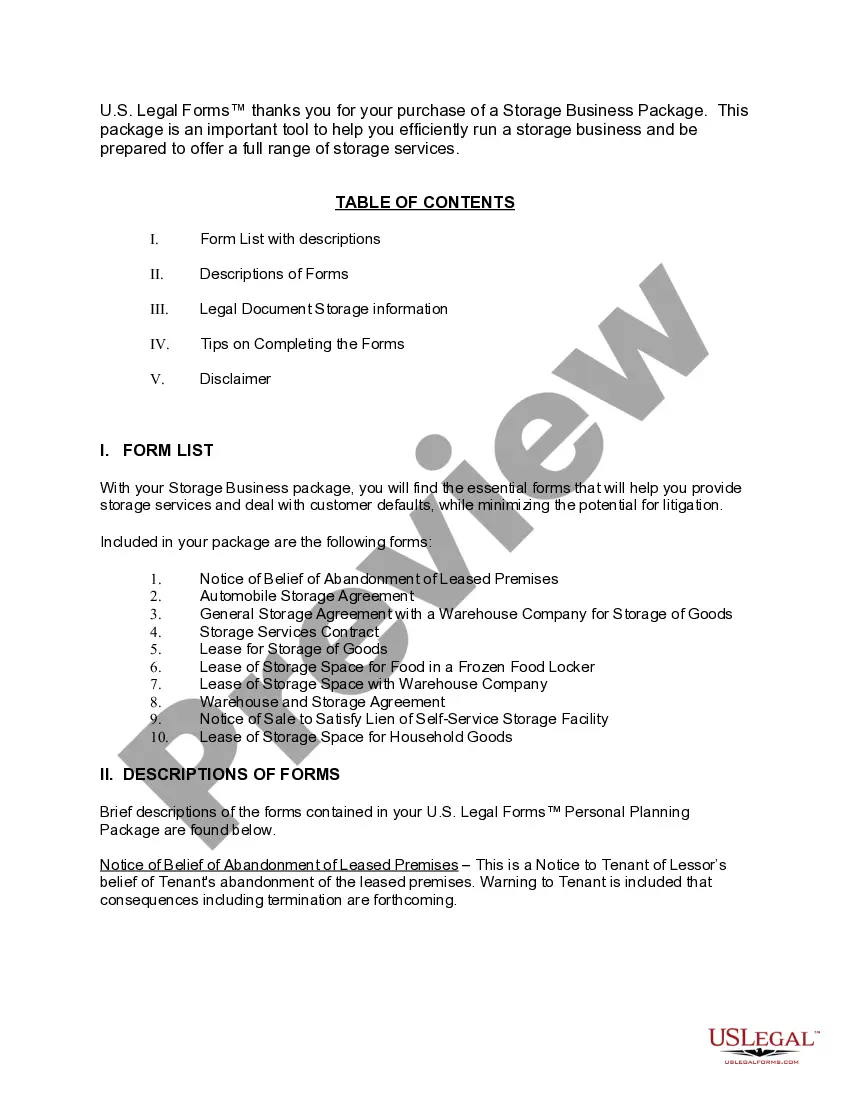
Forms included in this package
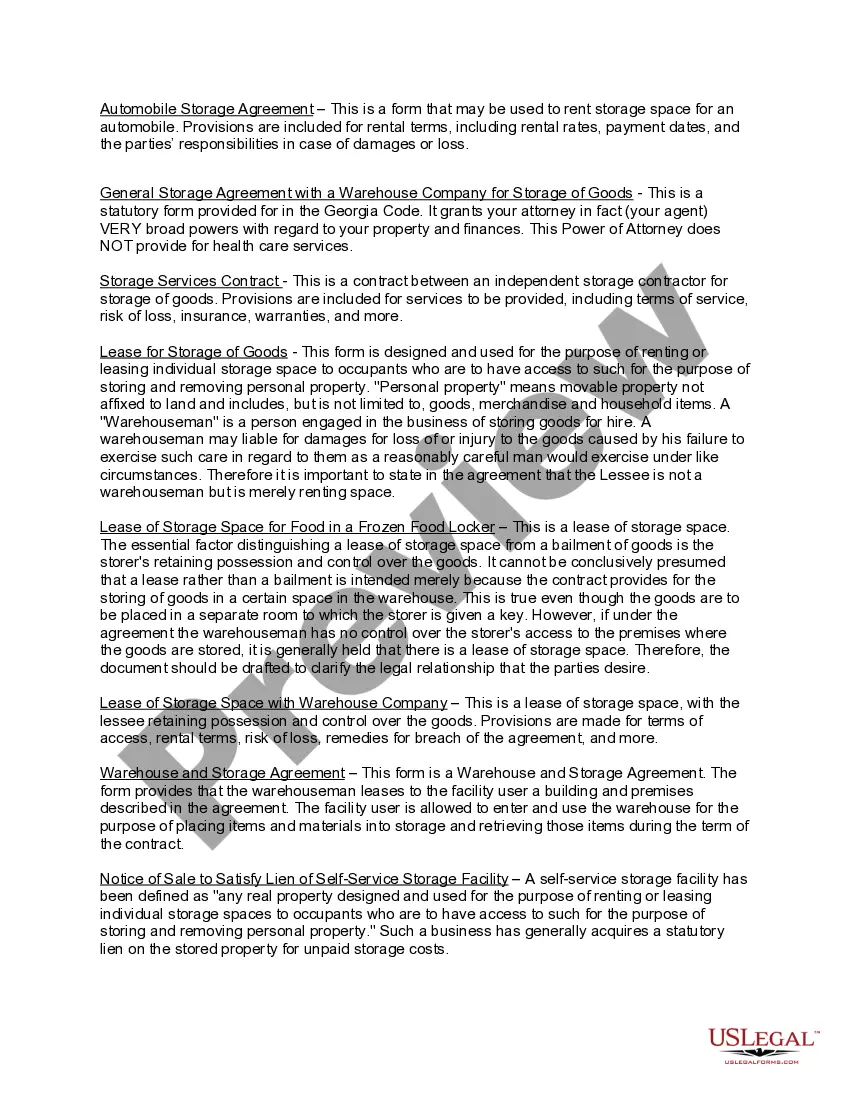
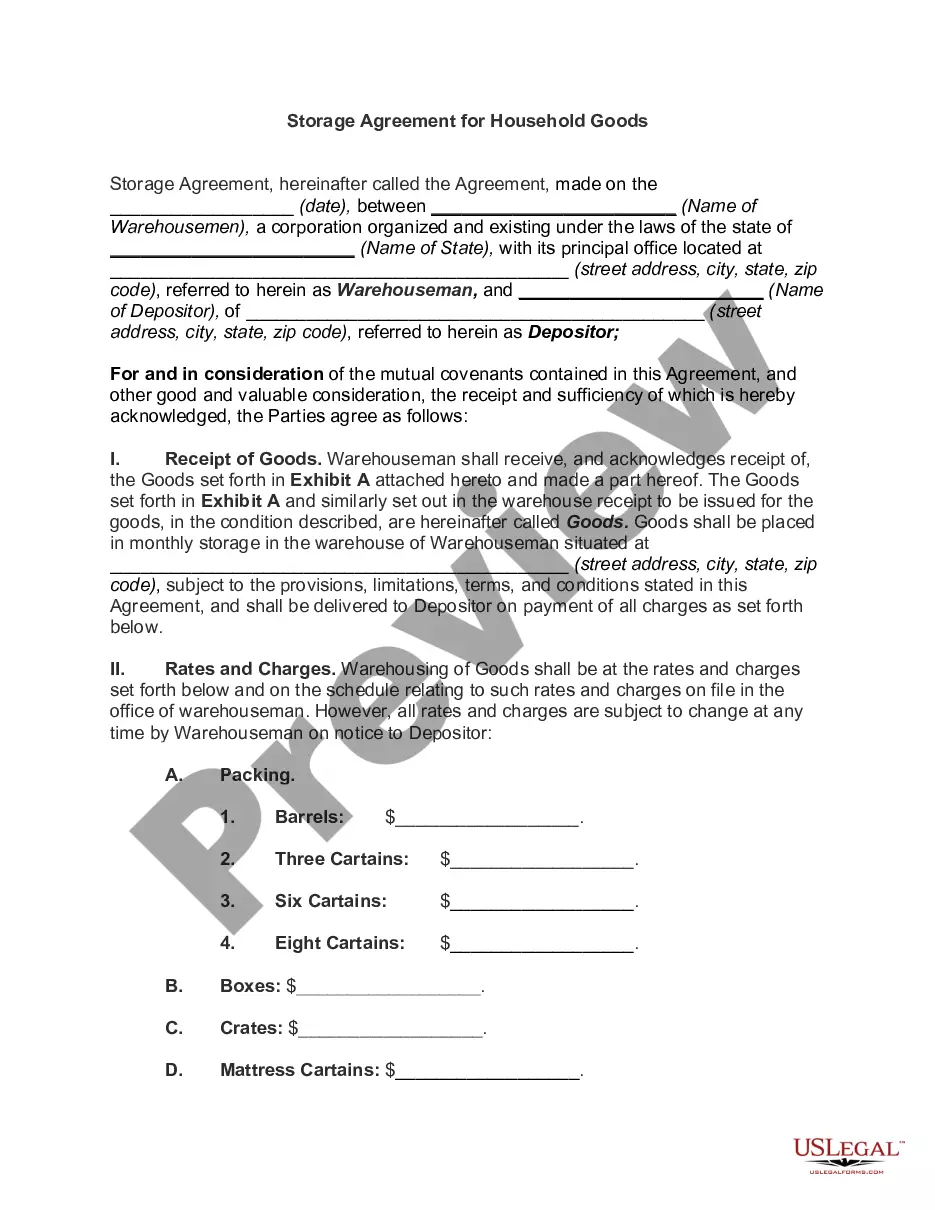
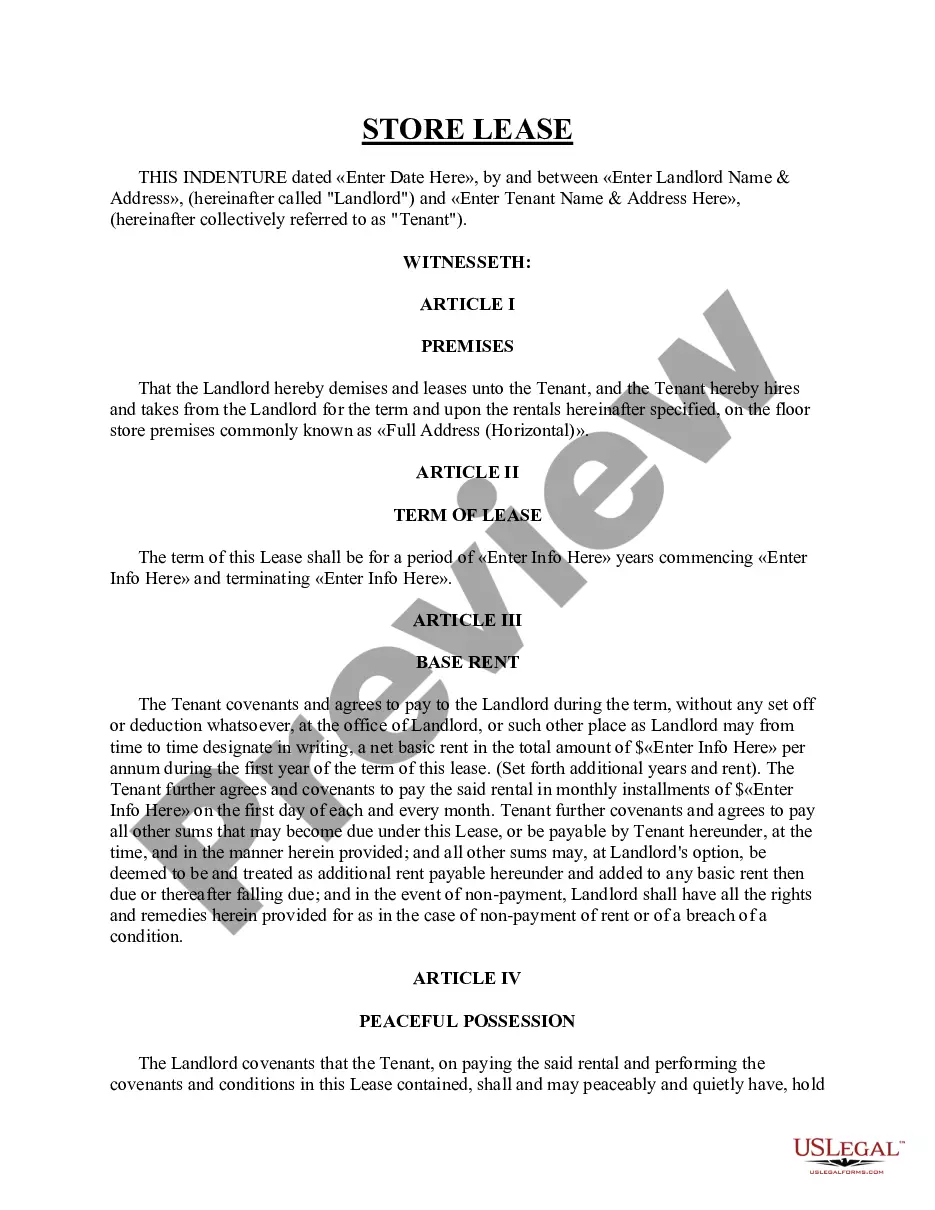
- Lease for Storage of Goods
- Notice of Sale to Satisfy Lien of Self-Service Storage Facility
- Automobile Storage Agreement
- Lease of Storage Space for Food in a Frozen Food Locker
- Lease of Storage Space with Warehouse Company
- General Storage Agreement with a Warehouse Company for Storage of Goods
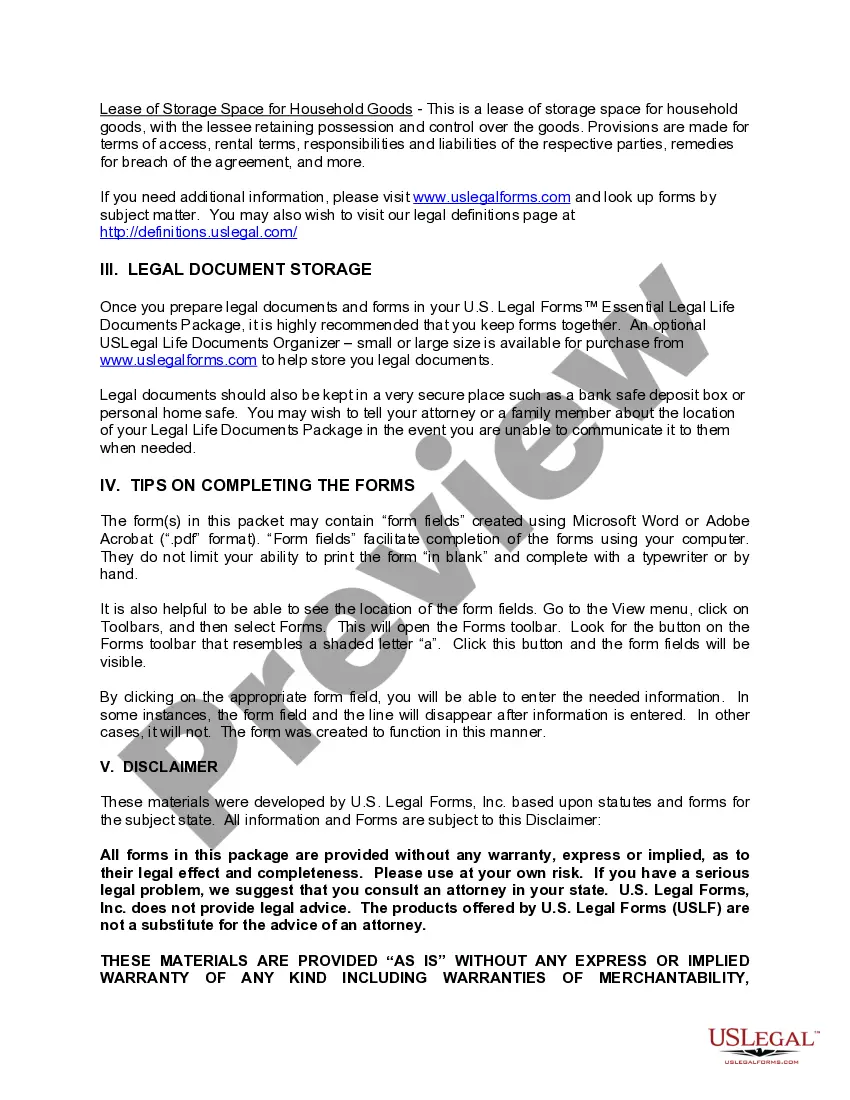
- Lease of Storage Space for Household Goods
- Warehouse and Storage Agreement
- Notice of Belief of Abandonment of Leased Premises
- Storage Services Contract - Self-Employed

When this form package is needed
This form package is beneficial in several real-world scenarios, including:
- When starting a new storage business and needing to establish legal contracts with customers.
- When handling situations involving abandoned property or customer defaults.
- When leasing space for different types of goods, including automobiles and food items.
- When needing to enforce a lien on unpaid storage fees.
Who can use this document
- Storage facility owners and operators in Texas.
- Legal professionals assisting clients in the storage business.
- Individuals looking to enter into storage agreements.
- Businesses seeking to formalize contracts for storing various types of goods.
Completing these forms step by step
- Review the included forms thoroughly to understand their purpose.
- Identify the parties involved in the agreements.
- Enter applicable details, such as rental terms and conditions.
- Ensure all necessary parties sign the agreements where required.
- Store completed forms in a secure location for future reference.
Do documents in this package require notarization?
Notarization is not commonly needed for forms in this package. However, if your state’s laws require it, our notarization service, powered by Notarize, allows you to finalize documents online 24/7 without in-person visits.
Get your form ready online
Our built-in tools help you complete, sign, share, and store your documents in one place.
Make edits, fill in missing information, and update formatting in US Legal Forms—just like you would in MS Word.
Download a copy, print it, send it by email, or mail it via USPS—whatever works best for your next step.
Sign and collect signatures with our SignNow integration. Send to multiple recipients, set reminders, and more. Go Premium to unlock E-Sign.
If this form requires notarization, complete it online through a secure video call—no need to meet a notary in person or wait for an appointment.
We protect your documents and personal data by following strict security and privacy standards.

Make edits, fill in missing information, and update formatting in US Legal Forms—just like you would in MS Word.

Download a copy, print it, send it by email, or mail it via USPS—whatever works best for your next step.

Sign and collect signatures with our SignNow integration. Send to multiple recipients, set reminders, and more. Go Premium to unlock E-Sign.

If this form requires notarization, complete it online through a secure video call—no need to meet a notary in person or wait for an appointment.

We protect your documents and personal data by following strict security and privacy standards.
Common mistakes
- Failing to provide accurate details about the property being stored.
- Not specifying the terms of access and rental rates clearly.
- Overlooking required signatures from all parties involved.
- Neglecting to store completed forms securely, increasing the risk of loss or misuse.
Benefits of completing this package online
- Convenience of downloading forms at any time without needing a legal office visit.
- Editability allows customization to meet specific business needs quickly.
- Access to professionally drafted documents ensures adherence to legal standards.
Legal use & context
Using these forms ensures that storage agreements are legally binding and comply with Texas state laws. Proper documentation protects both storage owners and clients, minimizing disputes and facilitating clear understanding of responsibilities.
Summary of main points
- The Texas Storage Business Package is essential for legal compliance in storage operations.
- A comprehensive set of forms helps manage various aspects of storage agreements.
- Correct usage of these forms can significantly reduce litigation risks.
Looking for another form?
Form popularity
FAQ
The average self storage cap rate is 6.5% and that compares to the 10-year Treasury at 1.6% and compressed multifamily cap rates of 5.5%. As an investor, if you move from a lower cap rate multifamily into self storage, you can be rewarded by the difference in cap rates by over 100 basis points.
Unlike other real estate rentals, the occupancy rate for mini storage facilities is much lower, with a break-even point at 40-45% occupancy. From 1994 to 2017, self-storage facilities averaged an annual return on investment of 17.43%, significantly higher than office, retail, residential or apartment spaces.
For many real estate investors, self-storage is an appealing asset class because it has large income potential with low overhead, fewer construction costs than other commercial real estate (CRE) sectors, and relatively low ongoing management.Cash flow with large income potential.
Divide your net operating income (NOI) by the cap rate to calculate your property value. This reflects your income stream, which is an important consideration in determining a sale price for your self-storage facility.
STEP 1: Plan your business. STEP 2: Form a legal entity. STEP 3: Register for taxes. STEP 4: Open a business bank account & credit card. STEP 5: Set up business accounting. STEP 6: Obtain necessary permits and licenses. STEP 7: Get business insurance.
The Cost of Construction Once you begin construction of the building, if you're going to build single story units, you can expect to pay $25 to $40 per square foot you build. If you want a multi-story building, costs will be around $42 to $70 per square foot.
Typically, a self-storage facility still makes a profit at 60% to 70% of full occupancy. Currently, the industry average occupancy stands near 90%, according to Statista. Nevertheless, experts say it takes one to two years to reach 90% capacity. Many self-storage owners run family operations.
Divide your net operating income (NOI) by the cap rate to calculate your property value. This reflects your income stream, which is an important consideration in determining a sale price for your self-storage facility.