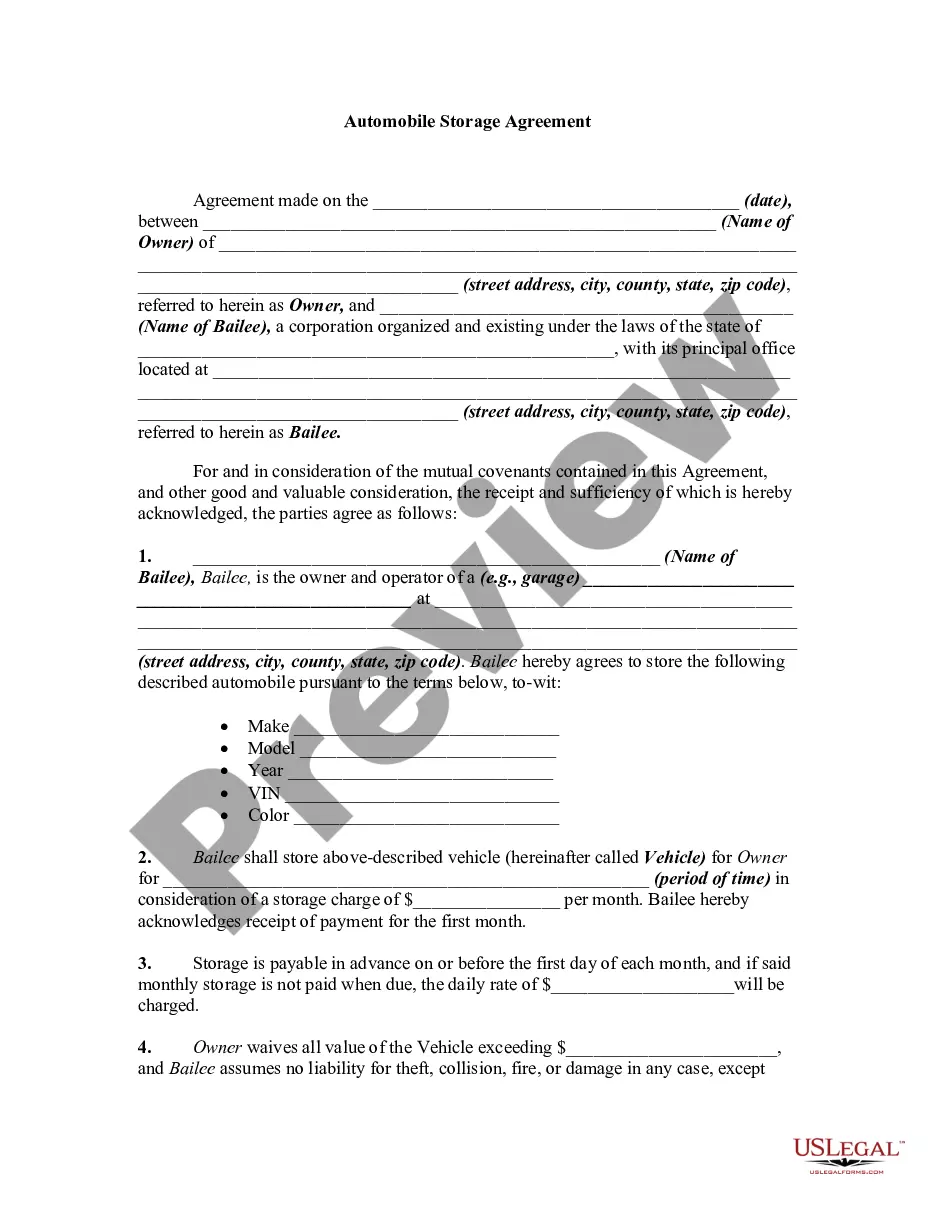
Automobile Storage Agreement
Understanding this form
The Automobile Storage Agreement is a legal document that outlines the terms under which a vehicle owner (Owner) entrusts their automobile to a storage provider (Bailee). This form establishes a bailment relationship, where the Bailee is responsible for the care and return of the vehicle. It is essential for defining the obligations of both parties, distinguishing it from other types of agreements, such as rental or lease agreements, which may include different terms of use and liability.
What’s included in this form
- Identification of the parties involved: Owner and Bailee.
- Description of the vehicle being stored, including make, model, year, and VIN.
- Storage duration and payment terms, including monthly charges and penalties for late payment.
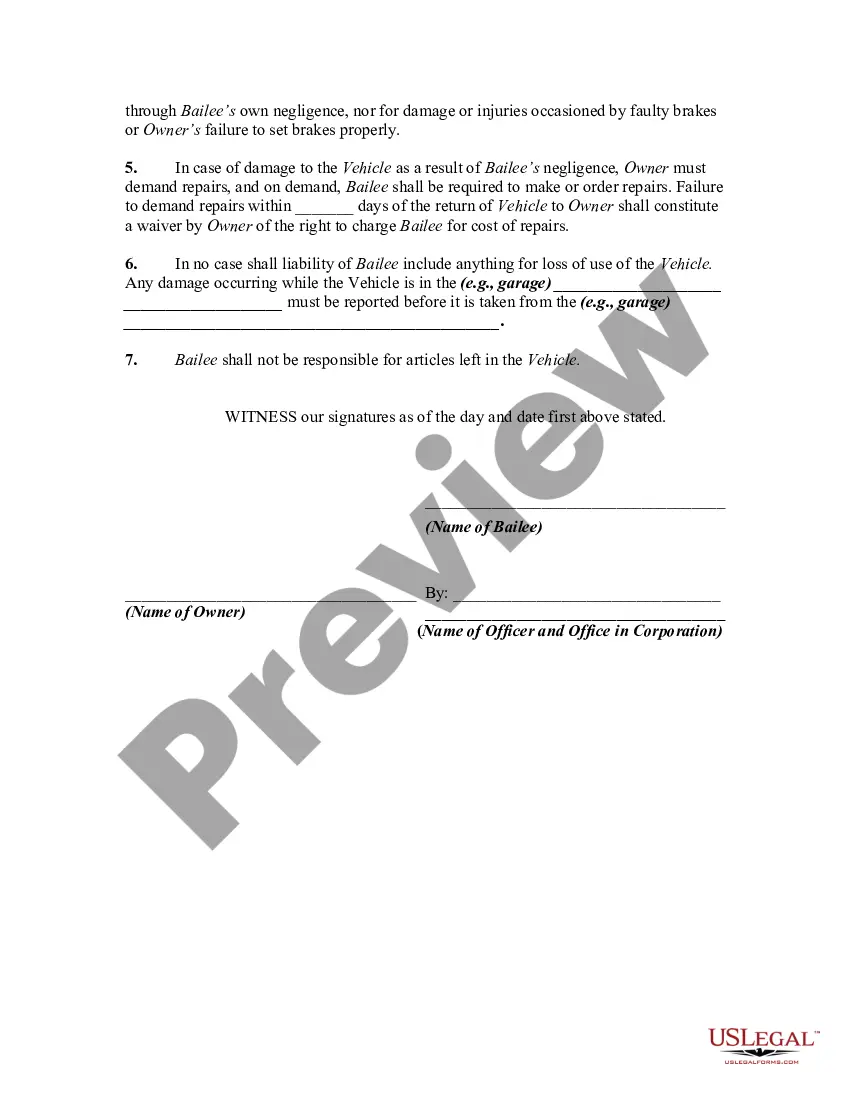
- Liability limitations for damages, theft, and loss.
- Terms regarding the ownerâs responsibilities for the vehicleâs condition.
Situations where this form applies
This form is useful when a vehicle owner needs to store their vehicle in a garage or storage facility. It is appropriate in scenarios where the vehicle owner wants to protect their interests by specifying clear terms about the care and handling of the vehicle. Common situations for using this agreement include seasonal vehicle storage, temporary relocation, or when needing secure storage during repairs.
Who should use this form
This form is suitable for:
- Individuals or businesses needing to store a vehicle temporarily.
- Storage facility owners who require a formal agreement with vehicle owners.
- Anyone looking to clarify responsibilities and liabilities associated with vehicle storage.
Instructions for completing this form
- Identify and enter the names and addresses of both the Owner and Bailee at the start of the agreement.
- Provide a detailed description of the vehicle, including its make, model, year, VIN, and color.
- Specify the storage duration and payment terms, including monthly charges and any penalties for late payment.
- Review and agree on liability limitations and responsibilities regarding vehicle damage.
- Sign the agreement and have it dated to complete the process.
Notarization requirements for this form
This form does not typically require notarization unless specified by local law. However, having it notarized can add an extra layer of authenticity to the agreement.
Get your form ready online
Our built-in tools help you complete, sign, share, and store your documents in one place.
Make edits, fill in missing information, and update formatting in US Legal Forms—just like you would in MS Word.
Download a copy, print it, send it by email, or mail it via USPS—whatever works best for your next step.
Sign and collect signatures with our SignNow integration. Send to multiple recipients, set reminders, and more. Go Premium to unlock E-Sign.
If this form requires notarization, complete it online through a secure video call—no need to meet a notary in person or wait for an appointment.
We protect your documents and personal data by following strict security and privacy standards.

Make edits, fill in missing information, and update formatting in US Legal Forms—just like you would in MS Word.

Download a copy, print it, send it by email, or mail it via USPS—whatever works best for your next step.

Sign and collect signatures with our SignNow integration. Send to multiple recipients, set reminders, and more. Go Premium to unlock E-Sign.

If this form requires notarization, complete it online through a secure video call—no need to meet a notary in person or wait for an appointment.

We protect your documents and personal data by following strict security and privacy standards.
Avoid these common issues
- Failing to accurately describe the vehicle, which could lead to disputes.
- Not specifying the duration of storage, causing confusion about the agreement's validity.
- Overlooking the liability limitations, which can impact a party's legal recourse in case of damage.
Why use this form online
- Instant access to a legally-sound document crafted by licensed attorneys.
- Editable format, allowing customization based on individual needs.
- Time-saving convenience without the need for in-person visits or meetings.
Legal use & context
- This agreement serves as a binding contract that helps establish mutual responsibilities between the Owner and Bailee.
- It helps in limiting the Baileeâs liability, clearly outlining their responsibilities regarding vehicle care.
- Failure to comply with the terms could result in enforceable claims for damages or other remedies under state law.
Quick recap
- The Automobile Storage Agreement is essential for formalizing the storage of vehicles and defining liability.
- Key components include detailed descriptions of the vehicle, payment terms, and responsibilities of both parties.
- Understanding and complying with state-specific regulations is vital for the legality of the agreement.
Looking for another form?


Form popularity
FAQ
While the cost to store a car or RV can range anywhere between $45 and $450 per month, depending on the size. Climate controlled storage may cost an additional $50 per month.
Use an all-weather car cover if you cannot leave your car in a garage. Get the car washed and waxed before placing it in storage. Be sure to fill up the gas tank and add a gas stabilizer if you will be storing the car for more than 30 days. Use a battery tender to avoid having to jump-start the battery.
Your full size automobiles will require a minimum depth of 20 feet (for example, a 10x20, 10x25, or 10x30 size unit). You also need to measure the height for pickup trucks, sport utility vehicles.
While the cost to store a car or RV can range anywhere between $45 and $450 per month, depending on the size. Climate controlled storage may cost an additional $50 per month.
For smaller vehicles, a 10x10 or 10x15 storage unit is your go-to because it's very similar in size to a one-car garage.Ranging from $80-$105 per month, a 10x10 storage unit will fit your vehicle perfectly.
No, unfortunately working on a car in a storage unit is prohibited. Working on cars on site creates issues with oil and fluid spills. Lack of electricity, noise, smoke, and odors are all factors that affect other customers. Get all engine maintenance done off-site before storing your vehicle in a storage unit.
Can you store a car in a storage unit? Yes, you can! Drive-up storage units provide an indoor, garage-like storage space for cars. With varying unit sizes available at Extra Space Storage locations, anything from a compact car to a large pickup truck or commercial cargo van can be stored in these units.
A garage is an ideal place to store a vehicle. This will protect it from the elements and keep it at a temperature that's relatively stable. If you don't have a garage and you can find accommodation at a reasonable price, consider putting the car in a public storage facility.
A 10 x 15 storage space is good for compact cars, such as: A 10 x 20 storage space is ideal for storing several commonly used vehicles, such as: A 10 x 25 storage space is good for most bigger vehicles, such as: