South Carolina Permanent Restraining Order
What is this form?
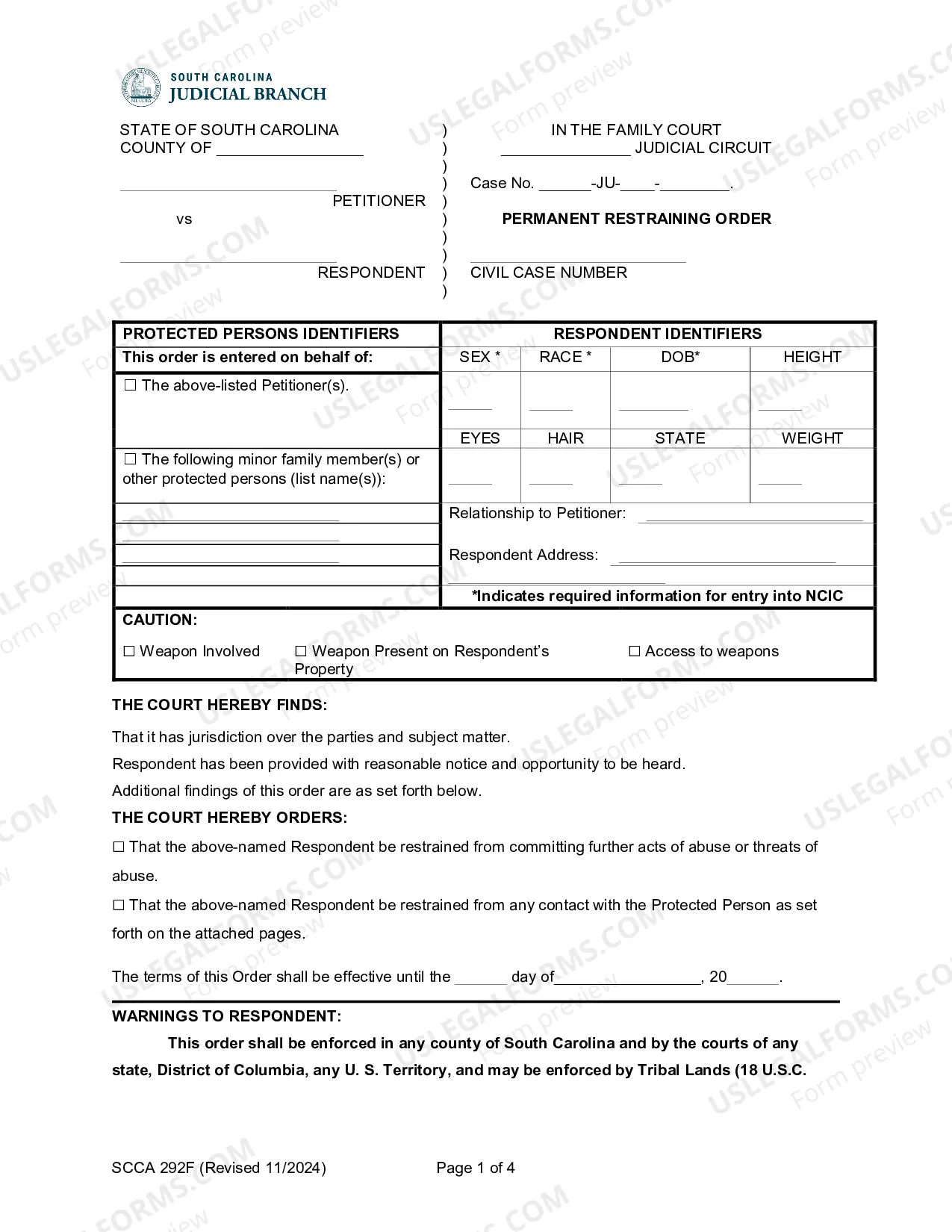
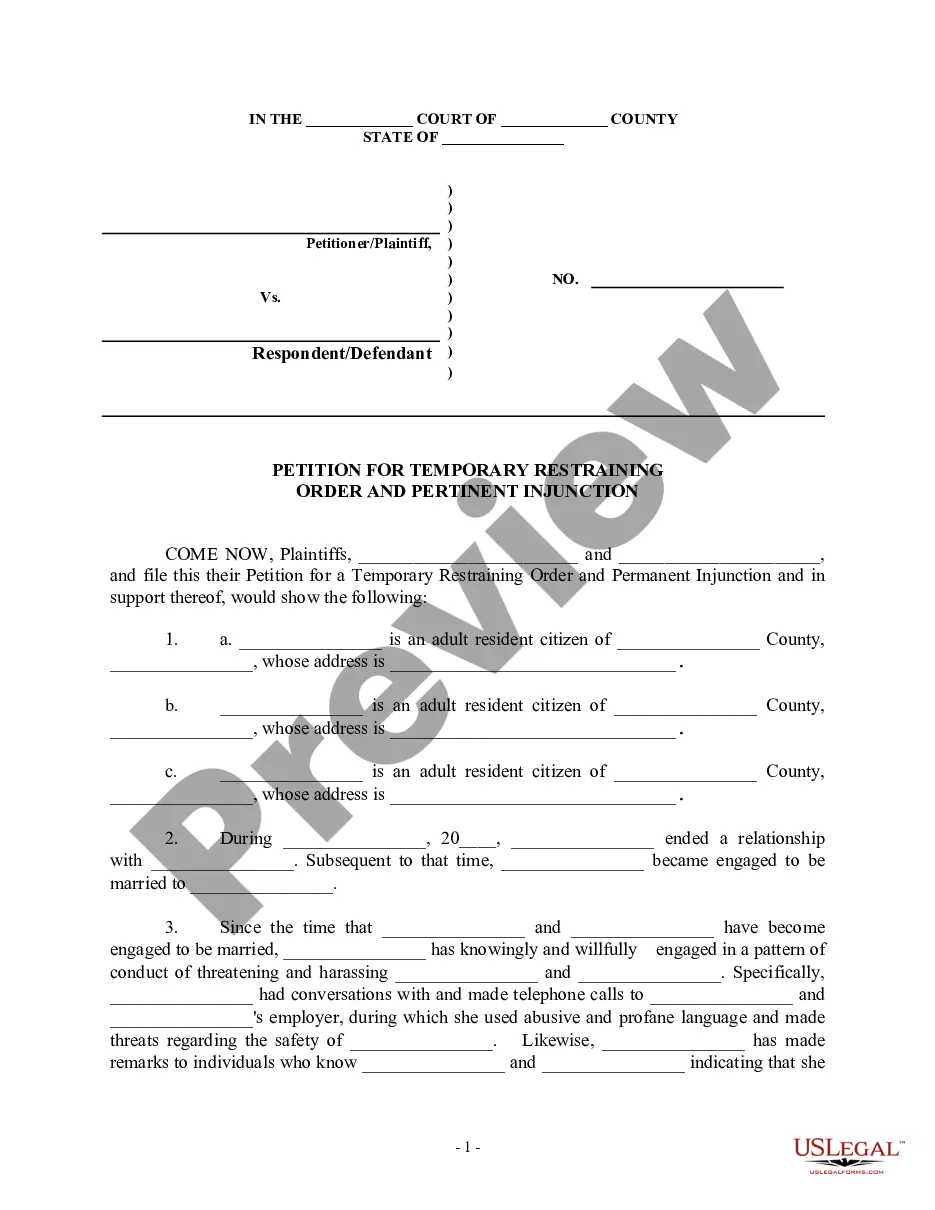
The Permanent Restraining Order is a legal document issued by a court to protect an individual from harassment, abuse, or threats. This order restricts the respondent from contacting or approaching the complainant, ensuring their safety and well-being. Unlike temporary restraining orders, a permanent restraining order typically remains in effect until formally lifted or modified by the court.
Main sections of this form
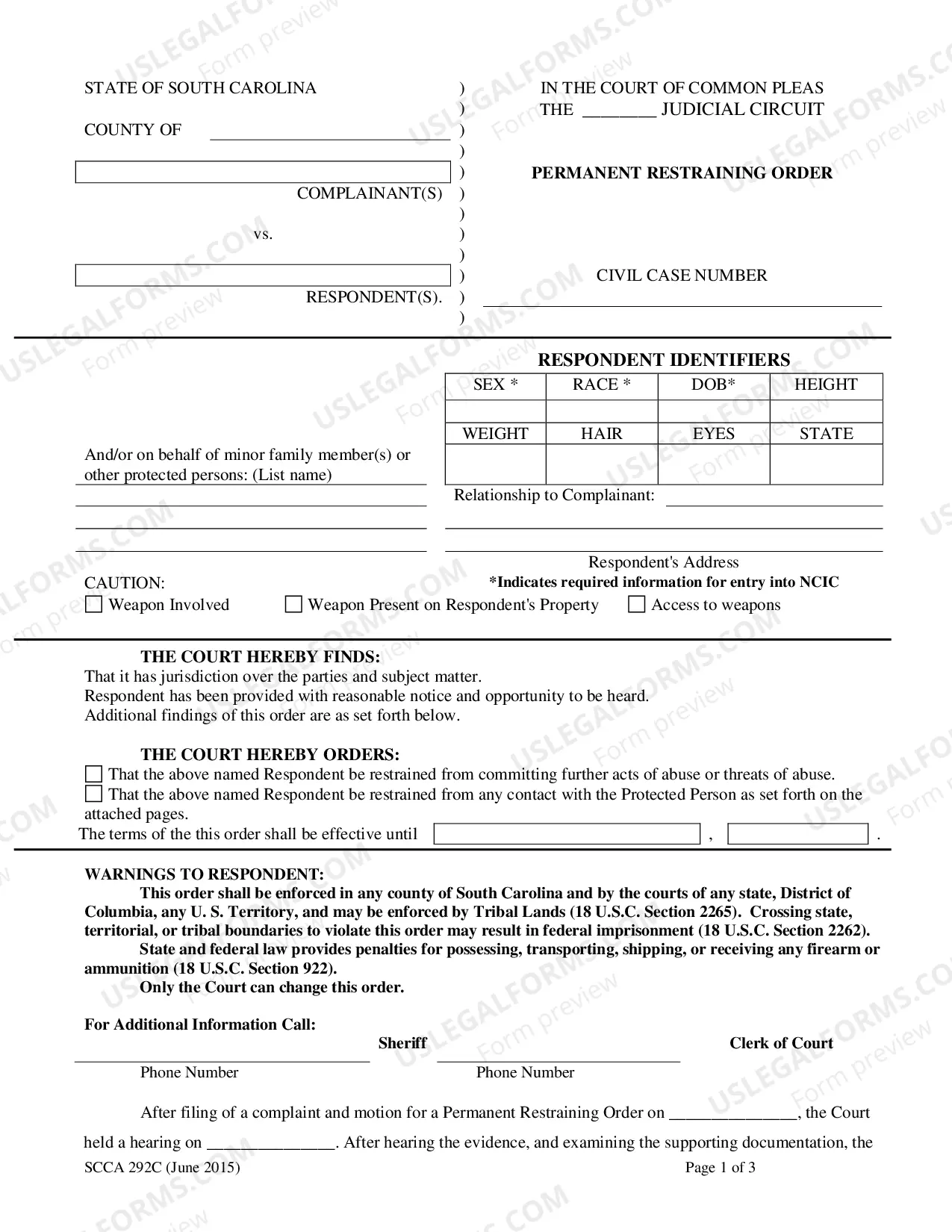
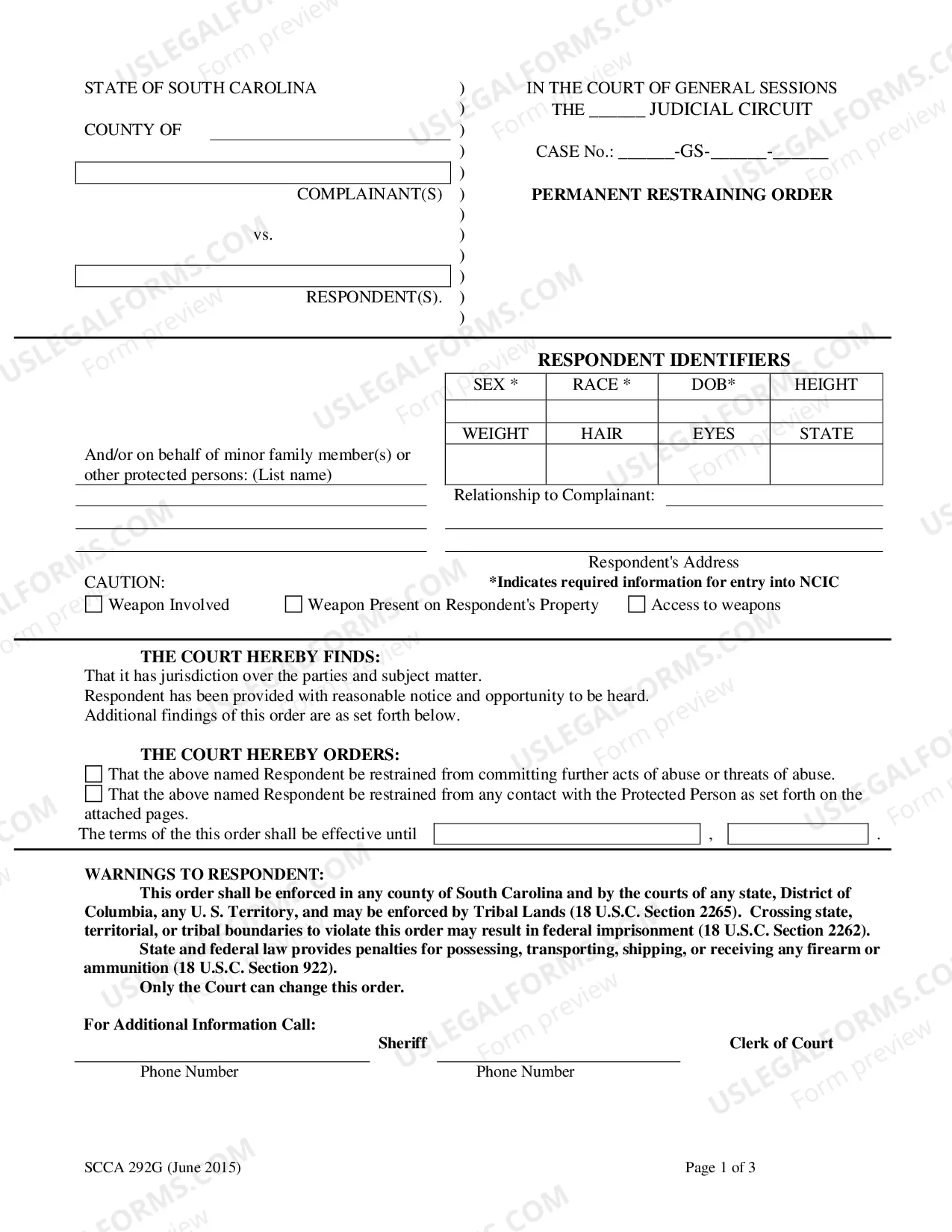
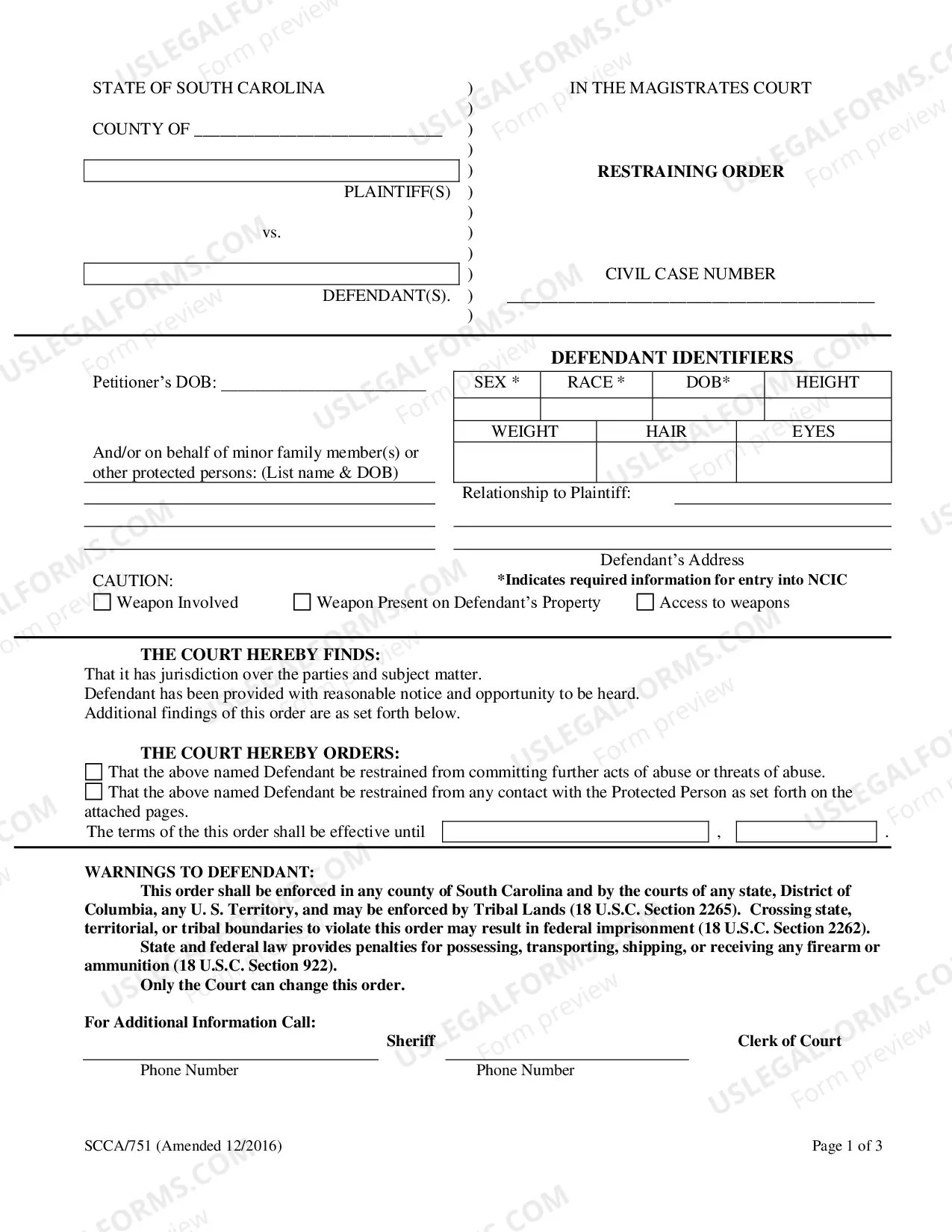
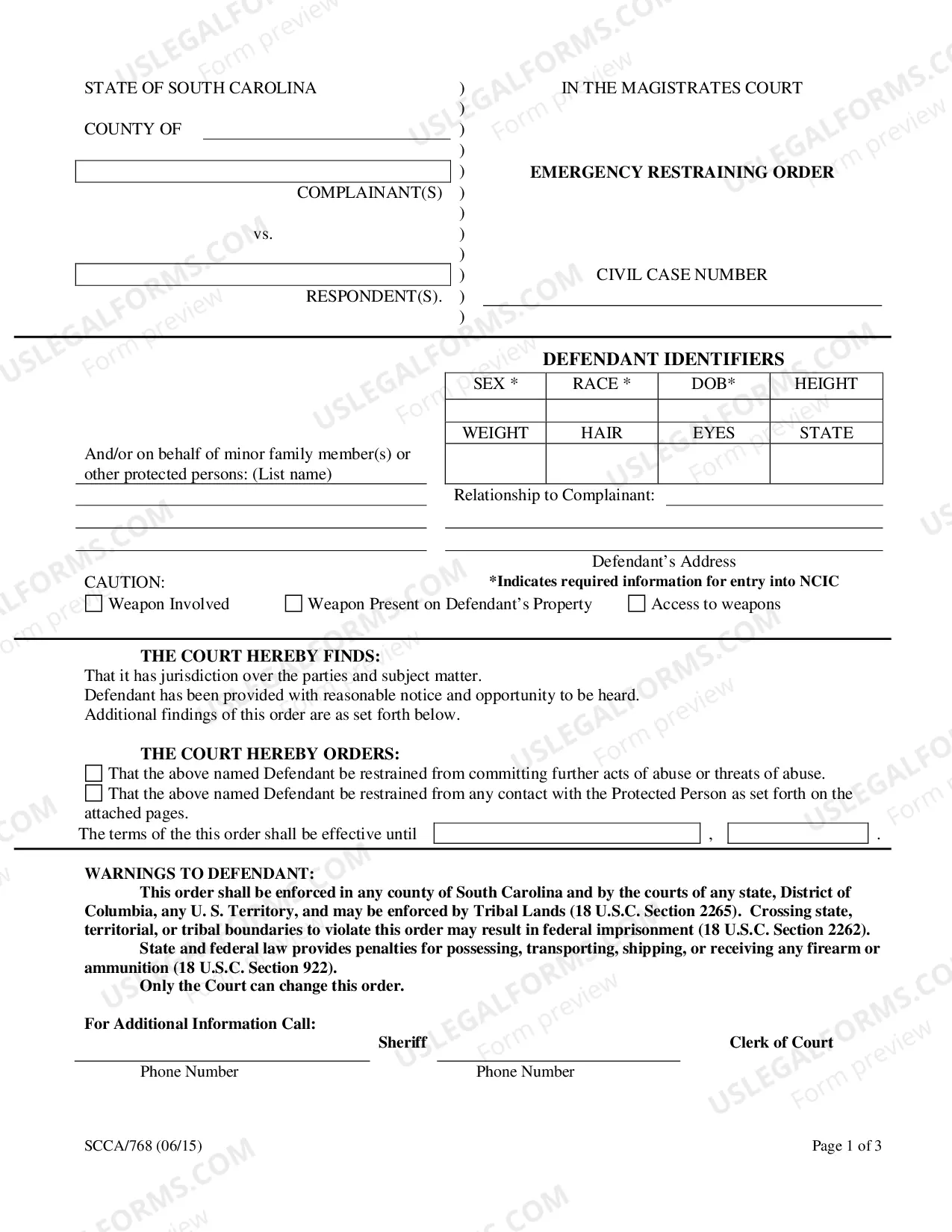
- Identification of parties: Includes details about the complainant and respondent, such as names, addresses, and identifying information.
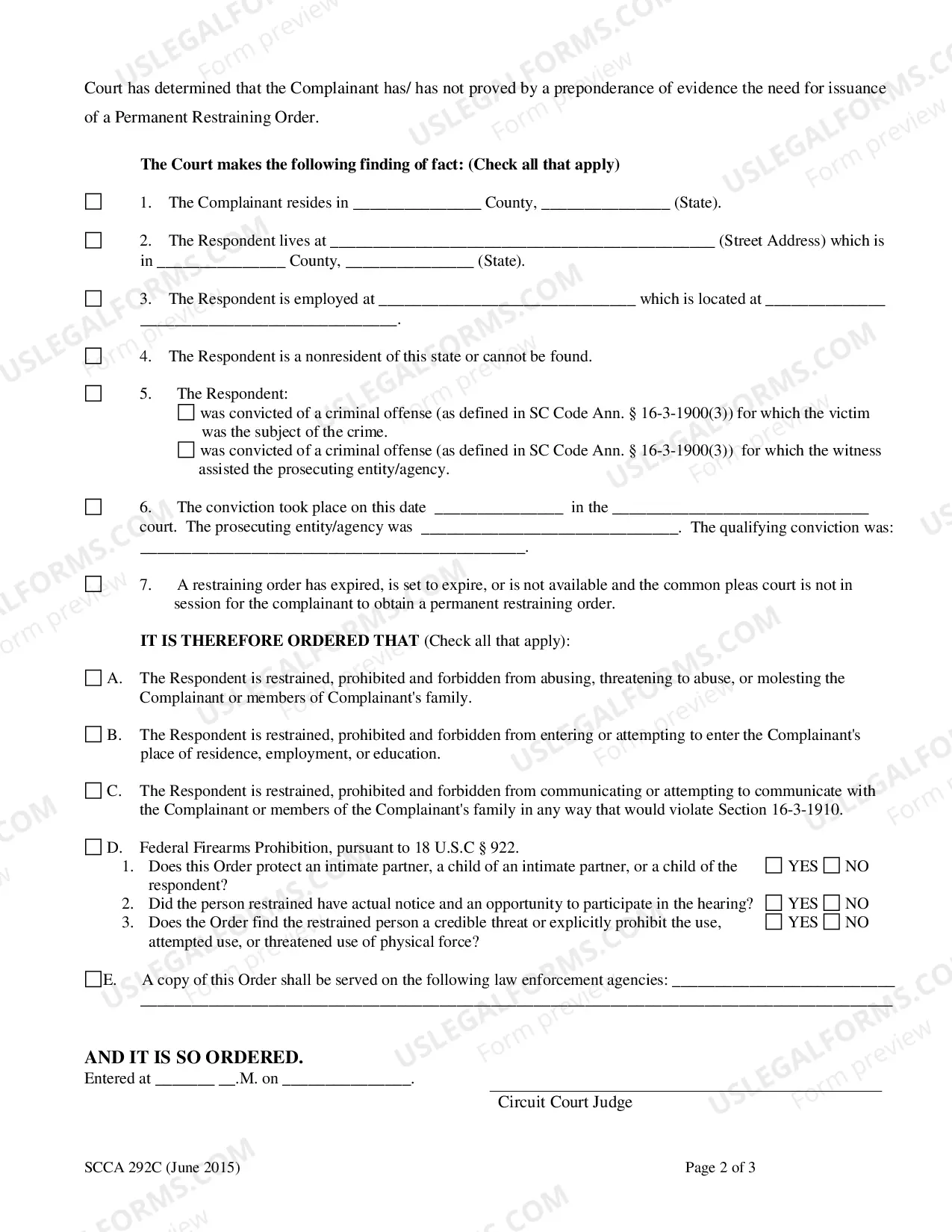
- Court findings: Lists the court's determination of jurisdiction and the respondent's opportunity for a fair hearing.
- Restraining orders: Specifies the actions the respondent is prohibited from taking against the complainant and any protected persons.
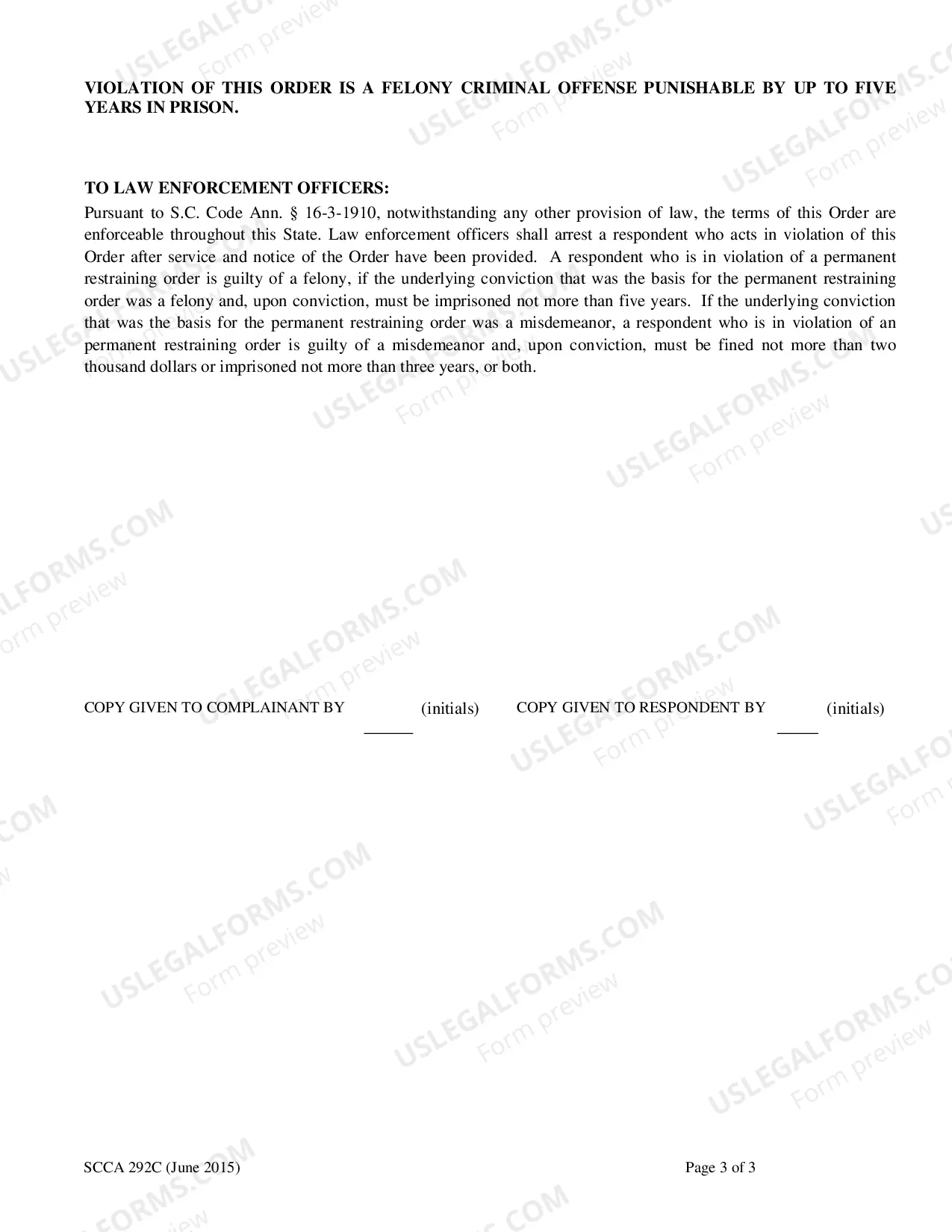
- Enforcement details: Provides information on how the order can be enforced across various jurisdictions.
- Fines and penalties: Outlines the consequences for violating the order, including potential imprisonment.
When this form is needed
This form should be used when an individual feels threatened or has experienced abuse from another person and seeks long-term protection. Situations may include domestic violence, stalking, or persistent harassment where safety and contact restrictions are crucial. It is typically filed after establishing a need for protection and can follow an initial temporary restraining order.
Who should use this form
- Individuals who have been victims of domestic violence or harassment.
- Parents or guardians seeking protection for minor children or other family members.
- Any party who requires legal intervention due to credible threats of harm from another individual.
Steps to complete this form
- Identify the complainant and respondent, entering their names and relevant details.
- Include information regarding any protected persons, such as minors, and your relationship to them.
- Fill in the specific allegations of abuse or threats and indicate if any weapons are involved.
- Ensure the court's jurisdiction and findings are clearly stated, providing evidence where necessary.
- Review the order for accuracy before submission, including the required signatures and dates.
Notarization guidance
This form does not typically require notarization to be legally valid. However, some jurisdictions or document types may still require it. US Legal Forms provides secure online notarization powered by Notarize, available 24/7 for added convenience.
Get your form ready online
Our built-in tools help you complete, sign, share, and store your documents in one place.
Make edits, fill in missing information, and update formatting in US Legal Forms—just like you would in MS Word.
Download a copy, print it, send it by email, or mail it via USPS—whatever works best for your next step.
Sign and collect signatures with our SignNow integration. Send to multiple recipients, set reminders, and more. Go Premium to unlock E-Sign.
If this form requires notarization, complete it online through a secure video call—no need to meet a notary in person or wait for an appointment.
We protect your documents and personal data by following strict security and privacy standards.

Make edits, fill in missing information, and update formatting in US Legal Forms—just like you would in MS Word.

Download a copy, print it, send it by email, or mail it via USPS—whatever works best for your next step.

Sign and collect signatures with our SignNow integration. Send to multiple recipients, set reminders, and more. Go Premium to unlock E-Sign.

If this form requires notarization, complete it online through a secure video call—no need to meet a notary in person or wait for an appointment.

We protect your documents and personal data by following strict security and privacy standards.
Typical mistakes to avoid
- Failing to provide complete contact information for both parties involved.
- Not including all necessary evidence or documentation to support the claims made.
- Overlooking required signatures or dates, which can delay the process.
- Neglecting to specify all restrictions needed for the respondent in the order.
Benefits of completing this form online
- Convenience: Access and complete the form from anywhere, at any time.
- Editability: Easily make changes as required before submitting to the court.
- Reliability: Ensure forms are up-to-date with the latest legal standards and requirements.
Legal use & context
- A Permanent Restraining Order is enforceable throughout South Carolina and in other jurisdictions in accordance with federal law.
- Violation of this order can lead to serious criminal penalties, including incarceration.
- It's essential to understand the legal implications and protections provided by the order.
Looking for another form?

Form popularity
FAQ
These terms are often used interchangeably, but an Order of Protection has more strict requirements and can usually be enforced more quickly than a Restraining Order. There are several different types of Restraining Orders. Both Orders of Protection and Restraining Orders are issued by Judges.
Restraining Order Remedies in South Carolina Restraining OrderOrder of ProtectionWhere do I file?Magistrates CourtFamily CourtHow long does the order last?1 year6 months to 1 year2 more rows
For you to file a restraining order, the perpetrator must have committed at least two acts of stalking, harassment or other threatening behavior. While it can be helpful to have two police reports, it is not necessary by state law.
Cases for Restraining Orders must involve at least 2 incidents of harassment, stalking, or other threatening situations. There is no filing fee. You will also be asked to fill out a complaint and motion. A hearing date will be set for 5 to 15 days from the date you file your paperwork in the Magistrates' Court.
It does not cost anything to file a Complaint and Motion for a Restraining Order, but the Court does charge a $55 fee at the end of a Restraining Order case. At the end of a Restraining Order hearing, the Court will either order you or the Defendant to pay the $55 fee for filing a Restraining Order.
SC Code § 16-3-1700(B) defines harassment in the second degree as ?a pattern of intentional, substantial, and unreasonable intrusion into the private life of a targeted person that serves no legitimate purpose and causes the person and would cause a reasonable person in his position to suffer mental or emotional
Permanent restraining orders; procedure. (A) The circuit court and family court have jurisdiction over an action seeking a permanent restraining order. (c) the complainant resides, if the respondent is a nonresident of the State or cannot be found.
How to File for an Order Step One: Fill out the forms. Get the forms from the courthouse. You can get help from the clerk of court, an attorney or a domestic violence advocate. Step Two: File for the order. Give your completed forms to the clerk. There should be no filing fees.
Cases for Restraining Orders must involve at least 2 incidents of harassment, stalking, or other threatening situations. There is no filing fee. You will also be asked to fill out a complaint and motion. A hearing date will be set for 5 to 15 days from the date you file your paperwork in the Magistrates' Court.