Accounting Procedures
Overview of this form
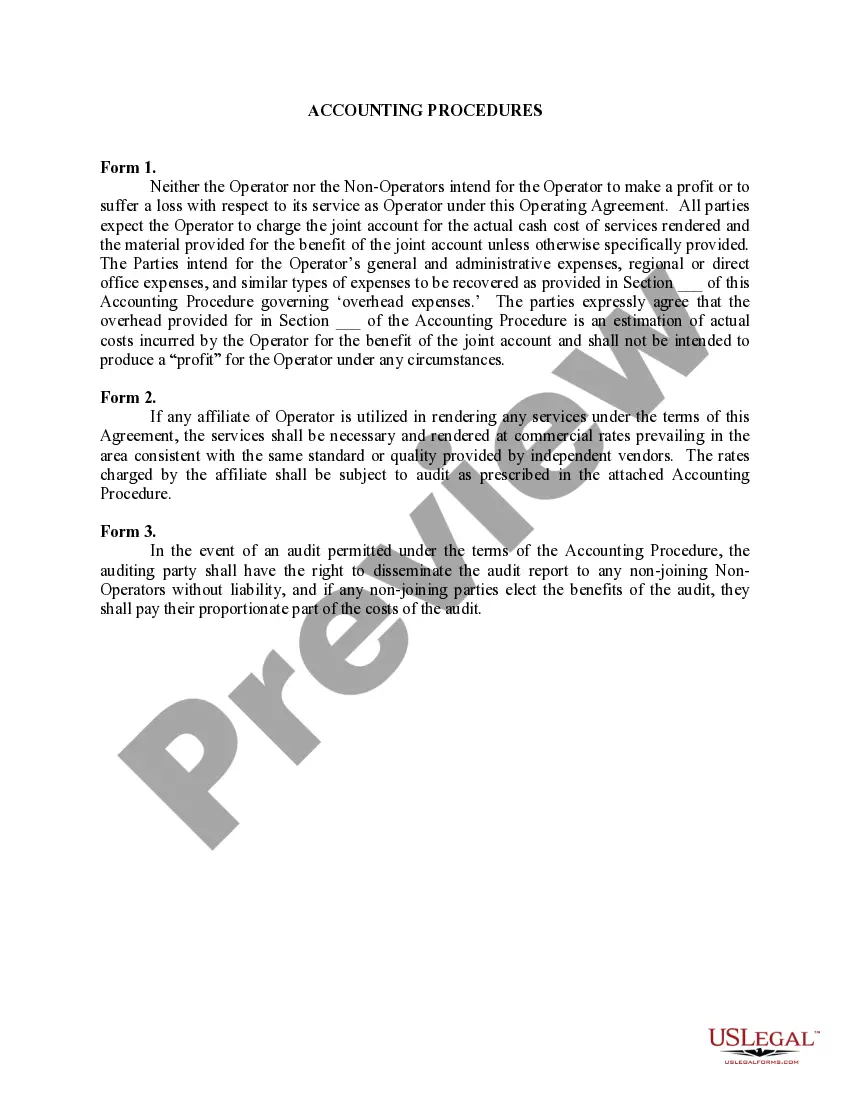
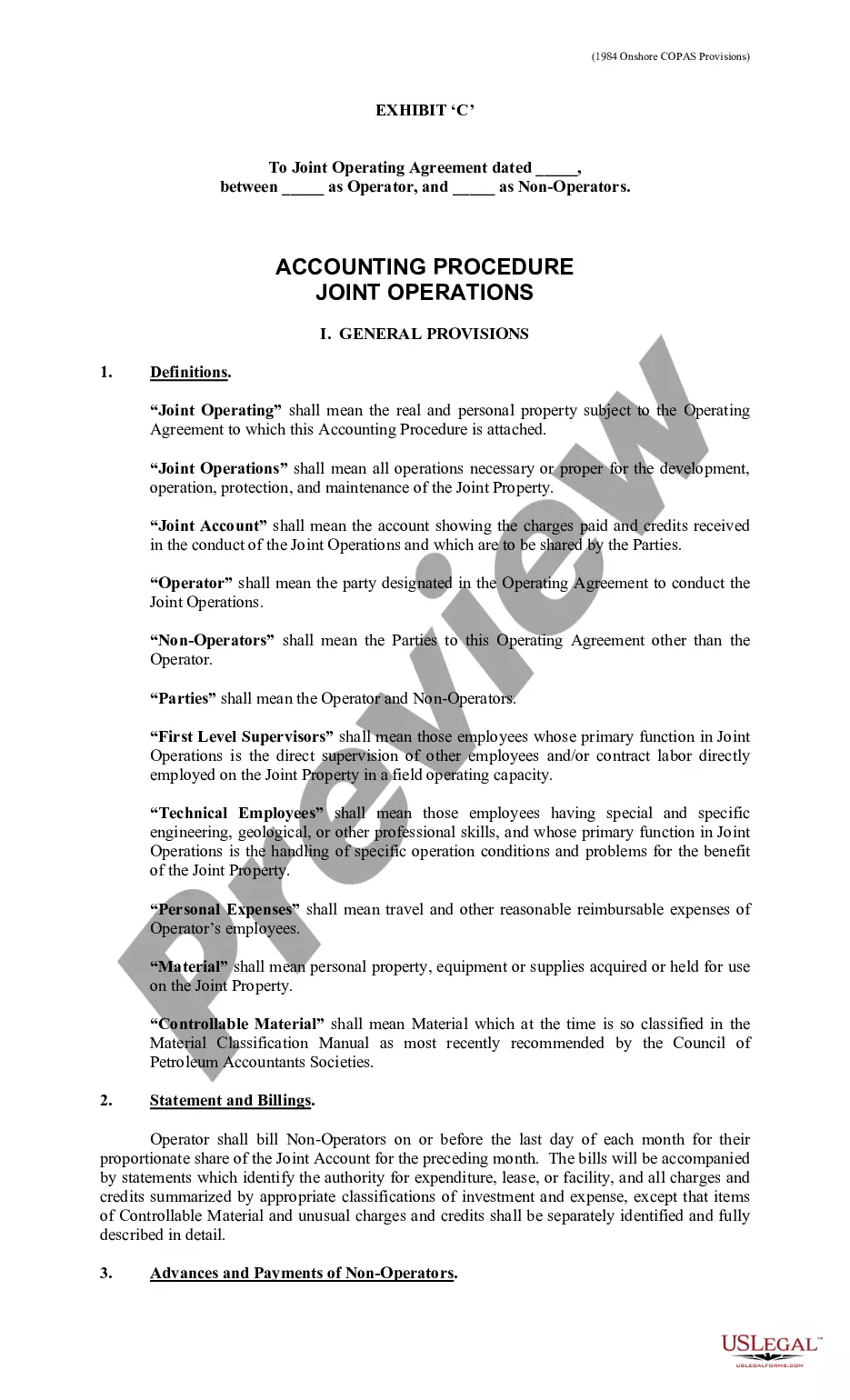
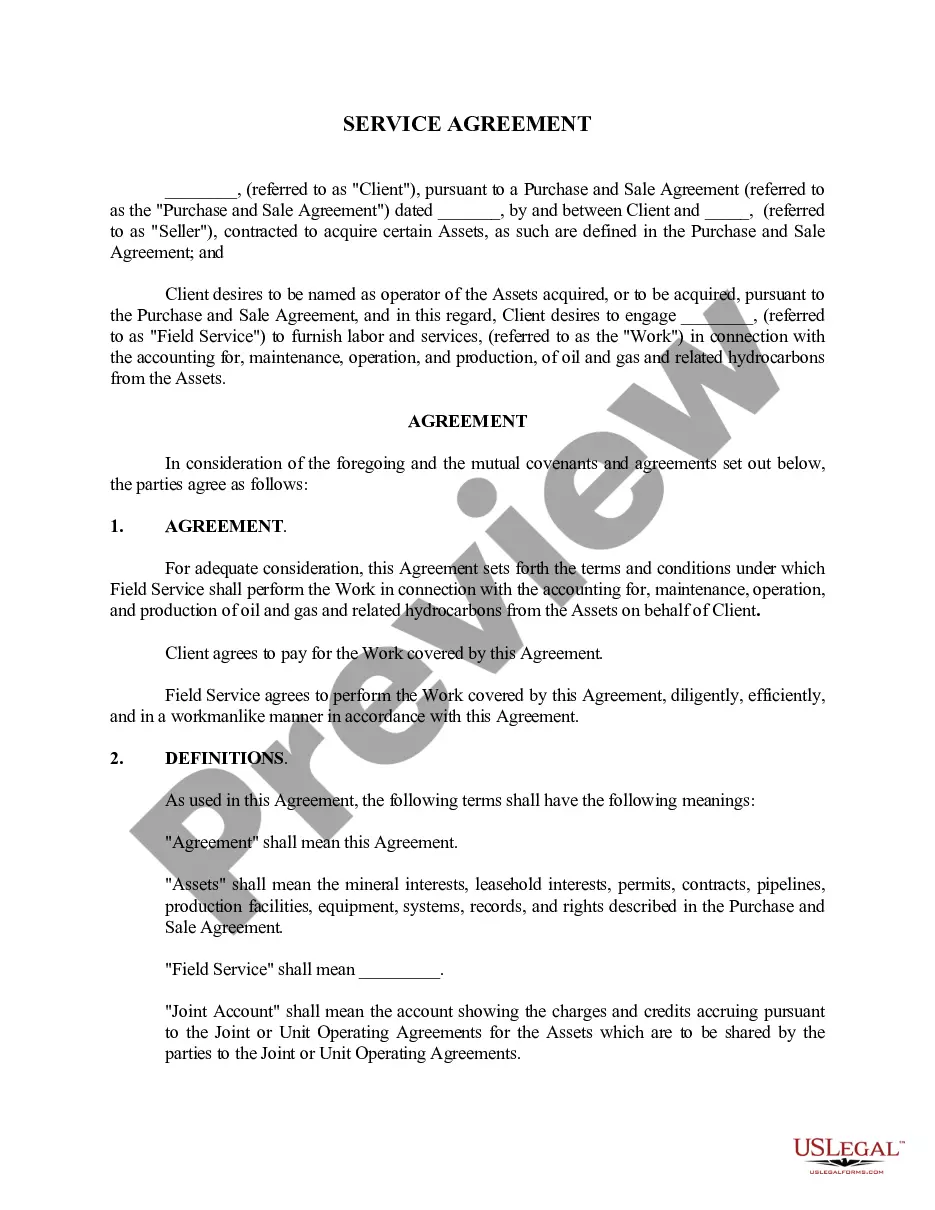
The Accounting Procedures form is a legal document used within the framework of an Operating Agreement. It outlines the methods and stipulations regarding financial transactions and accounting practices that govern the relationship between an Operator and Non-Operators in a joint account. This form is essential for ensuring clarity in cost allocations and profit arrangements, differentiating it from other financial documents by specifically addressing the roles and responsibilities related to accounting in joint ventures or partnerships.
Form components explained
- Provisions for charging the joint account for actual costs incurred.
- Stipulations on the Operator's right to recover general and administrative expenses.
- Guidance on audits and dissemination of audit reports to Non-Operators.
- Requirements for services provided by affiliates of the Operator.
- Clarification that overhead costs are estimations and not designed to yield profit.

When to use this document
This form should be used when establishing an Operating Agreement among parties involved in a joint venture. It is particularly relevant for instances where financial arrangements and service costs need to be clearly defined and agreed upon to prevent misunderstandings or disputes. This is essential when all parties seek to maintain transparency regarding financial operations and ensure equitable handling of expenses and profits.
Who can use this document
This Accounting Procedures form is intended for:
- Operators managing joint accounts in partnerships or joint ventures.
- Non-Operators who are part of an Operating Agreement.
- Business owners seeking to clarify financial obligations and expectations.
- Affiliates or service providers involved in joint operations.
How to complete this form
- Identify and list all parties involved in the Operating Agreement.
- Clearly state the terms regarding cost recovery and allocation of expenses.
- Include sections that outline the scope of services rendered by the Operator.
- Specify the audit procedures and rights concerning financial reports.
- Sign and date the form where indicated to finalize the agreement.
Does this form need to be notarized?
This form does not typically require notarization unless specified by local law. However, having it notarized can enhance its legal standing in certain jurisdictions. Consider consulting with a legal professional if you are unsure about the requirements in your state.
Get your form ready online
Our built-in tools help you complete, sign, share, and store your documents in one place.
Make edits, fill in missing information, and update formatting in US Legal Forms—just like you would in MS Word.
Download a copy, print it, send it by email, or mail it via USPS—whatever works best for your next step.
Sign and collect signatures with our SignNow integration. Send to multiple recipients, set reminders, and more. Go Premium to unlock E-Sign.
If this form requires notarization, complete it online through a secure video call—no need to meet a notary in person or wait for an appointment.
We protect your documents and personal data by following strict security and privacy standards.

Make edits, fill in missing information, and update formatting in US Legal Forms—just like you would in MS Word.

Download a copy, print it, send it by email, or mail it via USPS—whatever works best for your next step.

Sign and collect signatures with our SignNow integration. Send to multiple recipients, set reminders, and more. Go Premium to unlock E-Sign.

If this form requires notarization, complete it online through a secure video call—no need to meet a notary in person or wait for an appointment.

We protect your documents and personal data by following strict security and privacy standards.
Mistakes to watch out for
- Failing to clearly define the roles of Operator and Non-Operators.
- Omitting specific sections related to cost recovery and audits.
- Not signing the form or failing to indicate a date.
- Misunderstanding or miscommunicating the profitability terms for the Operator.
Why use this form online
- Instant access to a customizable template designed by legal professionals.
- Efficient editing for specific needs and scenarios.
- Secure and reliable format for important financial agreements.
- Convenience of downloading and filing from any location.
- The form serves as an enforceable contract among parties involved in an Operating Agreement.
- It provides necessary guidelines for financial accountability and dispute resolution regarding costs.
Key takeaways
- The Accounting Procedures form provides clear guidelines for managing shared accounting responsibilities.
- It is essential for ensuring that all parties understand the financial framework of the joint account.
- Proper completion and adherence to this form can help prevent disputes over financial allocations.
Looking for another form?

Form popularity
FAQ
The accounting cycle refers to the process of generating financial statements. It begins with analyzing business transactions, recording them in journals, and posting them to ledgers.Next the accountant prepares the financial statements and reports. The final step involves analyzing these reports and making decisions.
The Revenue Principle. Image via Flickr by LendingMemo. The Expense Principle. The Matching Principle. The Cost Principle. The Objectivity Principle.
Basic accounting refers to the process of recording a company's financial transactions.The financial statements used in basic accounting are a brief summary of financial transactions over an accounting period, summarizing a company's cash flows, operations and financial position.
Step 1: Identify Transactions. Step 2: Record Transactions in a Journal. Step 3: Posting. Step 4: Unadjusted Trial Balance. Step 5: Worksheet. Step 6: Adjusting Journal Entries. Step 7: Financial Statements. Step 8: Closing the Books.
An accounting procedure is a standardized process that is used to perform a function within the accounting department. Examples of accounting procedures are: Issue billings to customers. Pay invoices from suppliers. Calculate payroll for employees.
Collecting Financial Documents. Posting Transactions. Account Reconciliation. Accounts Payable And Receivable. Internal And External Reporting.
We will examine the steps involved in the accounting cycle, which are: (1) identifying transactions, (2) recording transactions, (3) posting journal entries to the general ledger, (4) creating an unadjusted trial balance, (5) preparing adjusting entries, (6) creating an adjusted trial balance, (7) preparing financial
Define the Policy. When coming up with the accounting policy and procedure handbook used by accountants and others in the company, you must first define each rule or guideline as an individual policy that you want people to follow. Write the Overview. Outline the Procedures. Number the Steps. Policy and Procedure Manual.
The process of going from sales to end-of-month statements has several steps, all of which must be executed correctly for the entire accounting cycle to function properly. Part of this process includes the three stages of accounting: collection, processing and reporting.