Deed Transfer Questionnaire
About this form
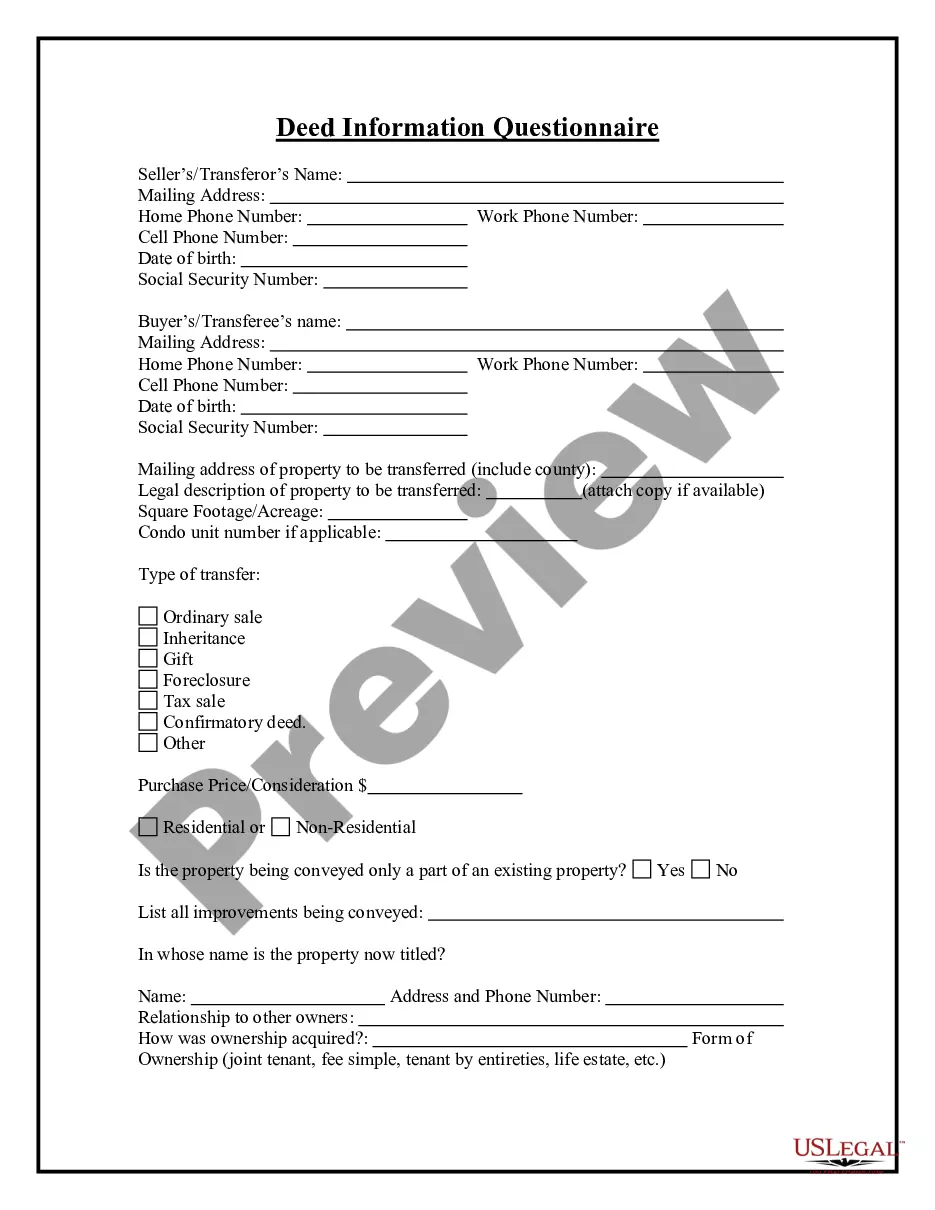
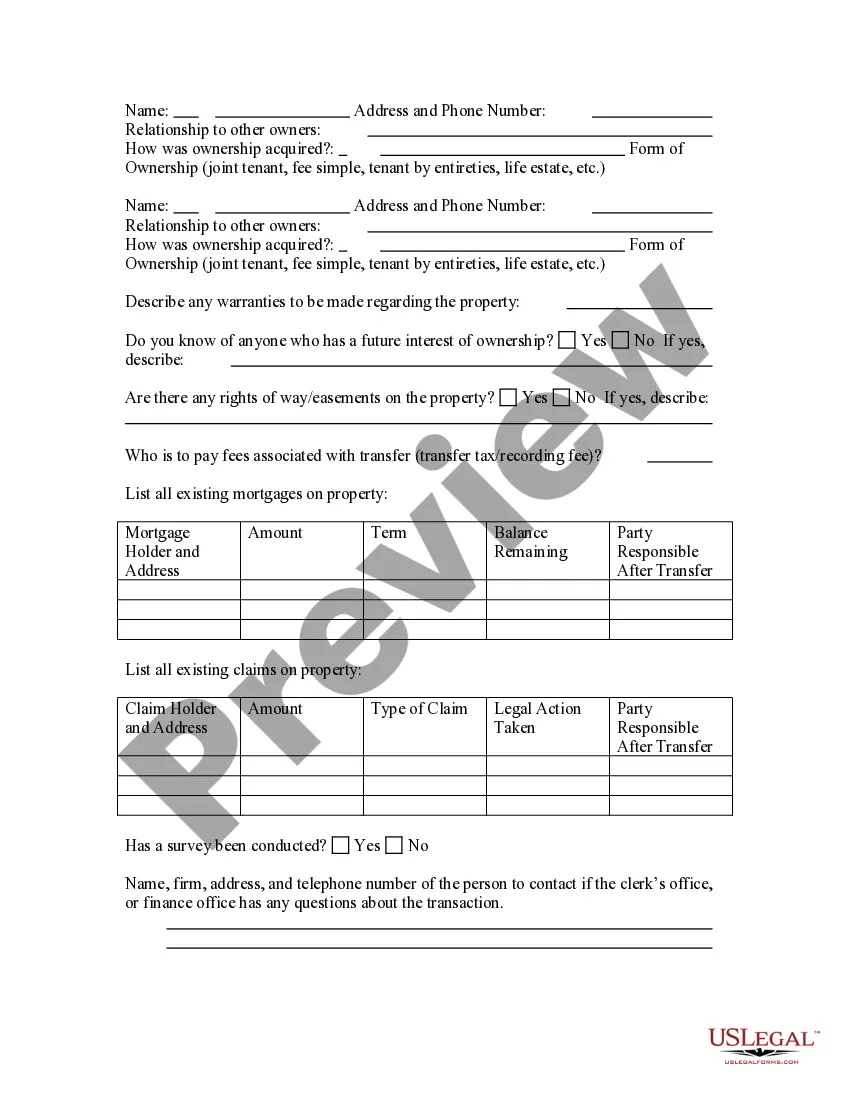
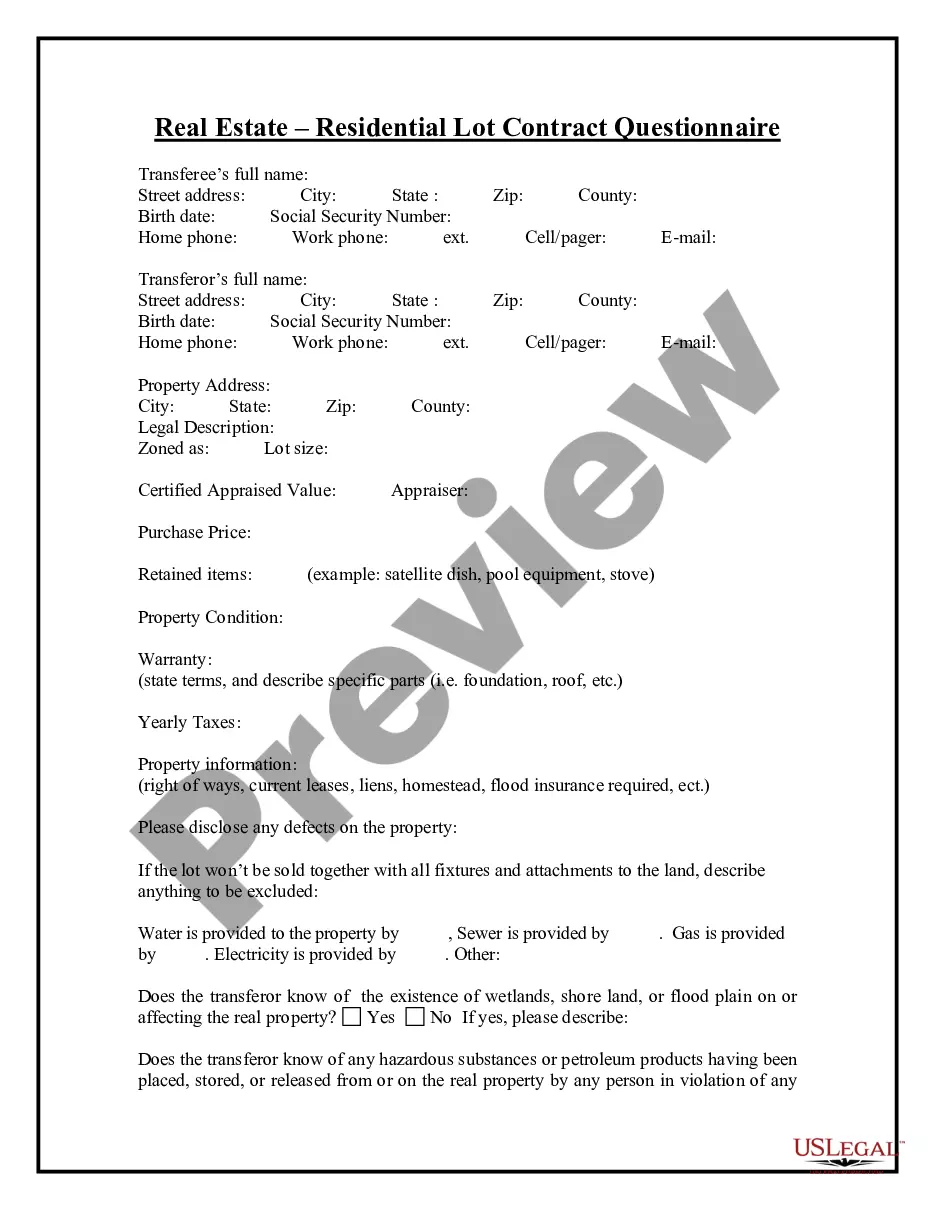
The Deed Transfer Questionnaire is a legal document designed to gather essential information related to transferring real property. This form distinguishes itself from other property transfer documents by focusing specifically on the needs and considerations of both the parties involved. It helps identify potential issues, streamline collaboration with legal counsel, and ensures that all necessary information is accurately collected to facilitate the transfer process.
Key components of this form
- Information about the parties involved in the transfer.
- Details regarding the property being transferred.
- Considerations affecting rights and obligations in the transaction.
- Specific questions designed to explore potential legal issues or concerns.

Common use cases
Use this form when you are preparing to transfer ownership of real property and need to ensure that all relevant details are addressed. It is especially useful if you are seeking legal assistance for the transaction, as it can help clarify the issues that may arise during the process. This questionnaire can also be beneficial for lawyers gathering information from new clients regarding property transactions.
Who can use this document
- Individuals or entities transferring real property.
- Homeowners or real estate investors seeking legal assistance.
- Attorneys who need to gather information from new clients regarding property transfers.
How to prepare this document
- Identify the parties involved in the property transfer.
- Specify the property being transferred, including address and legal description.
- Answer all questions regarding legal considerations and potential issues in the transfer.
- Review the information for accuracy before submission.
Notarization requirements for this form
To make this form legally binding, it must be notarized. Our online notarization service, powered by Notarize, lets you verify and sign documents remotely through an encrypted video session.
Get your form ready online
Our built-in tools help you complete, sign, share, and store your documents in one place.
Make edits, fill in missing information, and update formatting in US Legal Forms—just like you would in MS Word.
Download a copy, print it, send it by email, or mail it via USPS—whatever works best for your next step.
Sign and collect signatures with our SignNow integration. Send to multiple recipients, set reminders, and more. Go Premium to unlock E-Sign.
If this form requires notarization, complete it online through a secure video call—no need to meet a notary in person or wait for an appointment.
We protect your documents and personal data by following strict security and privacy standards.

Make edits, fill in missing information, and update formatting in US Legal Forms—just like you would in MS Word.

Download a copy, print it, send it by email, or mail it via USPS—whatever works best for your next step.

Sign and collect signatures with our SignNow integration. Send to multiple recipients, set reminders, and more. Go Premium to unlock E-Sign.

If this form requires notarization, complete it online through a secure video call—no need to meet a notary in person or wait for an appointment.

We protect your documents and personal data by following strict security and privacy standards.
Typical mistakes to avoid
- Failing to provide complete information about the property.
- Not disclosing relevant legal issues that may affect the transfer.
- Inaccurate identification of the parties involved.
Why use this form online
- Convenient access to legal forms anytime and from anywhere.
- Editability allows you to customize the questionnaire to your specific needs.
- Reliability ensured by forms drafted by licensed attorneys.
Legal use & context
- The Deed Transfer Questionnaire serves as a vital tool for capturing necessary information before a property transaction.
- It supports legal enforceability by promoting thorough preparation and accurate documentation.
- Using this questionnaire can help minimize disputes and misunderstandings related to property transfers.
Summary of main points
- The Deed Transfer Questionnaire is essential for documenting details surrounding real property transfers.
- It helps both individuals and attorneys streamline information gathering for legal evaluations.
- Using it can prevent common mistakes and ensure compliance with state-specific regulations.
Looking for another form?





Form popularity
FAQ
Obtaining approval from the bank to transfer the Title, if there is a mortgage. New loan document and mortgage, if your bank requires this. Preparing legal documents to transfer the property into the name of the Trustees.
Quitclaim deeds are most often used to transfer property between family members.Examples include when an owner gets married and wants to add a spouse's name to the title or deed, or when the owners divorce and one spouse's name is removed from the title or deed.
The drawback, quite simply, is that quitclaim deeds offer the grantee/recipient no protection or guarantees whatsoever about the property or their ownership of it. Maybe the grantor did not own the property at all, or maybe they only had partial ownership.
Grantor's name. Grantee's name and address. Description of grantee (ex: unmarried man, husband and wife, joint tenants) Person who requested grant deed. Address of real estate that is being transferred. Legal description of property (lot number) Original title order number for property.
What documents are needed for a conventional transfer? Power of Attorney: The seller will have to sign a Power of Attorney document which gives the conveyancing attorney the authority to act on his/her behalf in the Deeds Office in order for the property to be transferred from the seller to the buyer.
But you might be wondering if an owner can transfer a deed to another person without a real estate lawyer. The answer is yes. Parties to a transaction are always free to prepare their own deeds.A quitclaim deed, for example, is far simpler than a warranty deed.
Fill out the quit claim deed form, which can be obtained online, or write your own using the form as a guide. The person giving up the interest in the property is the grantor, and the person receiving the interest is the grantee.
Print a grant deed from an online source. Sign the document in the presence of a notary public. Take the deed to the recorder's office in the county where the property is located.
A Quitclaim Deed must be notarized by a notary public or attorney in order to be valid.Consideration in a Quitclaim Deed is what the Grantee will pay to the Grantor for the interest in the property.