South Carolina FALSE STATEMENTS
Overview of this form
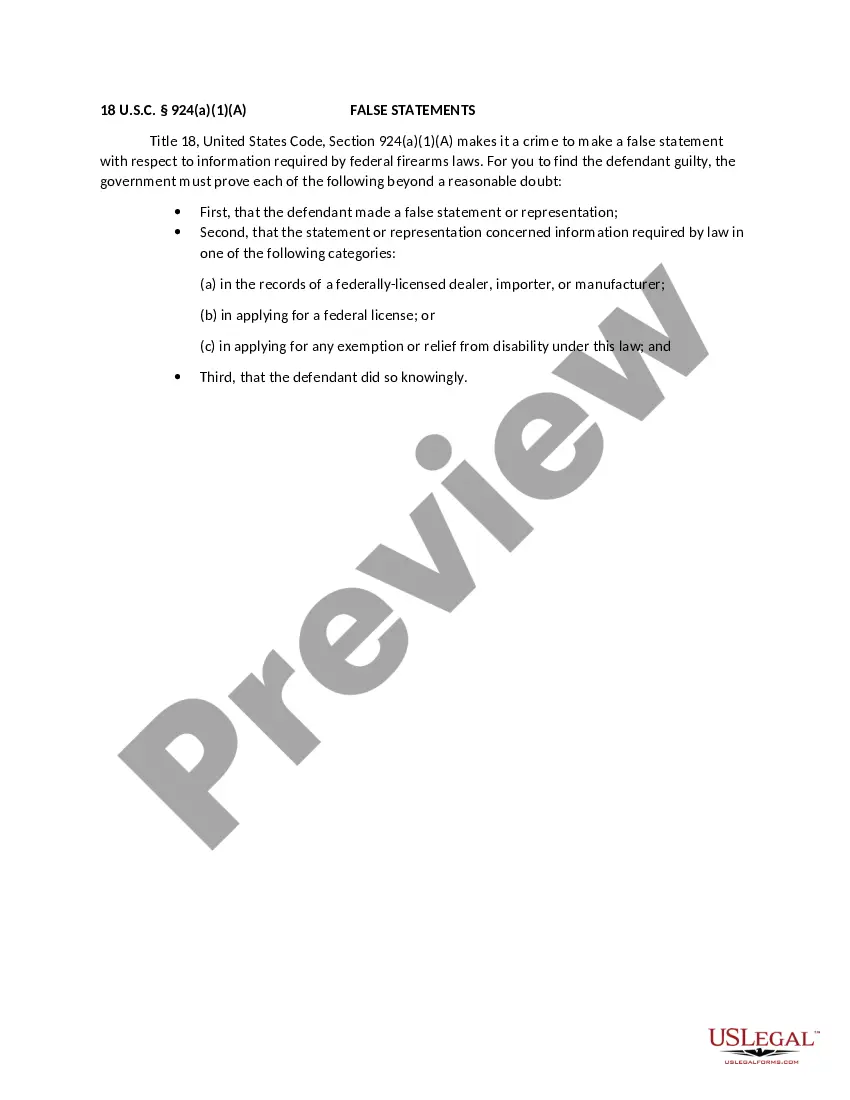
The False Statements form outlines the legal implications of making a false statement regarding federal firearms laws. Under Title 18, United States Code, Section 924(a)(1)(A), this form is essential in federal criminal cases where accuracy in firearms-related information is crucial. This form serves to inform defendants of the specific charges against them, differentiating it from other legal forms related to firearms by focusing on false representations rather than broader issues of firearm ownership or licensing.
Form components explained
- Definition of a false statement: Clarifies what constitutes a false statement under federal law.
- Categories of information: Outlines the types of information where false statements are prohibited, including records held by federally-licensed dealers and applications for federal licenses.
- Intent requirement: Specifies that the defendant must have knowingly made a false statement for a conviction.
- Burden of proof: States that the government must prove the case beyond a reasonable doubt.
When this form is needed
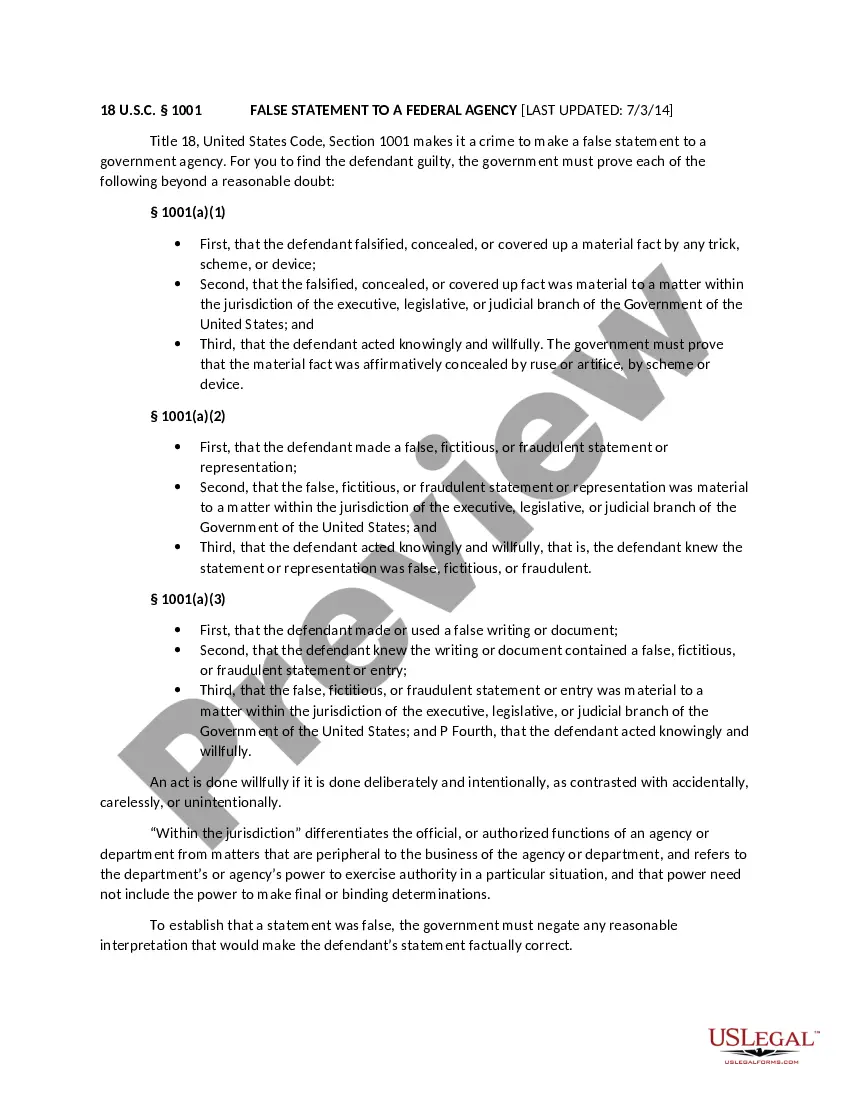
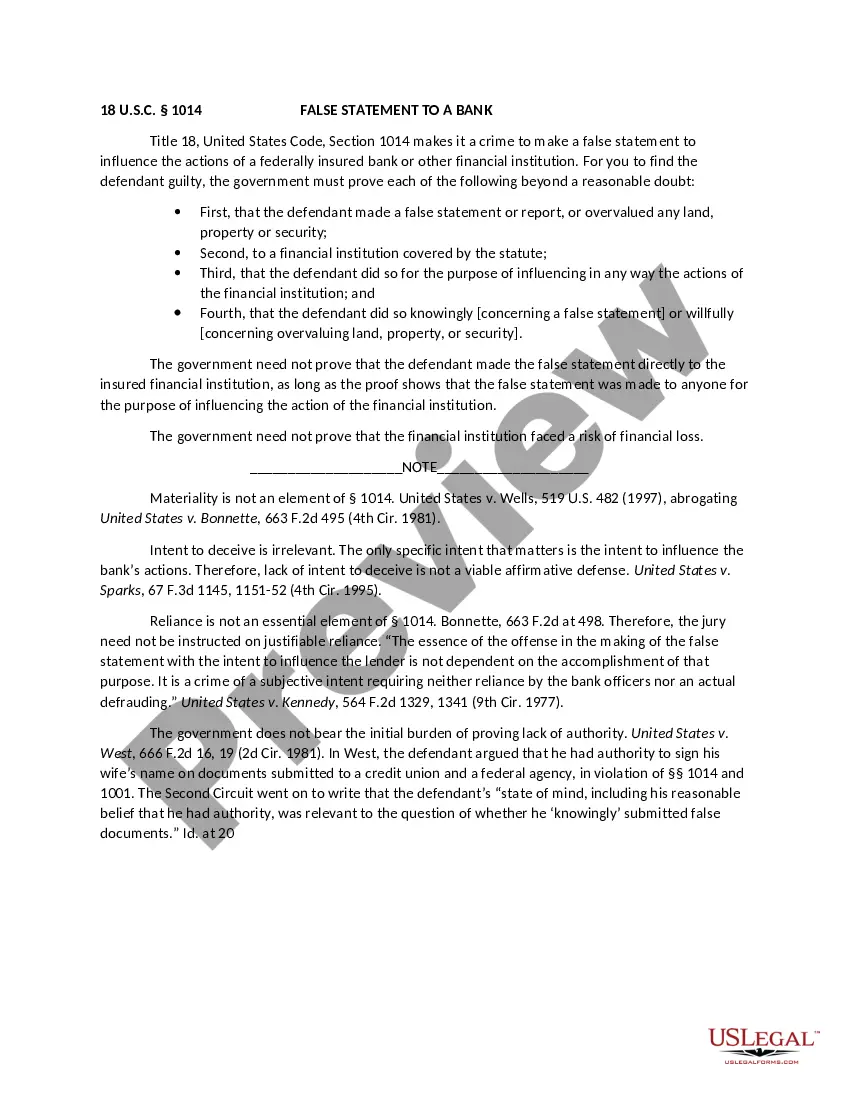
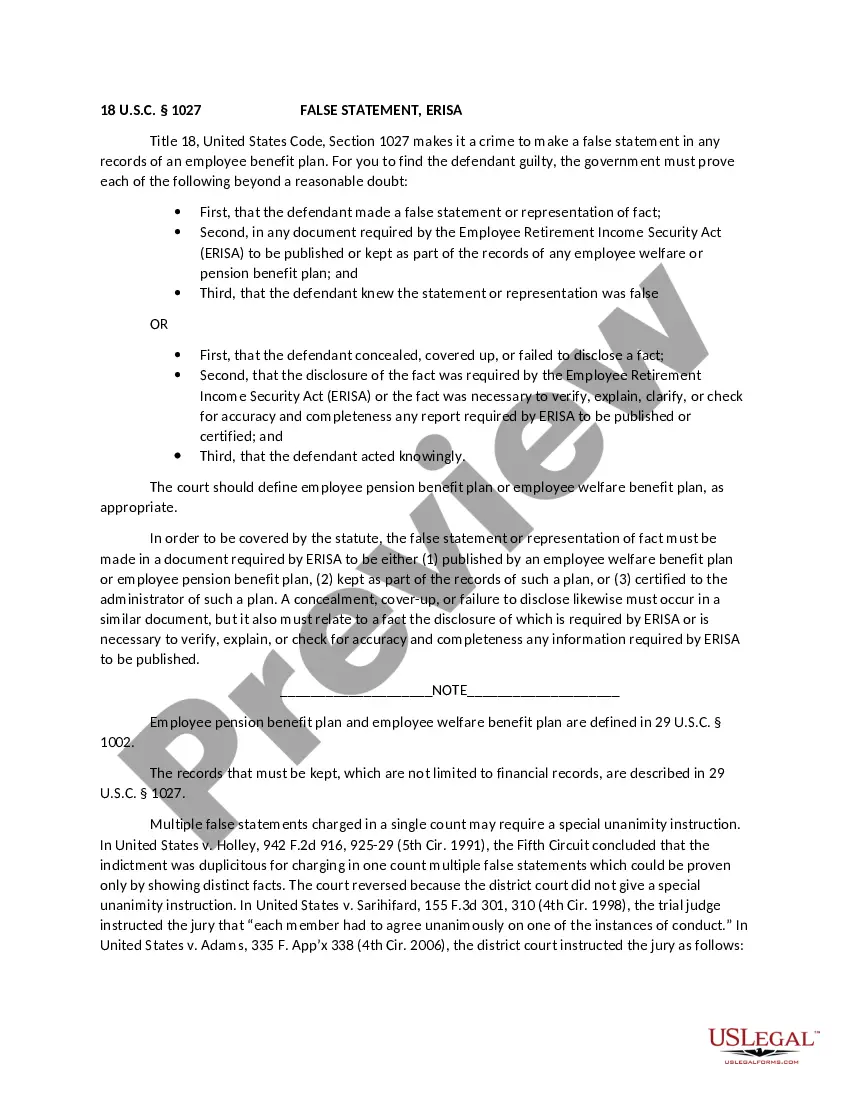
This form is used in criminal cases involving allegations of false statements related to firearms laws. It is applicable in situations where a defendant is accused of providing inaccurate information in firearm transaction records, during license applications, or in any request for exemptions related to firearm regulations. Using this form is crucial when navigating the legal complexities following such accusations.
Who should use this form
- Defendants in federal firearms-related criminal cases who are accused of making false statements.
- Defense attorneys representing clients facing allegations under federal firearms laws.
- Individuals seeking to understand their rights and responsibilities under firearms law.
How to prepare this document
- Identify the defendant: Clearly state the name of the individual facing charges.
- List the specific false statements: Provide detailed examples of the alleged falsehoods in question.
- Specify the context: Indicate whether the false statement relates to licensing, records with dealers, or exemption applications.
- Document intent: Include any evidence or statements that show the defendant's knowledge of the false statement.
- Seek legal advice: Consult with an attorney to ensure accuracy and compliance with federal law.
Notarization guidance
This form usually doesn’t need to be notarized. However, local laws or specific transactions may require it. Our online notarization service, powered by Notarize, lets you complete it remotely through a secure video session, available 24/7.
Get your form ready online
Our built-in tools help you complete, sign, share, and store your documents in one place.
Make edits, fill in missing information, and update formatting in US Legal Forms—just like you would in MS Word.
Download a copy, print it, send it by email, or mail it via USPS—whatever works best for your next step.
Sign and collect signatures with our SignNow integration. Send to multiple recipients, set reminders, and more. Go Premium to unlock E-Sign.
If this form requires notarization, complete it online through a secure video call—no need to meet a notary in person or wait for an appointment.
We protect your documents and personal data by following strict security and privacy standards.

Make edits, fill in missing information, and update formatting in US Legal Forms—just like you would in MS Word.

Download a copy, print it, send it by email, or mail it via USPS—whatever works best for your next step.

Sign and collect signatures with our SignNow integration. Send to multiple recipients, set reminders, and more. Go Premium to unlock E-Sign.

If this form requires notarization, complete it online through a secure video call—no need to meet a notary in person or wait for an appointment.

We protect your documents and personal data by following strict security and privacy standards.
Typical mistakes to avoid
- Failing to provide sufficient details about the false statements.
- Not clearly indicating the context of the statements made.
- Inaccurately describing the defendant's intent or knowledge regarding the statements.
- Overlooking the need for legal representation when filing the form.
Benefits of completing this form online
- Convenient access to the form anytime and anywhere, eliminating the need for in-person visits.
- Editable in Word format, allowing for ease in making necessary modifications.
- Provides guidance from attorneys during the drafting process, ensuring compliance with legal standards.
Looking for another form?
Form popularity
FAQ
Moreover, perjury may suggest an individual has a propensity for lying which can be a threat to their personal and professional reputation. Additionally, lying under oath is a felony in South Carolina and can result in a jail sentence of five years, a fine, or both.
Potential Consequences Providing false information in an affidavit or other legal document is a misdemeanor in South Carolina. This may result in a maximum of six months' incarceration, a minimum fine of $100, or both.
Section 16-9-340 - Intimidation of court officials, jurors or witnesses (A) It is unlawful for a person by threat or force to: (1) intimidate or impede a judge, magistrate, juror, witness, or potential juror or witness, arbiter, commissioner, or member of any commission of this State or any other official of any court,
The charge of providing false information to law enforcement is a serious public corruption crime in South Carolina. The offense is detailed in South Carolina Code of Laws §16-17-725 (2011), which makes it a misdemeanor criminal offense with a maximum penalty of up to 30 days in jail.
As laid out in South Carolina General Code Section 16-13-240, it is a crime to obtain a signature, money, or property from someone under false pretenses or misrepresentation of a fact with ?intent to cheat and defraud a person of that property.? Simply put, if you obtain money, property, or the title to property from
(A)(1) It is unlawful for a person to wilfully give false, misleading, or incomplete testimony under oath in any court of record, judicial, administrative, or regulatory proceeding in this State.
The charge of providing false information to law enforcement is a serious public corruption crime in South Carolina. The offense is detailed in South Carolina Code of Laws §16-17-725 (2011), which makes it a misdemeanor criminal offense with a maximum penalty of up to 30 days in jail.
In South Carolina and in many other states throughout the country, filing a false police report is a criminal offense. ing to state law, a person who falsely reports a felony can be charged with a felony, punishable by imprisonment for up to five years and/or a maximum fine of $1,000.