Rhode Island Acknowledgment for Copy Certification
Overview of this form
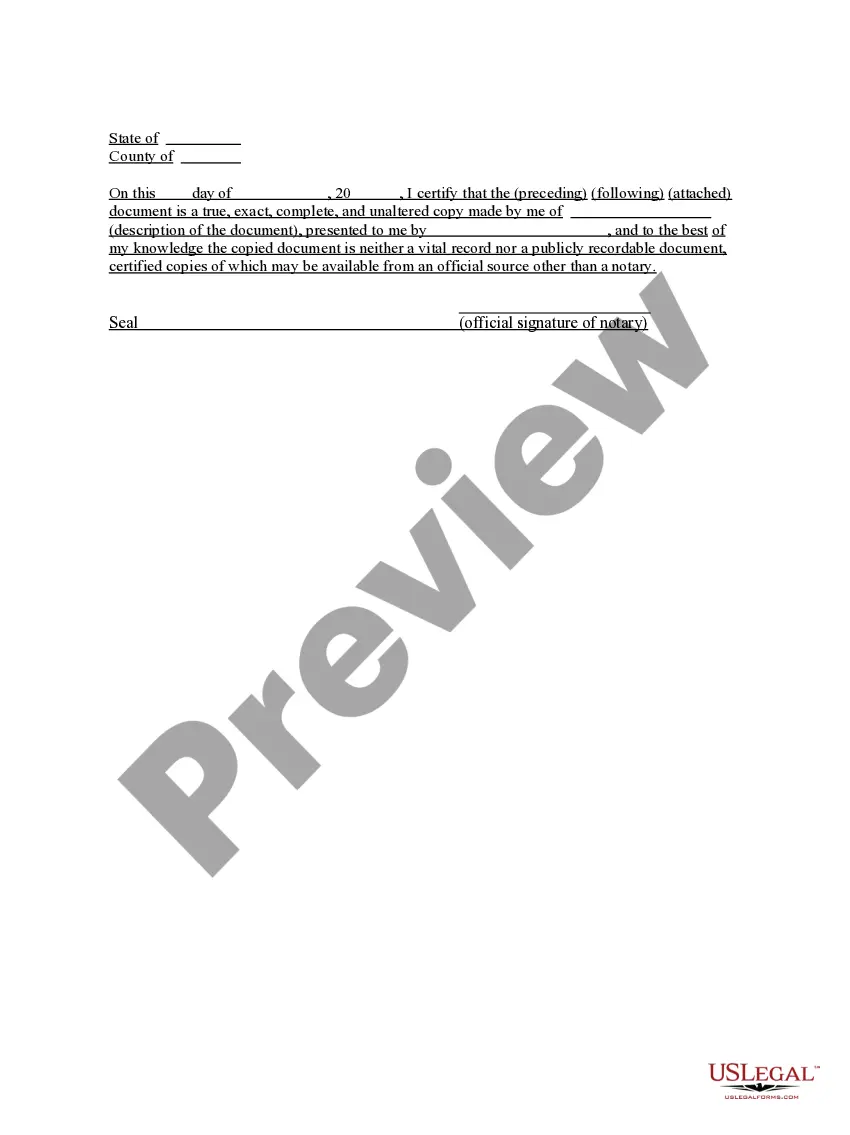
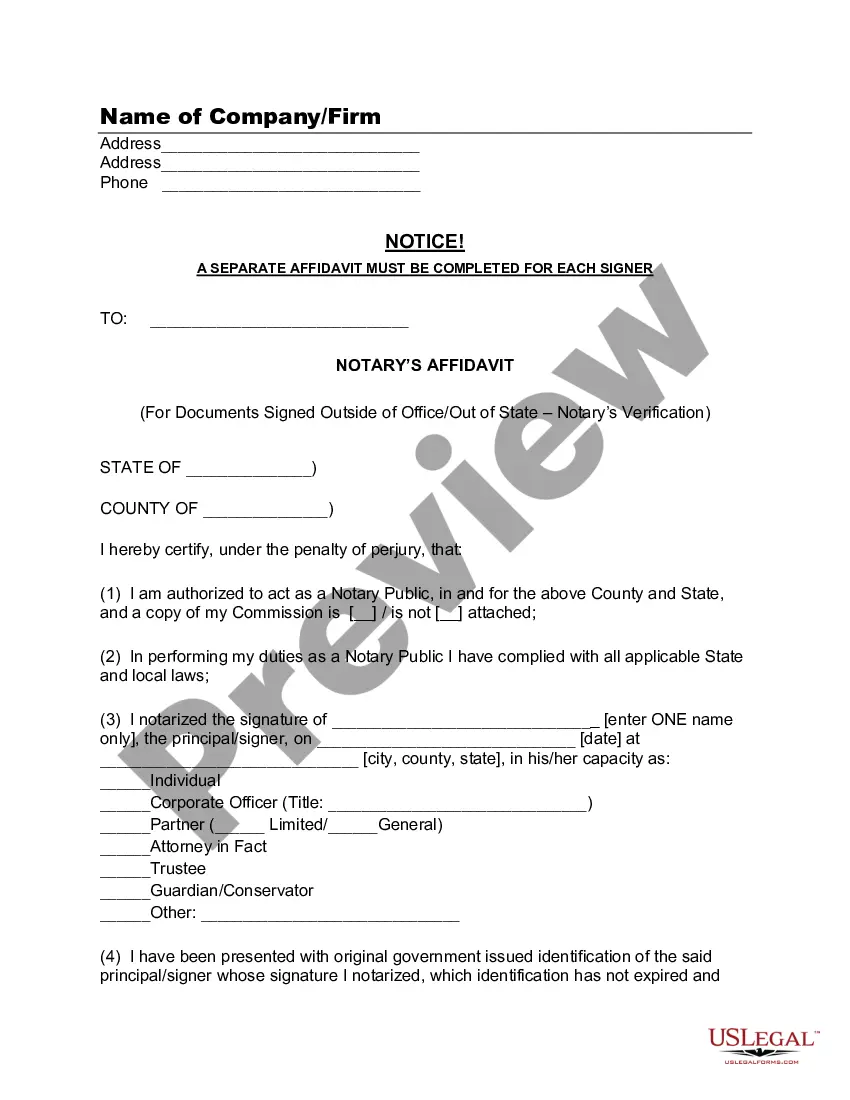
The Acknowledgment for Copy Certification is a legal document used to confirm that a copy of a document is a true and accurate representation of the original. This form is essential in situations where a certified copy is required for legal or administrative purposes. Unlike other notarial certificates, this form specifically certifies copies rather than original documents, ensuring authenticity in the copying process.
Form components explained
- A statement certifying the document is a true and complete copy.
- Details about the document being certified, including its title or description.
- The date and location of the acknowledgment.
- The notary's signature and official seal.
- A declaration that the document is not a vital or publicly recordable document.

When this form is needed
This form is typically used when an individual or organization needs to present a certified copy of a document for legal, business, or administrative purposes. Examples include submitting documents for court cases, applying for permits, or meeting requirements for financial transactions.
Who needs this form
- Individuals needing to certify copies of personal documents, such as contracts or licenses.
- Businesses requiring certified copies of corporate documents for regulatory compliance.
- Lawyers who need certified documentation for court submissions.
- Organizations submitting paperwork to government agencies.
Steps to complete this form
- Identify the document you are certifying and fill in its title or description.
- Enter the date and location where the acknowledgment is being made.
- Have the notary review the document and acknowledge that it is a true copy.
- The notary should sign and affix their official seal to validate the certification.
- Ensure that all required information is complete and accurate before submission.
Is notarization required?
To make this form legally binding, it must be notarized. Our online notarization service, powered by Notarize, lets you verify and sign documents remotely through an encrypted video session.
Get your form ready online
Our built-in tools help you complete, sign, share, and store your documents in one place.
Make edits, fill in missing information, and update formatting in US Legal Forms—just like you would in MS Word.
Download a copy, print it, send it by email, or mail it via USPS—whatever works best for your next step.
Sign and collect signatures with our SignNow integration. Send to multiple recipients, set reminders, and more. Go Premium to unlock E-Sign.
If this form requires notarization, complete it online through a secure video call—no need to meet a notary in person or wait for an appointment.
We protect your documents and personal data by following strict security and privacy standards.

Make edits, fill in missing information, and update formatting in US Legal Forms—just like you would in MS Word.

Download a copy, print it, send it by email, or mail it via USPS—whatever works best for your next step.

Sign and collect signatures with our SignNow integration. Send to multiple recipients, set reminders, and more. Go Premium to unlock E-Sign.

If this form requires notarization, complete it online through a secure video call—no need to meet a notary in person or wait for an appointment.

We protect your documents and personal data by following strict security and privacy standards.
Typical mistakes to avoid
- Failing to enter a complete description of the document being certified.
- Not providing the notary with the original document for comparison.
- Leaving the date or location blank when filling out the form.
- Overlooking the requirement for a notary signature or seal.
Benefits of using this form online
- Convenience of downloading and printing the form from home or office.
- Editability allows customization to fit specific needs or local laws.
- Access to updated and legally compliant templates drafted by licensed attorneys.
Looking for another form?
Form popularity
FAQ
The purpose of an acknowledgment is for a signer, whose identity has been verified, to declare to a Notary or notarial officer that he or she has willingly signed a document.
They key difference is that for a signature witnessing, the signer must always sign the document in the Notary's presence.An acknowledgment, on the other hand, does not require the Notary to witness the signature in most states (one exception is Maryland).
The certificate of a notary public, justice of the peace, or other authorized officer, attached to a deed, mortgage, or other instrument, setting forth that the parties thereto personally appeared before him on such a date and acknowledged the instrument to be their free and voluntary act and deed. Read v.
As long as the signer is personally present before the notary and acknowledges the signature, then the notary can proceed with performing the notarial act. A notary's certificate of acknowledgment should always reflect the date on which the signer personally appeared before the notary.
In general, a contract does not need to be notarized or witnessed to be binding.But for most contracts, we do not generally require them to be witnessed or notarized, to be "legal." The notary removes the issue as to the identity of the parties signing the contract.
It depends. You may notarize a document that does not have pre-printed notarial wording as long as the signer tells you what type of notarization is needed.As nonattorneys, Notaries cannot decide the type of notarization to perform on a document because the choice can have important legal ramifications.
The purpose of an acknowledgment is for a signer, whose identity has been verified, to declare to a Notary or notarial officer that he or she has willingly signed a document.The signer may either sign the document before appearing before you, or in your presence.
N. the section at the end of a document where a notary public verifies that the signer of the document states he/she actually signed it. The acknowledgment or due proof of the instrument by witnesses, must be made before it can be put upon record.
Only you, as the notary, may make corrections to the notary certificate. Illegible/ Expired Notary Seal: Stamp impressions that are too dark, too light, incomplete, smudged, or in any way unreadable may cause an otherwise acceptable document to be rejected for its intended use.