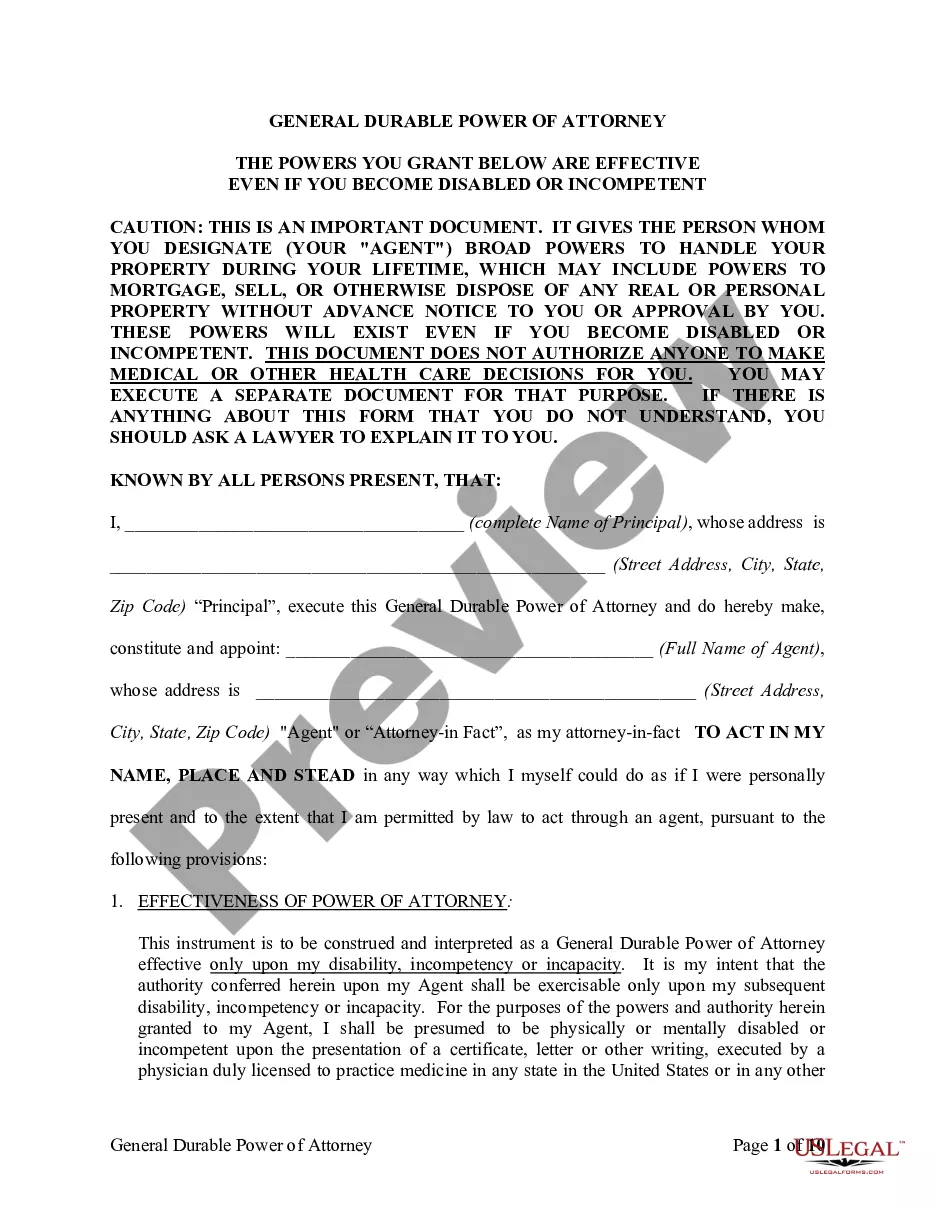
Ohio New Resident Guide
Overview of this form
The New Resident Guide is a comprehensive resource designed for individuals relocating to a new state. This guide provides essential information on residency requirements, voter registration, identification cards, driver's licenses, and vehicle registration. Unlike other forms that only cover specific aspects of relocation, this guide serves as a consolidated reference to help new residents navigate the legal landscape of their new home state effectively.
What’s included in this form
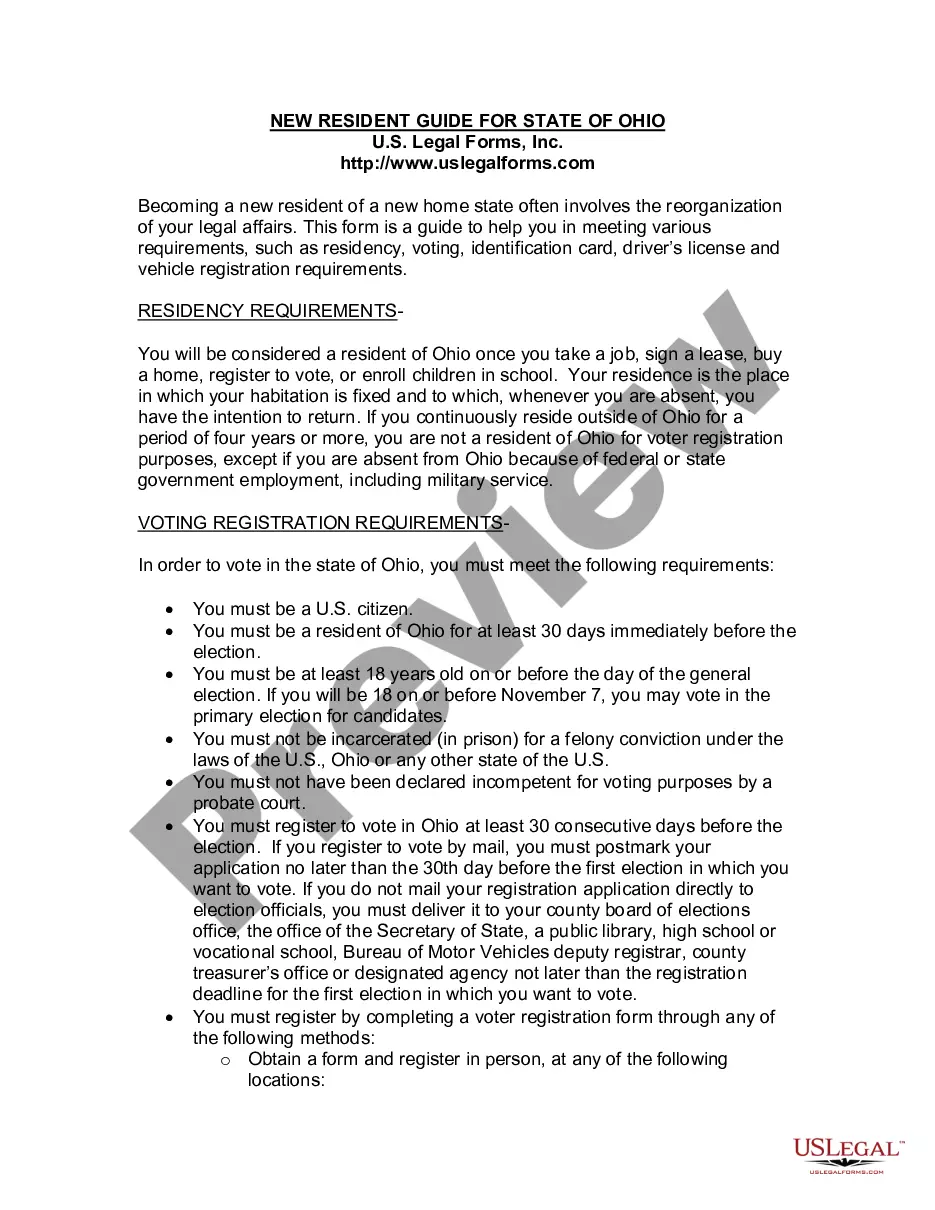
- Residency Requirements: Conditions that establish your residency in the state.
- Voting Registration Requirements: Steps to register for voting, including deadlines and eligibility criteria.
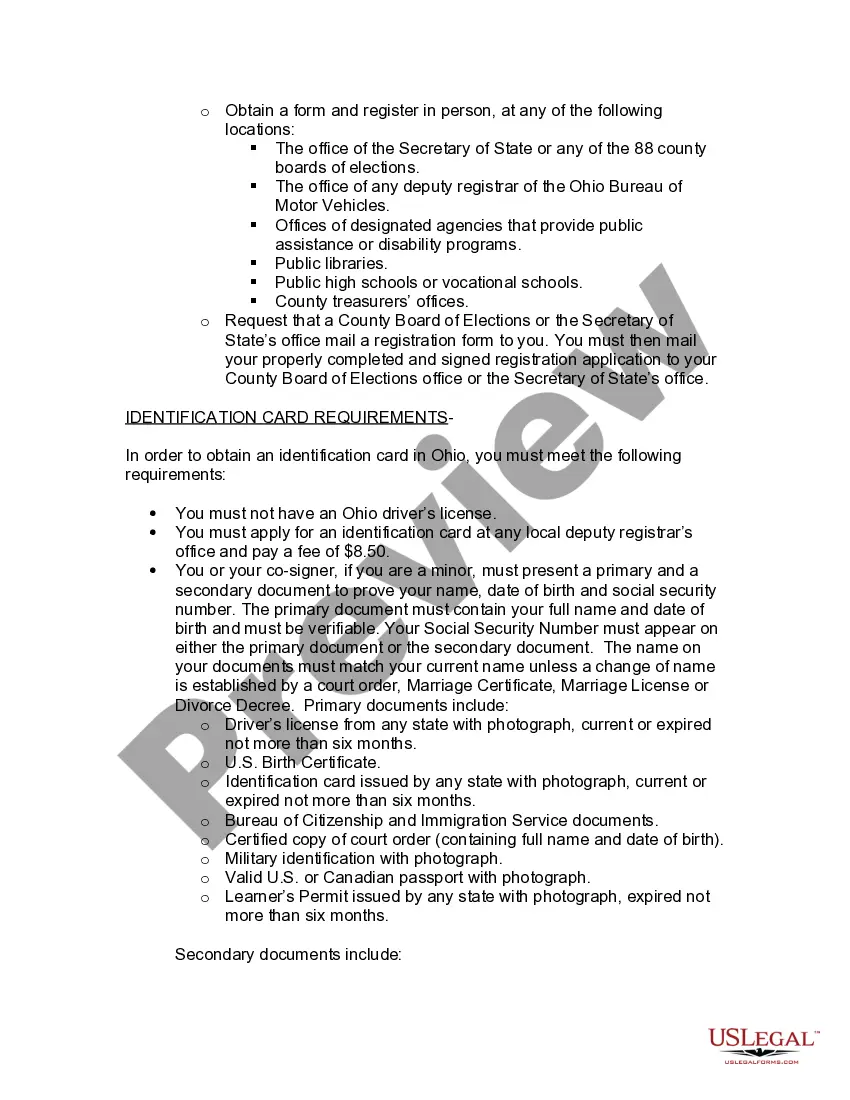
- Identification Card Requirements: Essentials for obtaining a state identification card.
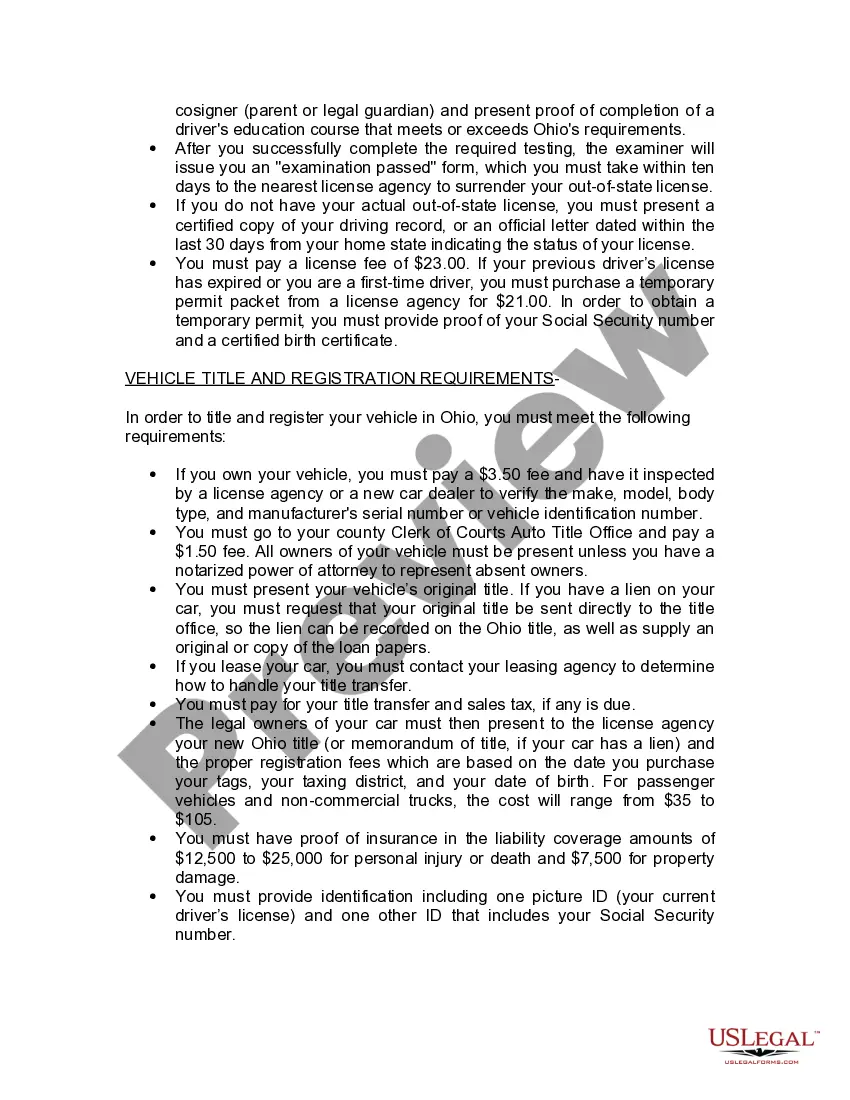
- Driver's License Requirements: Procedures for acquiring an Ohio driver's license, including testing and documentation.
- Vehicle Title and Registration Requirements: Guidelines to title and register a vehicle in the new state.












Common use cases
This form is particularly useful for individuals who have recently moved to a new state and need to understand the legal requirements for establishing residency, voting, and registering their vehicles. It is also helpful for those transitioning from out-of-state and requires a structured guide to complete necessary legal tasks in their new location.
Who can use this document
- Individuals who have recently relocated to a new state.
- New residents seeking to register to vote.
- Those who need to obtain a state-issued identification or driver's license.
- People looking to register their vehicles in a new state.
Completing this form step by step
- Review the residency requirements to establish your legal presence in Ohio.
- Complete your voter registration at least 30 days before the election by submitting the necessary forms.
- Gather primary and secondary documents for obtaining an identification card or driver's license.
- Visit the appropriate state agencies for vehicle title transfer and registration, ensuring all owners are present if applicable.
- Pay any required fees associated with identification, licensing, and vehicle registration.
Does this document require notarization?
This form does not typically require notarization unless specified by local law. However, some documents related to vehicle registration and title transfers may need additional notarization depending on the guidelines set forth by state authorities.
Get your form ready online
Our built-in tools help you complete, sign, share, and store your documents in one place.
Make edits, fill in missing information, and update formatting in US Legal Forms—just like you would in MS Word.
Download a copy, print it, send it by email, or mail it via USPS—whatever works best for your next step.
Sign and collect signatures with our SignNow integration. Send to multiple recipients, set reminders, and more. Go Premium to unlock E-Sign.
If this form requires notarization, complete it online through a secure video call—no need to meet a notary in person or wait for an appointment.
We protect your documents and personal data by following strict security and privacy standards.

Make edits, fill in missing information, and update formatting in US Legal Forms—just like you would in MS Word.

Download a copy, print it, send it by email, or mail it via USPS—whatever works best for your next step.

Sign and collect signatures with our SignNow integration. Send to multiple recipients, set reminders, and more. Go Premium to unlock E-Sign.

If this form requires notarization, complete it online through a secure video call—no need to meet a notary in person or wait for an appointment.

We protect your documents and personal data by following strict security and privacy standards.
Avoid these common issues
- Failing to register to vote at least 30 days before an election.
- Not bringing required documentation for identification or driver's license applications.
- Missing deadlines for vehicle title transfers after moving to Ohio.
- Overlooking specific residency requirements unique to Ohio.
Why complete this form online
- Convenience: Access the New Resident Guide from anywhere, at any time.
- Editability: Download and customize the forms according to your needs.
- Reliability: Ensure compliance with up-to-date legal standards and state requirements.
- Used as a guiding document to help new residents understand their legal obligations.
- Valid and enforceable as long as the required procedures are followed according to Ohio law.
Key takeaways
- The New Resident Guide is essential for understanding legal responsibilities in a new state.
- Confirm residency, voter registration, and identification needs promptly upon moving.
- Be aware of state-specific requirements to ensure compliance with local laws.
- Utilizing this guide can streamline the transition into a new residence.
Looking for another form?






Form popularity
FAQ
Have a parent or legal guardian that is an Ohio resident, whom you live with at least half the year. Have lived in Ohio for 12 consecutive months immediately preceding enrollment or applying for the reduced rate.
An independent person who is living and is gainfully employed on a full-time or part-time and self-sustaining basis in Ohio and who is pursuing a part-time program of instruction at an institution of higher education and has not resided in the state for 12 months shall be considered a resident of Ohio for these
Full legal name. Date of birth. Legal presence in the US. Social Security number (SSN) Ohio street address TWO documents, from different sources, proving Ohio street address that are listed on the Acceptable Document List are required for proof of Ohio residency. Proof of name change (if applicable)
Typical factors states use to determine residency. Often, a major determinant of an individual's status as a resident for income tax purposes is whether he or she is domiciled or maintains an abode in the state and are present" in the state for 183 days or more (one-half of the tax year).
Generally, any individual with an abode in Ohio is presumed to be a resident. The abode can be either owned or rented. Temporary absence from your Ohio abode, no matter how long, does not change your residency status.Nonresident: You are a nonresident if you were a resident of another state for the entire tax year.
2. What are the requirements for establishing Ohio residency for tuition purposes? The student is expected to live in Ohio for a full 12 consecutive months immediately preceding the term for which he/she is applying for residency.
You know typically things like utility bills, a bank statement, insurance policy statement. If your current Ohio driver's license has your current residence address, that can be used as one proof of address."
A bona fide residency requirement asks a person to establish that she actually lives at a certain location and usually is demonstrated by the address listed on a driver's license, a voter registration card, a lease, an income tax return, property tax bills, or utilities bills.
Have a parent or legal guardian that is an Ohio resident, whom you live with at least half the year. Have lived in Ohio for 12 consecutive months immediately preceding enrollment or applying for the reduced rate.