Ohio Protecting Deceased Persons from Identity Theft
What this form package covers
The Ohio Protecting Deceased Persons from Identity Theft form package is designed to help families secure the identity of their deceased loved ones. This comprehensive package offers essential forms that assist in notifying creditors, government agencies, and other entities about a person's death and the potential misuse of their identifying information. With these unique forms, users can take proactive steps to mitigate the risk of identity theft after the passing of an individual, providing peace of mind during a difficult time.
Documents contained in this package
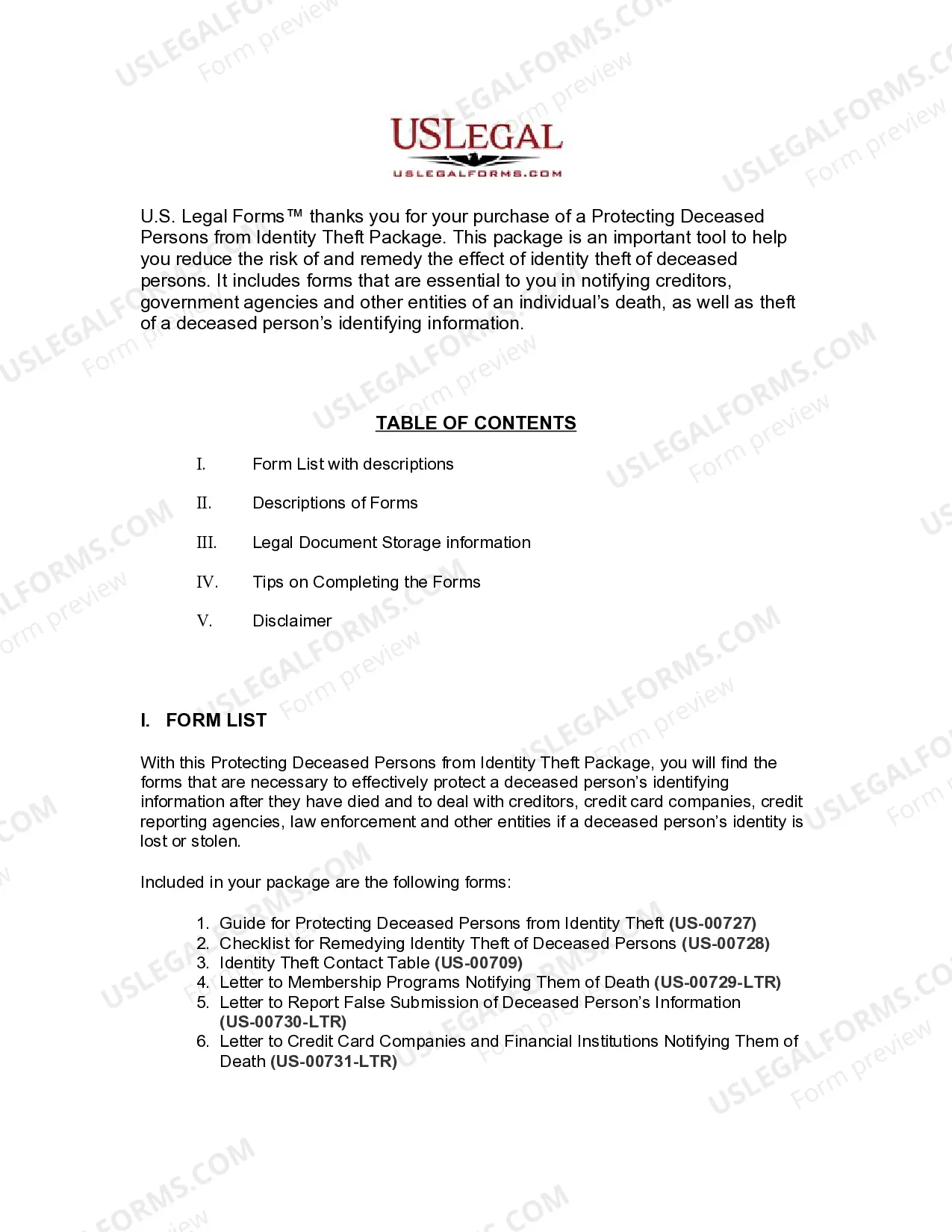
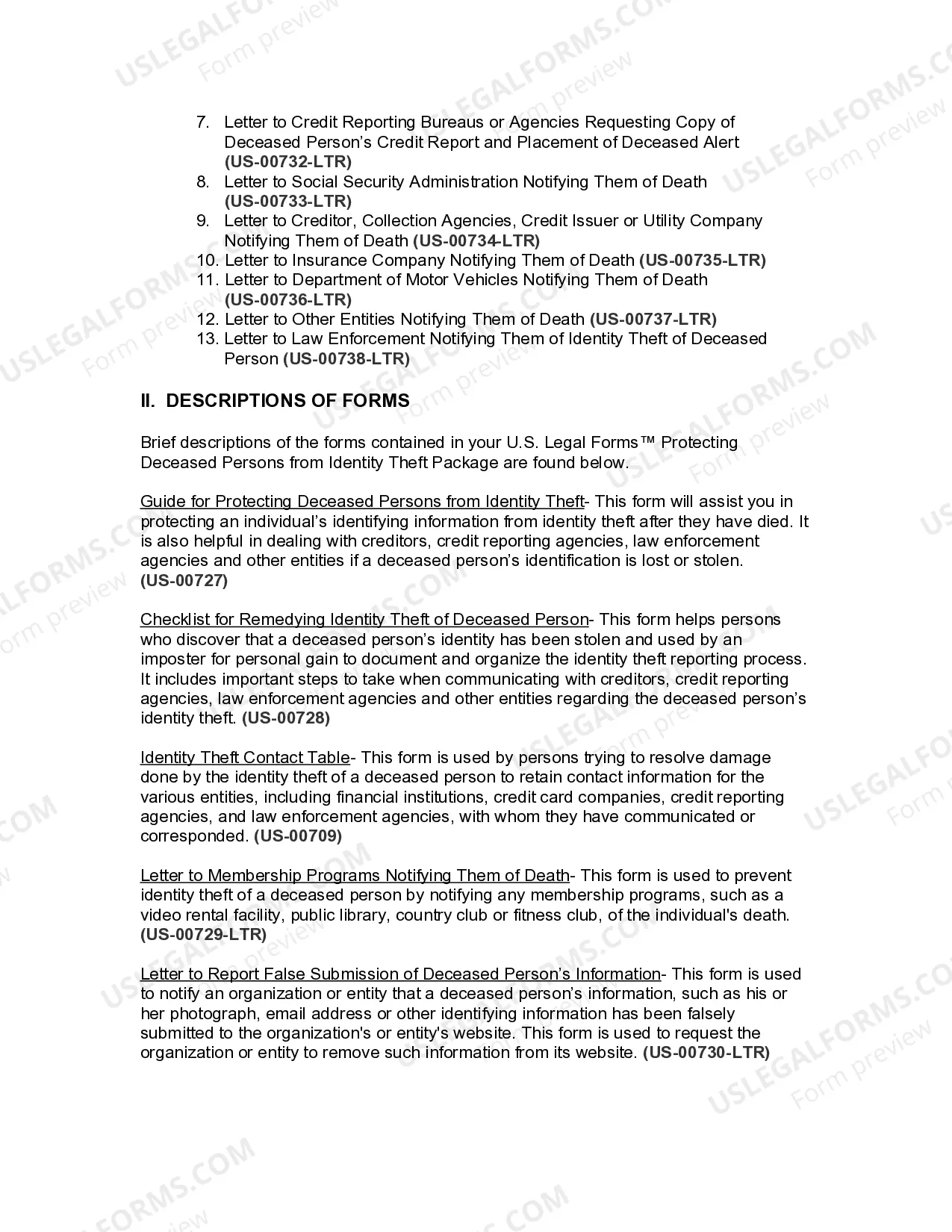
- Identity Theft Contact Table
- Guide for Protecting Deceased Persons from Identity Theft
- Checklist for Remedying Identity Theft of Deceased Persons
- Letter to Membership Programs Notifying Them of Death
- Letter to Report False Submission of Deceased Person's Information
- Letter to Credit Card Companies and Financial Institutions Notifying Them of Death
- Letter to Credit Reporting Bureaus or Agencies Requesting Copy of Deceased Person's Credit Report and Placement of Deceased Alert
- Letter to Social Security Administration Notifying Them of Death
- Letter to Creditor, Collection Agencies, Credit Issuer or Utility Company Notifying Them of Death
- Letter to Insurance Company Notifying Them of Death
- Letter to Department of Motor Vehicles Notifying Them of Death
- Letter to Other Entities Notifying Them of Death
- Letter to Law Enforcement Notifying Them of Identity Theft of Deceased Person


Common use cases
This form package is needed in various situations, including:
- After the death of a family member or loved one, to prevent identity theft.
- When discovering fraudulent use of a deceased individual's information.
- When addressing outstanding financial matters related to a deceased person.
- In the process of dealing with creditors and credit reporting agencies regarding a deceased's account.
Who should use this form package
- Family members and heirs of the deceased.
- Personal representatives handling estate matters.
- Close friends who need to manage the identity and financial affairs of a deceased individual.
- Anyone responsible for notifying various entities about the death of a person.
Instructions for completing these forms
- Review the included forms and instructions carefully.
- Identify the deceased individual's personal details to include, such as full name and date of death.
- Fill out each form accurately with the required information.
- Send the completed forms to the relevant entities, such as financial institutions, credit bureaus, and government agencies.
- Keep copies of all correspondence for your records.
Notarization requirements for forms in this package
Notarization is generally not required for forms in this package. However, specific circumstances or local laws may require it. You can complete notarization remotely through US Legal Forms, powered by Notarize, with 24/7 availability.
Get your form ready online
Our built-in tools help you complete, sign, share, and store your documents in one place.
Make edits, fill in missing information, and update formatting in US Legal Forms—just like you would in MS Word.
Download a copy, print it, send it by email, or mail it via USPS—whatever works best for your next step.
Sign and collect signatures with our SignNow integration. Send to multiple recipients, set reminders, and more. Go Premium to unlock E-Sign.
If this form requires notarization, complete it online through a secure video call—no need to meet a notary in person or wait for an appointment.
We protect your documents and personal data by following strict security and privacy standards.

Make edits, fill in missing information, and update formatting in US Legal Forms—just like you would in MS Word.

Download a copy, print it, send it by email, or mail it via USPS—whatever works best for your next step.

Sign and collect signatures with our SignNow integration. Send to multiple recipients, set reminders, and more. Go Premium to unlock E-Sign.

If this form requires notarization, complete it online through a secure video call—no need to meet a notary in person or wait for an appointment.

We protect your documents and personal data by following strict security and privacy standards.
Mistakes to watch out for
- Failing to notify all necessary agencies and creditors.
- Not providing complete information in the forms.
- Overlooking the importance of keeping copies of submitted forms.
- Assuming all forms are optional; many are essential for preventing identity theft.
Why use this package online
- Convenience of downloading forms from home.
- Editable fields for easy and accurate completion.
- Access to up-to-date legal forms created by licensed attorneys.
- Potential cost savings compared to purchasing forms individually.
Looking for another form?
Form popularity
FAQ
Financial identity theft. Tax identity theft. Medical identity theft. Employment identity theft. Child identity theft. Senior identity theft.
Financial Identity Theft. Financial identity theft is by far the most common type of identity theft. Medical Identity Theft. Criminal Identity Theft. Child Identity Theft. Identity Cloning & Concealment. Synthetic Identity Theft. Mitigate Your Risk.
Account Takeover Fraud. Debit Card Fraud or Credit Card Fraud. Driver's License Identity Theft. Mail Identity Theft. Online Shopping Fraud. Social Security Number Identity Theft. Senior Identity Theft and Scams. Child Identity Theft.
Financial identity theft. This is the most common form of identity theft -- when someone uses another person's information for financial gain. For instance, a fraudster may use your bank account or credit card numbers to steal money or make purchases, or use your Social Security number to open a new credit card.
1Limit the amount of personal information you share about the deceased in newspaper and online obituaries.2Notify the Social Security Administration of the death.3Send the IRS a copy of the death certificate so that the agency can note that the person is deceased.What is Ghosting? One More Form of Identity Theft - LifeLock\nwww.lifelock.com > learn-identity-theft-resources-what-is-ghosting-one-m...
Identity thieves can also use your identity when they commit other crimes, such as entering (or exiting) a country illegally, trafficking drugs, smuggling other substances, committing cyber crimes, laundering money and much more. In fact, they can use your identity to commit almost any crime imaginable in your name.
The four types of identity theft include medical, criminal, financial and child identity theft.
Identity Theft of a Deceased PersonIdentity thieves can get personal information about deceased individuals by reading obituaries, stealing death certificates, or searching genealogy websites that sometimes provide death records from the Social Security Death Index.
Financial Identity Theft. Driver's License Identity Theft. Criminal Identity Theft. Social Security Identity Theft. Medical Identity Theft. Insurance Identity Theft. Child Identity Theft. Synthetic Identity Theft.