New York Renunciation of Voluntary Administration
About this form
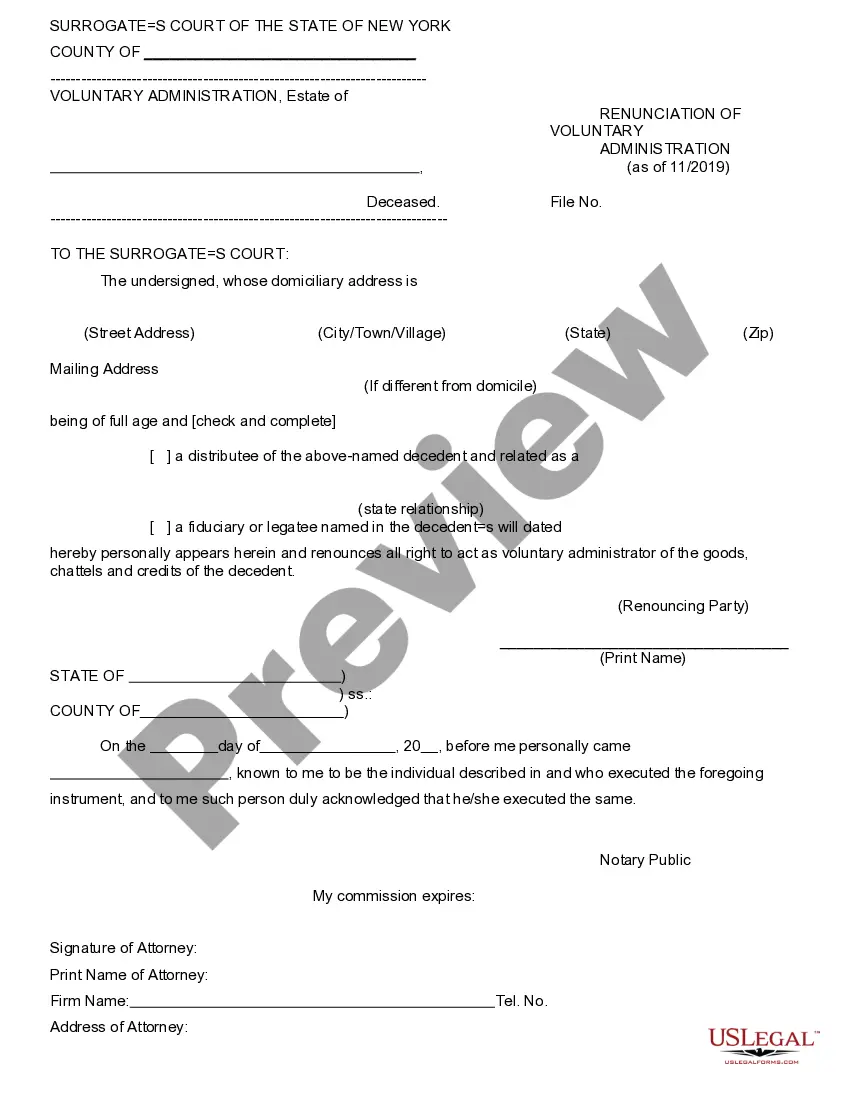
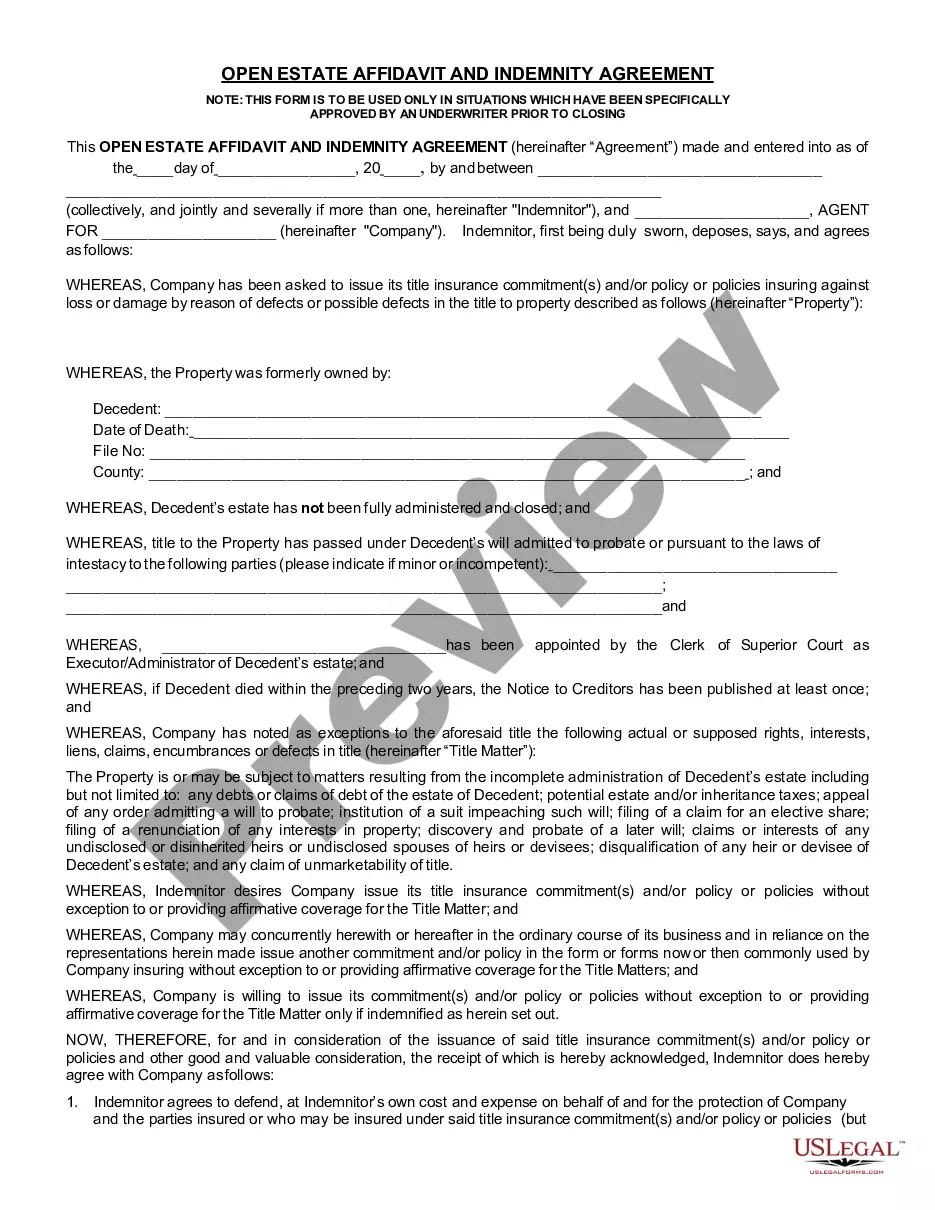
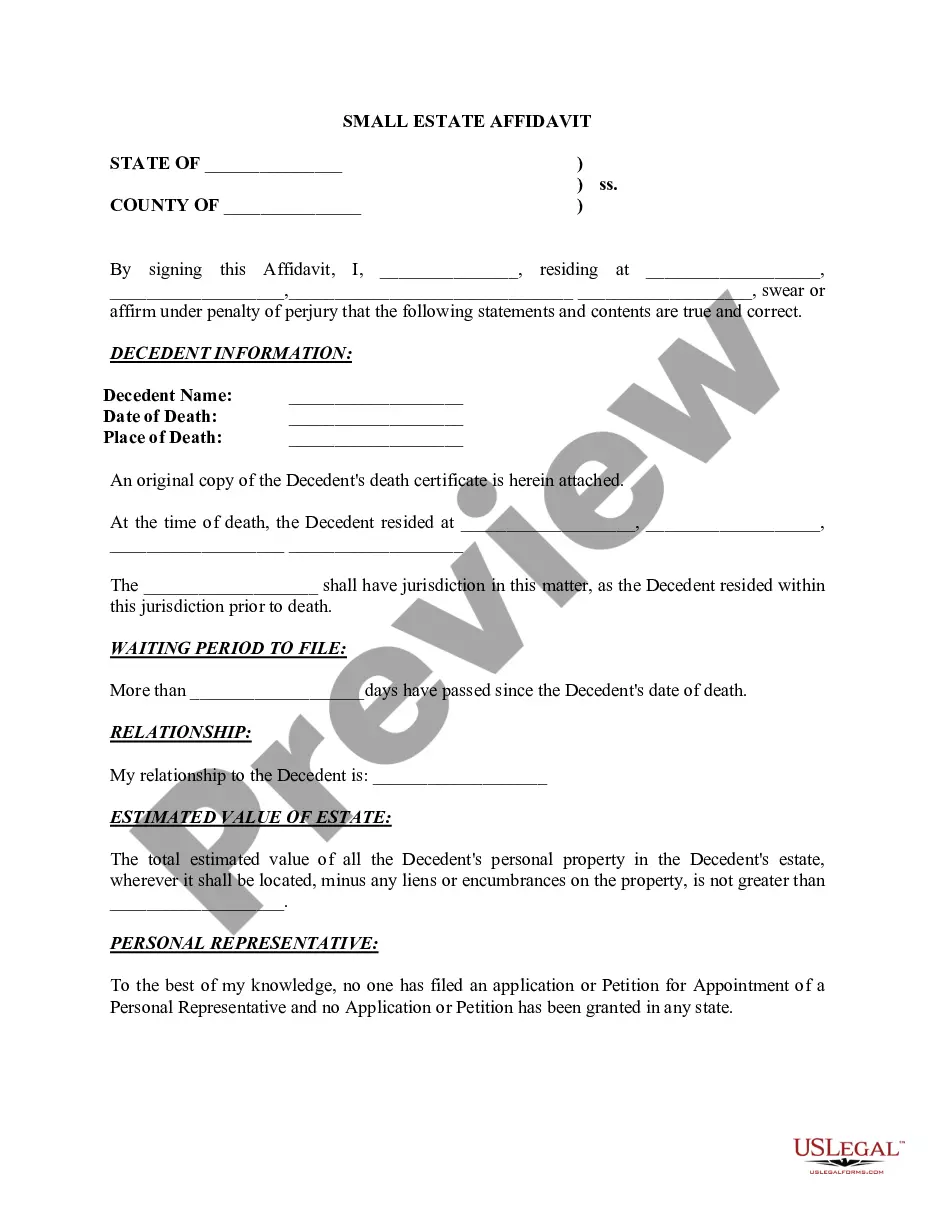
The renunciation of voluntary administration is an official form from the New York State Unified Court, designed for individuals who wish to renounce their role in a voluntary administration regarding estate matters. This form helps clarify the intent to withdraw from previously accepted responsibilities, distinguishing it from other estate-related forms. It ensures compliance with New York laws and provides a legal framework for the renunciation process.
Key parts of this document
- Identification of the renouncing party.
- Statement of the intent to renounce voluntary administration.
- Signature and date fields for the renouncing party.
- Section for notarization to authenticate the form.
- Contact information for the renouncing party.

When to use this form
This form is typically used when an individual involved in a voluntary administration decides to step back from their duties. Examples include circumstances where the administrator is unable to fulfill their obligations or wishes to withdraw for personal reasons. Filing this form ensures that the court and other interested parties are aware of the change in administration responsibilities.
Intended users of this form
This form is appropriate for:
- Individuals currently serving as voluntary administrators in New York.
- Those who wish to formally renounce their administrative powers over an estate.
- Beneficiaries or interested parties needing clarity about administration roles.
Steps to complete this form
- Identify the renouncing party and include their contact information.
- Clearly state the intent to renounce voluntary administration.
- Fill in the date of the renunciation.
- Sign the form in the designated area.
- Have the form notarized to validate the renunciation.
Is notarization required?
Notarization is not commonly needed for this form. However, certain documents or local rules may make it necessary. Our notarization service, powered by Notarize, allows you to finalize it securely online anytime, day or night.
Get your form ready online
Our built-in tools help you complete, sign, share, and store your documents in one place.
Make edits, fill in missing information, and update formatting in US Legal Forms—just like you would in MS Word.
Download a copy, print it, send it by email, or mail it via USPS—whatever works best for your next step.
Sign and collect signatures with our SignNow integration. Send to multiple recipients, set reminders, and more. Go Premium to unlock E-Sign.
If this form requires notarization, complete it online through a secure video call—no need to meet a notary in person or wait for an appointment.
We protect your documents and personal data by following strict security and privacy standards.

Make edits, fill in missing information, and update formatting in US Legal Forms—just like you would in MS Word.

Download a copy, print it, send it by email, or mail it via USPS—whatever works best for your next step.

Sign and collect signatures with our SignNow integration. Send to multiple recipients, set reminders, and more. Go Premium to unlock E-Sign.

If this form requires notarization, complete it online through a secure video call—no need to meet a notary in person or wait for an appointment.

We protect your documents and personal data by following strict security and privacy standards.
Common mistakes
- Failing to properly fill in all necessary fields.
- Not notarizing the form when required.
- Not providing complete contact information for the renouncing party.
- Confusing this form with other estate forms.
Why complete this form online
- Convenience of downloading and completing the form from home.
- Editability allows for easy corrections and updates before final submission.
- Access to legally compliant templates crafted by licensed attorneys.
- Guidance on completing the form accurately and efficiently.
Quick recap
- The renunciation of voluntary administration form is crucial for those wanting to withdraw from their administrative role.
- Proper completion and notarization are essential for legal validity.
- Using this form online offers many advantages, including ease of access and the ability to edit.
- Understanding state specifics, particularly in New York, is vital when filing.
Looking for another form?
Form popularity
FAQ
CLOSING THE ESTATE: FORM 207.42 must be prepared and executed by the fiduciary and the attorney and filed after 7 months or by the end of 2 years from the date of fiduciary appointment. RELEASES from all beneficiaries of the estate must be executed and filed at this time, if not already filed.
1) Petition the court to be the estate representative. 2) Notify heirs and creditors. 3) Change legal ownership of assets. 4) Pay Funeral Expenses, Taxes, Debts and Transfer assets to heirs.
Voluntary administration is a process designed to give a company 'breathing space' from its normal operations. When a company is experiencing financial difficulty and cannot pay its debts, the company directors can appoint someone called an administrator.
Generally, an executor has 12 months from the date of death to distribute the estate. This is known as 'the executor's year'. However, for various reasons the executor may have been delayed and has not distributed the estate within this time frame.
A: You may need to clarify what type of administration you are referring to, but if you are asking about administration of a decedent's estate, then renunciation refers to giving up your right to be qualified as the Administrator of the estate.
A voluntary administration, also referred to as a small estate proceeding, is a court proceeding on death for personal property worth $30,000 or less, and is used whether or not the decedent had a will.The voluntary administration aims to simplify the court process if your estate is smaller in value.
Essentially, most letters of administration can last forever.Look at an example of letters of administration there is no expiration date on it. With many courts in New York, one for each county, rules may vary from court to court.
Notify all creditors. File tax returns and pay final taxes. File the final accounting with the probate court. Distribute remaining assets to beneficiaries. File a closing statement with the court.
How Long to Settle an Estate in New York? The short answer: from 7 months to 3 years. Typically 9 months. Estate settlement (also known as estate administration) is the phase during which you, as the court-appointed executor, must collect the estate assets, organize and pays debts, and file all final taxes.