New Mexico Acknowledgment of a Mark
Understanding this form
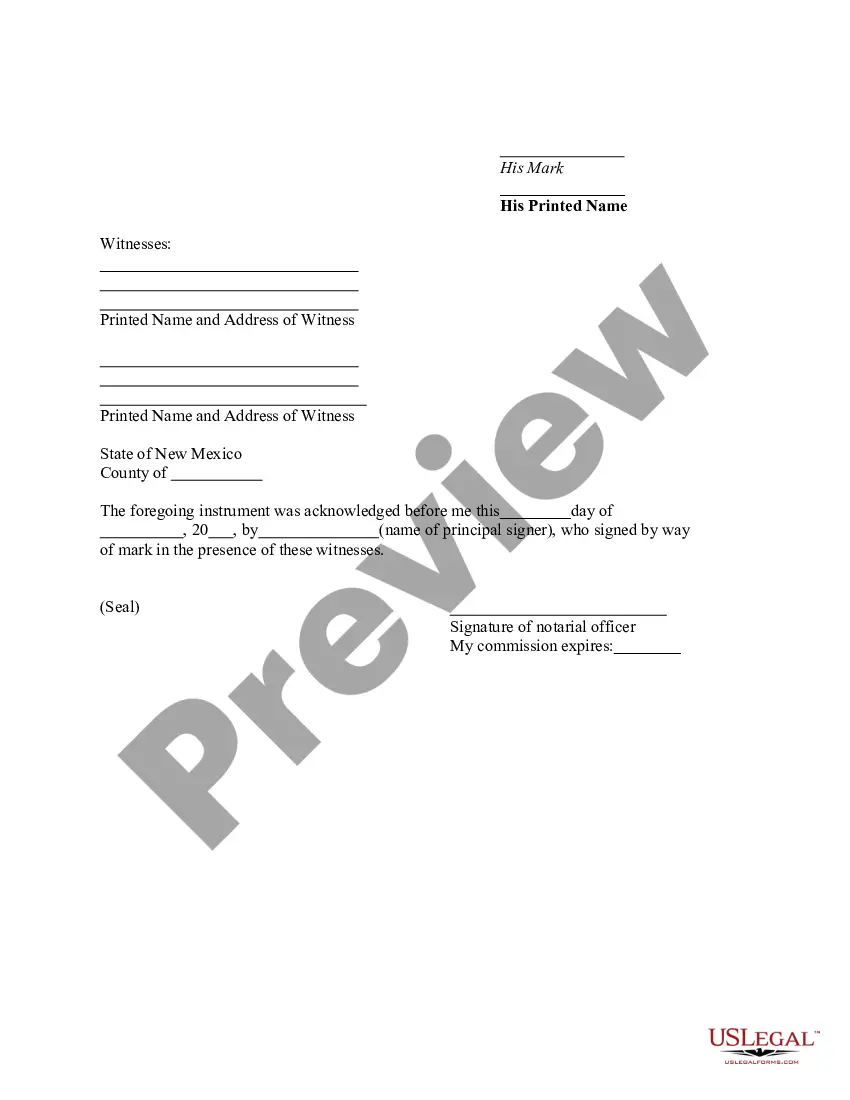
The Acknowledgment of a Mark is a legal document that recognizes a person's mark, which may be a signature made by an individual who is unable to sign their name. This form also serves as an official record of the act, confirming the identity of the signatory and the acknowledgment of the mark in the presence of a notary public. Unlike other forms of signature verifications, this document specifically addresses situations where traditional signature methods are unfeasible due to various circumstances.
Key components of this form
- Identification of the signer and confirmation of the mark made.
- Witness sections for individuals who observed the act.
- Notary acknowledgment including the notarial officerâs signature and seal.
- State and county where the acknowledgment occurs.
- Printed name and address of the witnesses involved in the acknowledgment.

When to use this form
This form should be used when an individual needs to officially acknowledge their identity by marking instead of signing, often due to physical limitations or impairment. It is applicable in various legal and non-legal scenarios, including but not limited to executing documents, making agreements, and other important transactions where official recognition of a mark is required.
Who needs this form
- Individuals who are unable to write their signature due to physical limitations.
- Parties involved in legal proceedings who require a formal acknowledgment of a mark for documentation.
- Witnesses who attest to the act of marking and must provide identifying information.
- Notaries public who are responsible for notarizing the document.
Steps to complete this form
- Identify the individual who will mark the document and have them state their name.
- Confirm the presence of the witnesses and have their names prepared to include on the form.
- Complete the acknowledgment section, including the date and location of the signing.
- Ensure a notary public is present to notarize the document, providing their signature and seal afterward.
- Have witnesses sign and include their printed names and addresses as required.
Is notarization required?
Yes, this form must be notarized to be legally valid. The acknowledgment of the mark should be done in the presence of a notary public who will verify the identity of the individual marking the document.
Get your form ready online
Our built-in tools help you complete, sign, share, and store your documents in one place.
Make edits, fill in missing information, and update formatting in US Legal Forms—just like you would in MS Word.
Download a copy, print it, send it by email, or mail it via USPS—whatever works best for your next step.
Sign and collect signatures with our SignNow integration. Send to multiple recipients, set reminders, and more. Go Premium to unlock E-Sign.
If this form requires notarization, complete it online through a secure video call—no need to meet a notary in person or wait for an appointment.
We protect your documents and personal data by following strict security and privacy standards.

Make edits, fill in missing information, and update formatting in US Legal Forms—just like you would in MS Word.

Download a copy, print it, send it by email, or mail it via USPS—whatever works best for your next step.

Sign and collect signatures with our SignNow integration. Send to multiple recipients, set reminders, and more. Go Premium to unlock E-Sign.

If this form requires notarization, complete it online through a secure video call—no need to meet a notary in person or wait for an appointment.

We protect your documents and personal data by following strict security and privacy standards.
Typical mistakes to avoid
- Failing to have the document signed in the presence of the required number of witnesses.
- Not obtaining a notary's signature or seal, making the document invalid.
- Skipping the inclusion of the printed name and address of witnesses.
- Inaccurately filling out the state and county information.
Why complete this form online
- Immediate access to customizable templates suitable for various legal situations.
- Ability to modify and save your document securely for future use.
- Assurance that forms are prepared by licensed attorneys to comply with legal standards.
- Convenient, on-demand download options to avoid delays in legal processes.
Main things to remember
- The Acknowledgment of a Mark is crucial for individuals unable to sign.
- Witnesses are essential to validate the mark's authenticity.
- Notarization is a mandatory step for the document's legal acceptance.
- Each state may have specific rules regarding the execution of this form.
Looking for another form?
Form popularity
FAQ
The purpose of an acknowledgment is for a signer, whose identity has been verified, to declare to a Notary or notarial officer that he or she has willingly signed a document. Click to expand.The signer must declare (acknowledge) signing the document for its intended purpose.
New Mexico allows Notaries to charge no more than $5 per notarial act. An additional fee for travel can be charged as long as the signer agrees to it in advance and understands the travel fee is separate from the notarial fee.
Step 1: Require Personal Appearance. Step 2: Check Over The Document. Step 3: Carefully Identify The Signer. Step 4: Record Your Journal Entry. Step 5: Complete The Notarial Certificate. A Last Note: Never Give Advice.
If the document has already been signed, the signer can sign his or her name again above or next to the first signature. You can then proceed with the notarization. You may want to notate in your journal that the signer was instructed to sign again in your presence.
A witness is brought in during the signing of a document to physically observe the parties sign it. Witnesses should be able to confirm the identity of both parties. They then sign the document as a witness to confirm that they saw each party sign.
Require Personal Appearance. Review The Document. Screen The Signer And Verify The Facts. Record The Notarization. Complete The Notarization.
They key difference is that for a signature witnessing, the signer must always sign the document in the Notary's presence.An acknowledgment, on the other hand, does not require the Notary to witness the signature in most states (one exception is Maryland).
The certificate of a notary public, justice of the peace, or other authorized officer, attached to a deed, mortgage, or other instrument, setting forth that the parties thereto personally appeared before him on such a date and acknowledged the instrument to be their free and voluntary act and deed. Read v.
The purpose of an acknowledgment is for a signer, whose identity has been verified, to declare to a Notary or notarial officer that he or she has willingly signed a document.The signer may either sign the document before appearing before you, or in your presence.