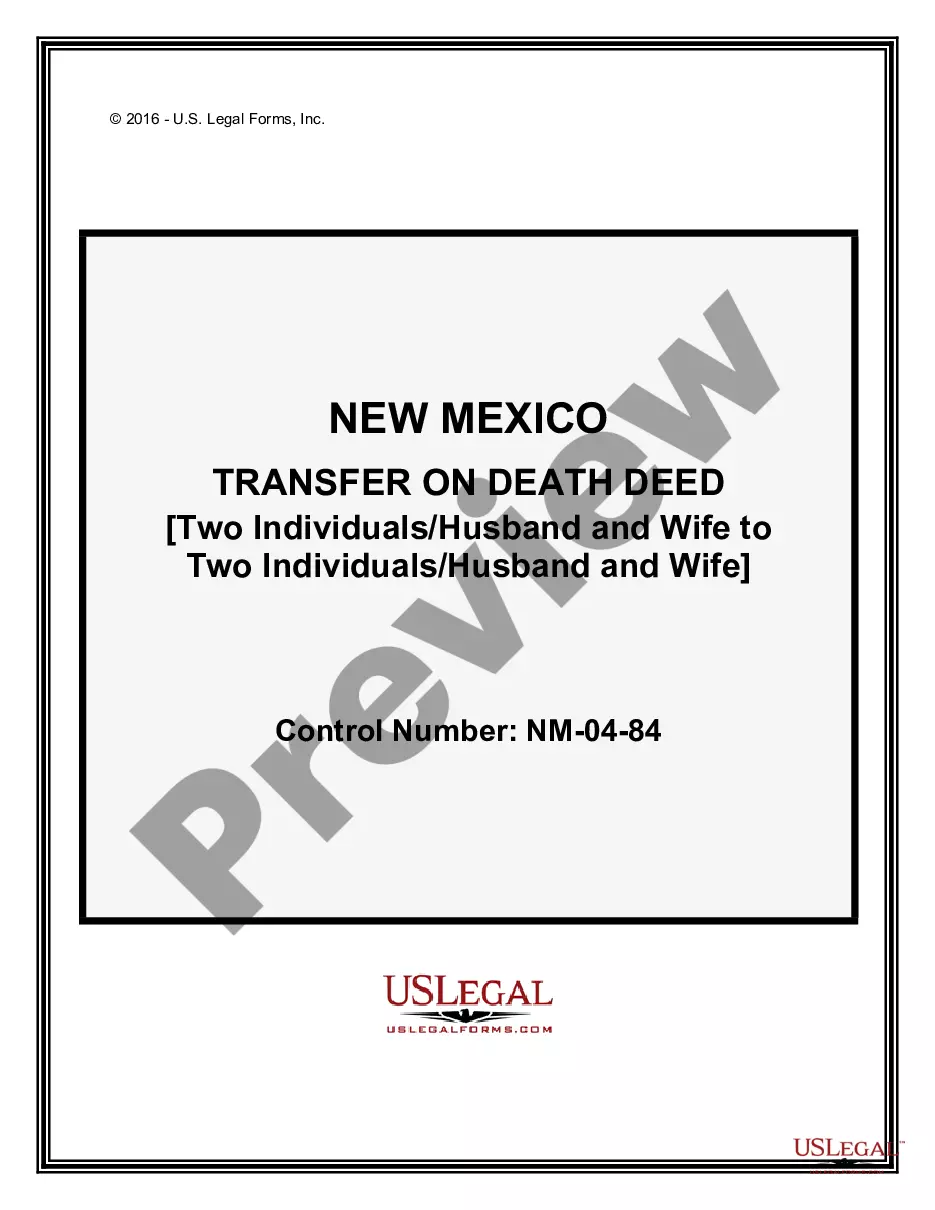
New Mexico Transfer on Death Deed from Two Individuals / Husband and Wife to Two Individuals / Husband and Wife
Understanding this form
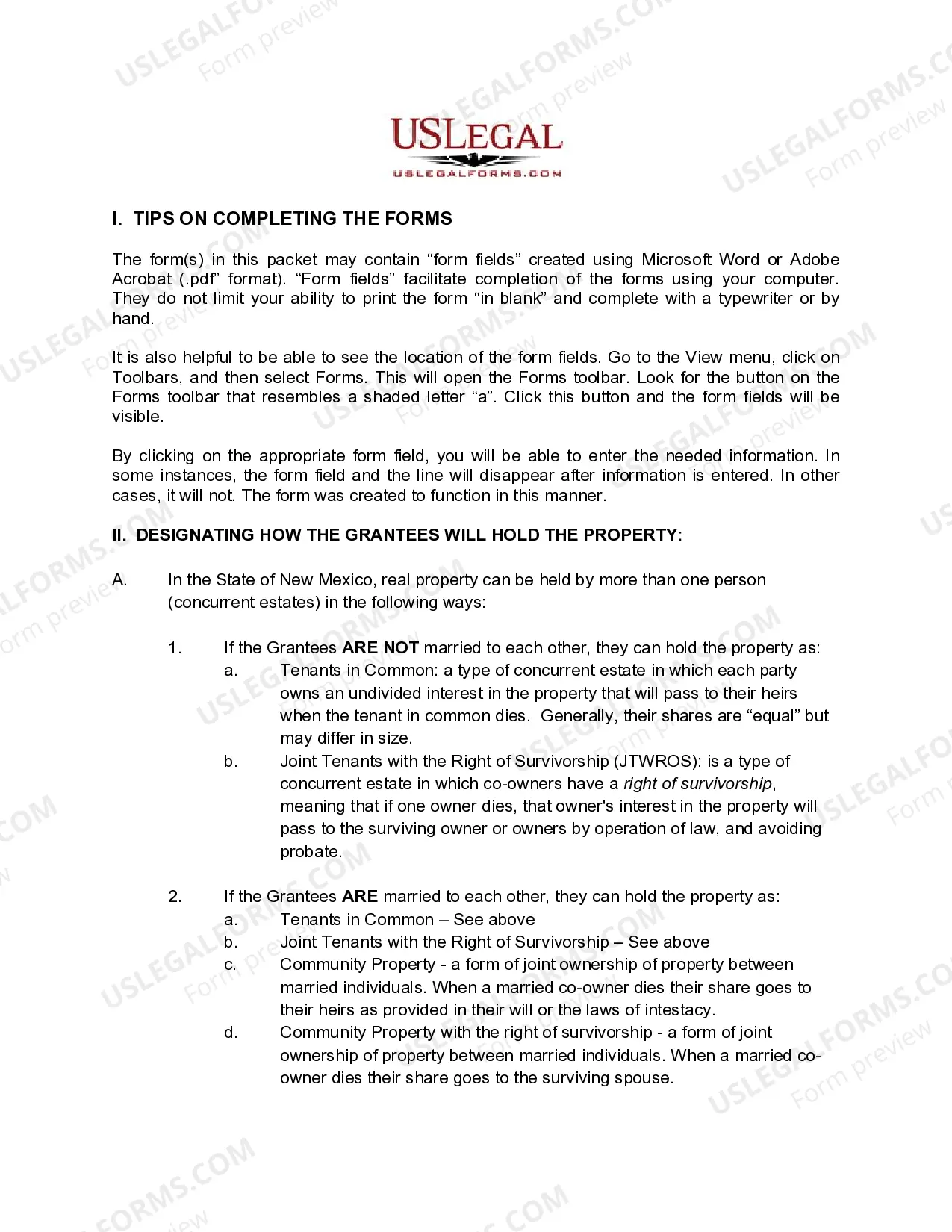
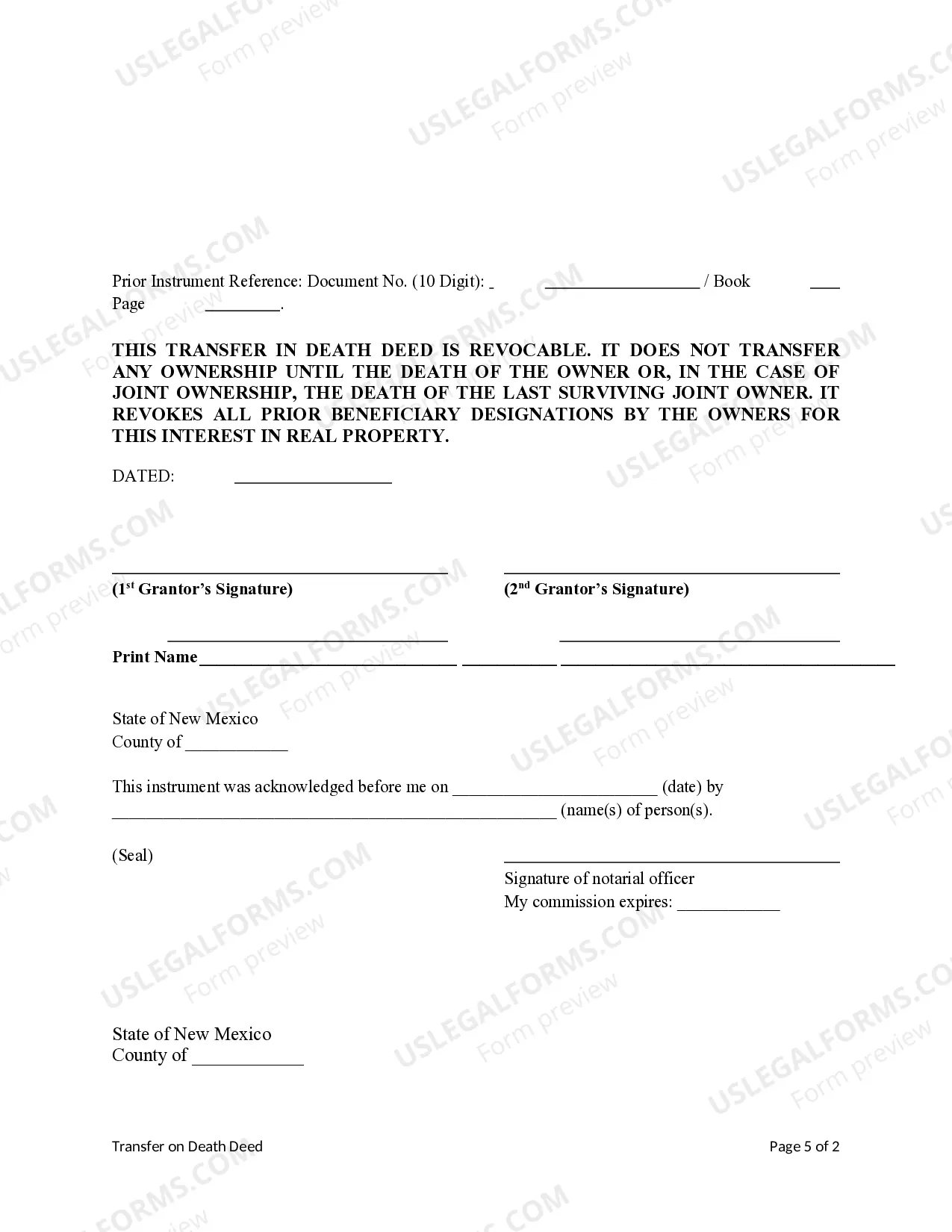
This form is a Transfer on Death Deed designed for two individuals, such as a husband and wife, to transfer property ownership upon death. Unlike traditional property transfers, this deed allows grantors to maintain control over the property during their lifetime, revocable until the death of the last surviving grantor. Upon their passing, the property transfers directly to the grantees, either as tenants in common or joint tenants with rights of survivorship. This ensures that the transfer complies fully with state statutory laws.
Key parts of this document
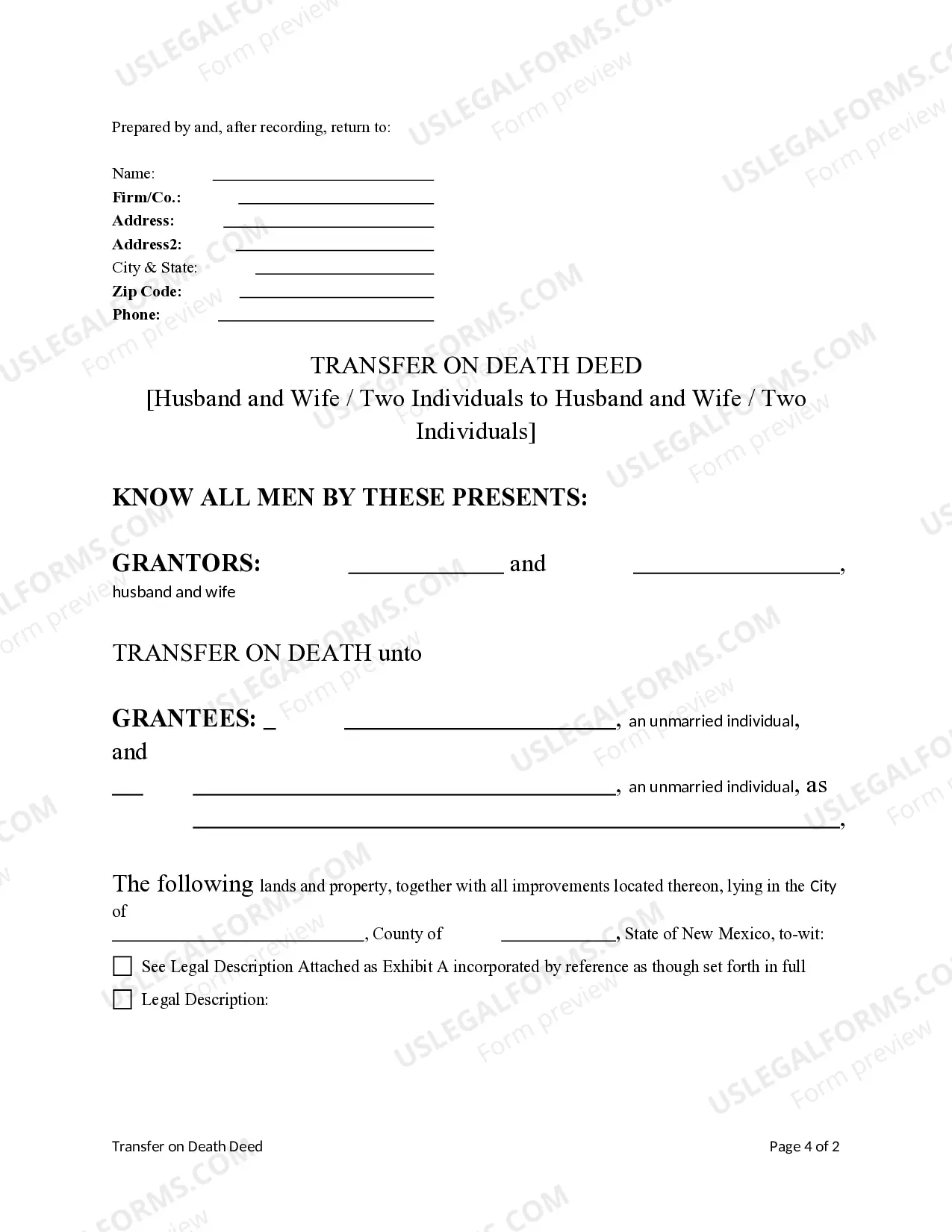
- Identification of the grantors (the owners) and grantees (the beneficiaries).
- Specification of the property being transferred.
- Choice of ownership type for the grantees (e.g., tenants in common or joint tenants with rights of survivorship).
- Revocation clause allowing grantors to change the deed before their death.
- Legal compliance statement confirming adherence to state laws.




When this form is needed
This form is suitable when you want to ensure a smooth transfer of property to your spouse or another individual upon your death. It is ideal for couples who wish to avoid the probate process, allowing property to pass directly to the designated grantees. Consider using this deed if you want to retain control over your property until your passing while ensuring that your loved ones inherit without complication.
Intended users of this form
This form is intended for:
- Couples (husband and wife or two individuals) who jointly own property.
- Individuals looking for a way to transfer property upon their death without going through probate.
- People who want to designate specific individuals to inherit property in a straightforward manner.
Steps to complete this form
- Identify the parties involved: fill in the names of the grantors and grantees.
- Specify the property: include a clear description of the property being transferred.
- Select the ownership type: indicate how the grantees will hold the property (e.g., tenants in common, joint tenants).
- Complete the revocation clause: make sure to include details about revocability by the grantors.
- Sign and date the document appropriately to finalize the deed.
Notarization requirements for this form
Notarization is required for this form to take effect. Our online notarization service, powered by Notarize, lets you verify and sign documents remotely through an encrypted video session, available 24/7.
Get your form ready online
Our built-in tools help you complete, sign, share, and store your documents in one place.
Make edits, fill in missing information, and update formatting in US Legal Forms—just like you would in MS Word.
Download a copy, print it, send it by email, or mail it via USPS—whatever works best for your next step.
Sign and collect signatures with our SignNow integration. Send to multiple recipients, set reminders, and more. Go Premium to unlock E-Sign.
If this form requires notarization, complete it online through a secure video call—no need to meet a notary in person or wait for an appointment.
We protect your documents and personal data by following strict security and privacy standards.

Make edits, fill in missing information, and update formatting in US Legal Forms—just like you would in MS Word.

Download a copy, print it, send it by email, or mail it via USPS—whatever works best for your next step.

Sign and collect signatures with our SignNow integration. Send to multiple recipients, set reminders, and more. Go Premium to unlock E-Sign.

If this form requires notarization, complete it online through a secure video call—no need to meet a notary in person or wait for an appointment.

We protect your documents and personal data by following strict security and privacy standards.
Avoid these common issues
- Failing to accurately describe the property can lead to enforceability issues.
- Not clearly designating how grantees will hold the property.
- Omitting the revocation clause or misunderstanding its implications.
- Not signing the form properly, which may invalidate the deed.
- Ignoring local state laws concerning property transfer.
Why use this form online
- Convenience of completing the form from home without the need for a legal appointment.
- Editability allows users to customize the form to their specific needs.
- Access to expert-drafted content that ensures compliance with legal standards.
- Immediate download availability for quick access and use.
Looking for another form?
Form popularity
FAQ
In most cases, the surviving owner or heir obtains the title to the home, the former owner's death certificate, a notarized affidavit of death, and a preliminary change of ownership report form. When all these are gathered, the transfer gets recorded, the fees are paid, and the county issues a new title deed.
To transfer it, you will have to get a succession certificate (for moveable property) and a letter of administration (for Immoveable property). While doing so, get the son and daughter to give no objections in court that they have no objection if all the property is transferred to the widow.
Get a Deed Form or Prepare Your Own. You can buy a state-specific TOD deed form for your state or type up your own document. Name the Beneficiary. Describe the Property. Sign the Deed. Record the Deed.
TOD becomes effective for joint accounts if both owners pass away simultaneously. Joint and TOD registration generally allow an account to pass outside the probate estate, enabling the surviving owner or beneficiaries to avoid the time and expense of that process for this account.
When one co-owner dies, property that was held in joint tenancy with the right of survivorship automatically belongs to the surviving owner (or owners). The owners are called joint tenants.
To transfer it, you will have to get a succession certificate (for moveable property) and a letter of administration (for Immoveable property). While doing so, get the son and daughter to give no objections in court that they have no objection if all the property is transferred to the widow.
If you'd like to avoid having your property going through the probate process, it's a good idea to look into a transfer on death deed. A transfer on death deed allows you to select a beneficiary who will receive your property, but only when you've passed away.
The California TOD deed form allows property to be automatically transferred to a new owner when the current owner dies, without the need to go through probate. It also gives the current owner retained control over the property, including the right to change his or her mind about the transfer.
All you need to do is fill out a simple form, provided by the bank, naming the person you want to inherit the money in the account at your death. As long as you are alive, the person you named to inherit the money in a payable-on-death (POD) account has no rights to it.