New Jersey Aging Parent Package
What is this form package?
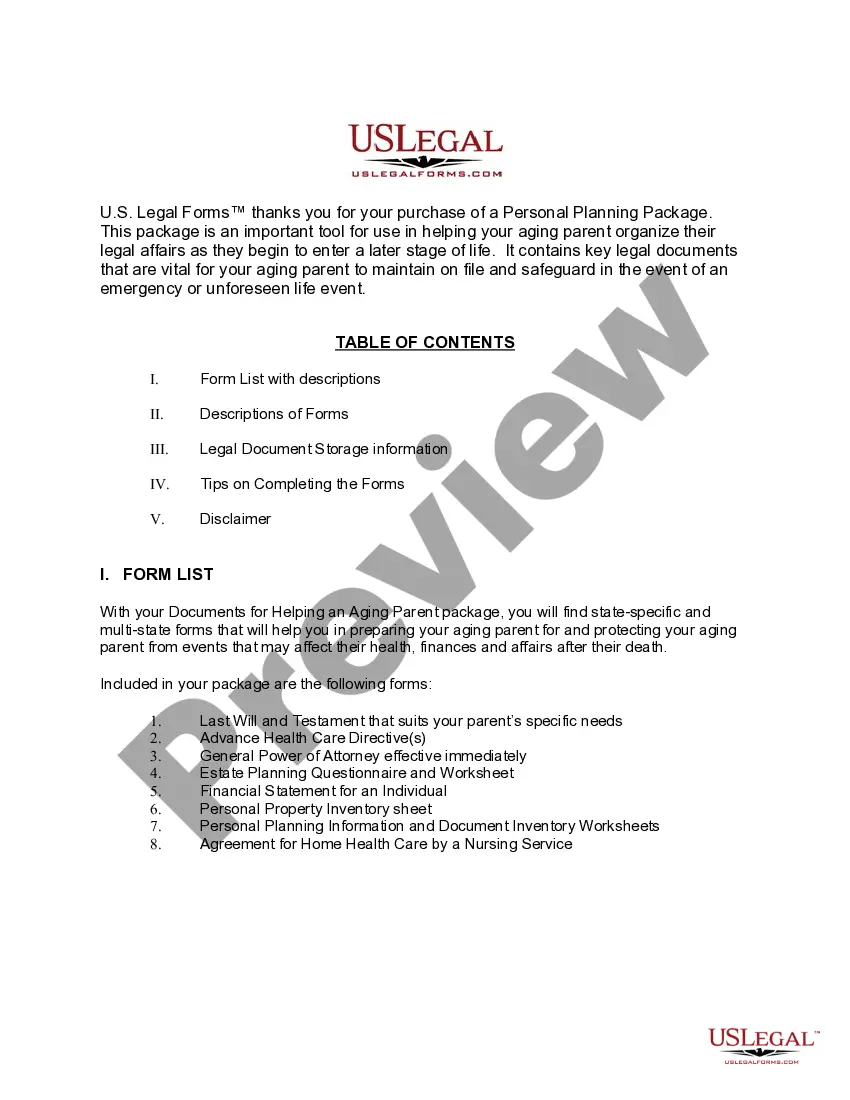
The New Jersey Aging Parent Package is designed to assist individuals in helping their aging parents organize their legal affairs as they move into later stages of life. This comprehensive package contains both state-specific and multi-state legal documents that prepare and protect aging parents from potential health, financial, and estate-related issues. Unlike generic legal form packages, this one is tailored to meet specific legal needs associated with aging, ensuring peace of mind during critical times.
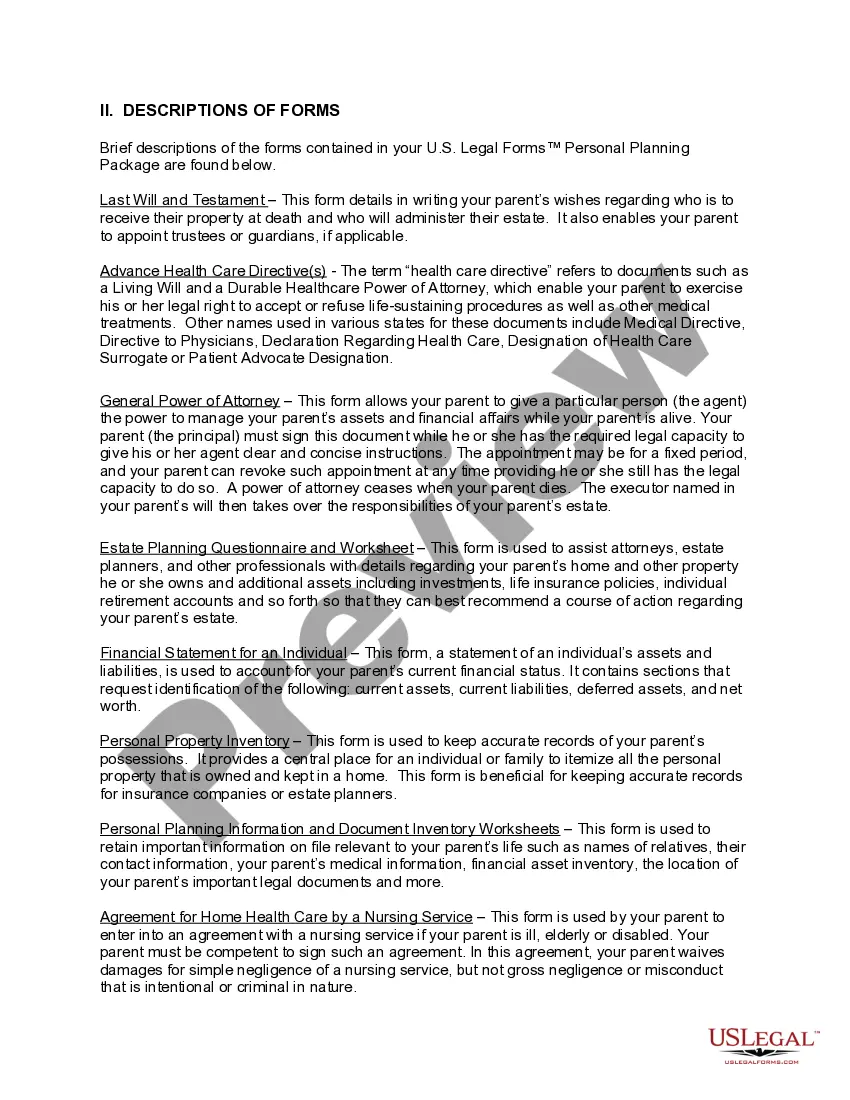
Documents contained in this package
- Last Will and Testament
- General Durable Power of Attorney for Property and Finances or Financial Effective Immediately
- Health Care Directive including Living Will
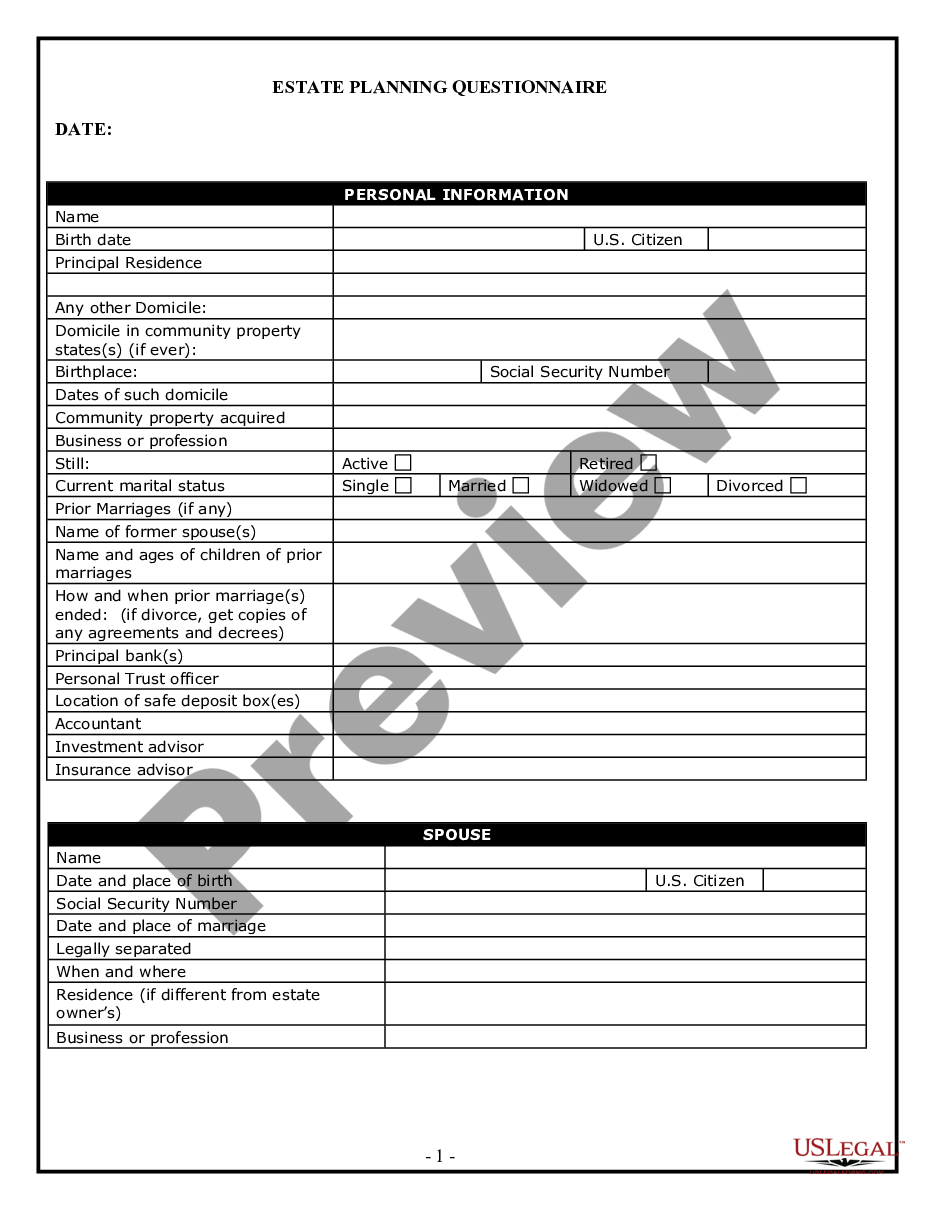
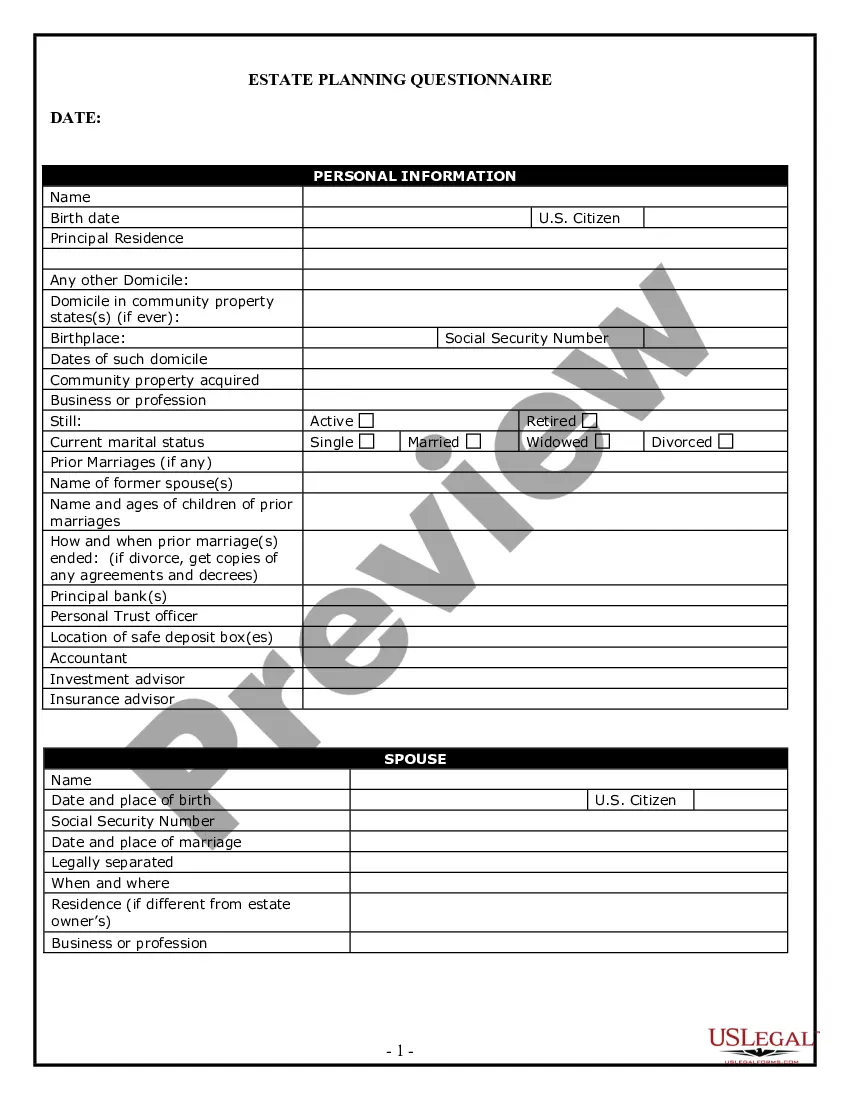
- Estate Planning Questionnaire and Worksheets
- Personal Care Agreement for Home Healthcare by a Nursing Service
- Personal Property Inventory
- Financial Statement Form - Husband and Wife Joint
- Personal Planning Information and Document Inventory Worksheets - A Legal Life Document



When to use this document
This package is essential in various scenarios, including:
- When your aging parent wishes to create a Last Will and Testament.
- If they need to outline their health care preferences through an Advance Health Care Directive.
- When establishing a financial representative using a General Power of Attorney.
- When seeking to document assets and personal belongings for estate planning purposes.
- In times of illness or disability, when home health care services are required.
Who needs this form package
- Adults with aging parents who need assistance in organizing legal affairs.
- Family members or guardians responsible for the health and finances of their aging loved ones.
- Individuals looking for a convenient way to manage end-of-life planning and health care decisions for their parents.
- Anyone needing legal documents tailored for compliance with New Jersey laws.
Steps to complete these forms
- Review the included forms carefully to understand their purpose and requirements.
- Identify the parties involved, including your aging parent and any designated agents.
- Complete each form by entering the required information, ensuring accuracy.
- Sign where indicated, making sure your aging parent is present to sign any legal documents.
- Store completed forms in a secure location where they can be easily accessed in an emergency.
Notarization requirements for forms in this package
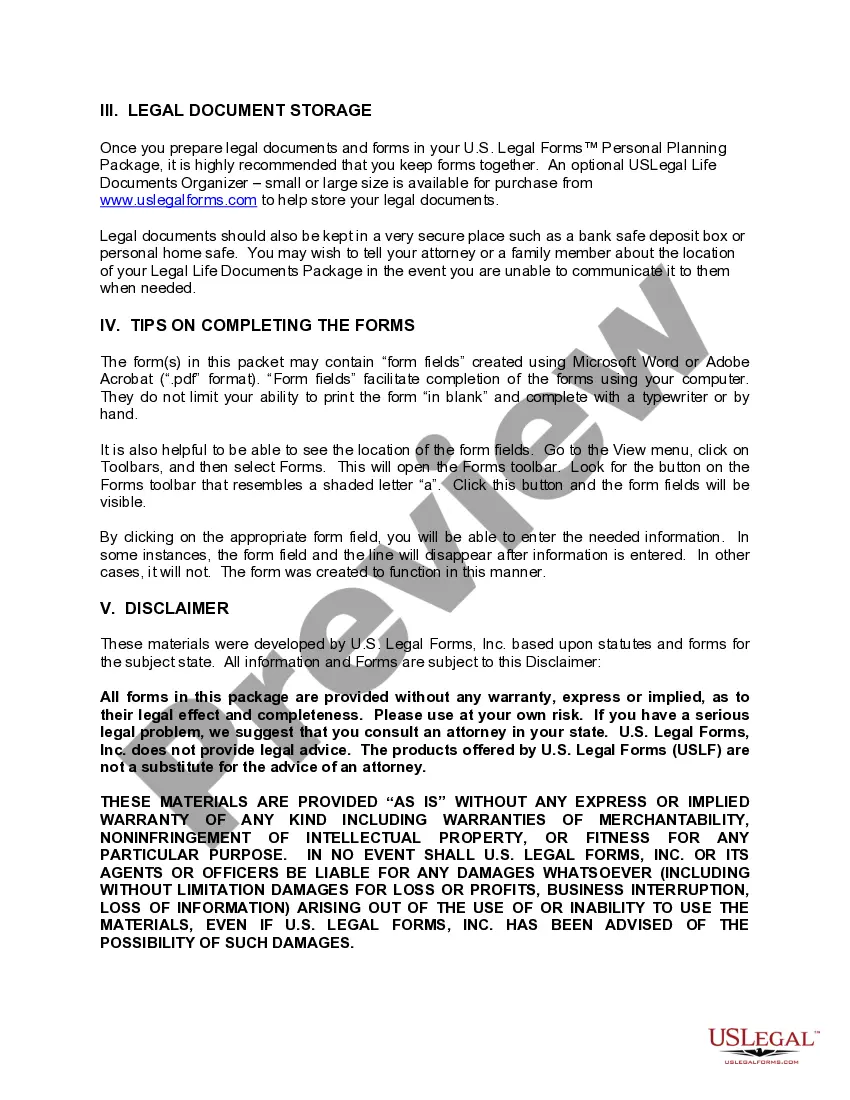
Some forms in this package need notarization to be legally binding. Our online notarization service, powered by Notarize, lets you verify and sign documents remotely through an encrypted video session, available 24/7.
Get your form ready online
Our built-in tools help you complete, sign, share, and store your documents in one place.
Make edits, fill in missing information, and update formatting in US Legal Forms—just like you would in MS Word.
Download a copy, print it, send it by email, or mail it via USPS—whatever works best for your next step.
Sign and collect signatures with our SignNow integration. Send to multiple recipients, set reminders, and more. Go Premium to unlock E-Sign.
If this form requires notarization, complete it online through a secure video call—no need to meet a notary in person or wait for an appointment.
We protect your documents and personal data by following strict security and privacy standards.

Make edits, fill in missing information, and update formatting in US Legal Forms—just like you would in MS Word.

Download a copy, print it, send it by email, or mail it via USPS—whatever works best for your next step.

Sign and collect signatures with our SignNow integration. Send to multiple recipients, set reminders, and more. Go Premium to unlock E-Sign.

If this form requires notarization, complete it online through a secure video call—no need to meet a notary in person or wait for an appointment.

We protect your documents and personal data by following strict security and privacy standards.
Typical mistakes to avoid
- Overlooking the signature requirements, which could invalidate the documents.
- Failing to discuss the contents of the forms with your aging parent before completion.
- Not reviewing the forms for accuracy, which may lead to issues down the road.
- Neglecting to store the documents in a safe and accessible place.
Benefits of using this package online
- Convenience of completing forms from home at your own pace.
- Editable documents allow customization to fit your parent's specific needs.
- Access to legally vetted forms drafted by licensed attorneys, ensuring reliability.
What to keep in mind
- The New Jersey Aging Parent Package is crucial for preparing aging parents for health and financial decisions.
- It includes essential documents tailored for New Jersey residents.
- Taking the time to complete these forms correctly can provide peace of mind for both you and your aging parent.
Looking for another form?



Form popularity
FAQ
Evaluate Your Parent's Situation. Before anything, take a look at your parent's living conditions, activities, and mental health. Focus On The Positives. Make It About You. Enlist Experts (If You Have To) Give Options. Start Small.
Medicare typically doesn't pay for in-home caregivers for personal care or housekeeping if that's the only care you need. Medicare may pay for short-term caregivers if you also need medical care to recover from surgery, an illness, or an injury.
The term senior citizen is meant to convey the distinction of those who are elders in our society, but how old is a senior citizen? The actual age of a senior citizen can vary depending on where and how the term is used. Some organizations consider age 50 to be a senior while others may define the age at 60 or higher.
Commonly, it is an adult child who is paid via Medicaid to provide care, but some states, such as Alabama, Arizona, California, Colorado, Delaware, Florida, Hawaii, Kentucky, Minnesota, Montana, New Hampshire, New Jersey, North Dakota, Oklahoma, Oregon, and Wisconsin, even provide funds for spouses to be paid
The Aid and Attendance Pension benefit is another program available in Texas that can be used to pay family members to provide care. At the forefront, it should be mentioned that this program is only relevant for war-time veterans or their surviving spouses who require assistance with their activities of daily living.
Senior citizens, people over 55 years of age, and the elderly can all receive assistance from the New Jersey Agencies on Aging centers. Locations are available in all counties, and programs can provide seniors with aid, information, and support.
The PFL Act allows you to take time off work to care for a family member. It also stipulates that you will receive a certain percentage of your salary while caring for your loved ones. This percentage varies, but California provides up to 60 70% of your pay up to a maximum amount of $1,300 per week.
New Jersey Assistance for Community Caregiving, or JACC for short, is a non-Medicaid program.Under JACC, family members can be paid to provide caregiving services for their loved ones. JACC offers program participants the option to choose their own service providers for several approved services.
Senior citizen: Variably defined as an elderly or retired person, this term generally refers to someone who is at least 60 or 65 years of age. Some people consider "senior citizen" to be a patronizing term.Elderly: Being in an advanced stage of life, well beyond middle age, is the basic elderly definition.