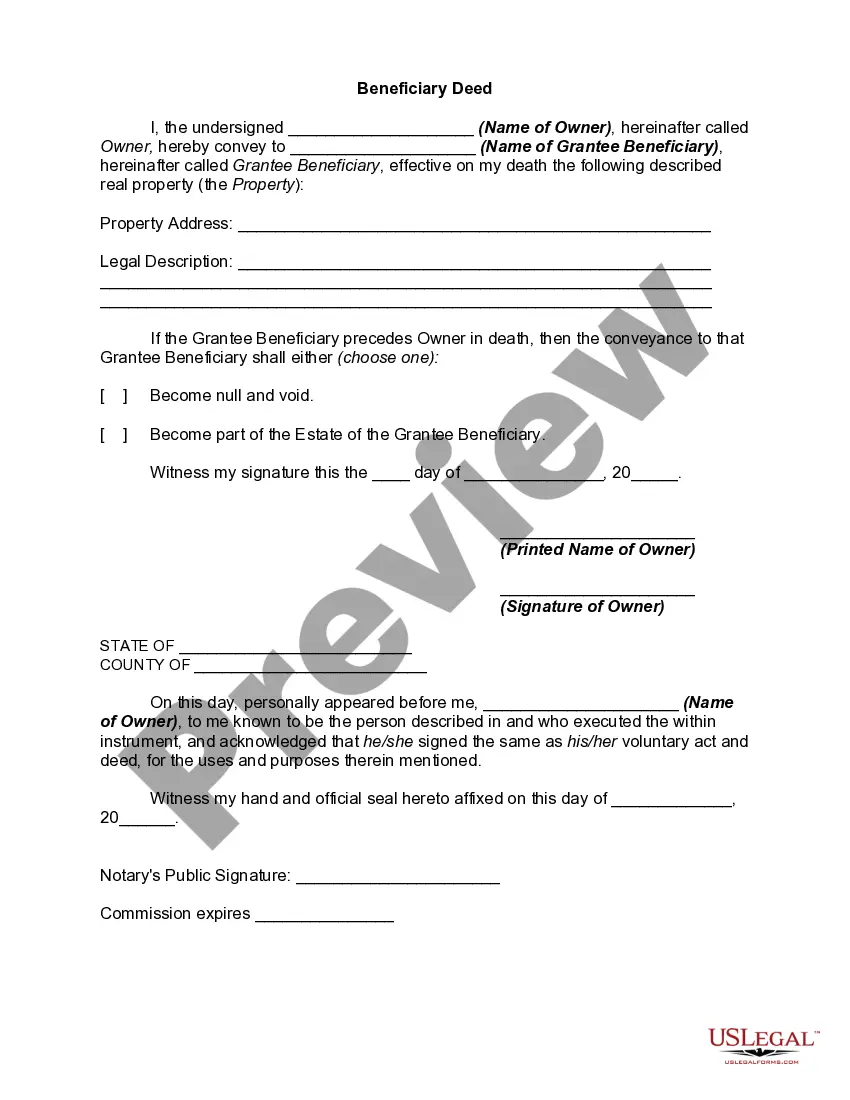
New Hampshire Beneficiary Deed

State:
Multi-State
Control #:
US-03279BG
Format:
Word; 
Rich Text
Instant download

Description

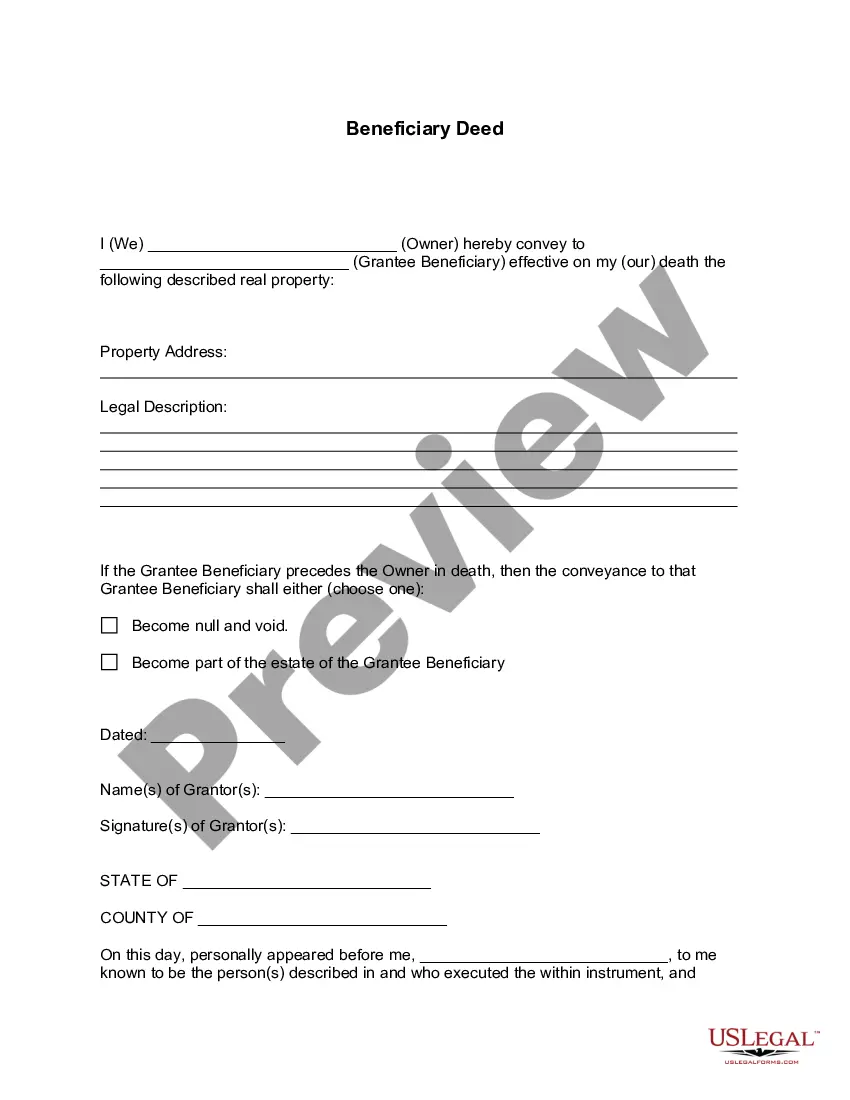
A beneficiary deed is a another type of real property deed used to transfer property. By signing and recording a beneficiary deed, an owner of an interest in real property may cause the owner's interest in the real property to be conveyed to people or entities upon the owner's death. The interest in real property conveyed by a beneficiary deed does not take effect until the death of the owner, at which time that interest transfers automatically by law to the designated grantee named in the beneficiary deed.


This form is a generic example that may be referred to when preparing such a form for your particular state. It is for illustrative purposes only. Local laws should be consulted to determine any specific requirements for such a form in a particular jurisdiction.


How to fill out Beneficiary Deed?

US Legal Forms - among the most significant libraries of legitimate forms in the USA - offers a variety of legitimate file themes you are able to download or print out. Using the internet site, you will get thousands of forms for organization and personal uses, sorted by classes, states, or keywords and phrases.You will discover the most recent variations of forms just like the New Hampshire Beneficiary Deed within minutes.

If you already possess a subscription, log in and download New Hampshire Beneficiary Deed from your US Legal Forms local library. The Obtain button can look on each and every form you view. You get access to all earlier acquired forms inside the My Forms tab of your own account.

If you would like use US Legal Forms the first time, here are straightforward instructions to obtain started:

  • Be sure you have selected the correct form for your personal metropolis/county. Click the Preview button to examine the form`s information. Browse the form explanation to ensure that you have chosen the proper form.
  • In case the form does not match your demands, utilize the Research industry at the top of the monitor to discover the one that does.
  • When you are pleased with the shape, validate your selection by clicking the Get now button. Then, choose the prices plan you like and give your accreditations to register for an account.
  • Approach the financial transaction. Utilize your credit card or PayPal account to accomplish the financial transaction.
  • Pick the formatting and download the shape on the system.
  • Make adjustments. Fill up, modify and print out and signal the acquired New Hampshire Beneficiary Deed.

Each and every design you included in your bank account does not have an expiry date and it is your own permanently. So, if you would like download or print out another version, just go to the My Forms segment and then click around the form you will need.

Gain access to the New Hampshire Beneficiary Deed with US Legal Forms, one of the most substantial local library of legitimate file themes. Use thousands of specialist and status-certain themes that meet up with your small business or personal requires and demands.

Form popularity

FAQ

A Will provides instructions for all of the assets included in your estate, whereas a beneficiary designation is for a specific asset. Further, a Will is something that you set up on your own , whereas a beneficiary designation is a document required by the company holding the asset.

You may be able to avoid probate in New Hampshire by: Making a Revocable Living Trust. Titling property: Joint Tenancy. Community Property With Right of Survivorship. Tenancy by the Entirety. Create accounts as TOD or POD (Transfer on Death; Payable on Death) Establish beneficiaries.

In New Hampshire, assets owned jointly usually pass directly to the surviving joint tenant upon the death of the other, bypassing probate. On the other hand, a TOD provision enables an asset owner to designate a beneficiary who will receive the asset upon their death, also avoiding the probate process.

The ?Revocable Transfer on Death Deed,? also called ?TOD Deed? or ?beneficiary deed,? is a simple way to leave a residence to your beneficiaries without the need for probate.

The beneficiary acquires ownership on the current owner's date of death. If the beneficiary later sells the property, any capital gain will be based upon the value of the property at the original owner's date of death, not the value when the original owner acquired the property.

The main difference between a beneficiary designation and a will is that assets with designated beneficiaries can avoid probate, while assets included in a will don't. Like assets in a living trust, assets with beneficiary attached to them operate separately from a will.

Cons To Using Beneficiary Deed Estate taxes. Property transferred may be taxed. No asset protection. The beneficiary receives the property without protection from creditors, divorces, and lawsuits. Medicaid eligibility. ... No automatic transfer. ... Incapacity not addressed. ... Problems with beneficiaries.

Trusted and secure by over 3 million people of the world’s leading companies

New Hampshire Beneficiary Deed