New Hampshire Affidavit of Broadcast
Understanding this form
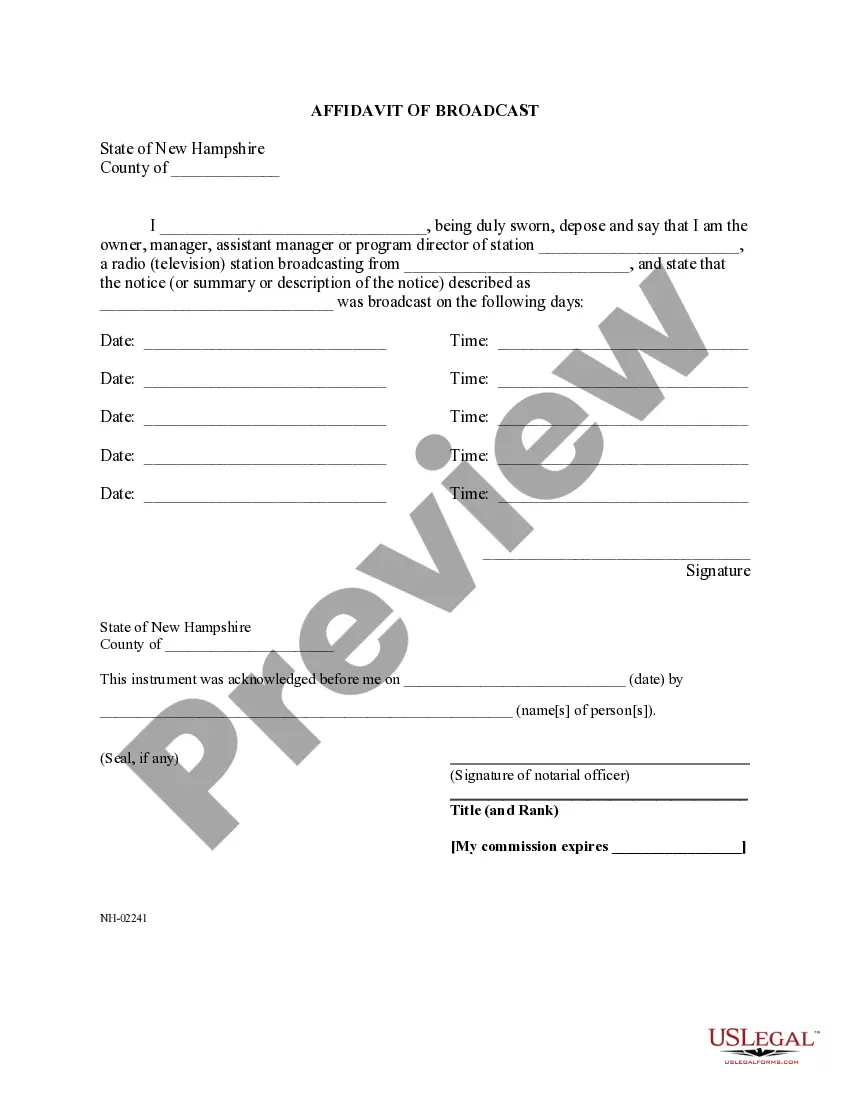
The Affidavit of Broadcast is a sworn statement used to officially declare the details of a broadcast made by a radio or television station. This form is distinct from other affidavits as it specifically records the time, date, and nature of the broadcast, confirming its occurrence for legal or regulatory purposes. It is signed by an authorized individual at the station and must be notarized to hold legal weight.
Key components of this form
- Identification of the affiant (owner, manager, or director of the station)
- Details of the broadcasting station (name and location)
- Description of the notice being broadcast
- Dates and times when the broadcast occurred
- Affiant's signature and notarization section
Common use cases
This affidavit is typically used when a radio or television station needs to provide verifiable evidence of a specific broadcast. It may be required for compliance with regulatory bodies, in legal proceedings, or to resolve disputes regarding the announcement of public notices or events.
Who this form is for
- Authorized personnel at a broadcasting station, such as owners, managers, or program directors
- Legal representatives needing to confirm broadcast details for litigation or regulatory compliance
- Individuals preparing documentation for governmental or FCC filings
Steps to complete this form
- Enter your name and position at the broadcasting station.
- Provide the name and location of your station.
- Describe the specific notice or announcement that was broadcasted.
- List the dates and times when the broadcast took place.
- Sign the document in the presence of a notary public.
Is notarization required?
Yes, this form must be notarized to be legally valid. It requires the personal signature of the affiant in the presence of a notary public or justice of the peace, who will then validate the document by adding their signature and stamp.
Get your form ready online
Our built-in tools help you complete, sign, share, and store your documents in one place.
Make edits, fill in missing information, and update formatting in US Legal Forms—just like you would in MS Word.
Download a copy, print it, send it by email, or mail it via USPS—whatever works best for your next step.
Sign and collect signatures with our SignNow integration. Send to multiple recipients, set reminders, and more. Go Premium to unlock E-Sign.
If this form requires notarization, complete it online through a secure video call—no need to meet a notary in person or wait for an appointment.
We protect your documents and personal data by following strict security and privacy standards.

Make edits, fill in missing information, and update formatting in US Legal Forms—just like you would in MS Word.

Download a copy, print it, send it by email, or mail it via USPS—whatever works best for your next step.

Sign and collect signatures with our SignNow integration. Send to multiple recipients, set reminders, and more. Go Premium to unlock E-Sign.

If this form requires notarization, complete it online through a secure video call—no need to meet a notary in person or wait for an appointment.

We protect your documents and personal data by following strict security and privacy standards.
Common mistakes
- Failing to provide all broadcast dates and times accurately.
- Not signing the affidavit in front of a notary public.
- Omitting the description of the broadcast notice.
- Incorrectly identifying the affiant's position at the station.
Advantages of online completion
- Convenient access to legal forms anytime, without the need for in-person visits.
- Easy to download and fill out, allowing for edits and customizations.
- Reliable templates drafted by licensed attorneys ensure legal accuracy.
Legal use & context
- This affidavit serves as a legal declaration and may be required in court as evidence of compliance with broadcasting regulations.
- It is enforceable in legal proceedings if properly completed and notarized.
- Using this form protects broadcasting stations by providing documented proof of aired notices.
Quick recap
- An Affidavit of Broadcast documents the content and timing of broadcasts.
- All sections of the form must be completed accurately.
- This form requires notarization for legal validity in New Hampshire.
- It is essential for compliance with broadcasting regulations.
Looking for another form?


Form popularity
FAQ
In its simplest sense, fair market value (FMV) is the price that an asset would sell for on the open market.
In New South Wales claims of less than $10,000 are heard in the Small Claims Division of the Local Court. The purpose of the small claims division is to deal with minor legal matters in a way that is more accessible to the ordinary person.
You usually have three years to file a claim in small claims court. This time limit is called prescription. It's the amount of time you have to file a claim before your right to sue expires. The time limit begins when you learn about the elements supporting your claim.
Try to settle the dispute outside of court. Contact the county clerk in the small claims court district closest to the residence or business of the person you are suing. Fill out a complaint form, otherwise known as a "Statement of Claim" at the clerk's office, and pay the filing fee.
The procedure is straightforward. A claim may be filed either in the district court where the plaintiff lives, where the defendant lives, or where the legal wrong arose. The small claim is filed with the district or municipal court clerk.
What Is a Financial Affidavit? A financial affidavit, which has different names in each state, is a statement showing your income, expenses, debts and assets. It allows a court to figure out how much spousal support and child support it should award.
A financial affidavit is a statement of a party's income, expenses, assets, and liabilities.
Both spouses live in New Hampshire. The spouse initiating the separation has lived in New Hampshire for at least one year. The spouse initiating the separation lives in New Hampshire and their partner can be served in New Hampshire.
The procedure is straightforward. A claim may be filed either in the district court where the plaintiff lives, where the defendant lives, or where the legal wrong arose. The small claim is filed with the district or municipal court clerk.
Both spouses live in New Hampshire. The spouse initiating the separation has lived in New Hampshire for at least one year. The spouse initiating the separation lives in New Hampshire and their partner can be served in New Hampshire.