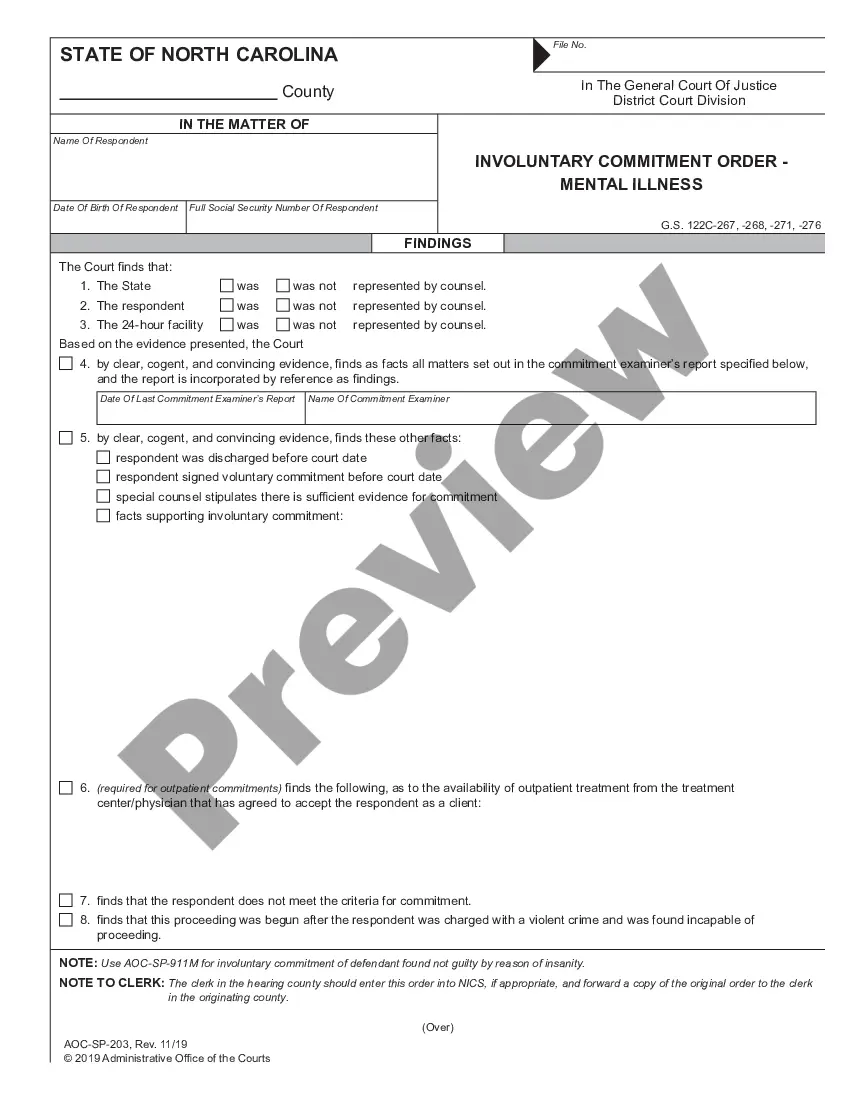
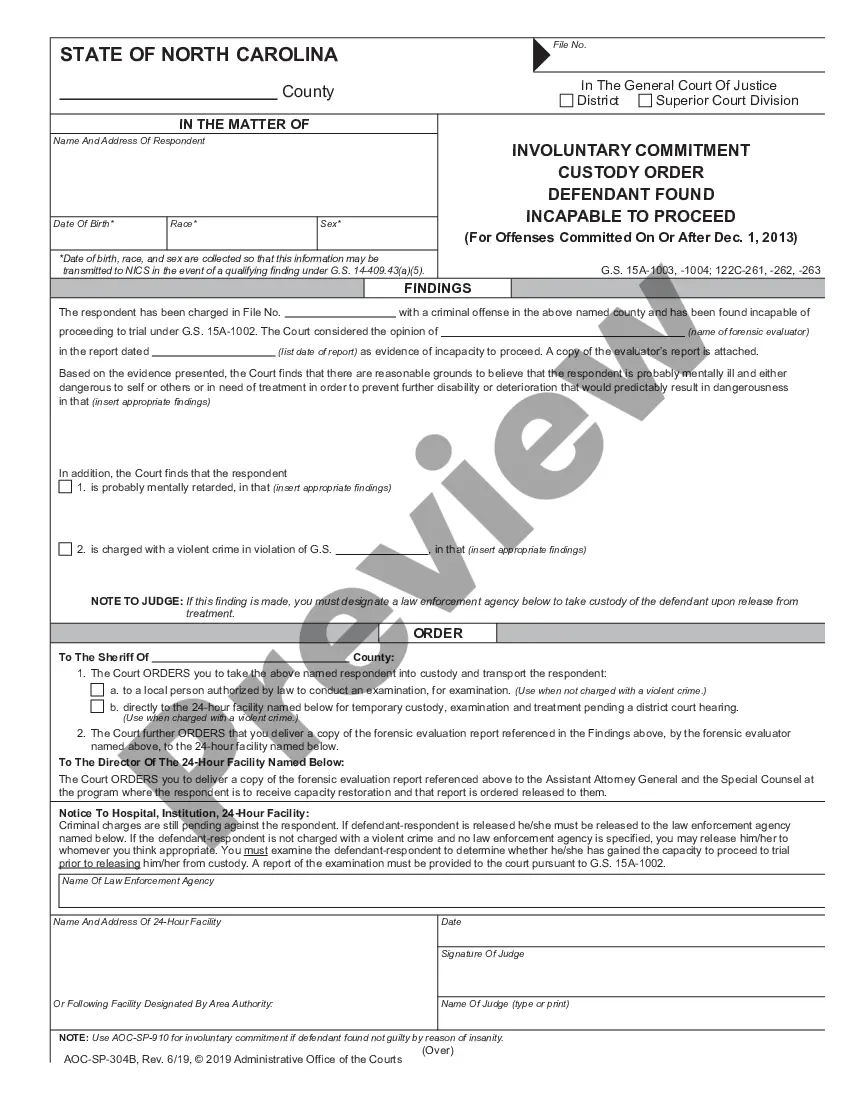
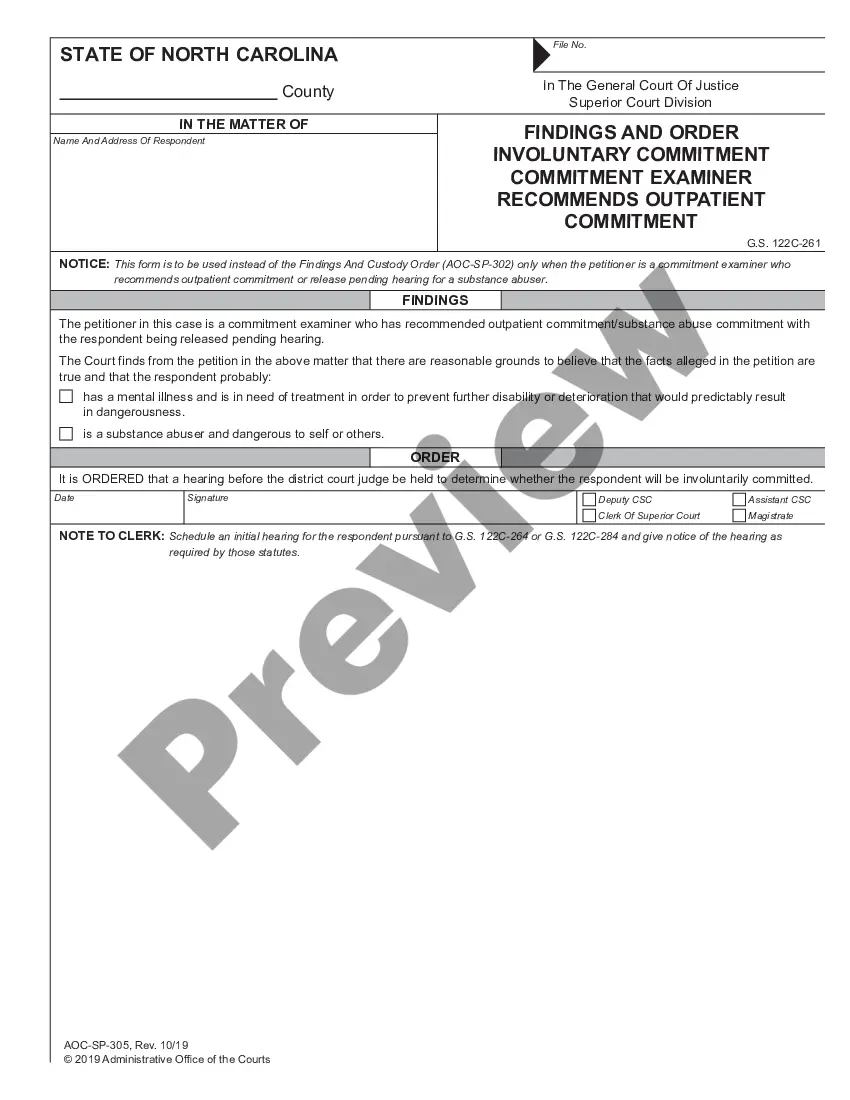
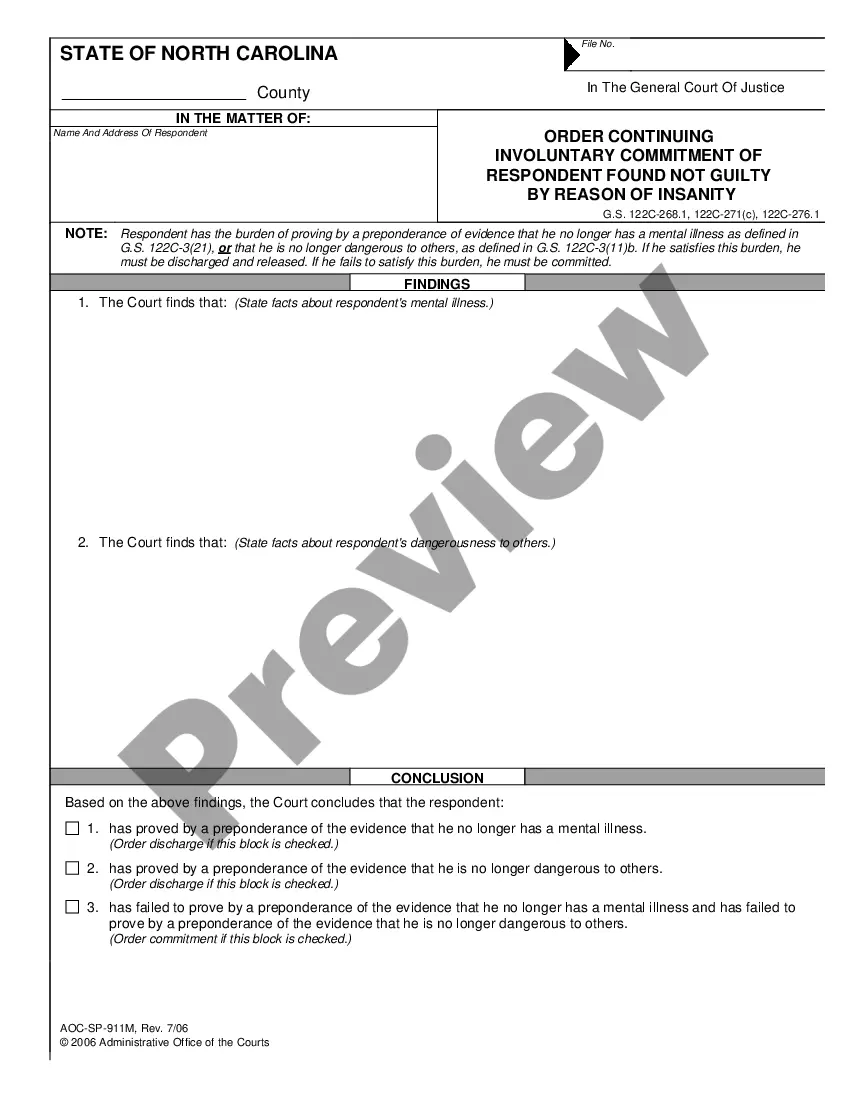
Findings and Custody Order Involuntary Commitment: This is an official form from the North Carolina Administration of the Courts (AOC), which complies with all applicable laws and statutes. USLF amends and updates the forms as is required by North Carolina statutes and law.
North Carolina Findings and Custody Order Involuntary Commitment
Category:
State:
North Carolina
Control #:
NC-SP-302
Format:
PDF
Instant download
This website is not affiliated with any governmental entity
Public form
Description
Get your form ready online
Our built-in tools help you complete, sign, share, and store your documents in one place.
Built-in online Word editor
Make edits, fill in missing information, and update formatting in US Legal Forms—just like you would in MS Word.
Export easily
Download a copy, print it, send it by email, or mail it via USPS—whatever works best for your next step.
E-sign your document
Sign and collect signatures with our SignNow integration. Send to multiple recipients, set reminders, and more. Go Premium to unlock E-Sign.
Notarize online 24/7
If this form requires notarization, complete it online through a secure video call—no need to meet a notary in person or wait for an appointment.
Store your document securely
We protect your documents and personal data by following strict security and privacy standards.
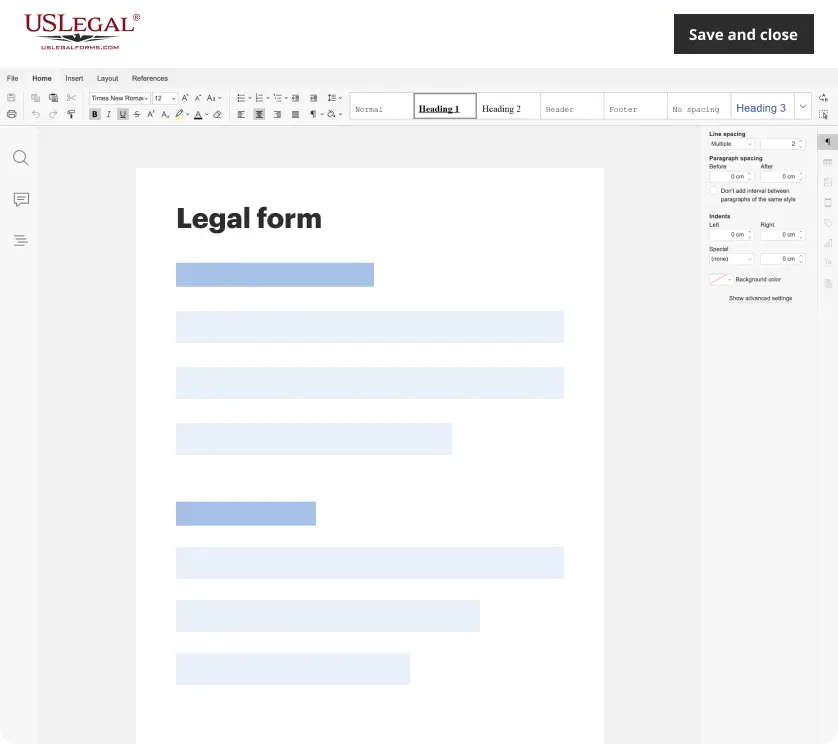
Make edits, fill in missing information, and update formatting in US Legal Forms—just like you would in MS Word.
Download a copy, print it, send it by email, or mail it via USPS—whatever works best for your next step.
Sign and collect signatures with our SignNow integration. Send to multiple recipients, set reminders, and more. Go Premium to unlock E-Sign.

If this form requires notarization, complete it online through a secure video call—no need to meet a notary in person or wait for an appointment.
We protect your documents and personal data by following strict security and privacy standards.
Looking for another form?


How to fill out North Carolina Findings And Custody Order Involuntary Commitment?
Steer clear of expensive lawyers and locate the North Carolina Findings and Custody Order Involuntary Commitment you need at an affordable price on the US Legal Forms site.
Utilize our straightforward categories feature to search for and acquire legal and tax documents. Review their descriptions and preview them before downloading.
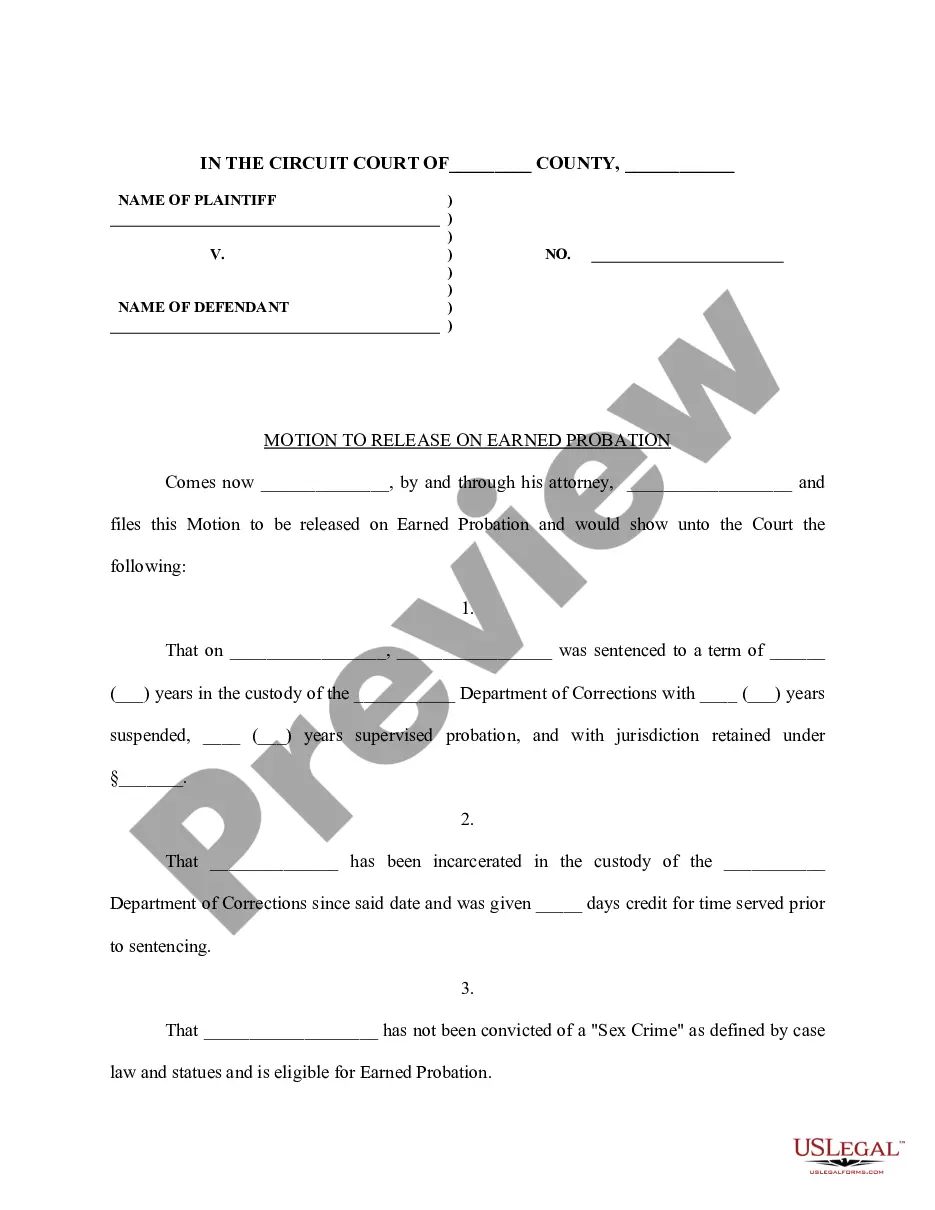
Choose to download the document in PDF or DOCX format. Simply click Download and locate your template in the My documents section. You can save the form to your device or print it out. After downloading, you can complete the North Carolina Findings and Custody Order Involuntary Commitment manually or with editing software. Print it out and reuse the template multiple times. Achieve more for less with US Legal Forms!
- Additionally, US Legal Forms offers users with detailed guidance on how to obtain and fill out each template.
- US Legal Forms users simply need to Log In and access the specific form they require from their My documents section.
- Those who do not have a subscription yet should adhere to the instructions outlined below.
- Ensure the North Carolina Findings and Custody Order Involuntary Commitment is valid for use in your jurisdiction.
- If possible, read through the description and utilize the Preview option before downloading the document.
- If you believe the template is suitable for you, click on Buy Now.
- If the template is not correct, use the search bar to find the appropriate one.
- Next, set up your account and select a subscription plan.
- Make payment via credit card or PayPal.
Form popularity
FAQ
The disadvantages include the fact that the child is often in a state of limbo, constantly going back and forth between the parents' houses and can feel alienated and confused. In addition, often it becomes very hard for parents to maintain two homes for the child's need.
When a parent is awarded full custody, they are the only parent entrusted with both legal and physical custody.Sole custody generally means that the non custodial parent was not awarded any visitation or custody rights.
The clearest reason to ask for sole custody is to protect your child from physical harm, especially if the other parent has a history of any of the following issues: ABUSE: If a parent has assaulted or sexually abused the other parent or any child, this presents an obvious danger to their child.
The answer is usually no, a parent cannot stop a child from seeing the other parent unless a court order states otherwise. This question often comes up in the following situations.The parents have an existing court order, and a parent is violating the court order by interfering with the other parent's parenting time.
50/50 schedules can benefit a child because the child spends substantial time living with both parents.The child is able to handle switching between parents' homes. Both parents are committed to putting the child's best interest first. The parents agree that the 50/50 schedule is the best one for their child.
Noun. 1. taking into custody - the act of apprehending (especially apprehending a criminal); "the policeman on the beat got credit for the collar" arrest, apprehension, pinch, collar, catch. capture, gaining control, seizure - the act of forcibly dispossessing an owner of property.
Drug or alcohol abuse. Physical abuse or neglect. Mental health issues. Money issues. Stability of the home.
Legal custody, which means who makes important decisions for your children (like health care, education, and welfare), and. Physical custody, which means who your children live with.
The criteria for involuntary hospitalization are as follows: patients must exhibit dangerous behavior toward themselves or others, they must be helpless and unable to provide for their basic daily needs, and there is a danger of essential harm to their mental health if they do not receive mental care.
Petition. People may be involuntarily committed when symptoms of a mental illness or substance use disorder escalate to the point of endangering themselves or others. In North Carolina, anyone who has first-hand knowledge of the individual's behavior or state of mind can complete a petition in front of a magistrate.