Missouri Release and Authorization
What is this form?
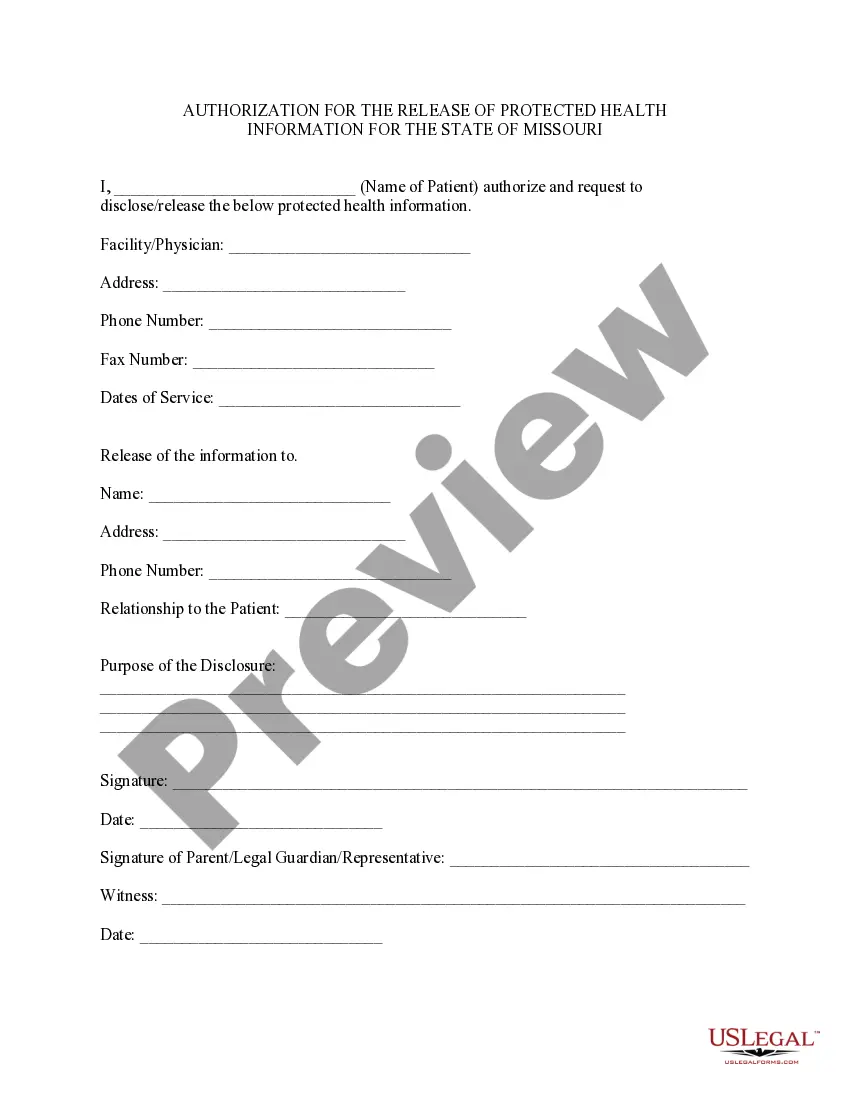
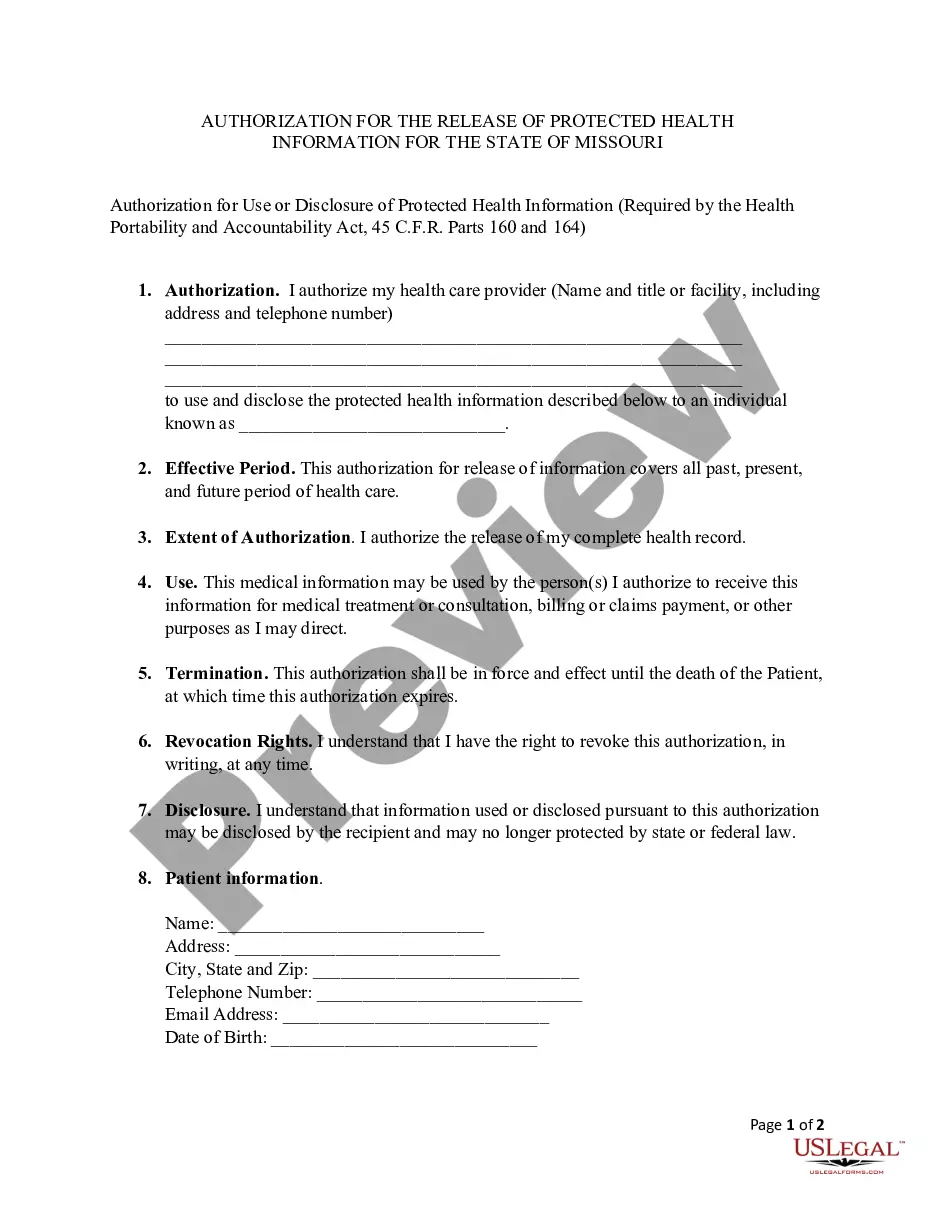
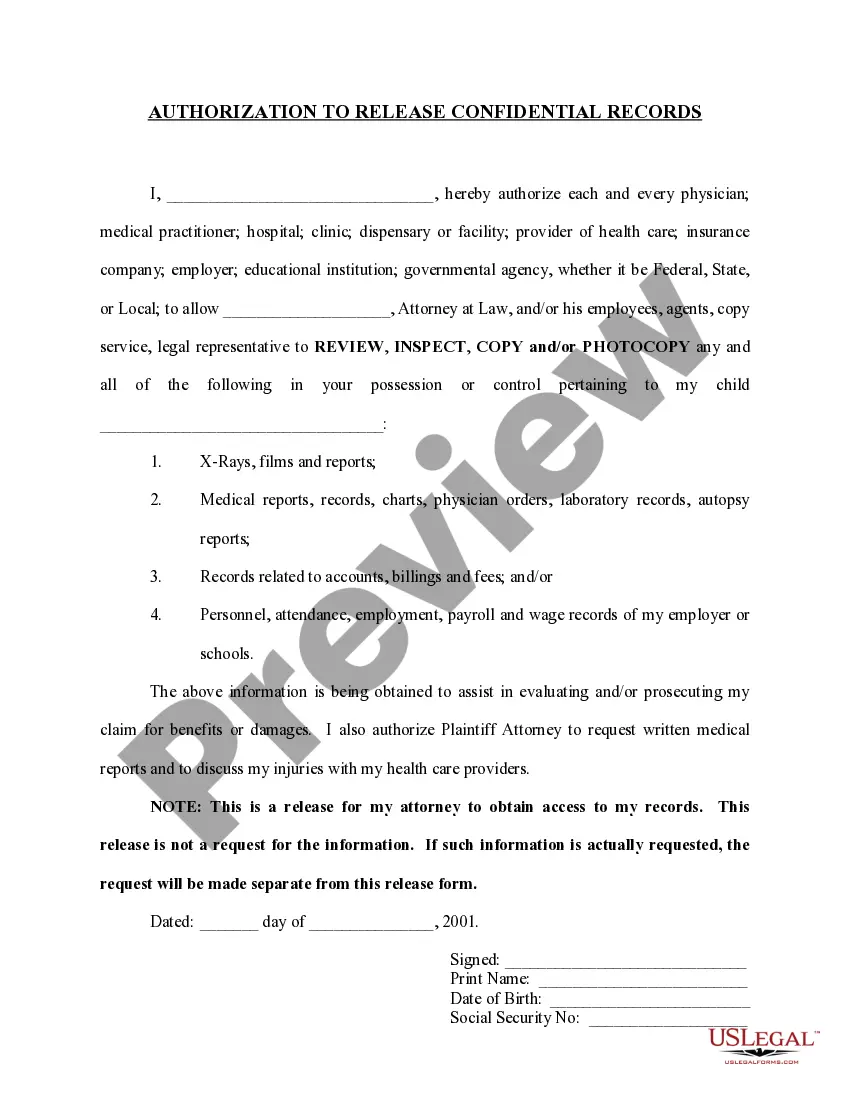
The Missouri Release and Authorization is a legal document that allows a patient to authorize the disclosure of their protected health information. Specifically designed for use in Missouri, this form adheres to HIPAA regulations to ensure patient privacy is maintained. The Missouri Release and Authorization differs from general authorization forms by being tailored for state-specific requirements and terminology, making it essential for any medical information transfer within the state.
Key components of this form
- Name of the patient: Identifies the individual whose health information will be disclosed.
- Facility/physician information: Includes the name, address, phone number, and fax number of the health care provider.
- Release recipient: Details who will receive the information, including their name, address, phone number, and relationship to the patient.
- Purpose of the disclosure: Clearly states why the health information is being shared.
- Signatures: Requires the signature of the patient or legal guardian, affirming consent.
- Date: Specifies when the authorization is signed.
When to use this document
This form should be used when a patient needs to authorize the release of their medical records or other health information to a third party. Situations may include transitioning care to another doctor, applying for disability benefits, or sharing information with family members for personal or legal reasons. Whenever disclosure of protected health information is necessary, this form provides the legal framework for such action.
Who can use this document
This form is intended for:
- Patients seeking to manage their health information and share it with third parties.
- Legal guardians or representatives making decisions on behalf of the patient.
- Healthcare providers requiring authorization to disclose patient information.
How to complete this form
- Identify the patient by entering their full name at the designated space.
- Fill in the facility or physician's information, including address and contact details.
- Specify the dates of service for which information is being released.
- Enter the name, address, and relationship of the individual or organization receiving the information.
- Clearly state the purpose of the disclosure in the provided section.
- Sign and date the form, ensuring a witness signature is added if required.
Notarization requirements for this form
This form does not typically require notarization unless specified by local law. However, valid signatures are essential for the form to be effective in releasing health information.
Get your form ready online
Our built-in tools help you complete, sign, share, and store your documents in one place.
Make edits, fill in missing information, and update formatting in US Legal Forms—just like you would in MS Word.
Download a copy, print it, send it by email, or mail it via USPS—whatever works best for your next step.
Sign and collect signatures with our SignNow integration. Send to multiple recipients, set reminders, and more. Go Premium to unlock E-Sign.
If this form requires notarization, complete it online through a secure video call—no need to meet a notary in person or wait for an appointment.
We protect your documents and personal data by following strict security and privacy standards.

Make edits, fill in missing information, and update formatting in US Legal Forms—just like you would in MS Word.

Download a copy, print it, send it by email, or mail it via USPS—whatever works best for your next step.

Sign and collect signatures with our SignNow integration. Send to multiple recipients, set reminders, and more. Go Premium to unlock E-Sign.

If this form requires notarization, complete it online through a secure video call—no need to meet a notary in person or wait for an appointment.

We protect your documents and personal data by following strict security and privacy standards.
Mistakes to watch out for
- Neglecting to provide all required signature fields.
- Forgetting to specify the purpose of the disclosure.
- Leaving out the dates of service.
- Not including contact information for both the releasing and receiving party.
Benefits of completing this form online
- Convenient access to a legally compliant form tailored for Missouri.
- Easy to fill out and edit, allowing for personalization.
- Instant availability for download, eliminating waiting time.
Looking for another form?


Form popularity
FAQ
To obtain a lien release in Missouri, you need to gather the necessary documentation, such as proof of payment or fulfillment of the obligation. Submit a written request to the lienholder, asking for the release. Utilizing the Missouri Release and Authorization process can streamline this procedure. US Legal Forms provides templates and guidance to help you draft the appropriate request and ensure compliance with state laws.
Yes, Missouri Medicaid often requires prior authorization for certain services and procedures. This means you must obtain approval before receiving specific medical treatments or services to ensure coverage. Understanding the Missouri Release and Authorization process can help you navigate these requirements efficiently. For more guidance, US Legal Forms offers resources to assist you in preparing the necessary documentation.
To fill out an authorization for release of information, start by identifying the specific information you want released. Clearly state who is authorized to release this information and to whom it should be sent. Ensure you include your contact information and signature, which validates the Missouri Release and Authorization. For a seamless process, consider using US Legal Forms to access pre-made templates tailored for your needs.
HIPAA Authorization is a document that authorizes the release of medical records which are protected under HIPAA. The authorization names designated representatives who may receive protected medical records, despite the privacy protections of HIPAA. HIPAA is an important piece of legislation.
A: ?Consent? is a general term under the Privacy Rule, but ?authorization? has much more specific requirements. The Privacy Rule permits, but does not require, a CE to obtain patient ?consent? for uses and disclosures of PHI for treatment, payment, and healthcare operations.
By setting up a Release Authorization (ARI), you are giving customer service your permission to disclose information about your accounts to another person. Typically, this is used to give account access to a spouse or other family member.
Authorization for release of information means the form prescribed by the agency for the purpose of authorizing the release of a confidential record, signed and dated by the person empowered to release the information.
The medical record information release (HIPAA) form allows a patient to give authorization to a 3rd party and access their health records.
Under the HIPAA Privacy Rule, healthcare providers, health plans, business associates, and others involved in administration of healthcare, may not share a patient's protected health information (PHI) without that patient's written authorization.
Under HIPAA, your site must retain the authorization for at least six years after the subject has signed it. Covered entities may use or disclose health information that is de-identified without restriction under the Privacy Rule.