Authorization to Release Confidential Records
What is this form?
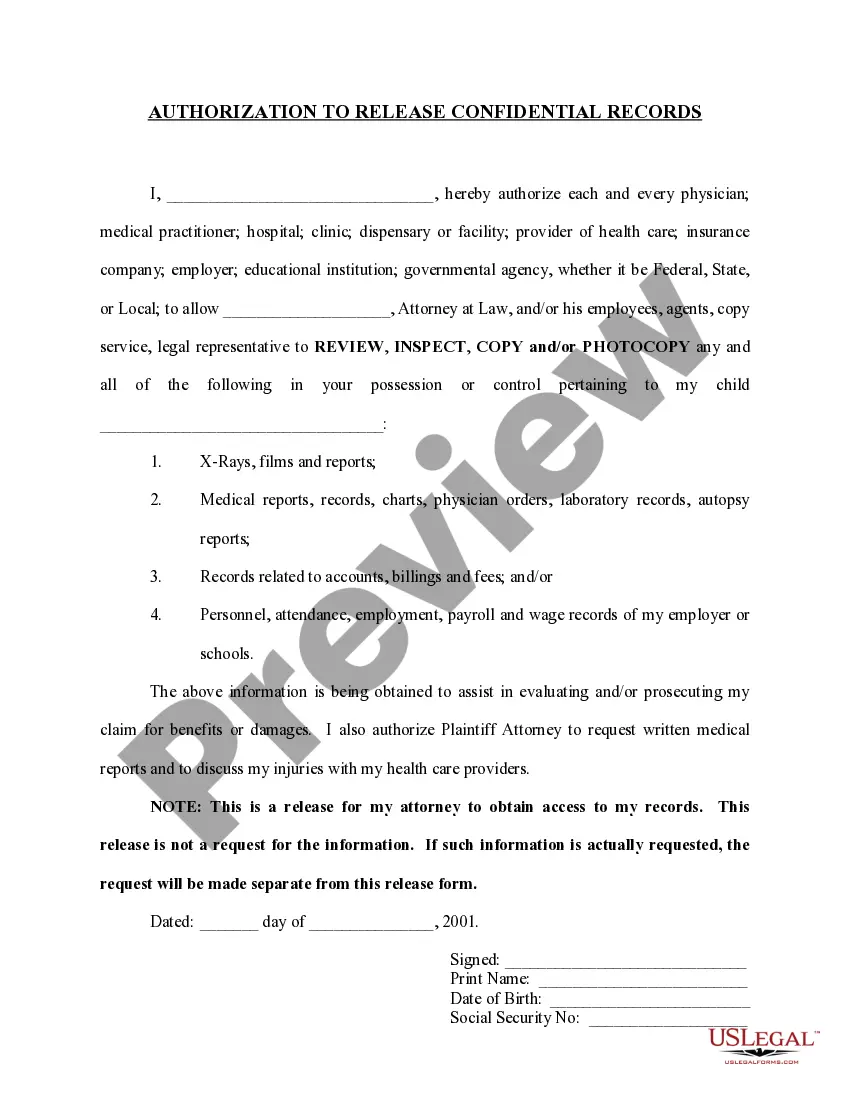
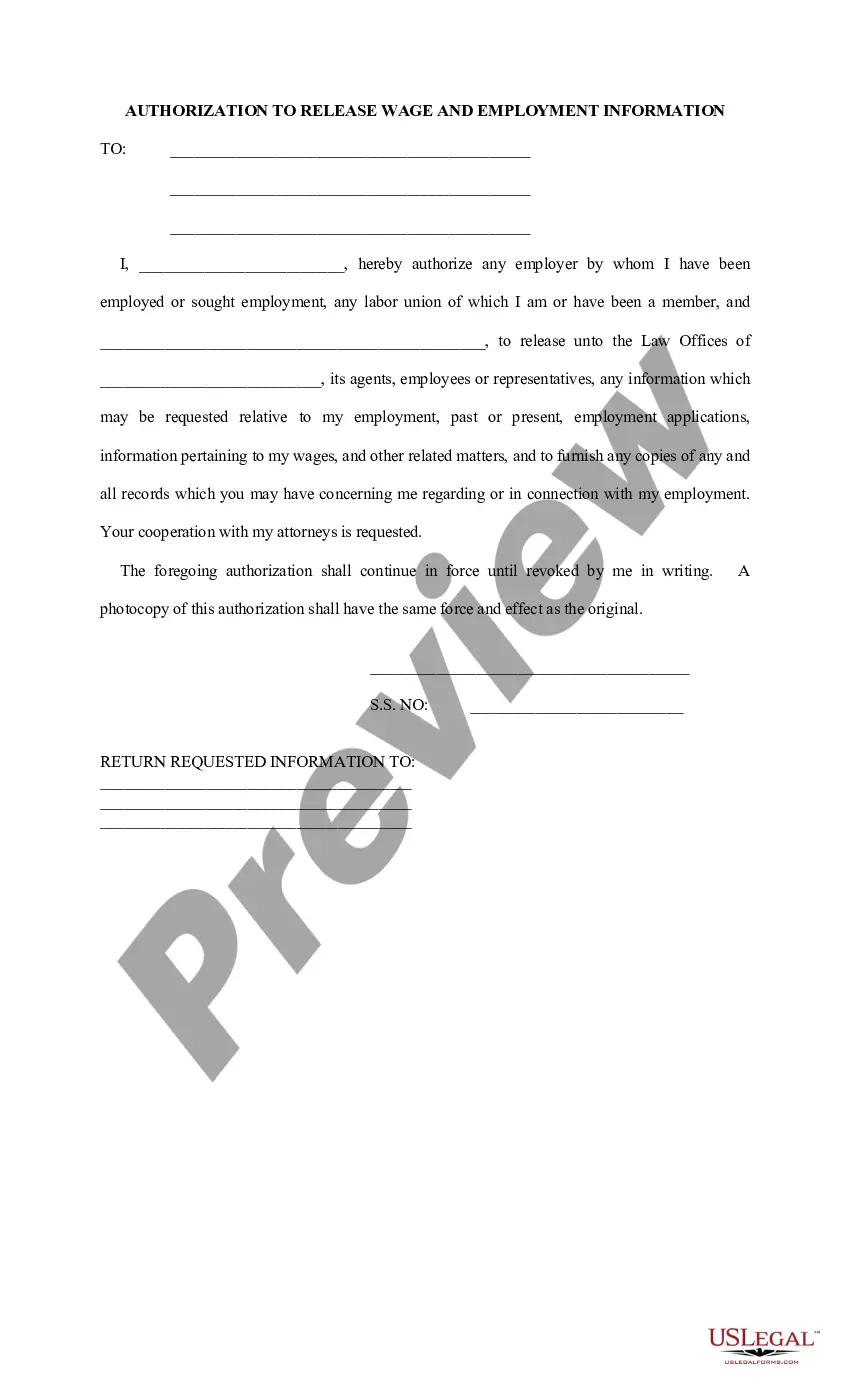
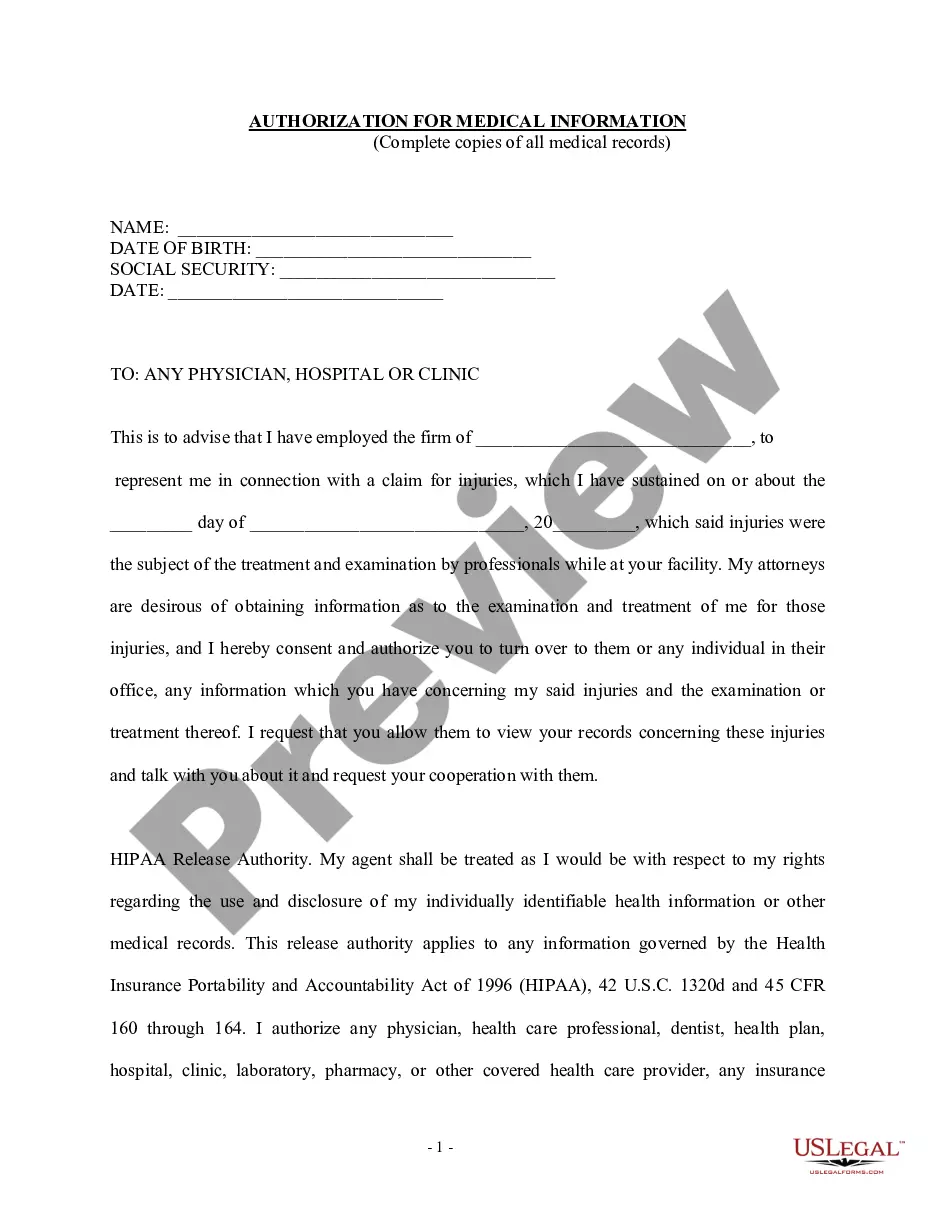
The Authorization to Release Confidential Records form is a legal document that grants permission to release a plaintiff's confidential medical records to their attorney. This form is essential for facilitating communication between the plaintiff's healthcare providers and legal counsel, assisting in the evaluation and prosecution of claims for benefits or damages. Unlike general medical release forms, this one specifically outlines the types of records that can be accessed and the entities that hold these records, ensuring a comprehensive approach to the plaintiff's legal needs.
Key parts of this document
- Authorization statement allowing healthcare providers and institutions to release records.
- Identification of the attorney and their representatives who are granted access.
- Detailed list of the types of medical records that can be reviewed, including X-rays, medical reports, and billing records.
- Clarification that this form is not a request for information but rather a release for access.
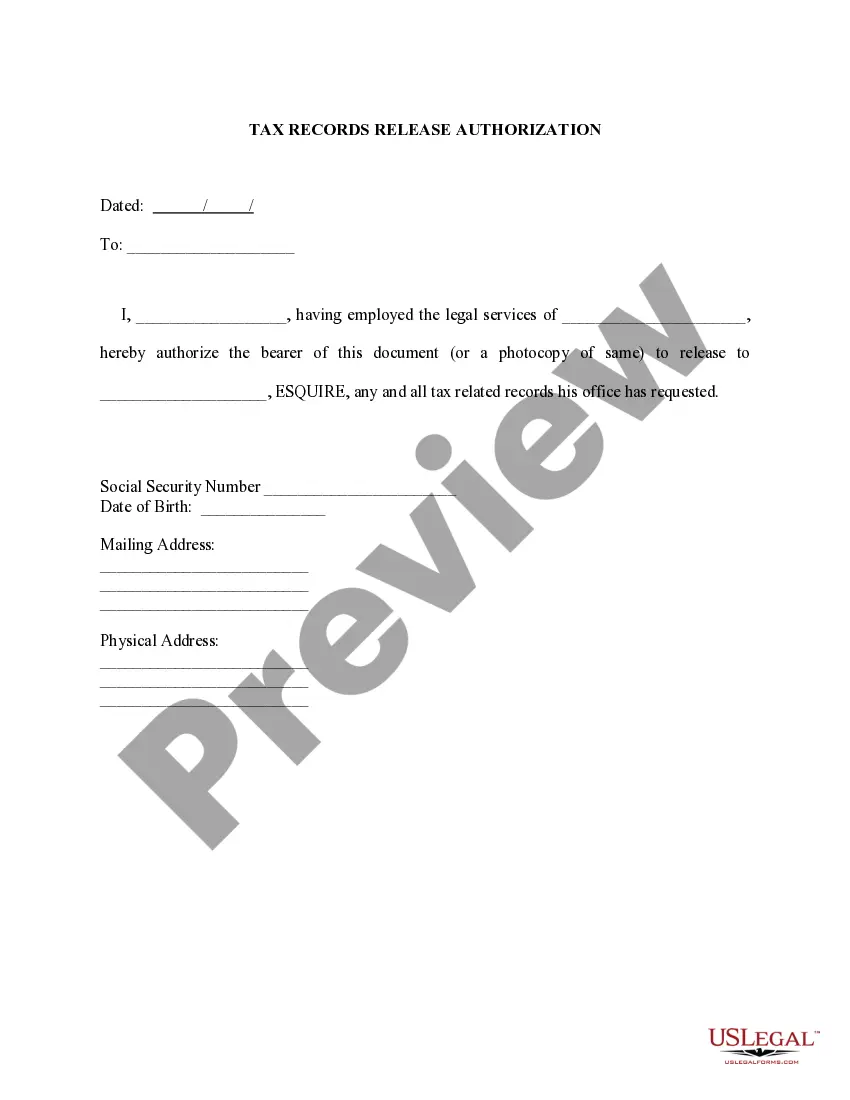
- Signature section for the plaintiff, including personal information such as date of birth and Social Security number.
When to use this document
This form should be used when a plaintiff needs their confidential medical records to be reviewed by their attorney, particularly in cases involving personal injury claims, workers' compensation, or any legal matters requiring medical evidence. It is necessary when the plaintiff's attorney needs to assess medical documentation to build a strong case for benefits or damages on behalf of the plaintiff.
Intended users of this form
- Individuals who are plaintiffs in legal proceedings and require their medical records to strengthen their case.
- Attorneys acting on behalf of clients needing access to confidential health information.
- Guardians or parents authorizing the release of their child's medical records for legal purposes.
How to complete this form
- Begin by entering your full name as the plaintiff at the top of the form.
- Clearly indicate the attorney's name who will be receiving the records.
- Specify the name of your child, if applicable, for whom the records are being requested.
- Check all relevant types of records that may be inspected or copied.
- Sign and date the form, providing your date of birth and Social Security number for identification purposes.
Does this form need to be notarized?
This form does not typically require notarization unless specified by local law. It is advisable to check regional rules to ensure adherence to any specific requirements regarding notarization for medical record releases.
Get your form ready online
Our built-in tools help you complete, sign, share, and store your documents in one place.
Make edits, fill in missing information, and update formatting in US Legal Forms—just like you would in MS Word.
Download a copy, print it, send it by email, or mail it via USPS—whatever works best for your next step.
Sign and collect signatures with our SignNow integration. Send to multiple recipients, set reminders, and more. Go Premium to unlock E-Sign.
If this form requires notarization, complete it online through a secure video call—no need to meet a notary in person or wait for an appointment.
We protect your documents and personal data by following strict security and privacy standards.

Make edits, fill in missing information, and update formatting in US Legal Forms—just like you would in MS Word.

Download a copy, print it, send it by email, or mail it via USPS—whatever works best for your next step.

Sign and collect signatures with our SignNow integration. Send to multiple recipients, set reminders, and more. Go Premium to unlock E-Sign.

If this form requires notarization, complete it online through a secure video call—no need to meet a notary in person or wait for an appointment.

We protect your documents and personal data by following strict security and privacy standards.
Common mistakes
- Failing to complete all required fields, such as the name of the attorney or the plaintiff's information.
- Not specifying the types of records to be released, which can lead to delays.
- Neglecting to sign and date the form, rendering it invalid.
Why use this form online
- Convenience of downloading and printing the form anytime, from anywhere.
- Editable fields allow you to enter your information easily before printing.
- Access to attorney-drafted templates ensures legal compliance and accuracy.
Quick recap
- The Authorization to Release Confidential Records form is essential for plaintiffs to obtain necessary medical information through their attorneys.
- Properly completing the form is crucial for legal compliance and effectiveness.
- This form should be tailored to comply with specific state laws when applicable.
Looking for another form?
Form popularity
FAQ
An authorization is a detailed document that gives covered entities permission to use protected health information for specified purposes, which are generally other than treatment, payment, or health care operations, or to disclose protected health information to a third party specified by the individual.
Your authorization allows the Health Plan (your health insurance carrier or HMO) to release your protected health information to a person or organization that you choose.Revoking this authorization will not affect any action taken prior to receipt of your written request.
A medical release form is a document that gives healthcare professionals permission to share patient medical information with other parties.
Release of information (ROI) in healthcare is critical to the quality of the continuity of care provided to the patient. It also plays an important role in billing, reporting, research, and other functions. Many laws and regulations govern how, when, what, and to whom protected health information (PHI) is released.
The core elements of a valid authorization include: A meaningful description of the information to be disclosed. The name of the individual or the name of the person authorized to make the requested disclosure. The name or other identification of the recipient of the information.
HIPAA does not impose any specific time limit on authorizations. For example, an authorization could state that it is good for 30 days, 90 days or even for 2 years. An authorization could also provide that it expires when the client reaches a certain age.
No, you should not sign the HIPAA authorization for the release of your medical records. Often, the insurance company will act as though they cannot begin to decide how much money to offer you until they have all of your medical records.
A Medical Records Release Form (also known as a Medical Information Release Form) is a form used to request that a health care provider (physician, dentist, hospital, chiropractor, psychiatrist, etc.)The automated form allows you to request information to be sent to multiple individuals and organizations at once.