New Jersey Final Order for Money Damages
About this form
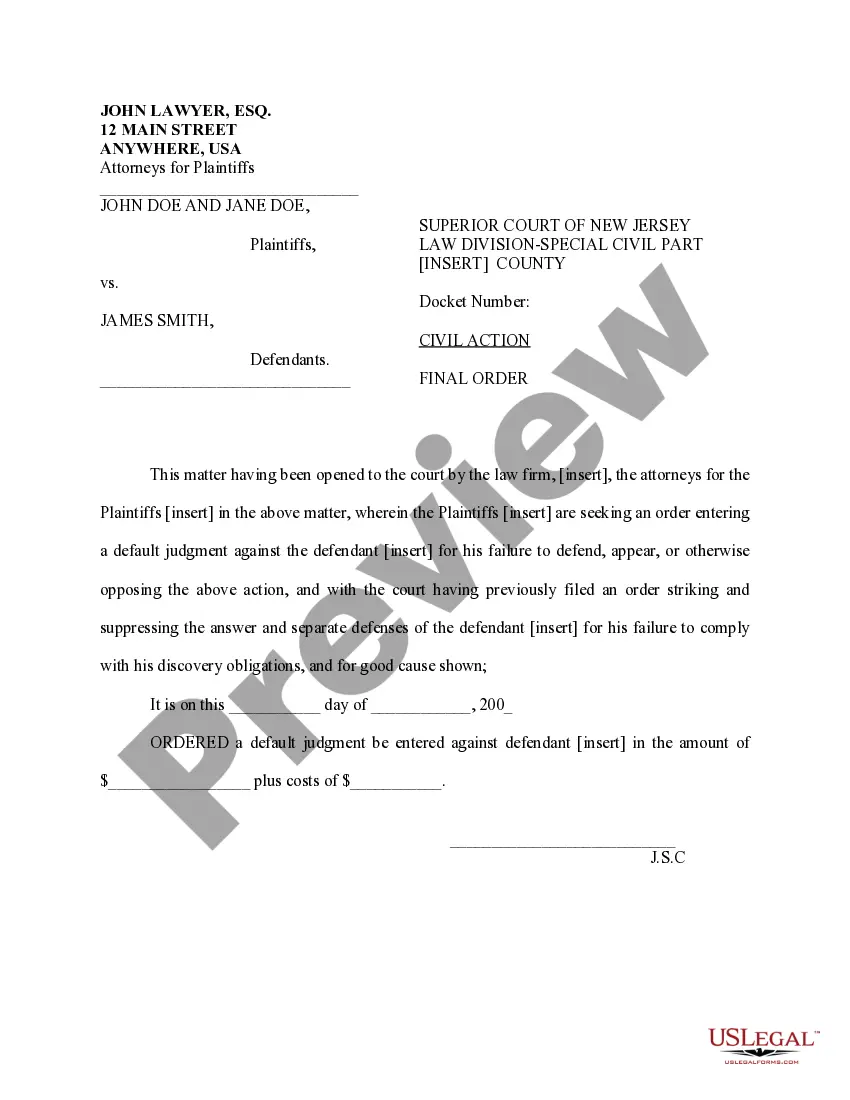
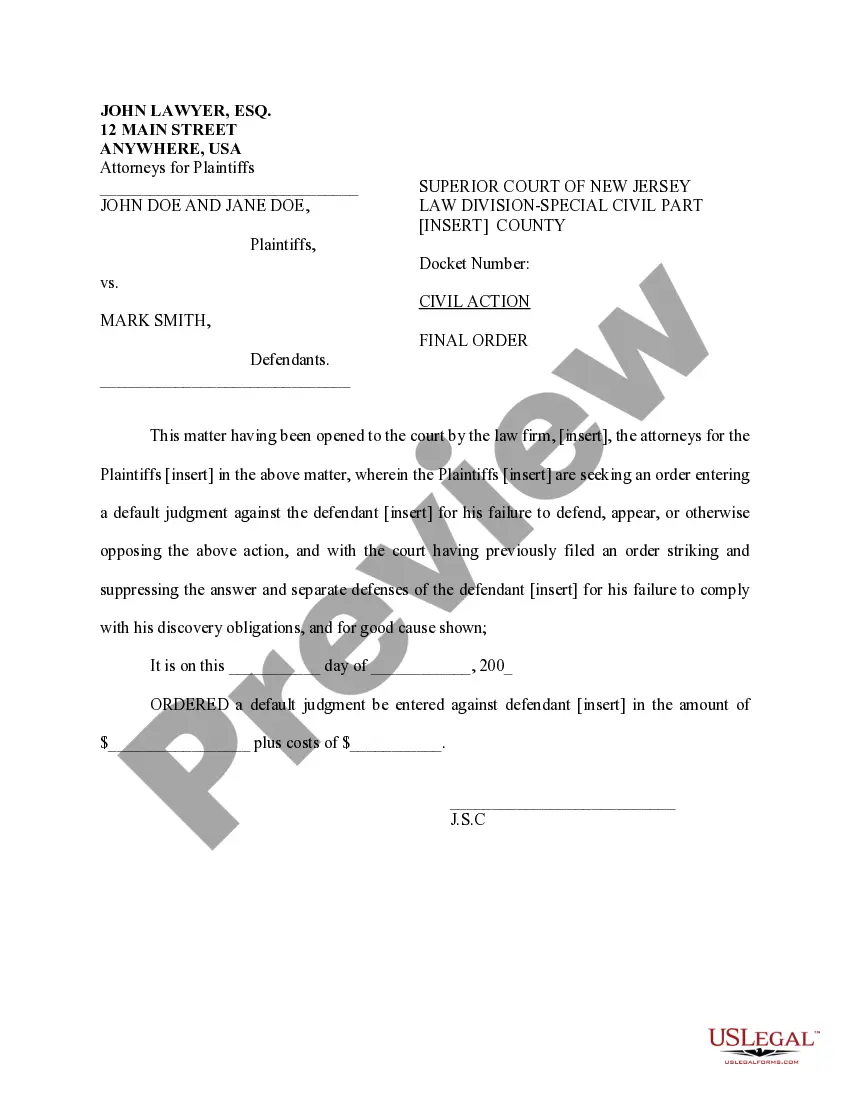
The Final Order for Money Damages is a legal document used in New Jersey to obtain a default judgment against a defendant who has failed to respond or defend themselves in a civil action. This form differs from other legal forms by specifically addressing the context of money damages and allowing plaintiffs to solidify their claims in court effectively.
What’s included in this form
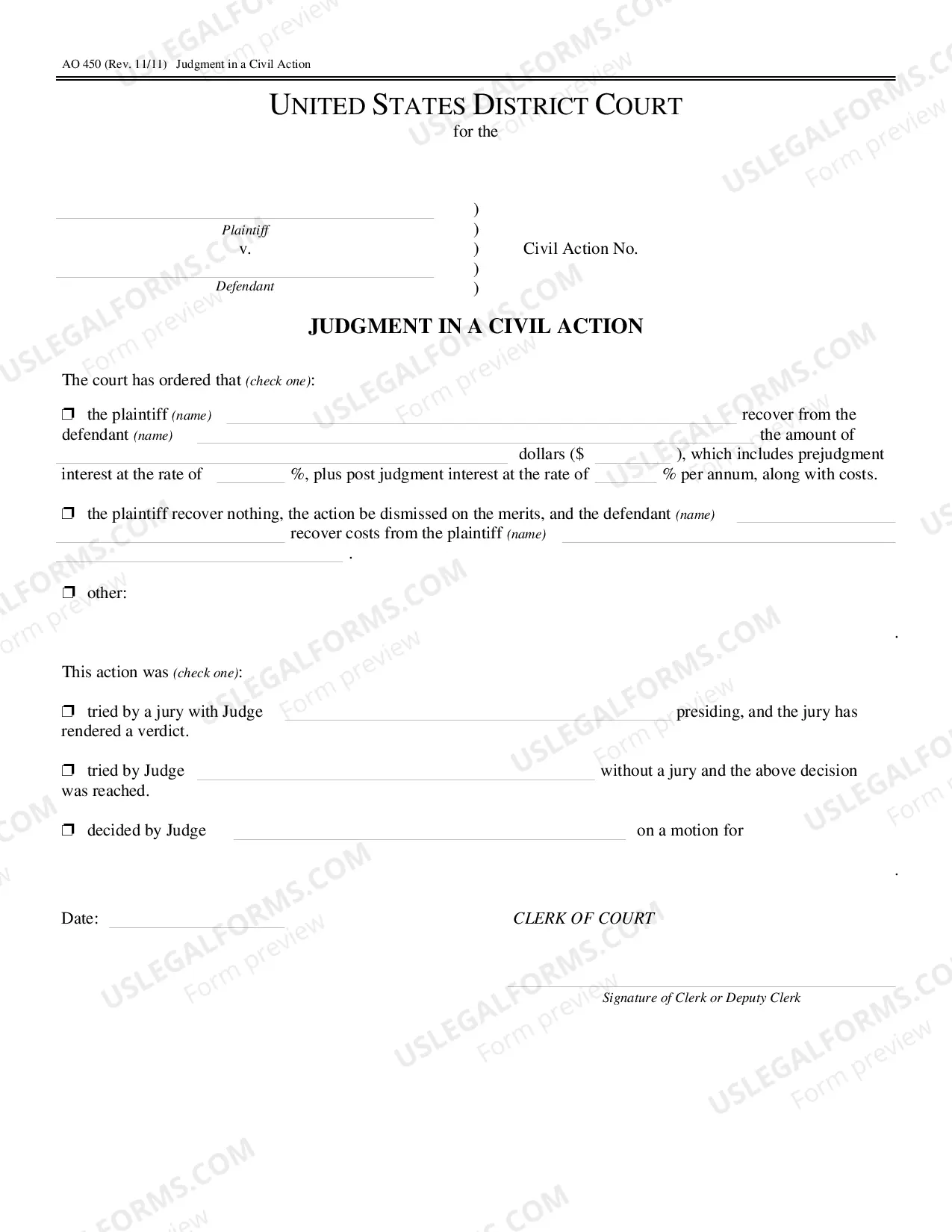
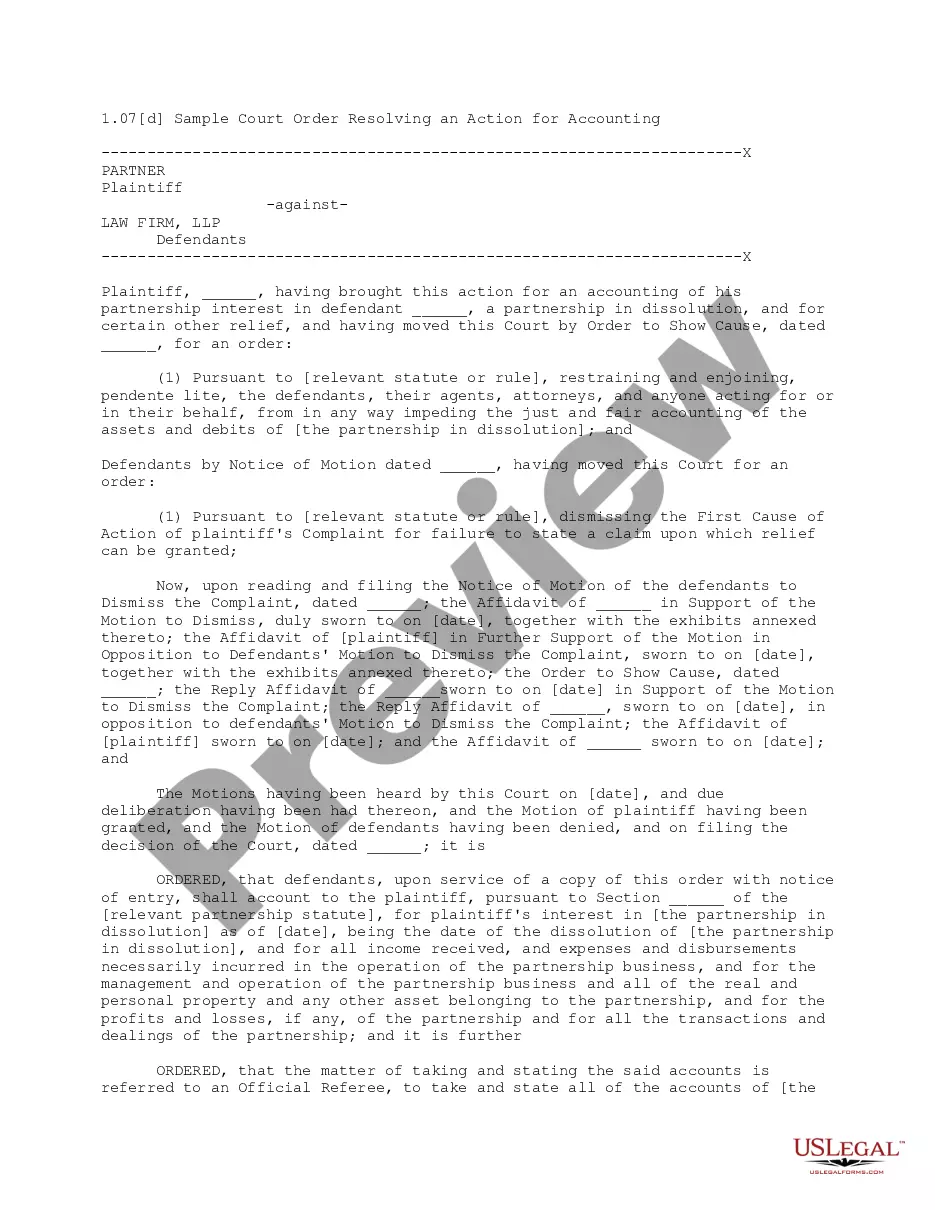
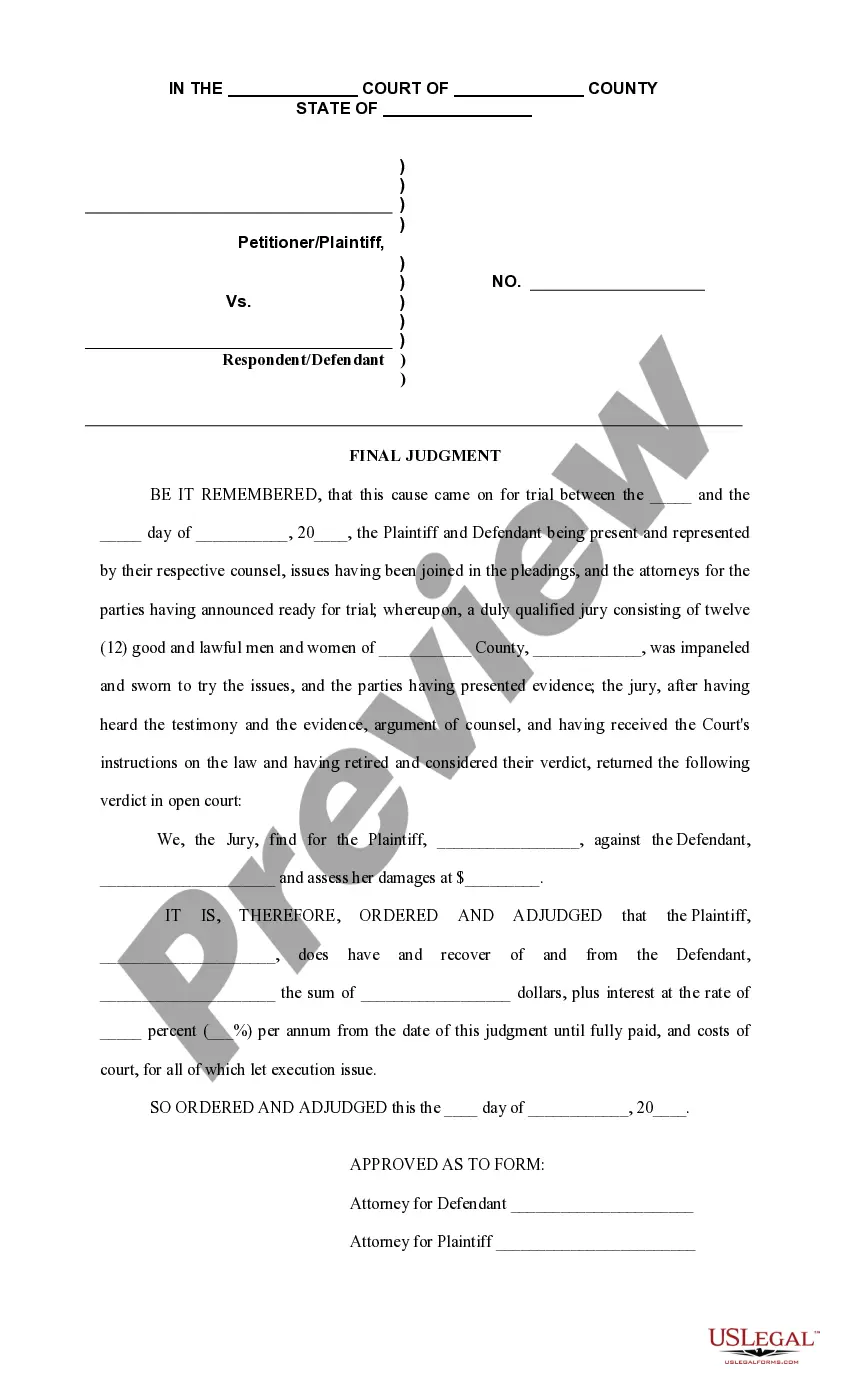
- Title: Clearly identifies the purpose as a Final Order for Money Damages.
- Parties Involved: Names the plaintiffs and defendants in the action.
- Court Details: Includes the court's name and jurisdiction specifics.
- Docket Number: A unique identifier for the case.
- Judgment Amount: States the amount of money being awarded to the plaintiffs.
- Costs: Includes any additional costs associated with the judgment.
- Signature: Requires a judge's signature to validate the order.
Common use cases
This form should be used when a plaintiff has taken legal action against a defendant, and that defendant has failed to appear in court or respond to the claims made. It is appropriate in situations where the plaintiffs are seeking monetary damages and wish to have a court-enforced judgment in their favor.
Who should use this form
This form is intended for:
- Plaintiffs who have initiated a civil lawsuit in New Jersey.
- Individuals or businesses asserting claims for money damages against a defendant.
- Attorneys representing clients in default judgment cases.
Completing this form step by step
- Identify the parties: Fill in the names of the plaintiffs and defendant.
- Provide the docket number: Input the case's unique identification number.
- Specify the judgment amount: Enter the total amount being awarded, including damages and costs.
- Include court details: Fill in the relevant court information, including the county.
- Obtain signatures: Ensure the judge signs the document for it to be valid.
Does this document require notarization?
This form does not typically require notarization unless specified by local law. However, it's important to check specific court requirements for any additional documentation needed.
Get your form ready online
Our built-in tools help you complete, sign, share, and store your documents in one place.
Make edits, fill in missing information, and update formatting in US Legal Forms—just like you would in MS Word.
Download a copy, print it, send it by email, or mail it via USPS—whatever works best for your next step.
Sign and collect signatures with our SignNow integration. Send to multiple recipients, set reminders, and more. Go Premium to unlock E-Sign.
If this form requires notarization, complete it online through a secure video call—no need to meet a notary in person or wait for an appointment.
We protect your documents and personal data by following strict security and privacy standards.

Make edits, fill in missing information, and update formatting in US Legal Forms—just like you would in MS Word.

Download a copy, print it, send it by email, or mail it via USPS—whatever works best for your next step.

Sign and collect signatures with our SignNow integration. Send to multiple recipients, set reminders, and more. Go Premium to unlock E-Sign.

If this form requires notarization, complete it online through a secure video call—no need to meet a notary in person or wait for an appointment.

We protect your documents and personal data by following strict security and privacy standards.
Typical mistakes to avoid
- Failing to fill out the docket number accurately.
- Not specifying costs associated with the judgment.
- Omitting the defendant's name or other party details.
- Neglecting to have the judge sign the order.
Benefits of completing this form online
- Convenience: Easily download and fill out the form from anywhere.
- Editability: Make changes quickly without needing to start from scratch.
- Reliability: Obtain forms that comply with legal standards and are drafted by licensed attorneys.
Legal use & context
- Used when a defendant defaults on responding to legal actions.
- Supports claims for damages awarded by the court in civil cases.
- Serves as a legally enforceable order once signed by a judge.
What to keep in mind
- The Final Order for Money Damages is crucial for securing default judgments in New Jersey.
- Please ensure all information is accurate before submission.
- The form should be signed by a judge for it to be valid.
Looking for another form?
Form popularity
FAQ
To do this, you need a Writ of Execution, a sample of which can be found on the Judiciary's Web site. You must complete the writ form and send it to the court. If the Judgment has a J docket number, you must send the writ to the Civil Division Manager in the county in which your case was originally filed.
Once you have filed a complaint with the court in New Jersey you have 15 days to issue a summons from the date of the Track Assignment Notice. If you fail to do so your action may be dismissed. The summons must be served together with a copy of the complaint to the defendant, namely the person you are suing.
Defendant(s) must file an answer to the complaint along with the appropriate filing fee within 35 days after service of the complaint. After the complaint is served and an answer is filed, the discovery period begins.
Grounds For Vacating A Default Judgment In California, for example, a judge can vacate a default judgment taken due to mistake, inadvertence, surprise, or excusable neglect.Both states allow the judge to set aside the judgment if you were never served with the original lawsuit papers.
In order to vacate a judgment in California, You must file a motion with the court asking the judge to vacate or set aside the judgment. Among other things, you must tell the judge why you did not respond to the lawsuit (this can be done by written declaration).You may even be able to win the case.
If you file a motion to vacate a default or a default judgment, you must file an answer to the original complaint along with any cross claims or counterclaims you may wish to assert, and the motion must be accompanied by the appropriate fee. Make a check or money order payable to Treasurer, State of New Jersey.
A Motion to Vacate Judgment is a specific request for the court to withdraw its judgment or order that it previously entered. Generally, a motion to vacate judgment may be granted to a party that can show that it didn't have a proper chance to present or prove their case.
In lieu of settlement by motion or consent, the party proposing the form of judgment or order may forward the original thereof to the judge who heard the matter and shall serve a copy thereof on every other party not in default together with a notice advising that unless the judge and the proponent of the judgment or
Judgments in New Jersey remain in effect for 20 years and may be renewed for an additional 20 years by filing a motion in the Superior Court, Law Division, Civil Part and/or in the Special Civil Part if the Special Civil Part case was assigned a DJ or J docket number.