New Jersey Final Judgment for Money Damages
What this document covers
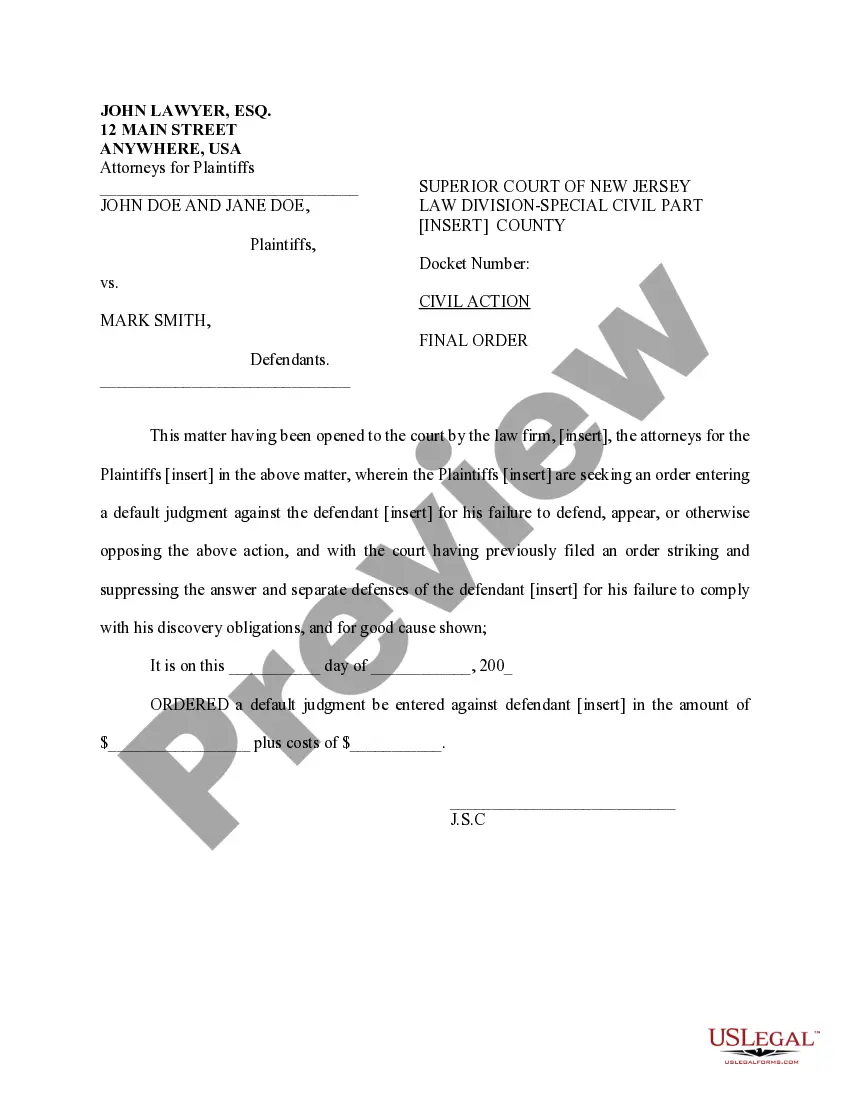
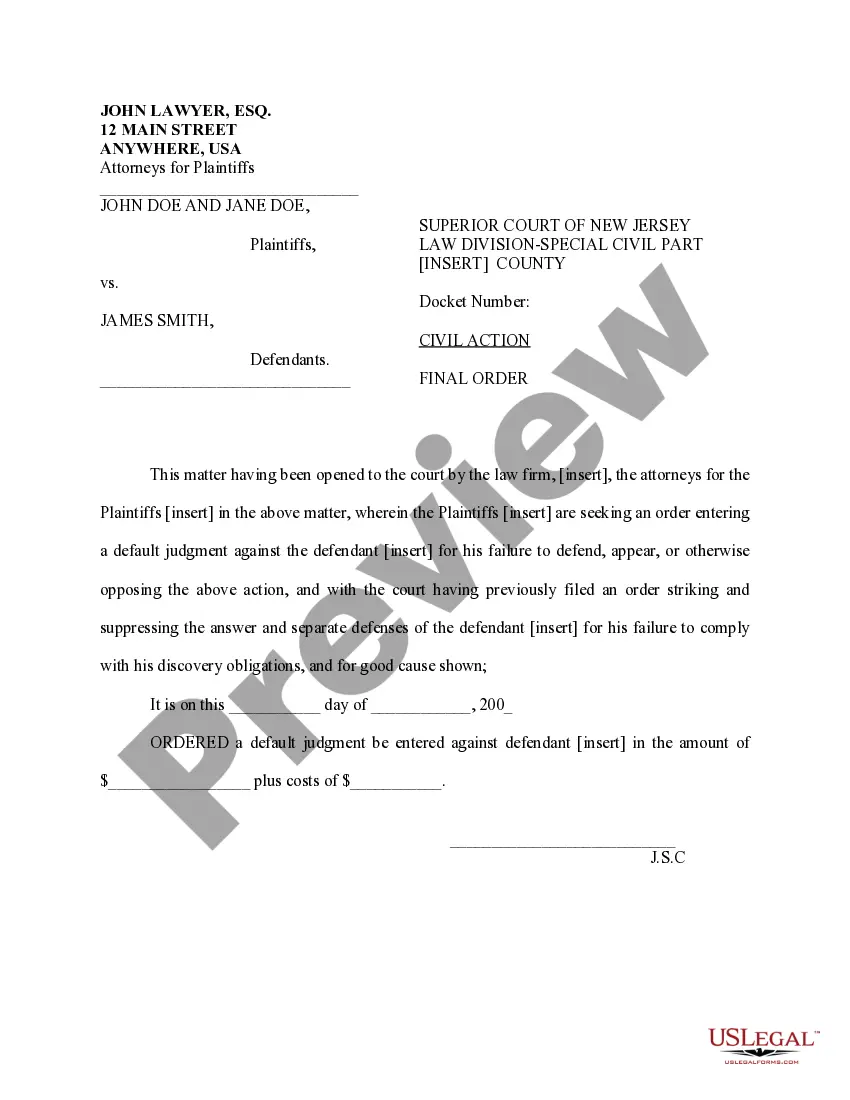
The Final Judgment for Money Damages is a legal document used in civil proceedings in New Jersey to formally record a court's decision to award monetary damages to a plaintiff after a defendant has failed to respond or defend against the claim. This form serves as a final order, distinguishing it from other forms that might deal with temporary relief or other legal requests in civil cases.
Key parts of this document
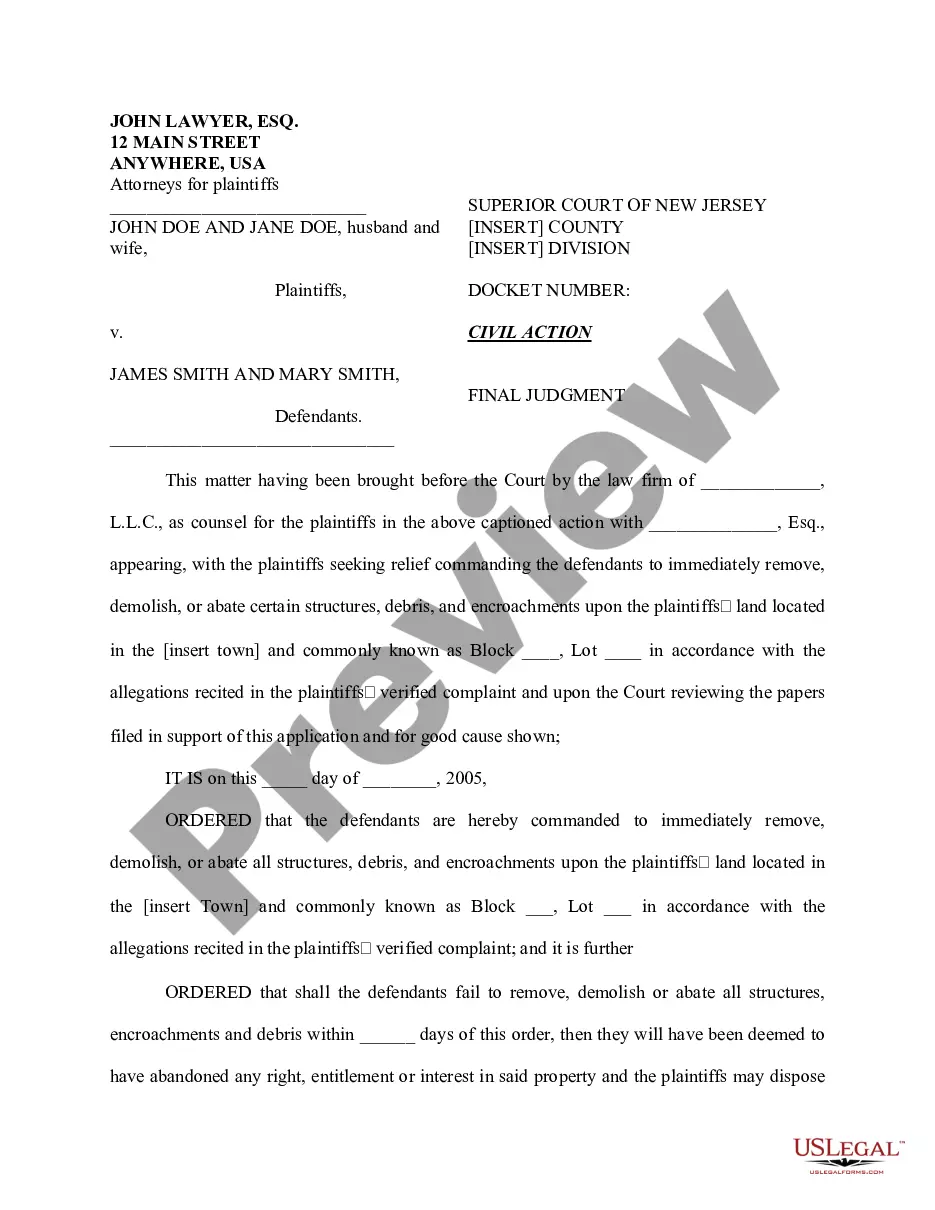
- Case caption identifying plaintiffs and defendants.
- Superior Court acknowledgment, including the county and docket number.
- Statement of default judgment due to the defendant's failure to appear.
- Details of the judgment amount awarded, including damages and costs.
- Signature line for a judge (J.S.C) to finalize the order.
Situations where this form applies
This form should be used when a plaintiff has initiated a civil action and the defendant does not respond to the court summons or otherwise fails to participate in the proceedings. It is applicable in situations where the court has determined that entry of default judgment is appropriate, allowing the plaintiff to receive the court's formal award of money damages without further contest from the defendant.
Who this form is for
- Plaintiffs who have filed a civil lawsuit in New Jersey.
- Individuals or businesses seeking to obtain a default judgment against defendants who have not responded to the action.
- Attorneys representing plaintiffs in civil actions.
How to prepare this document
- Identify and enter the names of the plaintiffs and defendants in the case caption.
- Fill in the docket number associated with the civil action.
- Specify the amount of money damages awarded in the judgment section.
- Include any additional costs that are part of the judgment.
- Sign and date the form where indicated by the judge.
Notarization guidance
In most cases, this form does not require notarization. However, some jurisdictions or signing circumstances might. US Legal Forms offers online notarization powered by Notarize, accessible 24/7 for a quick, remote process.
Get your form ready online
Our built-in tools help you complete, sign, share, and store your documents in one place.
Make edits, fill in missing information, and update formatting in US Legal Forms—just like you would in MS Word.
Download a copy, print it, send it by email, or mail it via USPS—whatever works best for your next step.
Sign and collect signatures with our SignNow integration. Send to multiple recipients, set reminders, and more. Go Premium to unlock E-Sign.
If this form requires notarization, complete it online through a secure video call—no need to meet a notary in person or wait for an appointment.
We protect your documents and personal data by following strict security and privacy standards.

Make edits, fill in missing information, and update formatting in US Legal Forms—just like you would in MS Word.

Download a copy, print it, send it by email, or mail it via USPS—whatever works best for your next step.

Sign and collect signatures with our SignNow integration. Send to multiple recipients, set reminders, and more. Go Premium to unlock E-Sign.

If this form requires notarization, complete it online through a secure video call—no need to meet a notary in person or wait for an appointment.

We protect your documents and personal data by following strict security and privacy standards.
Common mistakes
- Failing to include the correct case docket number.
- Omitting necessary signatures or dates.
- Incorrectly stating the amount of damages awarded.
- Not checking compliance with local court rules regarding default judgments.
Benefits of using this form online
- Convenience of accessing the form from any location with internet.
- Immediate download ensures you can get started without delays.
- Editability allows personalization for your specific case needs.
- Drafted by licensed attorneys, reflecting high legal standards.
Looking for another form?
Form popularity
FAQ
In lieu of settlement by motion or consent, the party proposing the form of judgment or order may forward the original thereof to the judge who heard the matter and shall serve a copy thereof on every other party not in default together with a notice advising that unless the judge and the proponent of the judgment or
In order to vacate a judgment in California, You must file a motion with the court asking the judge to vacate or set aside the judgment. Among other things, you must tell the judge why you did not respond to the lawsuit (this can be done by written declaration).
The statute of limitations for a debt collector to collect a past-due debt in New Jersey is six years, said Karra Kingston, a bankruptcy attorney in Union City.
To record a judgment, you should request a Statement for Docketing from the Office of the Special Civil Part in the county where the case was heard. The Statement for Docketing must be filed with the Clerk of the Superior Court, Richard J. Hughes Justice Complex, P.O. Box 971, Trenton, N.J. 08625.
Renew the judgment Money judgments automatically expire (run out) after 10 years.If the judgment is not renewed, it will not be enforceable any longer and you will not have to pay any remaining amount of the debt. Once a judgment has been renewed, it cannot be renewed again until 5 years later.
Judgments in New Jersey remain in effect for 20 years and may be renewed for an additional 20 years by filing a motion in the Superior Court, Law Division, Civil Part and/or in the Special Civil Part if the Special Civil Part case was assigned a DJ or J docket number.
A judgment from another state can be enforced by docketing it with the Clerk of the Superior Court in Trenton. It will then be a lien on any real estate owned by the debtor in New Jersey and other collection efforts must be made through the Sheriff's Office in the county where the debtor has assets.
In New Jersey, there is a six-year statute of limitations on collecting a debt. This means that a creditor can no longer make attempts to collect on a debt once six years have passed since the original date that payment was owed.