New Jersey Final Judgment Injunctive Relief
About this form
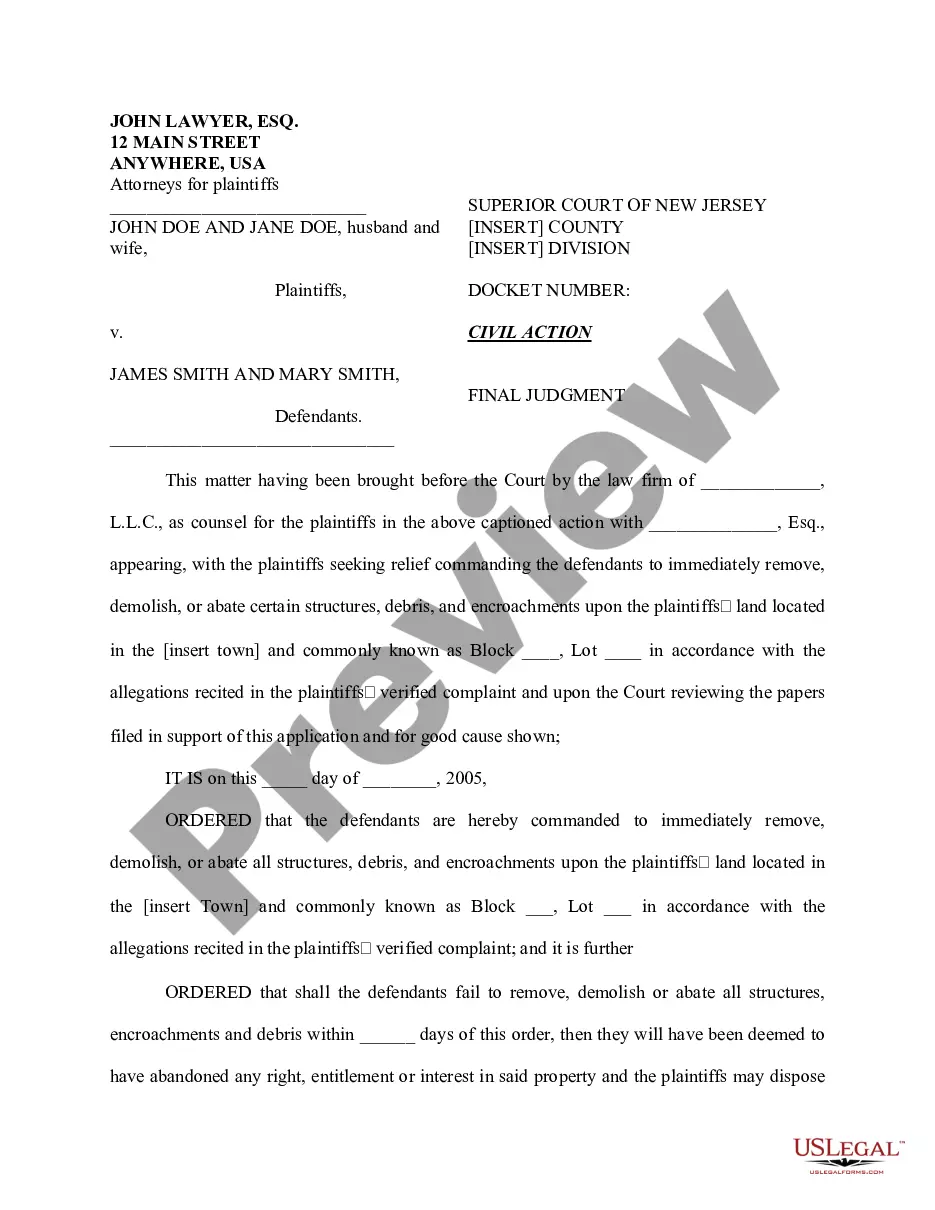
The Final Judgment Injunctive Relief is a New Jersey legal form used to obtain a court order directing a defendant to remove or abate encroachments or structures on a plaintiff's property. Unlike other judgment forms, this specific form is focused on injunctive relief, compelling immediate action from the defendants to protect the plaintiffs' property rights.
Main sections of this form
- Heading with case identification, including plaintiffs and defendants' names.
- Court information, including the Superior Court of New Jersey and county details.
- Details of the property in question, such as block and lot numbers.
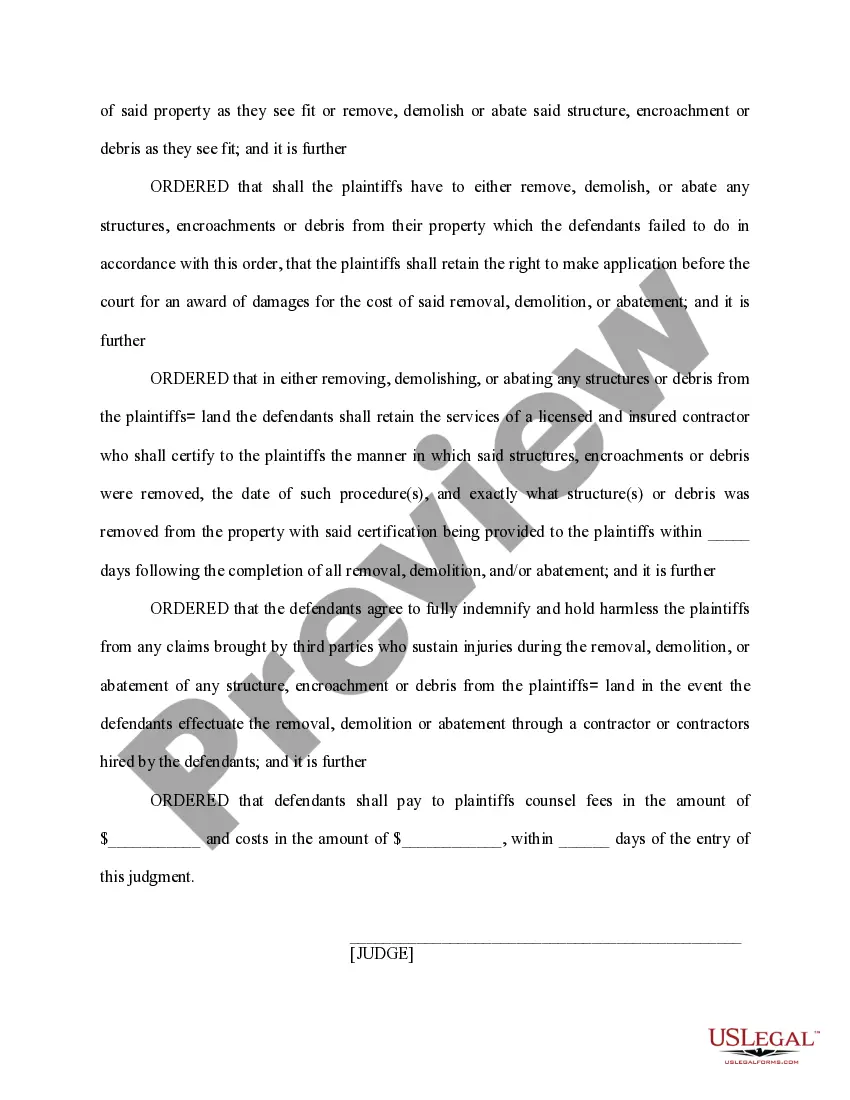
- Orders for defendants to remove or abate structures or debris within a specified time frame.
- Provisions for the plaintiffs to seek damages if defendants fail to comply.
- Requirement for defendants to indemnify plaintiffs against third-party claims during the removal process.
Common use cases
This form is applicable when a plaintiff needs court intervention to compel a defendant to remove unauthorized structures or debris from their property. It is particularly useful in disputes over property boundaries, encroachments, or violations that harm the use or enjoyment of one's land.
Who can use this document
- Property owners seeking to remove legal obstructions on their land.
- Individuals involved in property disputes with adjacent landowners.
- Real estate attorneys representing clients in civil actions related to property encroachments.
Instructions for completing this form
- Identify the parties involved by filling in the names of the plaintiffs and defendants on the form.
- Specify the property by inserting the block and lot numbers and the municipality where the property is located.
- Fill in the relevant court information, including the county and docket number.
- Detail any specific structures or debris that need to be addressed within the orders section.
- Enter the dates, amounts for fees, and any other required information in designated fields.
Is notarization required?
This form does not typically require notarization unless specified by local law. Users should confirm with local legal practices to ensure compliance.
Get your form ready online
Our built-in tools help you complete, sign, share, and store your documents in one place.
Make edits, fill in missing information, and update formatting in US Legal Forms—just like you would in MS Word.
Download a copy, print it, send it by email, or mail it via USPS—whatever works best for your next step.
Sign and collect signatures with our SignNow integration. Send to multiple recipients, set reminders, and more. Go Premium to unlock E-Sign.
If this form requires notarization, complete it online through a secure video call—no need to meet a notary in person or wait for an appointment.
We protect your documents and personal data by following strict security and privacy standards.

Make edits, fill in missing information, and update formatting in US Legal Forms—just like you would in MS Word.

Download a copy, print it, send it by email, or mail it via USPS—whatever works best for your next step.

Sign and collect signatures with our SignNow integration. Send to multiple recipients, set reminders, and more. Go Premium to unlock E-Sign.

If this form requires notarization, complete it online through a secure video call—no need to meet a notary in person or wait for an appointment.

We protect your documents and personal data by following strict security and privacy standards.
Common mistakes to avoid
- Failing to accurately identify the property, leading to confusion in enforcement.
- Not providing sufficient detail on the structures or debris to be abated.
- Neglecting to include proper legal representation details.
Why use this form online
- Convenient access to a legally compliant form that can be downloaded immediately.
- Editable formats allow for easy customization to suit specific needs.
- Reliable templates drafted by licensed attorneys ensure adherence to legal standards.
- This form provides a legal avenue to compel action regarding property disputes.
- It is essential for ensuring that property rights are respected and enforced in court.
- The final judgment is enforceable by law, allowing plaintiffs to take further action if the defendants do not comply.
Looking for another form?

Form popularity
FAQ
Injunctive relief, also known as an injunction, is a remedy which restrains a party from doing certain acts or requires a party to act in a certain way. It is generally only available when there is no other remedy at law and irreparable harm will result if the relief is not granted.
A petition for injunctive relief may request either a permanent or preliminary injunction. Regardless of the form sought, an injunction is not itself a cause of action; rather, a cause of action must exist on which injunctive relief may be granted. (Camp v.
In lieu of settlement by motion or consent, the party proposing the form of judgment or order may forward the original thereof to the judge who heard the matter and shall serve a copy thereof on every other party not in default together with a notice advising that unless the judge and the proponent of the judgment or
Definition: An injunction is a court order requiring a person to do or cease doing a specific action.Choosing whether to grant temporary injunctive relief is up to the discretion of the court. Permanent injunctions are issued as a final judgment in a case, where monetary damages will not suffice.
An injunction is an order by a court commanding or prohibiting a specific action. If a defendant fails to abide by an injunction issued against them, they can be held in contempt of court and punished with imprisonment or fines.The rules regarding the issuance of injunctions vary somewhat by jurisdiction.
Definition: An injunction is a court order requiring a person to do or cease doing a specific action.Choosing whether to grant temporary injunctive relief is up to the discretion of the court. Permanent injunctions are issued as a final judgment in a case, where monetary damages will not suffice.
Compensatory damages - the amount of money the plaintiff lost where the defendant's tort was the legal cause of the loss.Injunctive relief - a court order prohibiting the defendant from continuing or repeating the tortious behavior.
Injunctive relief clause is a component of a contract that specifically orders both parties of the contract to refrain from doing an act that would cause harm.