Checklist Due Diligence for Acquiring OnGoing Operations Asset or Stock
Understanding this form
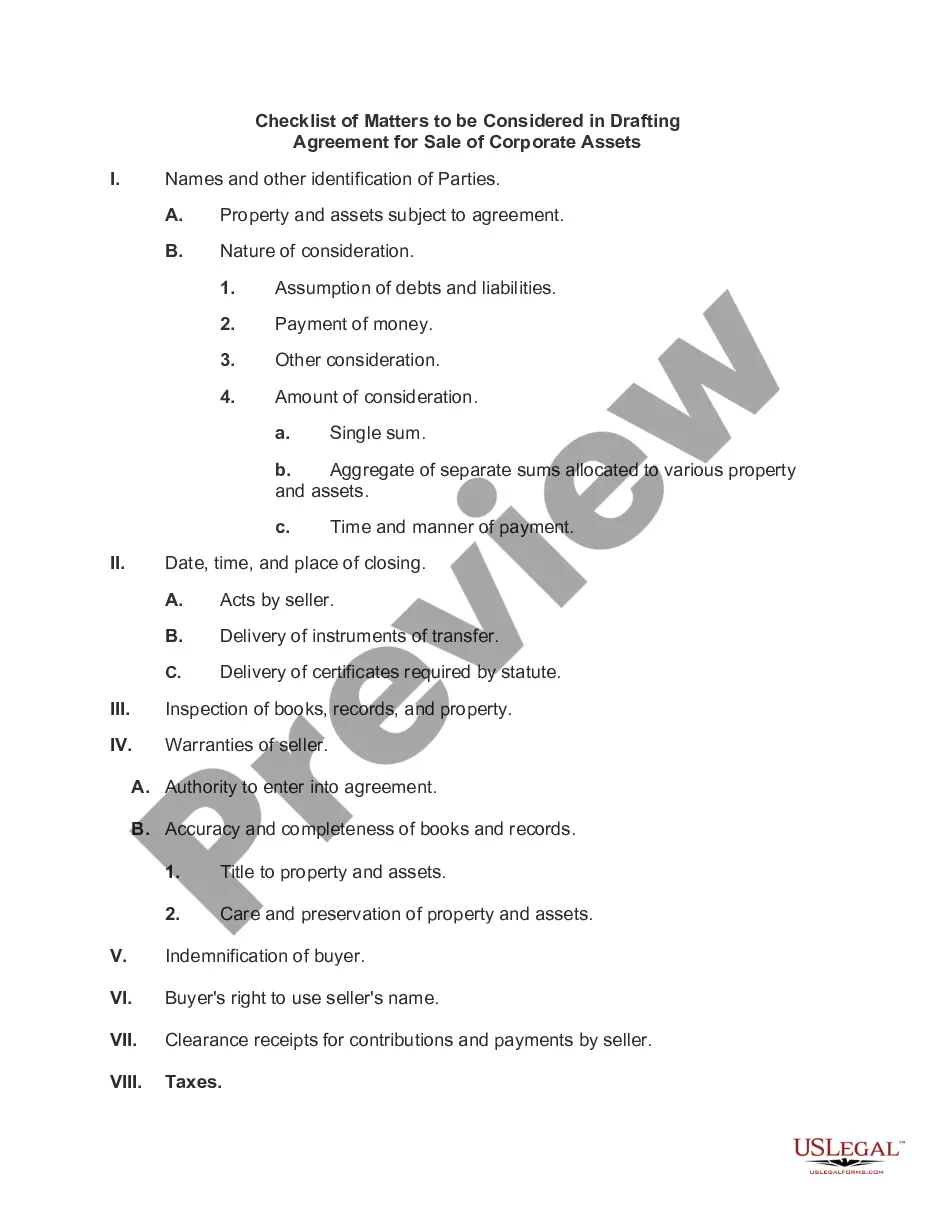
The Checklist Due Diligence for Acquiring Ongoing Operations Asset or Stock is a vital document that outlines the necessary information and documents required during a due diligence investigation. This form helps purchasers ensure they are thoroughly evaluating both tangible and intangible assets, liabilities, and operational matters of a business before making an acquisition. It stands apart from other forms by providing a comprehensive list tailored specifically for this crucial evaluation process.
What’s included in this form
- Charter documents and regulatory status
- Audited financial statements and other financial data
- Tangible assets, including real estate
- Intangible property, including intellectual property
- Labor and benefits matters
- Hazardous materials and environmental matters
- Federal, state, local, and foreign taxes
- Agreements and contracts
- Dispute-related proceedings
- Risk management






Situations where this form applies
This form is used when a business is considering acquiring another ongoing operation, whether through asset purchase or stock acquisition. It is essential to have a clear understanding of the acquired entity's financial health, regulatory status, and all related obligations. Key scenarios include mergers, acquisitions, or when entering strategic partnerships that involve significant investments.
Who this form is for
- Business owners seeking to acquire another business.
- Investors conducting due diligence before making an investment.
- Legal and financial advisors assisting clients with acquisitions.
- Corporate executives responsible for mergers and acquisitions.
Instructions for completing this form
- Identify all parties involved in the transaction.
- Gather relevant charter documents and regulatory agreements.
- Compile audited financial statements and other financial data.
- Review all agreements and contracts related to the business.
- Assess any pending disputes and litigation.
- Document any other significant assets or liabilities.
Notarization guidance
This form does not typically require notarization to be legally valid. However, some jurisdictions or document types may still require it. US Legal Forms provides secure online notarization powered by Notarize, available 24/7 for added convenience.
Get your form ready online
Our built-in tools help you complete, sign, share, and store your documents in one place.
Make edits, fill in missing information, and update formatting in US Legal Forms—just like you would in MS Word.
Download a copy, print it, send it by email, or mail it via USPS—whatever works best for your next step.
Sign and collect signatures with our SignNow integration. Send to multiple recipients, set reminders, and more. Go Premium to unlock E-Sign.
If this form requires notarization, complete it online through a secure video call—no need to meet a notary in person or wait for an appointment.
We protect your documents and personal data by following strict security and privacy standards.

Make edits, fill in missing information, and update formatting in US Legal Forms—just like you would in MS Word.

Download a copy, print it, send it by email, or mail it via USPS—whatever works best for your next step.

Sign and collect signatures with our SignNow integration. Send to multiple recipients, set reminders, and more. Go Premium to unlock E-Sign.

If this form requires notarization, complete it online through a secure video call—no need to meet a notary in person or wait for an appointment.

We protect your documents and personal data by following strict security and privacy standards.
Mistakes to watch out for
- Failing to gather all relevant documents and agreements.
- Not reviewing financial data thoroughly.
- Overlooking state-specific regulatory requirements.
- Neglecting to consult with legal and financial professionals.
Why use this form online
- Immediate access to a comprehensive checklist tailored for due diligence.
- Easy to download and edit to suit specific business needs.
- Created by licensed attorneys with expertise in business transactions.
- Streamlines the due diligence process and enhances accuracy.
Legal use & context
- The form serves as a guideline for conducting due diligence, which is a critical component of corporate transactions.
- While this checklist aids in ensuring comprehensive evaluations, it does not replace the need for legal advice.
- Its use can minimize risks associated with business acquisitions.
Key takeaways
- The checklist is essential for conducting thorough due diligence in business acquisitions.
- It helps identify and evaluate financial, legal, and operational aspects of the target business.
- Using this form can streamline the acquisition process and reduce potential liability.
Looking for another form?

Form popularity
FAQ
Due Diligence Examples Conducting thorough inspections on a property before buying it in order to make sure that it is a good investment. An underwriter auditing an issuer's business and operations prior to selling it.
Company information. Who owns the company? Finances. Where are the company's quarterly and annual financial statements from the past several years? Products and services. What are the company's current and future products and services? Customers. Technology assets. IP assets. Physical assets. Legal issues.
Due diligence documents are the research and analysis of a company or organization done in preparation for a business transaction (such as a corporate merger or purchase of securities). Due diligence documents typically include the following categories; legal, financial, sales and marketing, and human resources.
Due diligence is the investigation of every aspect of a property that could affect its value and suitability as a home or investment. Unfortunately for many buyers, due diligence involves little more than a building and pest inspection and contract review. These steps are essential, but only form part of the process.
The report will include a list of key findings and valid recommendations, as well as a reasoned conclusion with a financial analysis explaining the feasibility of our recommendations, and its impact on the company.
Target Company Overview. Understanding why the owners of the company are selling the business Financials. Technology/Patents. Strategic Fit. Target Base. Management/Workforce. Legal Issues. Information Technology.
A due diligence checklist is an organized way to analyze a company. The checklist will include all the areas to be analyzed, such as ownership and organization, assets and operations, the financial ratios, shareholder value, processes and policies, future growth potential, management, and human resources.
Due diligence is a process of verification, investigation, or audit of a potential deal or investment opportunity to confirm all relevant facts and financial information. These three core statements are, and to verify anything else that was brought up during an M&A deal.
Step 1: Company Capitalization. Step 2: Revenue, Margin Trends. Step 3: Competitors & Industries. Step 4: Valuation Multiples. Step 5: Management and Ownership. Step 6: Balance Sheet Exam. Step 7: Stock Price History. Step 8: Stock Options & Dilution.