Prioritized Industrial Operational Due Diligence Checklist
About this form
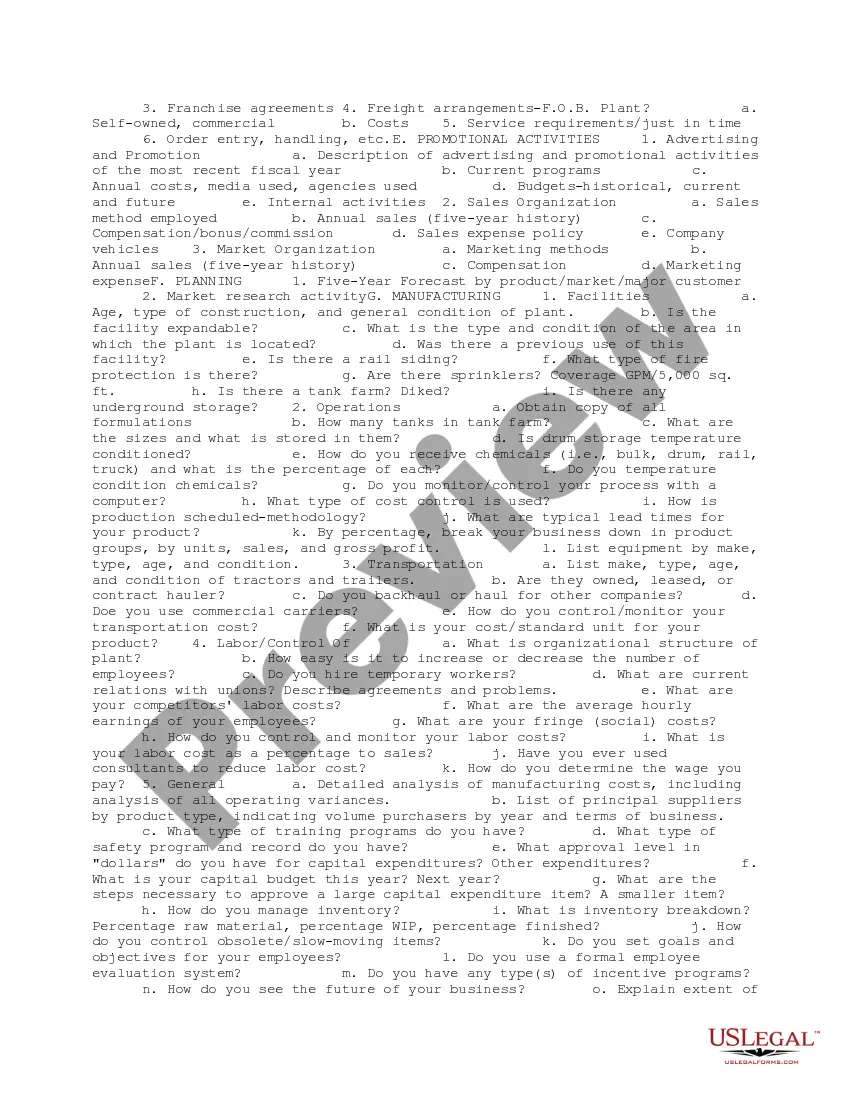
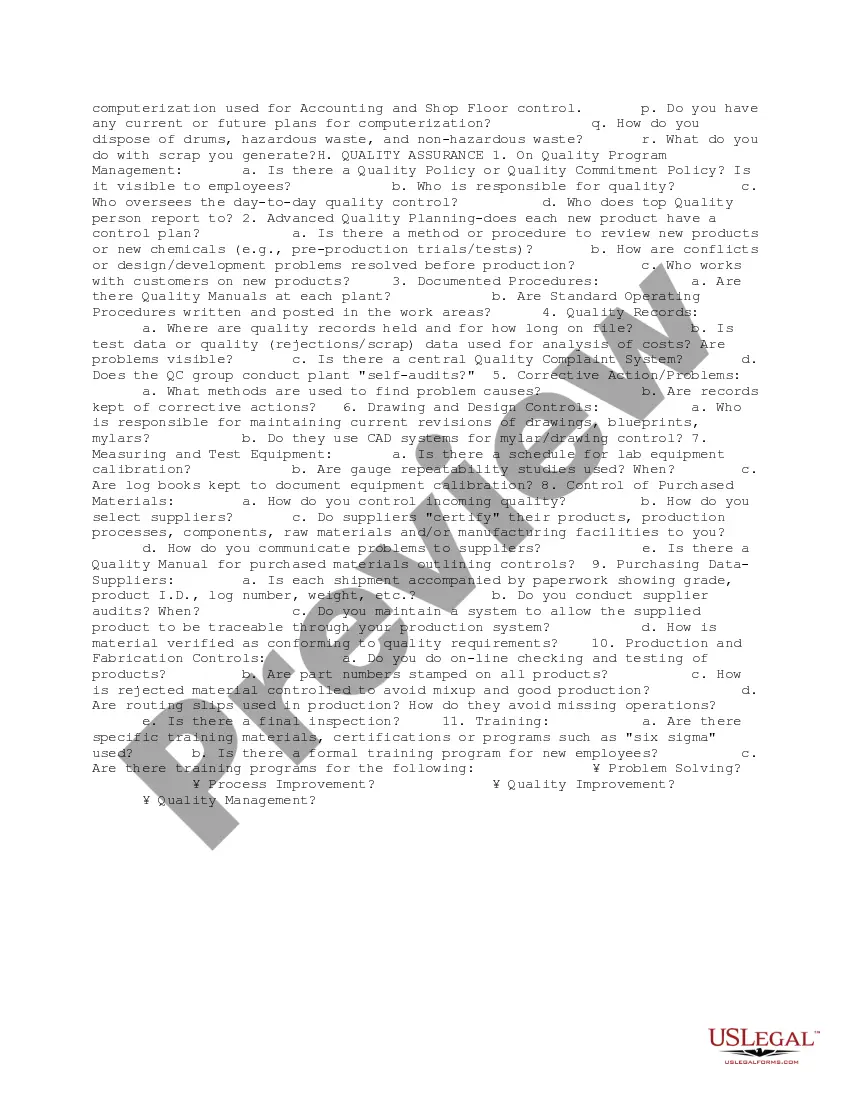
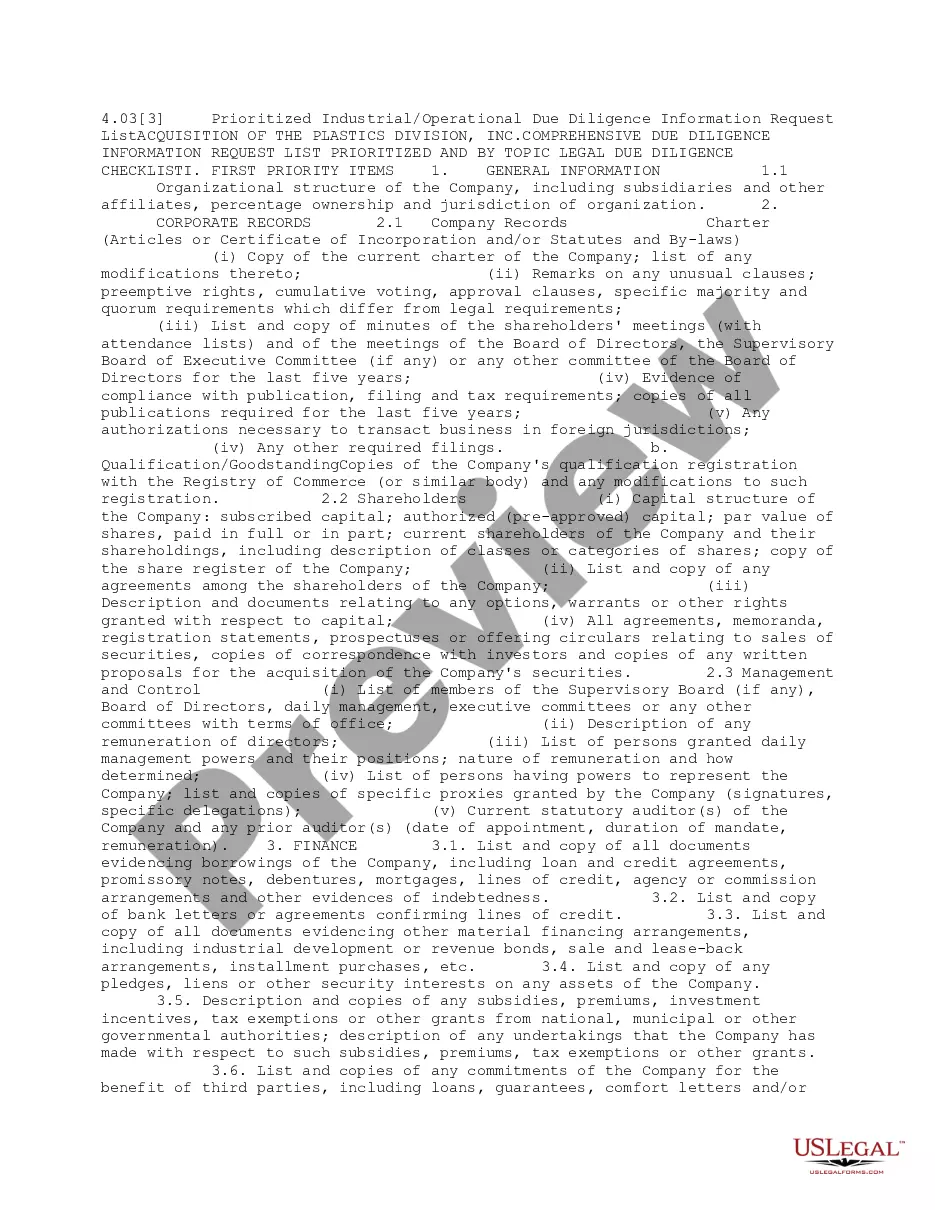
The Prioritized Industrial Operational Due Diligence Checklist is a comprehensive tool used to assess various industrial and operational aspects of a business during a transaction. Unlike general due diligence forms, this checklist focuses specifically on operational elements across key areas such as sales and marketing, human resources, environmental compliance, and manufacturing processes, making it essential for businesses looking to make informed decisions in mergers, acquisitions, or partnerships.
Main sections of this form
- Sales and marketing guidelines, including pricing, market share, and major customer contracts.
- Human resource policies, covering job descriptions, salary structures, and severance policies.
- Environmental compliance checks, including existing issues and regulatory adherence.
- Manufacturing details, such as employee numbers, product lines, and efficiency reports.
- Key quality assurance practices and procedures for monitoring quality control.




When this form is needed
This checklist should be used when evaluating a business's operational integrity during potential mergers or acquisitions. It is particularly useful when detailed industrial and operational insights are necessary to determine the viability or risks associated with the business transaction. Companies looking to streamline their due diligence process will find this checklist invaluable in identifying critical areas that require further investigation.
Who should use this form
- Business analysts conducting due diligence on potential mergers or acquisitions.
- Corporate managers and executives assessing internal operations before significant transactions.
- Investors and advisors needing comprehensive insights into operational risks.
- Compliance officers ensuring adherence to environmental and operational regulations.
Instructions for completing this form
- Gather relevant data from each department, including sales, marketing, human resources, and environmental compliance.
- Review the checklist to ensure all first and second priority items are completed with accurate information.
- Document the findings clearly, highlighting areas of concern or compliance to address in the due diligence process.
- Ensure that all stakeholders involved in the transaction have reviewed the completed checklist for input and accuracy.
- Use the checklist as a foundational document for discussions on operational strengths and weaknesses during negotiations.
Does this form need to be notarized?
In most cases, this form does not require notarization. However, some jurisdictions or signing circumstances might. US Legal Forms offers online notarization powered by Notarize, accessible 24/7 for a quick, remote process.
Get your form ready online
Our built-in tools help you complete, sign, share, and store your documents in one place.
Make edits, fill in missing information, and update formatting in US Legal Forms—just like you would in MS Word.
Download a copy, print it, send it by email, or mail it via USPS—whatever works best for your next step.
Sign and collect signatures with our SignNow integration. Send to multiple recipients, set reminders, and more. Go Premium to unlock E-Sign.
If this form requires notarization, complete it online through a secure video call—no need to meet a notary in person or wait for an appointment.
We protect your documents and personal data by following strict security and privacy standards.

Make edits, fill in missing information, and update formatting in US Legal Forms—just like you would in MS Word.

Download a copy, print it, send it by email, or mail it via USPS—whatever works best for your next step.

Sign and collect signatures with our SignNow integration. Send to multiple recipients, set reminders, and more. Go Premium to unlock E-Sign.

If this form requires notarization, complete it online through a secure video call—no need to meet a notary in person or wait for an appointment.

We protect your documents and personal data by following strict security and privacy standards.
Avoid these common issues
- Neglecting to gather complete data from all relevant departments.
- Failing to update the checklist with the most current information prior to use.
- Overlooking secondary priority items that may impact the overall assessment.
- Not involving all stakeholders in the review process, leading to incomplete evaluations.
Why use this form online
- Easy access and download of the checklist for immediate use.
- Allows for quick editing and customization to meet specific business needs.
- Provides a reliable template designed by licensed attorneys, ensuring legal soundness and effectiveness.
- Facilitates collaboration among team members by enabling shared access to the document.
Legal use & context
- This checklist is designed to help organizations conduct thorough due diligence before transactions.
- It is an assessment tool to identify risks associated with operational practices.
- While the form provides a structured approach, it should be supplemented with professional legal advice for specific situations.
What to keep in mind
- The checklist is vital for evaluating operational and industrial factors in business transactions.
- It covers critical areas like sales, human resources, environmental compliance, and manufacturing.
- Using this form can help identify potential risks and streamline the due diligence process.
Looking for another form?


Form popularity
FAQ
Get A Professional Home Inspection. Have The Property Surveyed. Get Lead-Based Paint Testing. Pump And Inspect The Septic Tank. Mold & Air Quality Testing. Get A Termite Inspection. Test For Electromagnetic Fields. Check Flood Maps.
Due diligence is a process of research and analysis that is initiated before an acquisition, investment, business partnership or bank loan, in order to determine the value of the subject of the due diligence or whether there are any major issues involved.
Step 1: Company Capitalization. Step 2: Revenue, Margin Trends. Step 3: Competitors & Industries. Step 4: Valuation Multiples. Step 5: Management and Ownership. Step 6: Balance Sheet Exam. Step 7: Stock Price History. Step 8: Stock Options & Dilution.
The report will include a list of key findings and valid recommendations, as well as a reasoned conclusion with a financial analysis explaining the feasibility of our recommendations, and its impact on the company.
Company information. Who owns the company? Finances. Where are the company's quarterly and annual financial statements from the past several years? Products and services. What are the company's current and future products and services? Customers. Technology assets. IP assets. Physical assets. Legal issues.
A Statement describing the subject of research. Documents in support of the research such as corporate reports, legal documents, transaction copies, market research, etc. SWOT Analysis i.e. an overview of the strengths, weaknesses, opportunities, and threats linked with the proposal.
A due diligence checklist is an organized way to analyze a company. The checklist will include all the areas to be analyzed, such as ownership and organization, assets and operations, the financial ratios, shareholder value, processes and policies, future growth potential, management, and human resources.
Financial due diligence. Legal due diligence. Tax due diligence. Operational due diligence. IP due diligence. Commercial due diligence. IT due diligence. HR due diligence.
A due diligence checklist is an organized way to analyze a company. The checklist will include all the areas to be analyzed, such as ownership and organization, assets and operations, the financial ratios, shareholder value, processes and policies, future growth potential, management, and human resources.