Amendment to Bylaws regarding election of president, chief executive officer and chairman of board
What this document covers
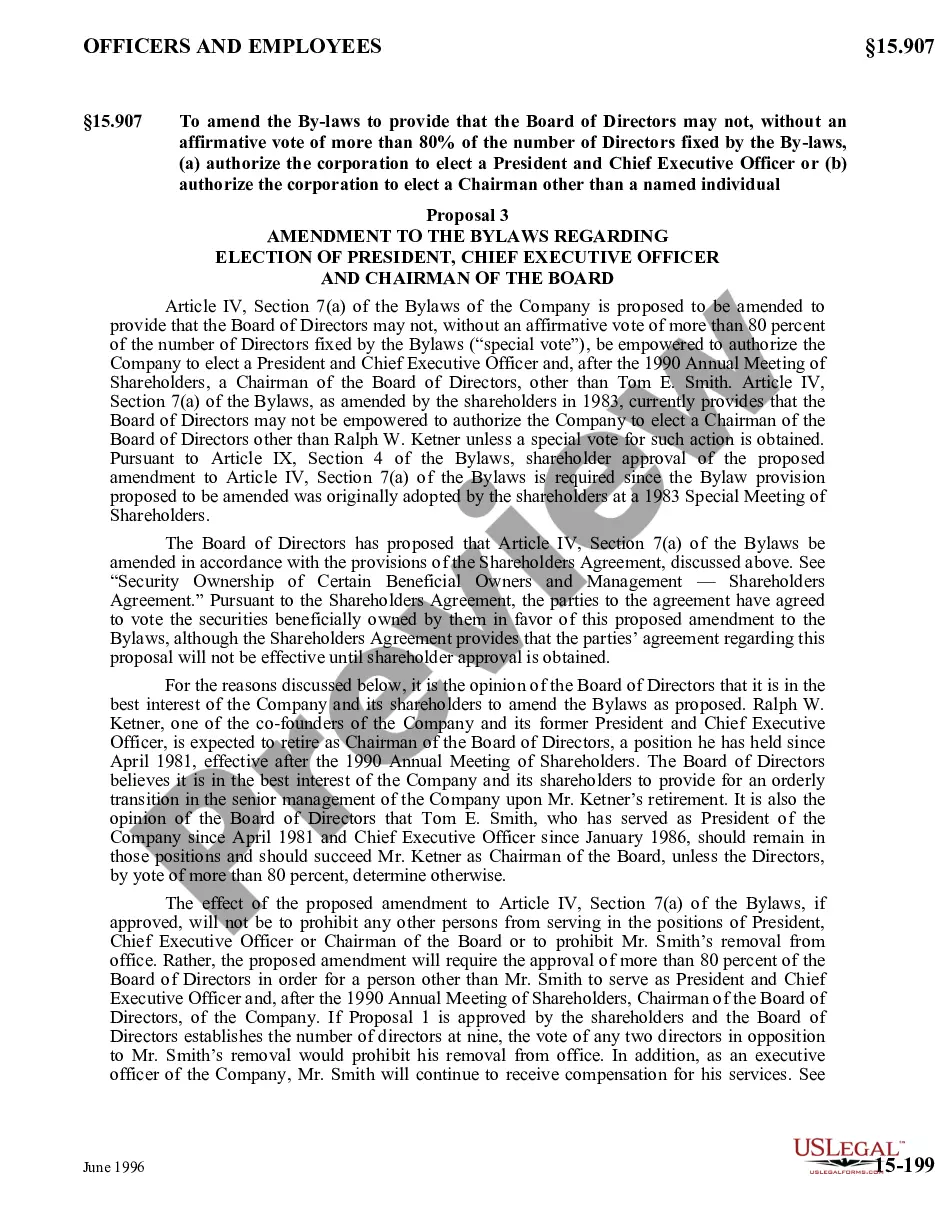
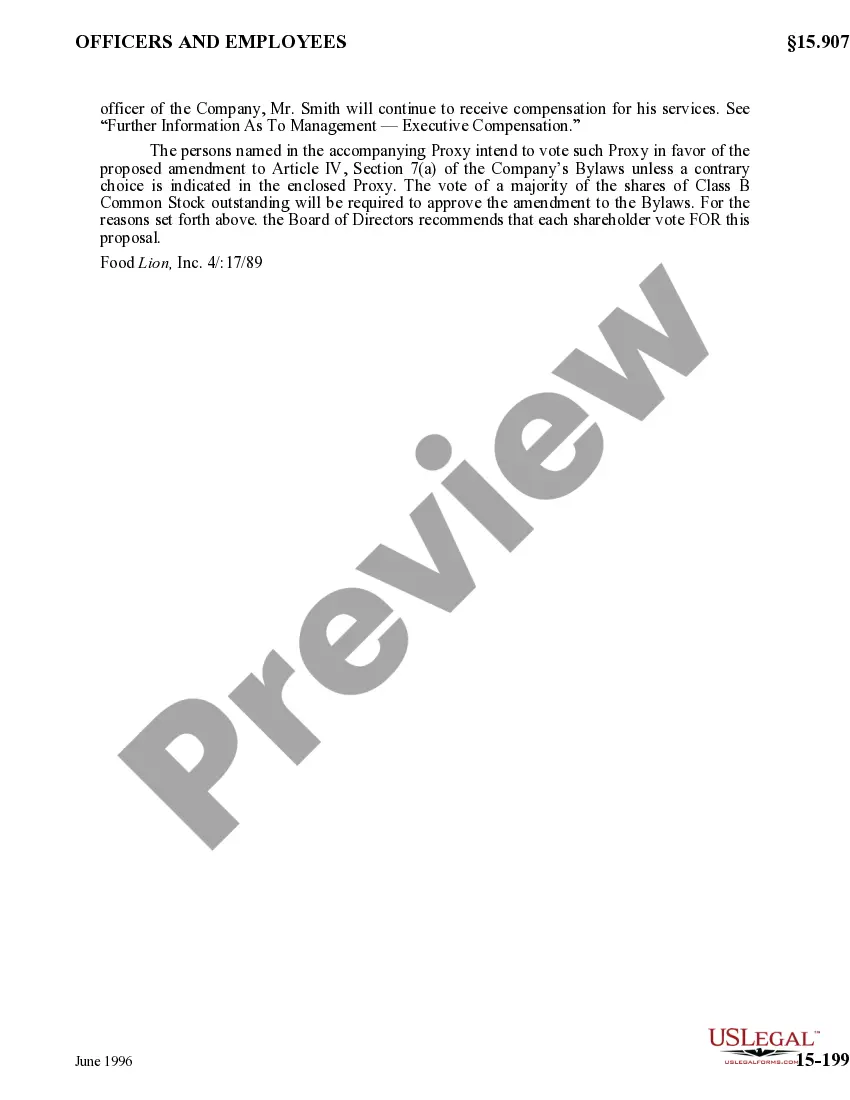
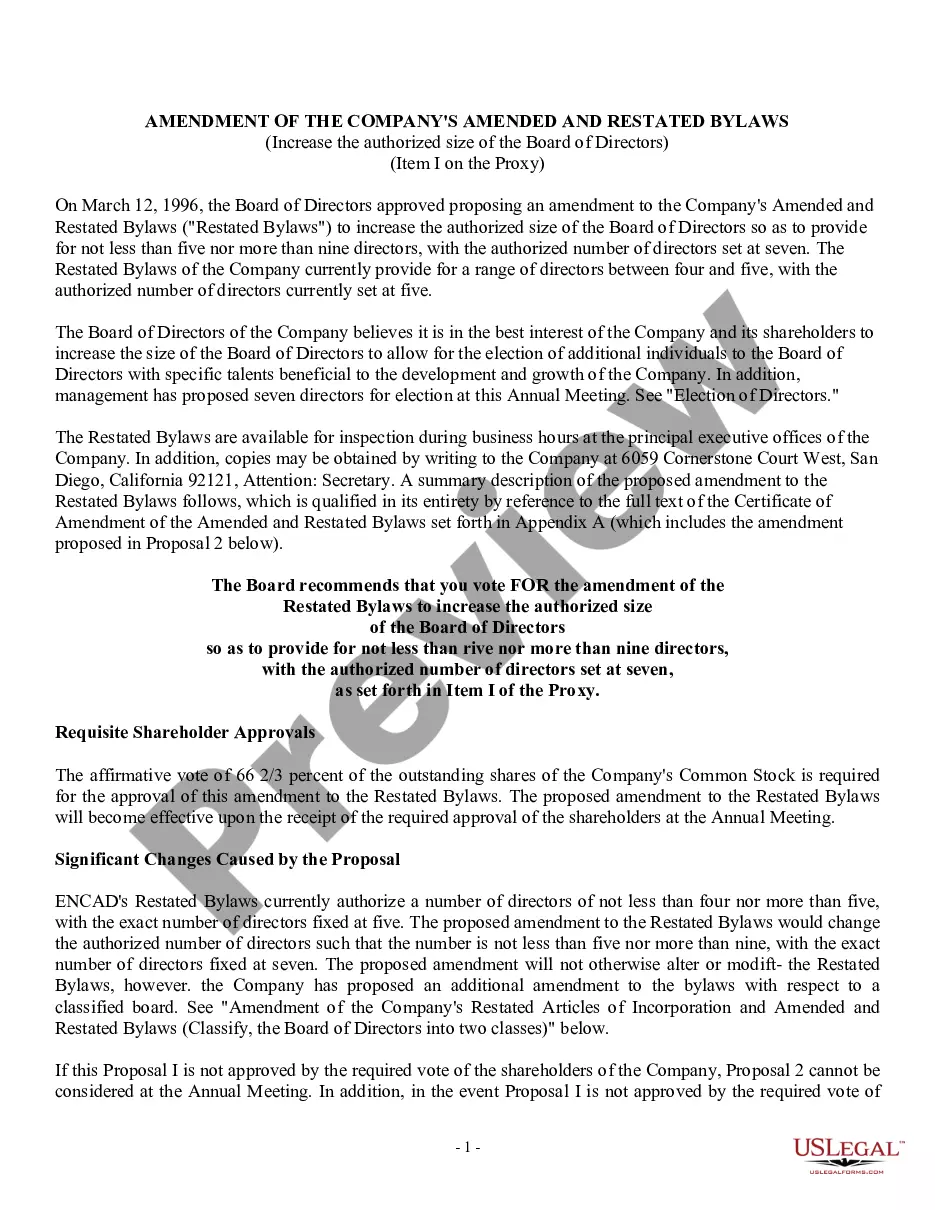
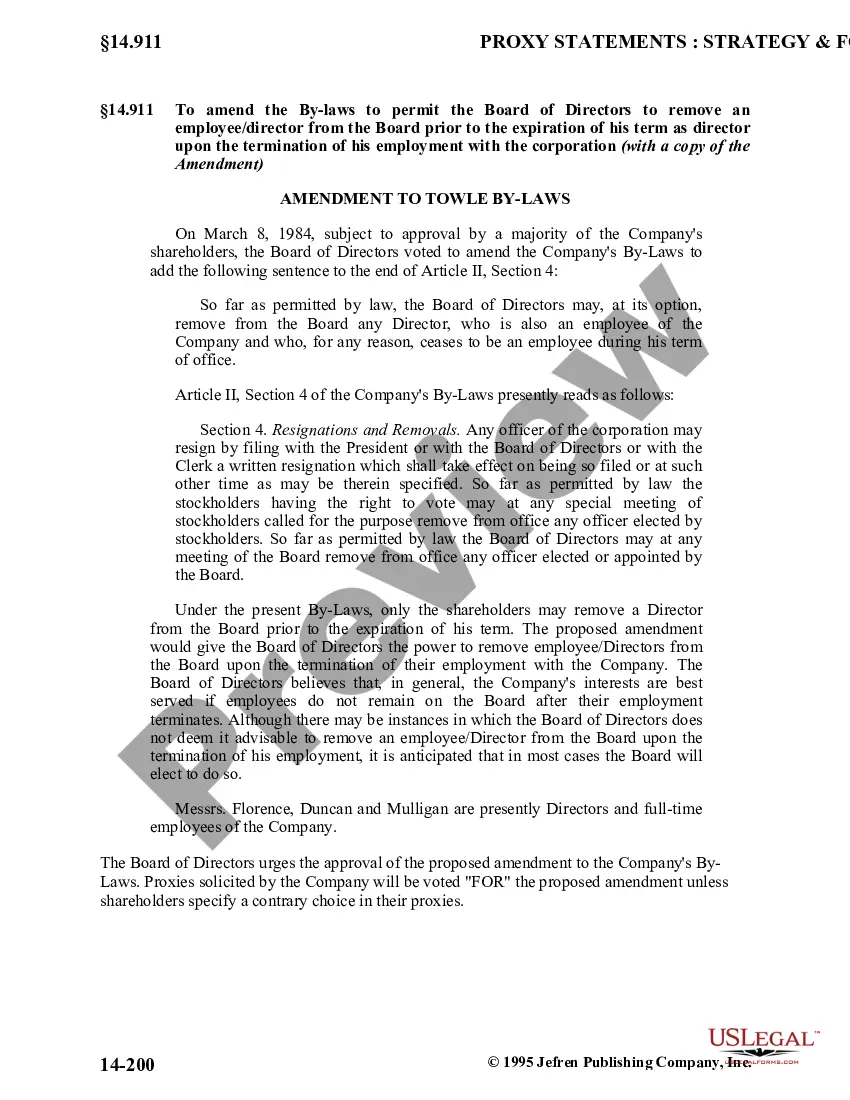
The Amendment to Bylaws regarding election of president, chief executive officer, and chairman of board is a legal document that allows a company to modify its bylaws related to the election of its top executives. This form ensures that significant changes in leadership succession are conducted transparently and with proper authorization, differentiating itself from other corporate governance documents by focusing specifically on election processes for these key positions.
Key components of this form
- Provision for a special vote by the board of directors, requiring over 80 percent approval for certain executive elections.
- Specifications regarding the succession of the chairman of the board after notable retirements.
- Requirements for shareholder approval based on previous bylaw amendments.
- Details on the roles of current executives and conditions for their continuation in office.
- Guidelines on how the board must handle executive elections moving forward.

Situations where this form applies
This form is needed when a corporation wishes to make formal changes to its bylaws concerning the election of the president, chief executive officer, and chairman of the board. It is particularly relevant during transitions in key leadership roles, such as when a long-serving chairman is set to retire, and the company aims to ensure a smooth transition and clear governance procedures.
Who this form is for
- Corporations looking to amend their internal governance documents.
- Shareholders who wish to propose changes to the election process of top executives.
- Boards of directors involved in planning for leadership transitions.
- Legal representatives managing corporate governance issues.
Instructions for completing this form
- Review the current bylaws to understand existing provisions governing executive elections.
- Draft the proposed language for the amendment that specifies the required special vote thresholds.
- Obtain necessary approvals from other board members or shareholders for the proposed amendment.
- Ensure the amendment is documented and circulated for shareholder voting, adhering to notice requirements.
- File the amended bylaws with appropriate regulatory bodies, if required by state law.
Does this form need to be notarized?
This form does not typically require notarization unless specified by local law. However, it is advisable to consult with a legal expert to ensure compliance with local regulations regarding corporate documentation.
Get your form ready online
Our built-in tools help you complete, sign, share, and store your documents in one place.
Make edits, fill in missing information, and update formatting in US Legal Forms—just like you would in MS Word.
Download a copy, print it, send it by email, or mail it via USPS—whatever works best for your next step.
Sign and collect signatures with our SignNow integration. Send to multiple recipients, set reminders, and more. Go Premium to unlock E-Sign.
If this form requires notarization, complete it online through a secure video call—no need to meet a notary in person or wait for an appointment.
We protect your documents and personal data by following strict security and privacy standards.

Make edits, fill in missing information, and update formatting in US Legal Forms—just like you would in MS Word.

Download a copy, print it, send it by email, or mail it via USPS—whatever works best for your next step.

Sign and collect signatures with our SignNow integration. Send to multiple recipients, set reminders, and more. Go Premium to unlock E-Sign.

If this form requires notarization, complete it online through a secure video call—no need to meet a notary in person or wait for an appointment.

We protect your documents and personal data by following strict security and privacy standards.
Common mistakes to avoid
- Failing to obtain the required shareholder approval before implementing the amendment.
- Not clearly outlining the voting procedure for board members in the amendment text.
- Neglecting to review how the amendment aligns with the existing bylaws.
- Overlooking state-specific filing requirements for amended bylaws.
Why complete this form online
- Convenience of immediate access to the form anytime and anywhere.
- Ability to customize the document to fit specific corporate needs.
- Reduction of errors by using attorney-drafted templates tailored for different states.
- Instant download for easy filing and distribution to relevant parties.
Legal use & context
- This form is legally binding once enacted and properly documented, ensuring the organizationâs compliance with its bylaws.
- It provides a clear procedure for managing leadership changes, contributing to organizational stability.
What to keep in mind
- Amending bylaws is essential for adapting to new leadership structures within a corporation.
- Ensure clarity and compliance by specifying voting percentages and shareholder approval processes.
- This form helps maintain transparency and order during significant corporate transitions.
Looking for another form?
Form popularity
FAQ
An arrest is found to violate the Fourth Amendment because it was not supported by probable cause or a valid warrant. Any evidence obtained through that unlawful arrest, such as a confession, will be kept out of the case.
The Fourth Amendment only protects against searches and seizures conducted by the government or pursuant to governmental direction. Surveillance and investigatory actions taken by strictly private persons, such as private investigators, suspicious spouses, or nosey neighbors, aren't governed by the Fourth Amendment.
The Fourth Amendment to the U.S. Constitution protects personal privacy, and every citizen's right to be free from unreasonable government intrusion into their persons, homes, businesses, and property -- whether through police stops of citizens on the street, arrests, or searches of homes and businesses.
Today the Fourth Amendment is understood as placing restraints on the government any time it detains (seizes) or searches a person or property.
The Fourth Amendment of the U.S. Constitution provides that "the right of the people to be secure in their persons, houses, papers, and effects, against unreasonable searches and seizures, shall not be violated, and no Warrants shall issue, but upon probable cause, supported by Oath or affirmation, and particularly
Most speech is protected to some degree by the First Amendment. However, the First Amendment does not protect police officers and other public employees from discipline for speech-related activities in a manner not afforded employees in the private sector.This undoubtedly includes police officers.
Even when they are off-duty, case law tells us that police officers don't have the same First Amendment rights as civilians.
The Fourth Amendment (Amendment IV) to the United States Constitution prohibits unreasonable searches and seizures and requires any search warrant to be judicially sanctioned and supported by probable cause. It is part of the Bill of Rights.