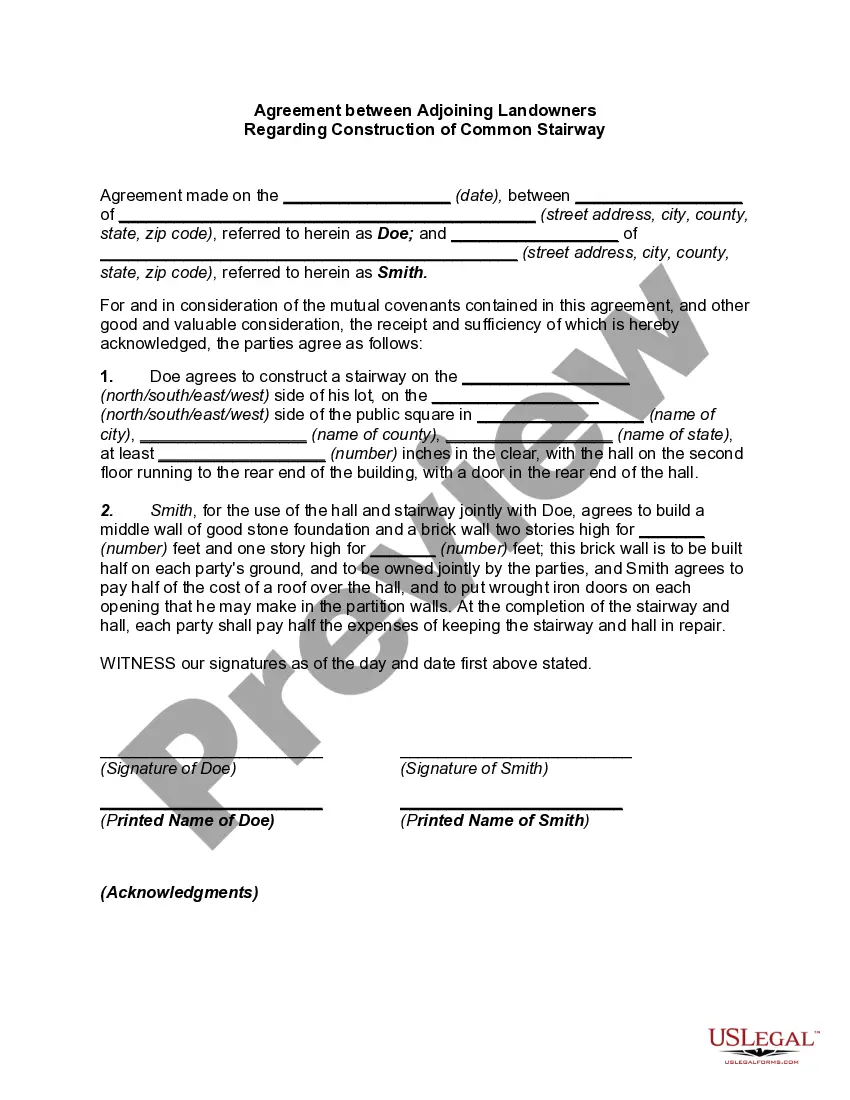
Agreement between Adjoining Landowners Regarding Construction of Common Stairway
Understanding this form
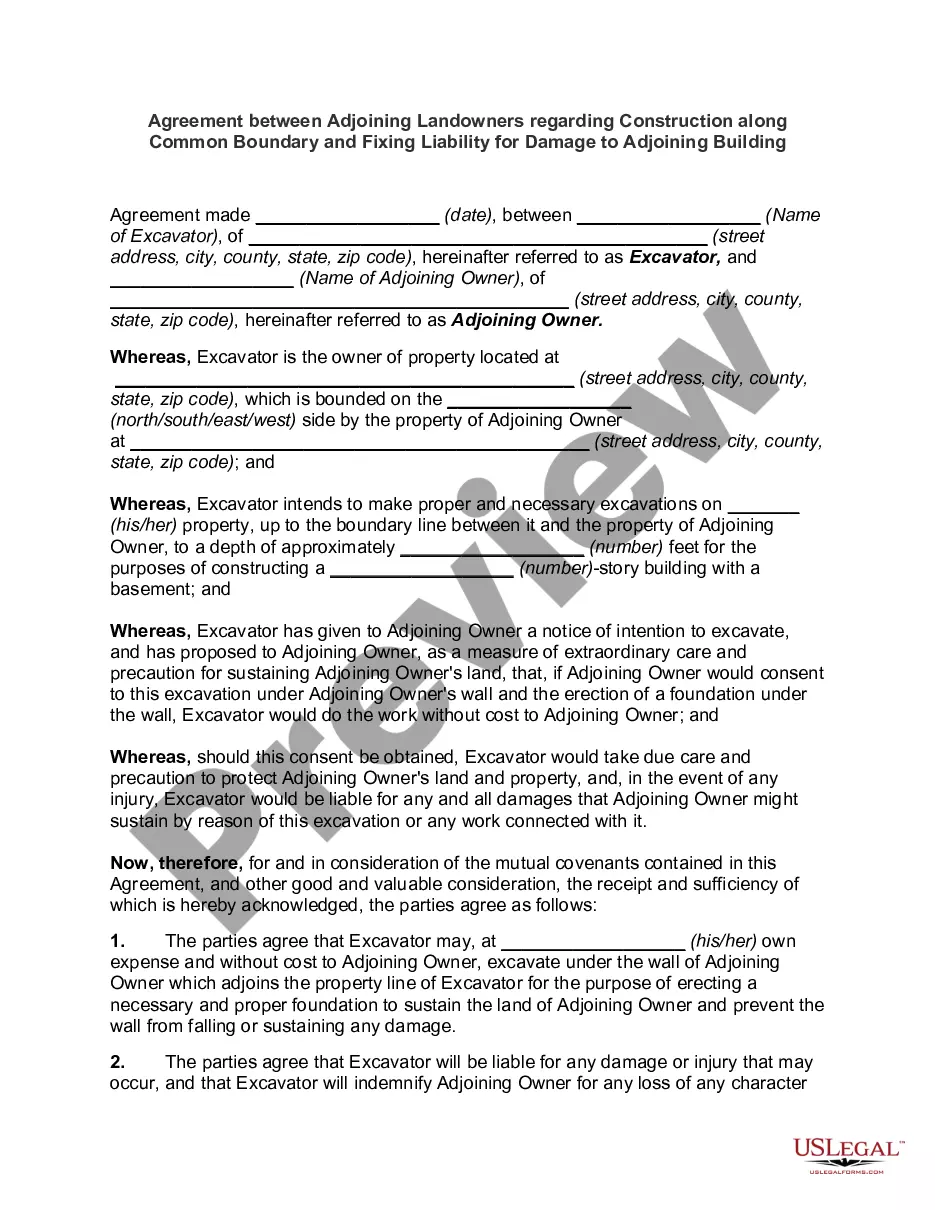
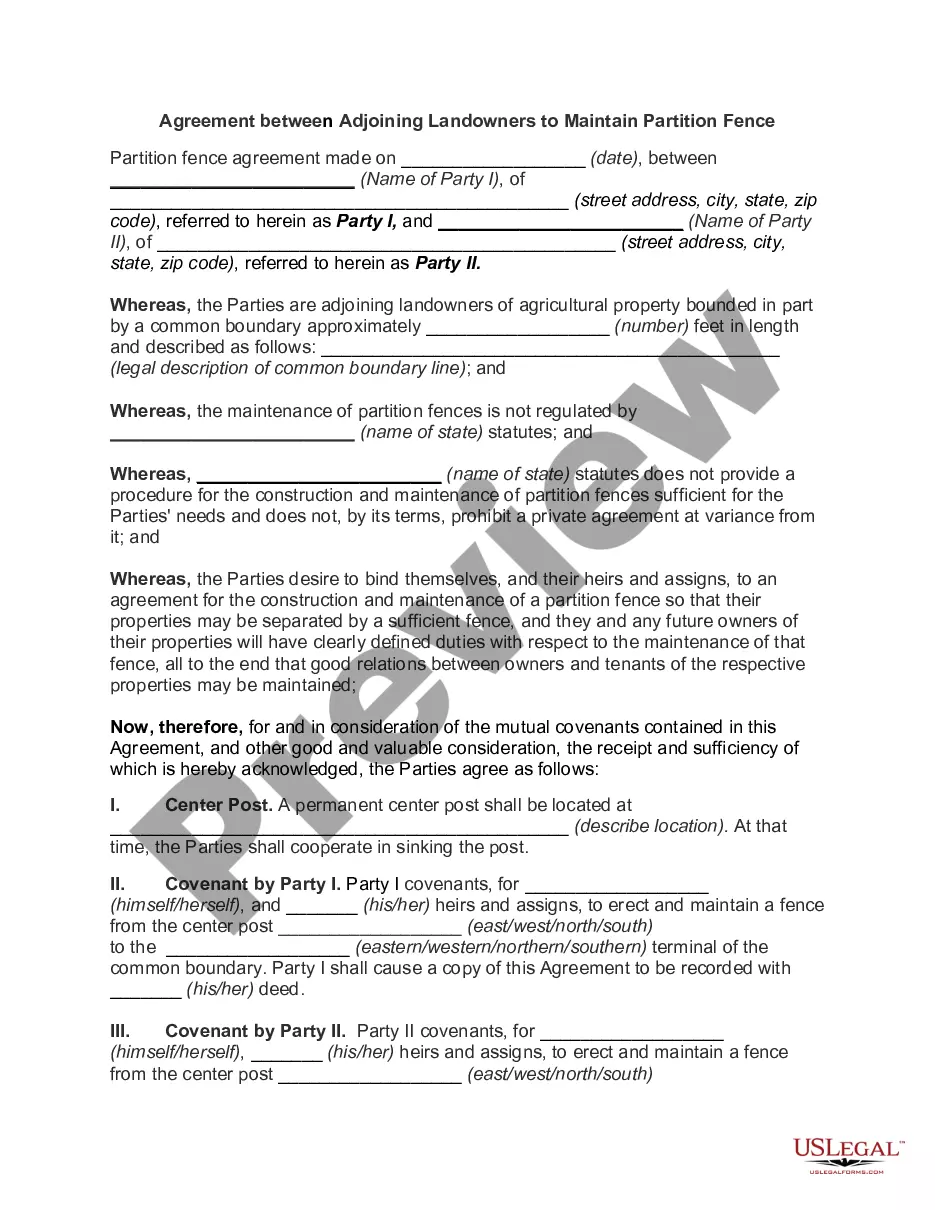
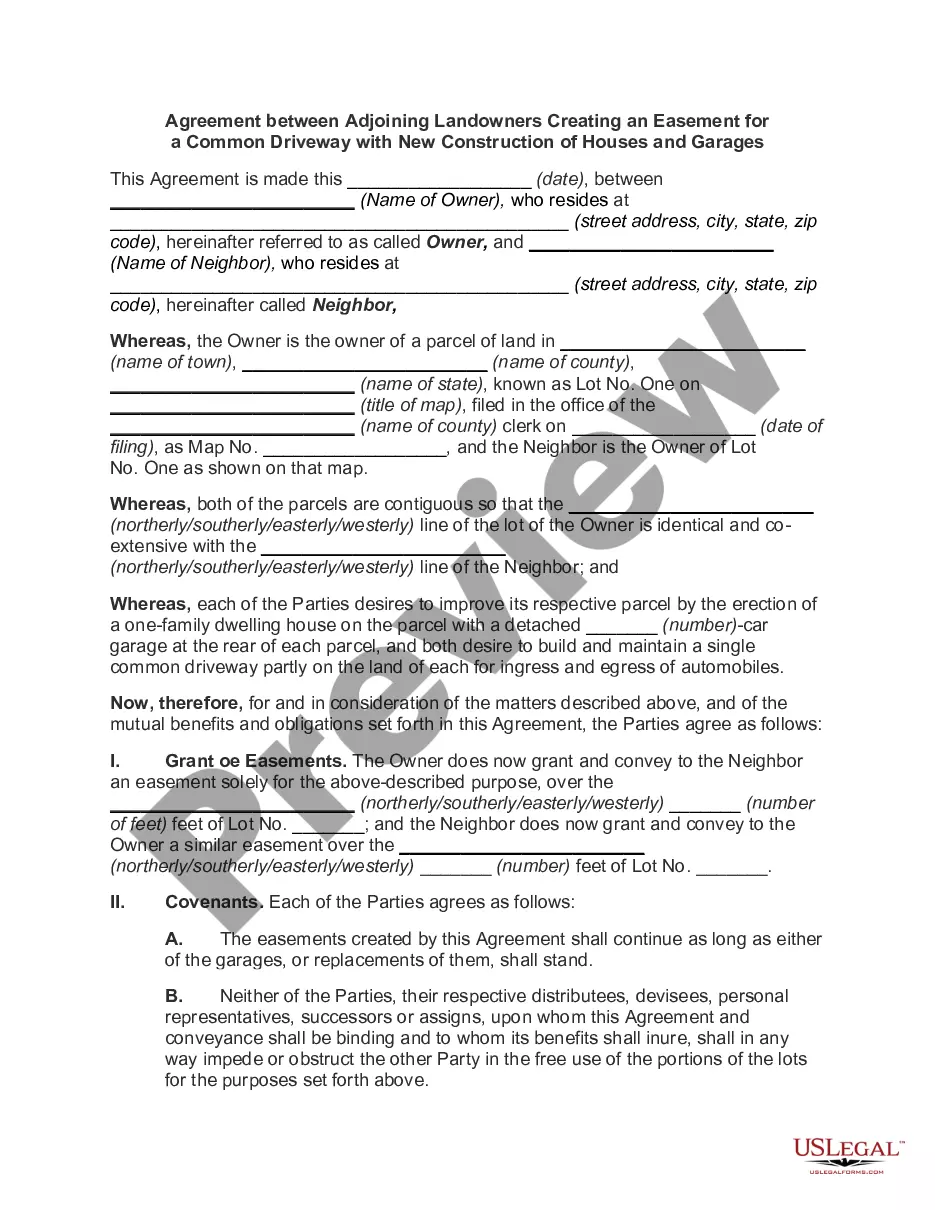
The Agreement between Adjoining Landowners Regarding Construction of Common Stairway is a legal document that outlines the responsibilities and rights of neighboring property owners when constructing a shared stairway. This form serves to ensure clarity and prevent disputes related to the shared use and maintenance of the stairway, setting it apart from other property agreements by focusing specifically on the construction of joint structures.
Form components explained
- Identification of the parties involved in the agreement.
- Details about the location and specifications of the stairway and hall.
- Responsibilities for construction costs, including the shared middle wall and roof.
- Maintenance obligations for the stairway and hall after completion.
- Signatures of both parties to validate the agreement.
When to use this document
This form is necessary when two or more adjoining landowners want to construct a common stairway that will benefit both parties. It should be used when property lines are located adjacent to each other, and both owners need to agree on the construction details, maintenance, and cost-sharing responsibilities. This agreement can help avoid disagreements about property use and ensure cooperative management of shared spaces.
Who should use this form
- Homeowners with adjoining properties planning to construct a common stairway.
- Landowners looking to formalize an agreement regarding shared property use.
- Developers involved in creating multi-unit buildings with shared access points.
- Property owners seeking to clarify the responsibilities related to joint improvements.
How to prepare this document
- Identify the parties by providing their full names and addresses.
- Specify the construction details, including the exact location and dimensions of the stairway.
- Detail the responsibilities of each party regarding the construction and costs.
- Include any additional clauses regarding maintenance of the stairway and hall.
- Both parties must sign and date the agreement to make it effective.
Notarization requirements for this form
This form usually doesn’t need to be notarized. However, local laws or specific transactions may require it. Our online notarization service, powered by Notarize, lets you complete it remotely through a secure video session, available 24/7.
Get your form ready online
Our built-in tools help you complete, sign, share, and store your documents in one place.
Make edits, fill in missing information, and update formatting in US Legal Forms—just like you would in MS Word.
Download a copy, print it, send it by email, or mail it via USPS—whatever works best for your next step.
Sign and collect signatures with our SignNow integration. Send to multiple recipients, set reminders, and more. Go Premium to unlock E-Sign.
If this form requires notarization, complete it online through a secure video call—no need to meet a notary in person or wait for an appointment.
We protect your documents and personal data by following strict security and privacy standards.

Make edits, fill in missing information, and update formatting in US Legal Forms—just like you would in MS Word.

Download a copy, print it, send it by email, or mail it via USPS—whatever works best for your next step.

Sign and collect signatures with our SignNow integration. Send to multiple recipients, set reminders, and more. Go Premium to unlock E-Sign.

If this form requires notarization, complete it online through a secure video call—no need to meet a notary in person or wait for an appointment.

We protect your documents and personal data by following strict security and privacy standards.
Common mistakes to avoid
- Failing to clearly define the responsibilities for maintenance.
- Not including precise measurements and descriptions of the stairway.
- Leaving out signatures or dates, which can invalidate the agreement.
- Not consulting local laws to ensure compliance.
Benefits of completing this form online
- Convenience of downloading and completing the form at your own pace.
- Editability allows customization according to individual property needs.
- Access to forms drafted by licensed attorneys for reliable legal protection.
Legal use & context
- The agreement establishes a legally binding understanding between the property owners.
- It protects the rights of both parties in the event of disputes related to construction or maintenance.
- Legal enforceability may vary based on state property laws and agreements must comply accordingly.
What to keep in mind
- The agreement outlines shared responsibilities between neighboring landowners.
- Clear specifications help prevent future disputes over shared property use.
- Both parties must agree and sign the document for it to be valid.
Looking for another form?



Form popularity
FAQ
Nondisclosure Agreement. Partnership Agreement. Indemnity Agreement. Property And Equipment Lease. General Employment Contract. Contractor Agreement.
Grant. Financial assistance for a specific purpose or specific project without expectation of any tangible deliverables other than a final report. Cooperative Agreement. Contract. Memorandum of Understanding. Non-Disclosure Agreement. Teaming Agreement. Material Transfer Agreement. IDIQ/Master Agreement.
Common law contracts. At its most basic level, an employment relationship between an employer and an employee is a civil contract where the employee agrees to perform work for the employer in exchange for monetary or other payment.
Common contracts are the business contracts you are most likely to encounter in the operation of a small business. Like all contracts, they are legally binding written or oral agreements between two or more parties designed to fulfill certain agreed upon terms.
Fixed price contracts. With a fixed price contract the buyer (that's you) doesn't take on much risk. Cost-reimbursable contracts. With a cost-reimbursable contract you pay the vendor for the actual cost of the work. Time and materials contracts.
Nondisclosure Agreement. Partnership Agreement. Indemnity Agreement. Property And Equipment Lease. General Employment Contract. Contractor Agreement.
Contract Types Overview. Express and Implied Contracts. Unilateral and Bilateral Contracts. Unconscionable Contracts. Adhesion Contracts. Aleatory Contracts. Option Contracts. Fixed Price Contracts.
A contract is a legally binding agreement between two or more parties obligating parties to do. or not to do a particular thing. A contract may be verbal or written, formal or informal, general or.