North Carolina Plumbing Contractor Package
Understanding this form package
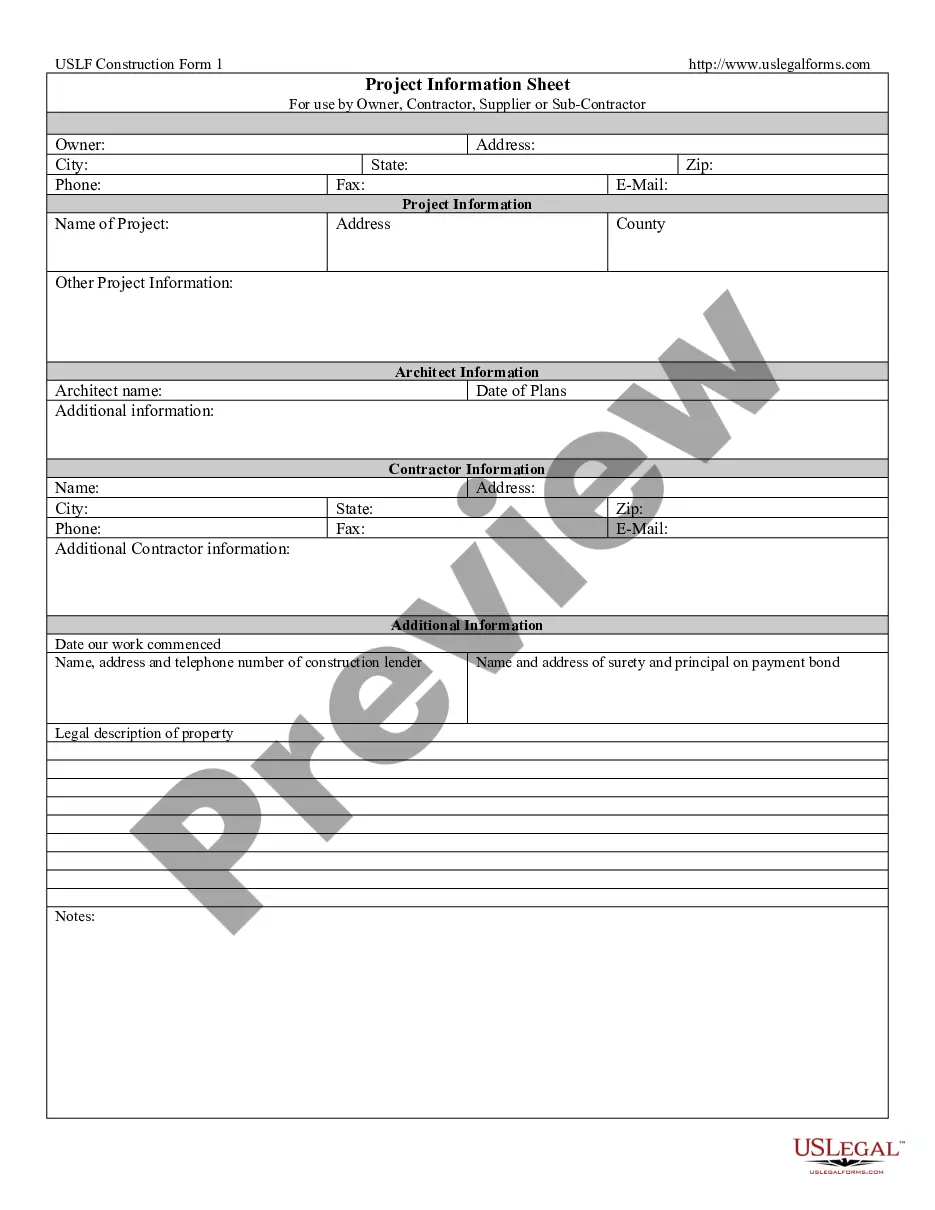
The North Carolina Plumbing Contractor Package is a comprehensive set of legal forms designed specifically for plumbing contractors and related parties involved in construction projects. This package helps manage legal issues that may arise between plumbing contractors, property owners, suppliers, and subcontractors during activities such as new construction, remodeling, or repairs. The centerpiece of this package is the plumbing contract, which adheres to North Carolina state law, ensuring compliance and protection for all involved stakeholders.
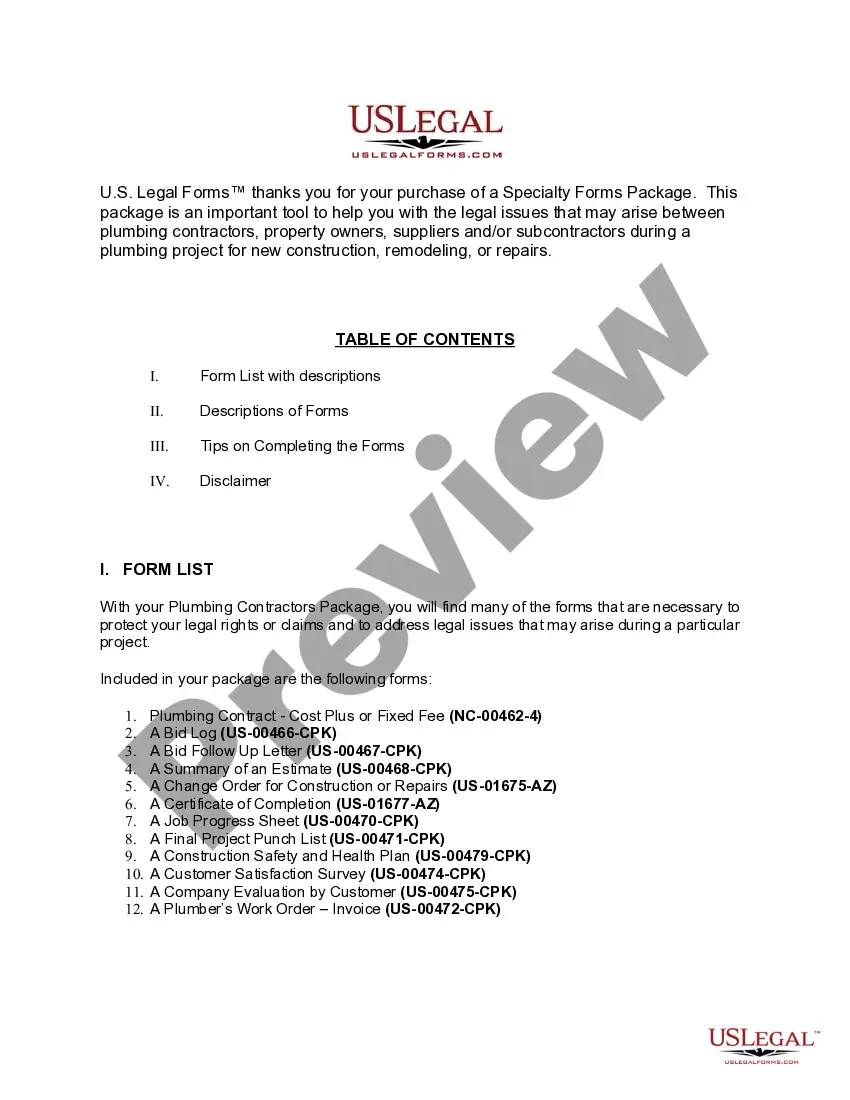
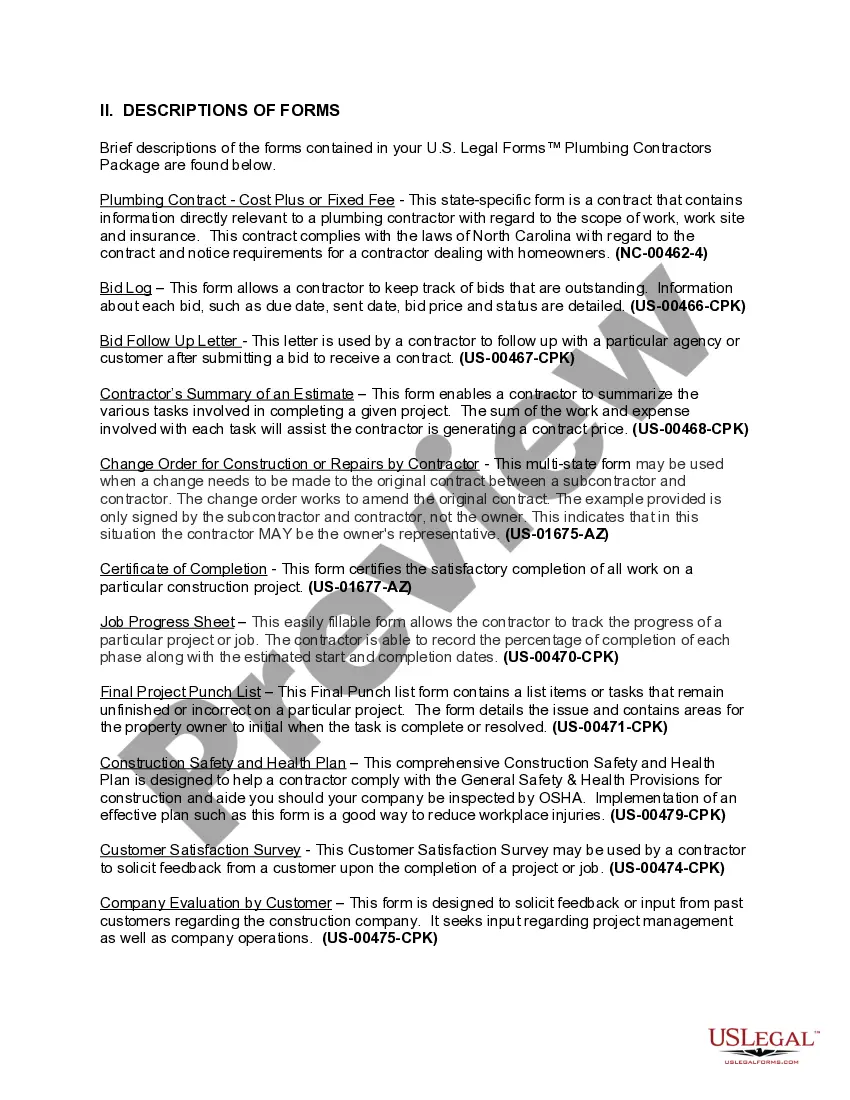
Documents contained in this package
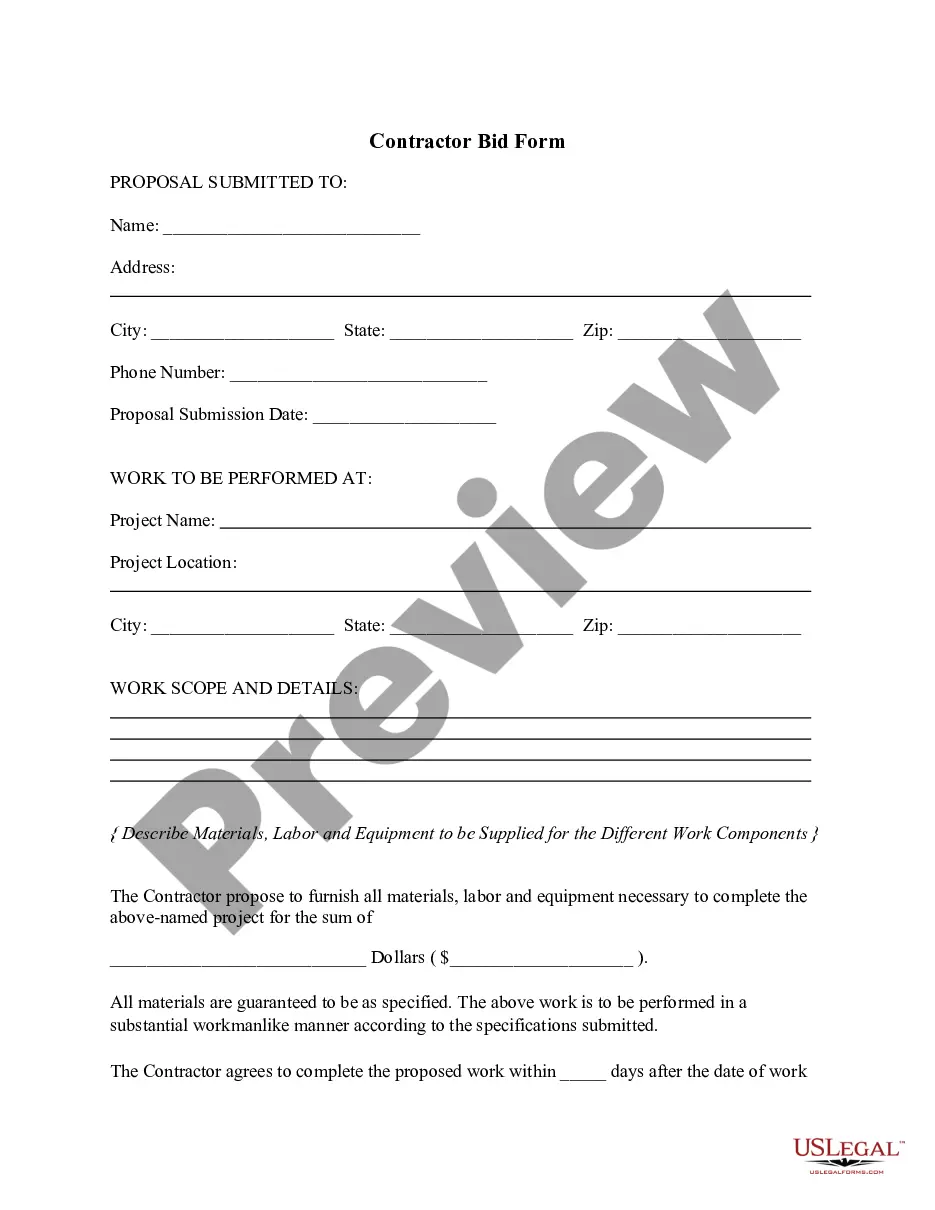
- Plumbing Contract for Contractor
- Contractor's Bid Log
- Contractor's Bid Follow Up Letter
- Contractor's Summary of an Estimate
- Contractor's Job Progress Sheet
- Plumber's Work Order - Invoice
- Customer Satisfaction Survey
- Construction Company Evaluation by a Customer
- Construction Safety and Health Plan
- Change Order for Construction or Repairs by Contractor
- Certification of Completion by Contractor
When to use this form package
This package is essential in the following situations:
- Before starting any plumbing contract to outline terms and conditions.
- When submitting bids for plumbing projects to establish a formal record.
- During ongoing projects when changes to the initial agreements are necessary.
- To ensure safety and compliance with health regulations while conducting plumbing work.
- After project completion to gain customer feedback and confirm work satisfaction.
Who can use this document
- Professional plumbing contractors operating in North Carolina.
- Property owners hiring plumbing contractors for construction or repair projects.
- Subcontractors working alongside plumbing contractors.
- Suppliers providing materials for plumbing projects.
- Anyone involved in managing plumbing contracts and agreements.
Completing these forms step by step
- Review the included forms thoroughly to understand their purposes.
- Identify all parties involved in the plumbing project, including contractors, property owners, and subcontractors.
- Enter the necessary details such as dates, names, and project specifics into the plumbing contract and other forms.
- Collect any additional information, such as project bids and estimates, to ensure accuracy.
- Sign and date the forms as needed, and retain copies for your records.
Notarization guidance for this package
Forms in this package typically do not require notarization unless required by local law. However, it is important to check if certain documents, like the plumbing contract, require notarization based on specific project needs.
Get your form ready online
Our built-in tools help you complete, sign, share, and store your documents in one place.
Make edits, fill in missing information, and update formatting in US Legal Forms—just like you would in MS Word.
Download a copy, print it, send it by email, or mail it via USPS—whatever works best for your next step.
Sign and collect signatures with our SignNow integration. Send to multiple recipients, set reminders, and more. Go Premium to unlock E-Sign.
If this form requires notarization, complete it online through a secure video call—no need to meet a notary in person or wait for an appointment.
We protect your documents and personal data by following strict security and privacy standards.

Make edits, fill in missing information, and update formatting in US Legal Forms—just like you would in MS Word.

Download a copy, print it, send it by email, or mail it via USPS—whatever works best for your next step.

Sign and collect signatures with our SignNow integration. Send to multiple recipients, set reminders, and more. Go Premium to unlock E-Sign.

If this form requires notarization, complete it online through a secure video call—no need to meet a notary in person or wait for an appointment.

We protect your documents and personal data by following strict security and privacy standards.
Typical mistakes to avoid
- Failing to include all relevant parties' names and signatures on contracts.
- Not using the correct version of the plumbing contract for your specific project type.
- Neglecting to complete all sections of the forms, which can lead to confusion or disputes.
- Incorrectly filling out change orders, leading to misunderstandings about project adjustments.
- Ignoring local regulations that could affect compliance and safety.
Why complete this package online
- Convenient access to all necessary forms in one package.
- Edit and customize forms easily to fit specific project needs.
- Downloadable and printable formats ensure you can work offline.
- Ensures compliance with state laws to mitigate legal risks.
- Saves time and money compared to purchasing forms individually.
Looking for another form?

Form popularity
FAQ
The North Carolina Licensing Board does not have full reciprocity with any other state. We currently have examination waiver agreements with South Carolina, Tennessee, Louisiana, Georgia, and Mississippi (see details regarding exam waivers).
If an application is submitted with a completed exam, the licensing process takes about 30 days. If an exam is required, it will depend on when exams are successfully completed. It takes about 2 to 3 weeks after exams are completed before a license to be granted.
In actuality the North Carolina construction license exam is more difficult to pass than similar closed book exams due to the fact that you have books available as a resource during the contractor exam. You are permitted to bring certain reference materials into the builder test.
Start by only answering the easy questions. Read the entire exam and only answer the questions you absolutely know the answer to. If you don't know it, wait. Don't second guess yourself. There is no penalty for guessing. Don't compete with other applicants.
In North Carolina are authorized to work on residential and commercial projects with a value that exceeds $30,000. This work includes demolitions, structural repairs, and installations.
The NASCLA-Accredited Examination Program was designed to assist contractors who need to be licensed in multiple jurisdictions. The following states accept the NASCLA Accredited Examination: AL, AR, AZ, GA, LA, MS, NV, NC, OR, SC, TN, UT, US Virgin Islands, VA, and WV.
1Get a business registration. You will need to get a business registration at the Office of the Secretary of State.2Complete your license application.3Get a contractor license surety bond.4Pass a licensing exam.5Pay an application and/or licensing fee.6License renewal.
Becoming a contractor may be a smart move if you have the required experience or education, or simply have a passion for construction work.However, becoming a contractor takes several years of experience first, as well as licensing requirements that can be difficult to meet without the proper preparation.
Although subcontractors may be required to obtain certain trade licenses if acting as electricians, plumbers, carpenters, etc., they are not required to have a general contractor's license even if their subcontract is valued at $30,000 or more if they are contracting with a licensed general contractor.