Mississippi Complaint to Suspend Visitation and Other Relief after Youth Court Permanency Order
About this form
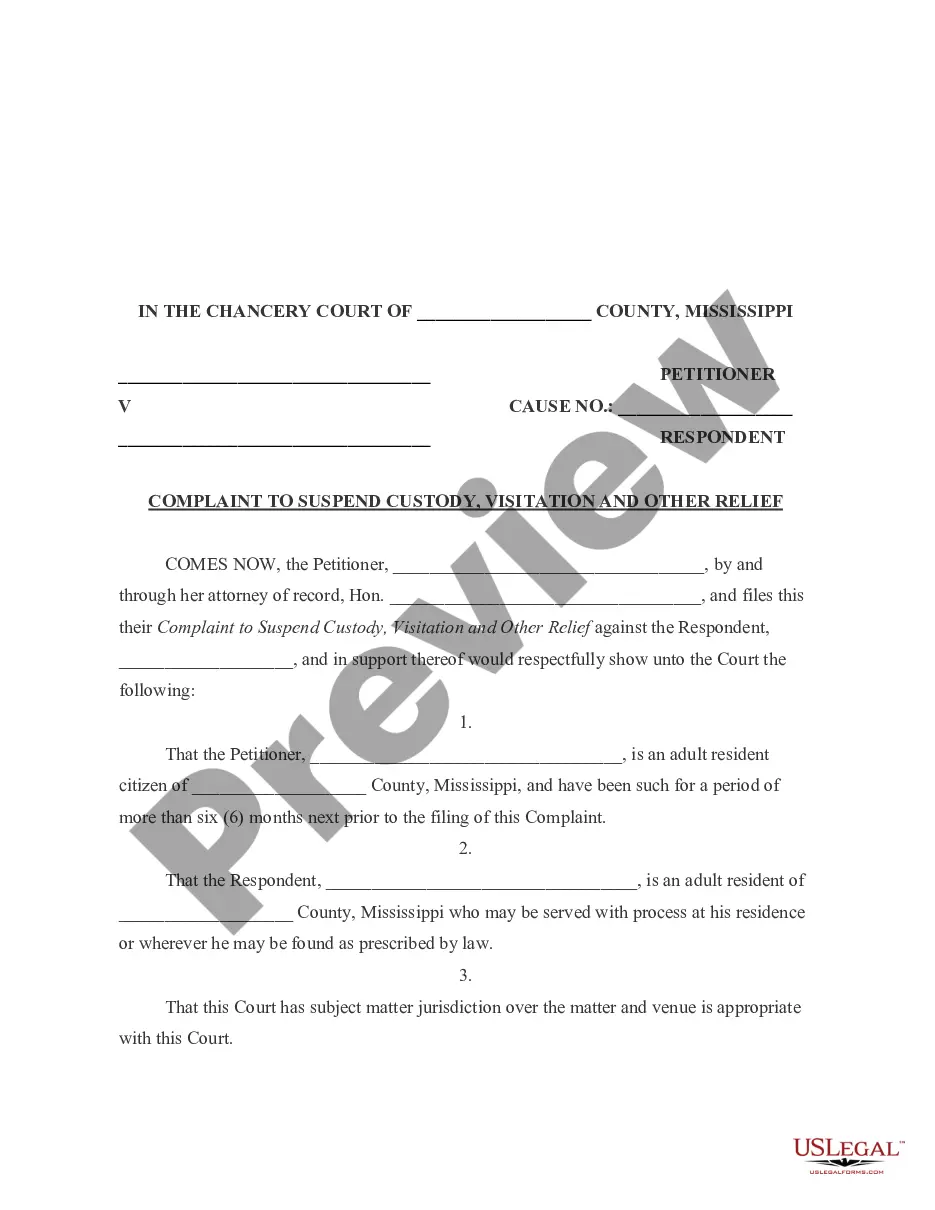
The Complaint to Suspend Visitation and Other Relief after Youth Court Permanency Order is a legal document designed for individuals seeking to suspend visitation rights for a non-custodial parent. This form is typically used when there are concerns about the well-being of the child following a Youth Court Permanency Order. Unlike other custody forms, this complaint specifically addresses the need for emergency intervention and outlines the petitioner's requests regarding custody and visitation modifications based on recent court findings.
What’s included in this form
- Petitioner's details: Information about the individual filing the complaint.
- Respondent's details: Information about the individual whose visitation rights are being questioned.
- Background facts: An account of the custody situation and previous court orders.
- Child information: Details about the minor child involved, including name and age.
- Request for relief: Specific requests to the court regarding custody and visitation, including any emergency measures.
- Guardian ad litem: Appointment of a representative for the child's best interests.


Common use cases
This form should be used when a custodial parent believes that the non-custodial parent's visitation rights should be suspended due to concerns about the child's safety or welfare. Common situations include instances of domestic violence, substance abuse, or significant changes in the non-custodial parent's circumstances that may negatively impact the child.
Who this form is for
- Custodial parents seeking to modify visitation rights.
- Individuals involved in ongoing custody disputes in Youth Court.
- Parents concerned about the safety of their child during visitations.
How to prepare this document
- Identify the parties involved by filling in the petitioner's and respondent's names and addresses.
- Provide the minor child's details, including full name and date of birth.
- Detail the background facts surrounding the custody situation and previous court orders.
- Make specific requests concerning custody and visitation, highlighting reasons for suspension if applicable.
- Include information regarding any appointed Guardian ad Litem if applicable.
- Sign and date the form, and ensure it's notarized if required.
Does this document require notarization?
Yes, this form must be notarized to be legally valid. US Legal Forms provides integrated online notarization services that allow you to complete this process securely via video call, ensuring that it meets all legal requirements without the need for in-person visits.
Get your form ready online
Our built-in tools help you complete, sign, share, and store your documents in one place.
Make edits, fill in missing information, and update formatting in US Legal Forms—just like you would in MS Word.
Download a copy, print it, send it by email, or mail it via USPS—whatever works best for your next step.
Sign and collect signatures with our SignNow integration. Send to multiple recipients, set reminders, and more. Go Premium to unlock E-Sign.
If this form requires notarization, complete it online through a secure video call—no need to meet a notary in person or wait for an appointment.
We protect your documents and personal data by following strict security and privacy standards.

Make edits, fill in missing information, and update formatting in US Legal Forms—just like you would in MS Word.

Download a copy, print it, send it by email, or mail it via USPS—whatever works best for your next step.

Sign and collect signatures with our SignNow integration. Send to multiple recipients, set reminders, and more. Go Premium to unlock E-Sign.

If this form requires notarization, complete it online through a secure video call—no need to meet a notary in person or wait for an appointment.

We protect your documents and personal data by following strict security and privacy standards.
Avoid these common issues
- Failing to provide complete and accurate information about the parties involved.
- Not including sufficient evidence or reasons for requesting suspension of visitation.
- Neglecting to sign or date the form where required.
- Forgetting to properly notify all parties involved, as required by law.
Why use this form online
- Convenience of accessing and completing forms from home.
- Editable templates that allow for personalized input.
- Immediate availability without the need for appointment scheduling.
- Guidance through the process with legal expertise accounted for in the templates.
Looking for another form?

Form popularity
FAQ
Section 93-5-2 - Divorce on ground of irreconcilable differences (1) Divorce from the bonds of matrimony may be granted on the ground of irreconcilable differences, but only upon the joint complaint of the husband and wife or a complaint where the defendant has been personally served with process or where the defendant
Parental Visitation in Mississippi In situations where a parent has sole physical custody, one parent will be designated as the "primary custodial parent".
Section 93-5-24, Mississippi Code of 1972, is amended as follows: 93-5-24. (1) Custody shall be awarded as follows ing to the best interests of the child: (a) Physical and legal custody to both parents jointly pursuant to subsections (2) through (7).
Joint legal custody gives the parties shared decision-making authority with regard to a child's health, education, and welfare. Parents who share joint legal custody are obligated by Page 6 6 statute to exchange information related to the child and to confer with each other in making decisions.
Children Can Express Preferences at Age 12 in Mississippi After the child reaches the age of 12, they can inform the court that they do not wish to see one of their parents, and a judge could modify the child custody agreement as a result.
Albright Factors in Mississippi Child Custody Cases The age, health and sex of a child. Which parent had continuing care of the child prior to separation.
Abandonment The timeline to be considered abandonment is based on the child's age. A child under the age of three is considered abandoned by their parents if contact has not been made for at least six months. For children over the age of three, it is considered abandonment after a year.
Either party may have a divorce if they are related to each other within the degrees of kindred between whom marriage is prohibited by law. Twelfth.