Mississippi Order Allowing Counsel to Withdraw
What is this form?
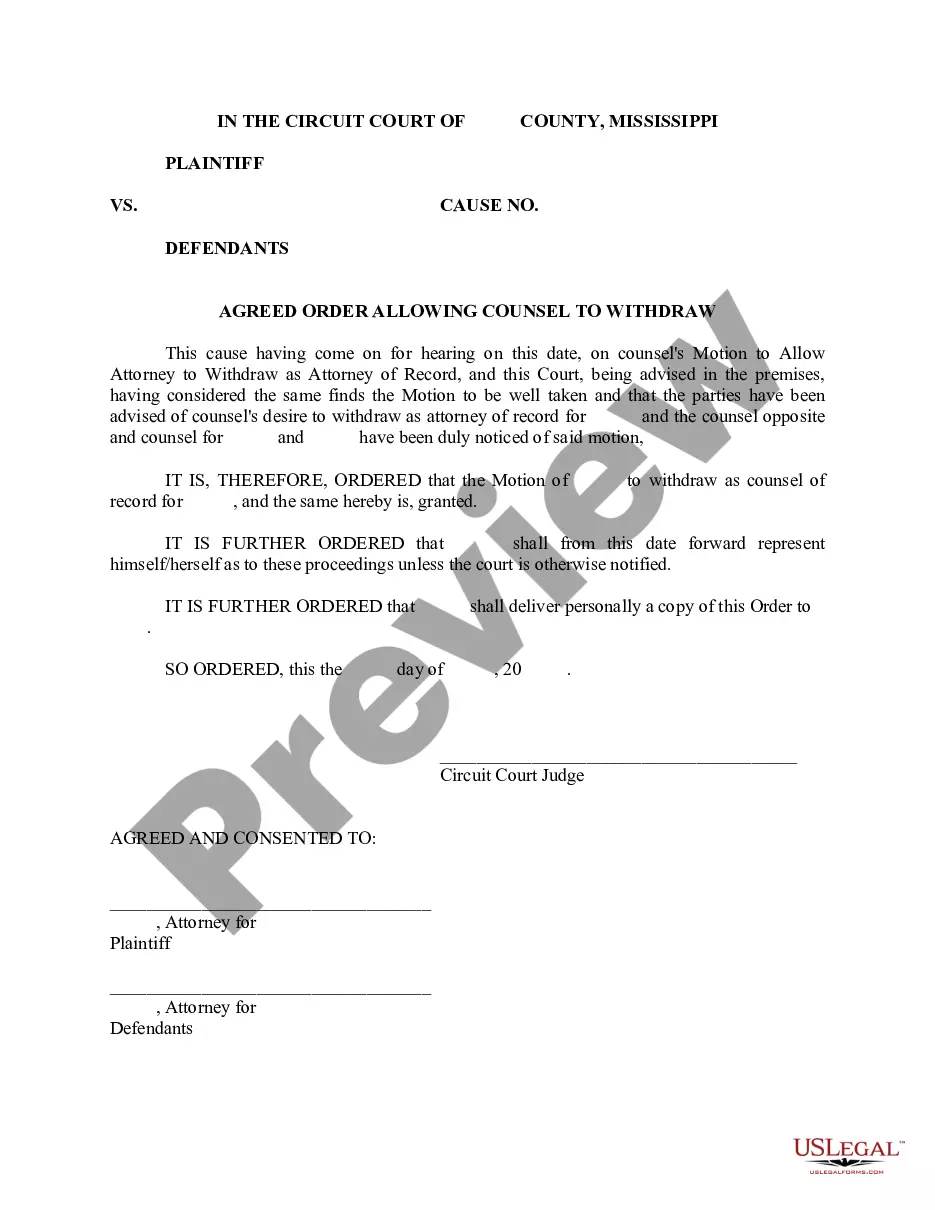
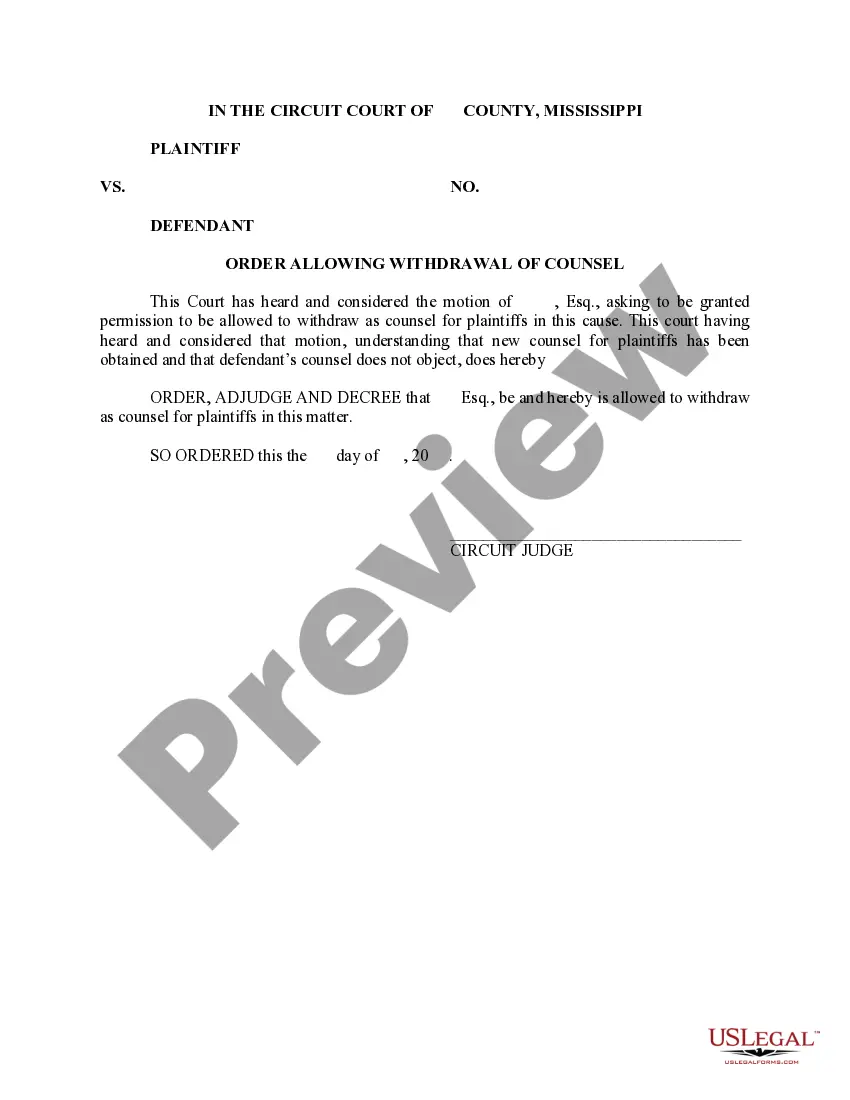
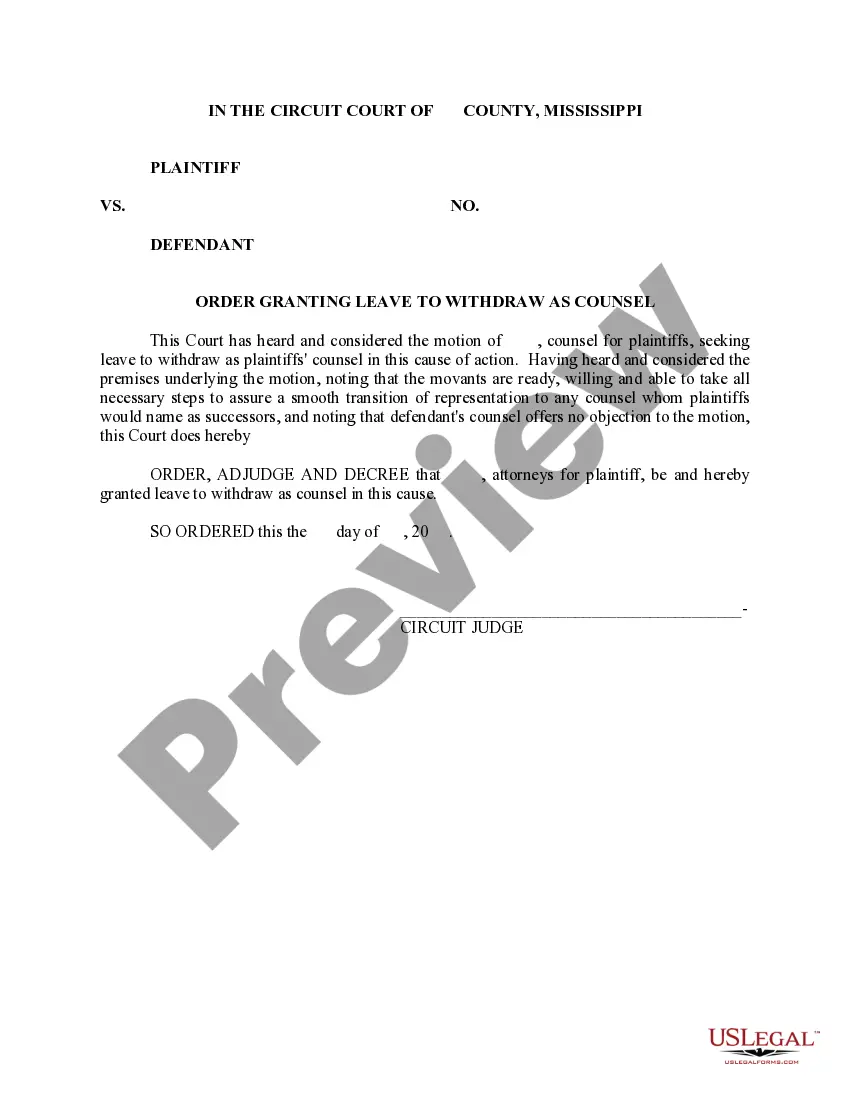
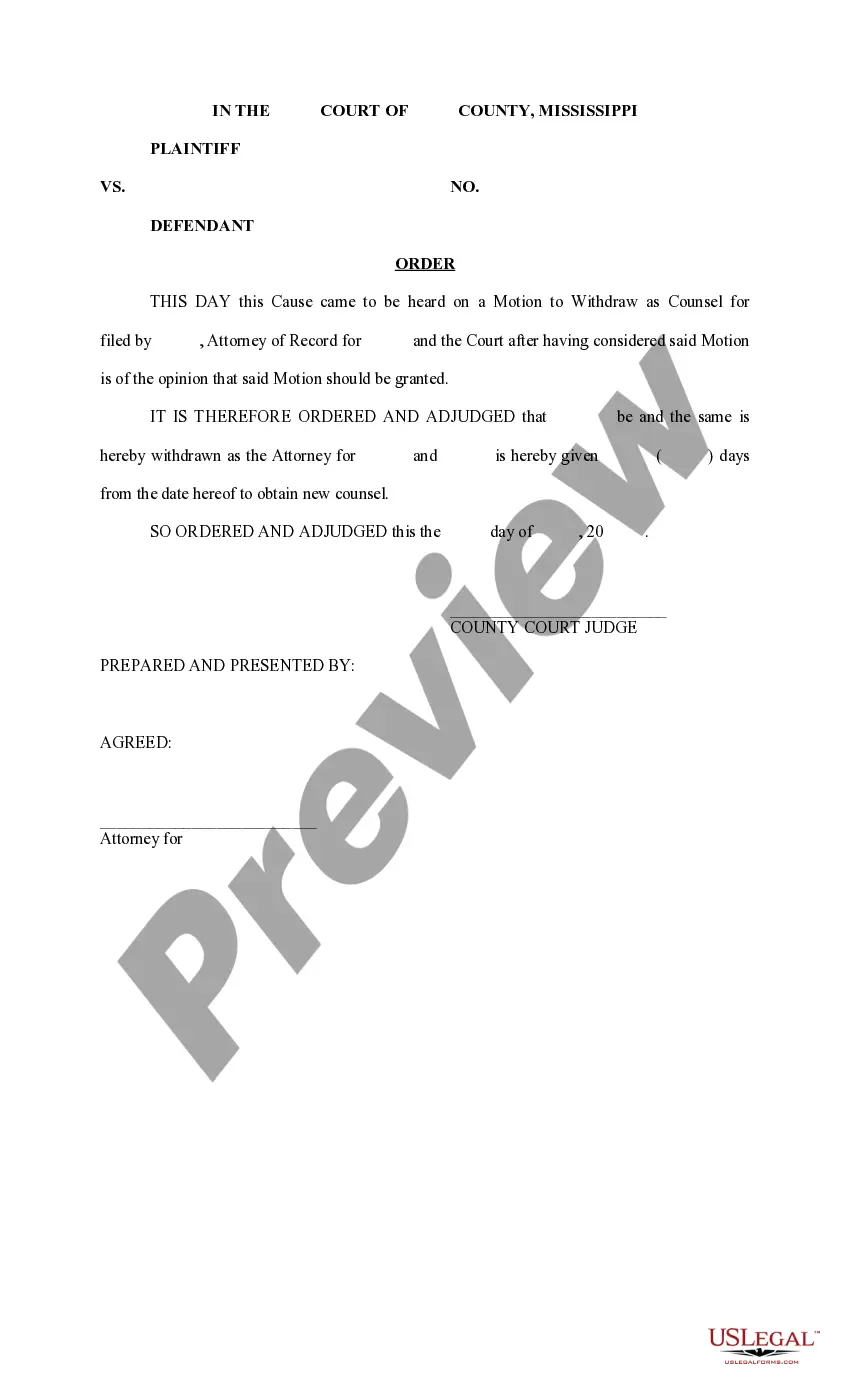
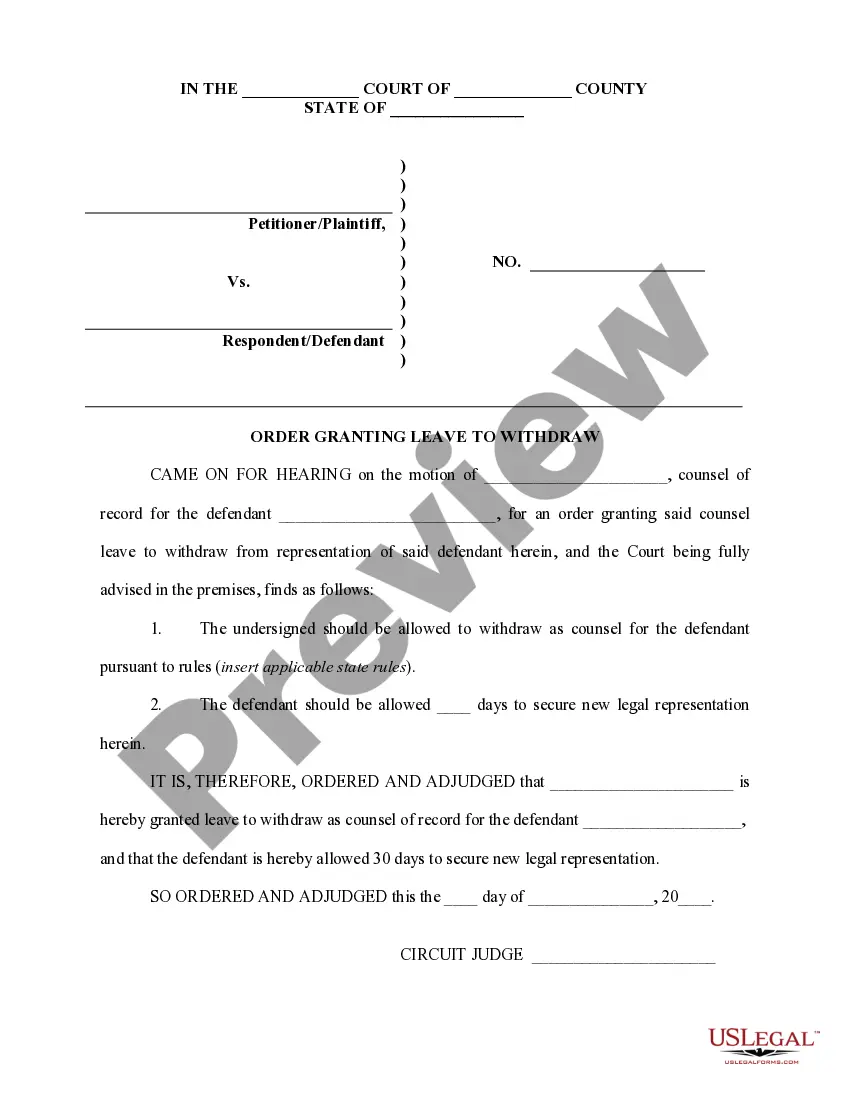
The Order Allowing Counsel to Withdraw is a legal document issued by a court to permit an attorney to withdraw from representing a client in a specific case. This form differs from other legal orders as it specifically addresses the relationship between an attorney and their client, ensuring that the client's rights are protected while allowing the attorney to cease their representation. With the intention of maintaining clarity and compliance with court procedures, this form serves as a template for drafting the necessary order requested by the court.
Key components of this form
- Court caption: Identifies the court handling the case and the involved parties.
- Withdrawal request: Clearly states the attorney's request to withdraw from representation.
- Reason for withdrawal: Provides the grounds for the attorney's withdrawal.
- Client's representation status: Clarifies whether the client will obtain new representation or proceed pro se (on their own).
- Judgeâs signature: An essential component which validates the order and confirms the court's approval.

Situations where this form applies
This form should be used when an attorney wants to formally withdraw from a case, either due to a conflict of interest, inability to continue representation, or mutual agreement with the client. It is particularly important in situations where the withdrawal could affect the client's legal rights or interests, necessitating the court's acknowledgment and approval.
Who can use this document
Suitable for the following individuals:
- Attorneys seeking to withdraw from representing a client.
- Clients who agree with their attorney's decision to withdraw.
- Parties involved in cases where court approval is required for an attorney to cease representation.
Steps to complete this form
- Identify the court: Fill in the name and location of the court where the case is filed.
- Enter the case title: Specify the names of the parties involved in the case.
- State the reason for withdrawal: Clearly articulate the grounds for the attorneyâs request to withdraw.
- Indicate client representation: Specify if the client will have new counsel or will represent themselves.
- Provide signature: Ensure the attorney signs the document where indicated, confirming the withdrawal request.
- Obtain judgeâs signature: Submit the completed form to the court to seek the judge's approval and signature.
Is notarization required?
This form does not typically require notarization unless specified by local law. Always check the rules in your jurisdiction for any additional requirements.
Get your form ready online
Our built-in tools help you complete, sign, share, and store your documents in one place.
Make edits, fill in missing information, and update formatting in US Legal Forms—just like you would in MS Word.
Download a copy, print it, send it by email, or mail it via USPS—whatever works best for your next step.
Sign and collect signatures with our SignNow integration. Send to multiple recipients, set reminders, and more. Go Premium to unlock E-Sign.
If this form requires notarization, complete it online through a secure video call—no need to meet a notary in person or wait for an appointment.
We protect your documents and personal data by following strict security and privacy standards.

Make edits, fill in missing information, and update formatting in US Legal Forms—just like you would in MS Word.

Download a copy, print it, send it by email, or mail it via USPS—whatever works best for your next step.

Sign and collect signatures with our SignNow integration. Send to multiple recipients, set reminders, and more. Go Premium to unlock E-Sign.

If this form requires notarization, complete it online through a secure video call—no need to meet a notary in person or wait for an appointment.

We protect your documents and personal data by following strict security and privacy standards.
Common mistakes
- Failing to include specific reasons for withdrawal, which can lead to rejection by the court.
- Not obtaining the required judgeâs signature, rendering the order invalid.
- Inaccurately completing the court caption or case title, which may cause confusion.
- Neglecting to inform the client about their rights and options regarding new representation.
Why complete this form online
- Convenient access: Download the form anytime from anywhere, saving travel time.
- Editability: Customize the template to fit the specific details of your case.
- Reliability: The form is drafted by licensed attorneys, ensuring compliance with legal standards.
What to keep in mind
- The Order Allowing Counsel to Withdraw is a formal request for an attorney to stop representing a client.
- It's crucial to follow local rules and procedures when using this form.
- Providing clear reasons and proper notification of all parties involved is essential for the order's success.
Looking for another form?
Form popularity
FAQ
In CA, a lawyer's motion to withdraw is routinely granted, and all the lawyer has to allege is your non-cooperation or a breakdown in communication --lawyers aren't compelled to represent someone they can't work with.
A Motion to Withdraw Appearance is filed by an attorney to ask the judge for leave (permission) to discontinue representing a person/party. Usually happens when a client-attorney relationship has been terminated (lawyer quits or is fired)...
Lawyers can withdraw based on the fact their client refuses to be truthful, refuses to follow the attorney's advice, demands to pursue an unethical course of action, demands unrealistic results, desires to mislead the Court, refuses to cooperate with their counsel as well as countless other reasons.
Typically, it is legally mandatory for an attorney to withdraw from the case if the client fires him or her. Your old attorney requests permission from the judge to withdraw as your attorney by filing a motion to withdraw.
Withdrawn - when what he says can mislead the jury, noon vanished and stuff that can get him banned from Court. So he withdraws his statement. Judge. Sustained - the objection is accepted. Overruled - the objection is not accepted so the judge can overrule it.
A motion to withdraw is usually when an attorney asks the permission of the judge to be taken off of a case. This usually happens when the client does not pay the lawyer, or when another attorney wants to take over or be substituted onto the...
Prior to taking any action, a lawyer should explain his reasons for withdrawing. This explanation should be objective, concise and clearly understandable rather than confrontational. If the reason is based on client conduct, the client should be afforded a reasonable opportunity to take corrective action.
(a) Notice of withdrawal. An attorney may withdraw from the case by filing with the court and serving on all parties a notice of withdrawal. The notice of withdrawal shall include the address of the attorney's client and a statement that no motion is pending and no hearing or trial has been set.
A motion to withdraw is a document an attorney files with the court when that attorney no longer wishes to represent his client.