Mississippi Brief in Support of Motion for Summary Judgment
About this form
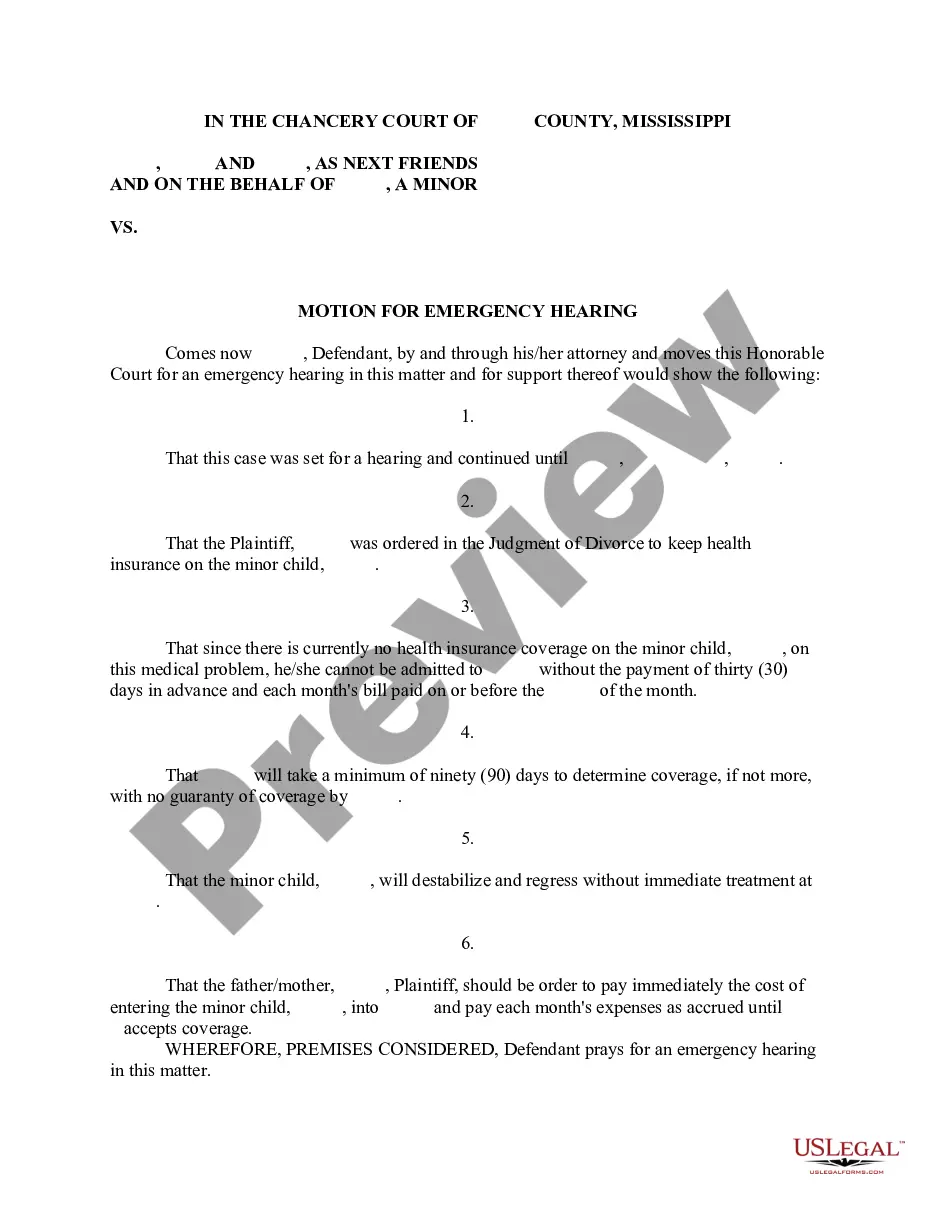
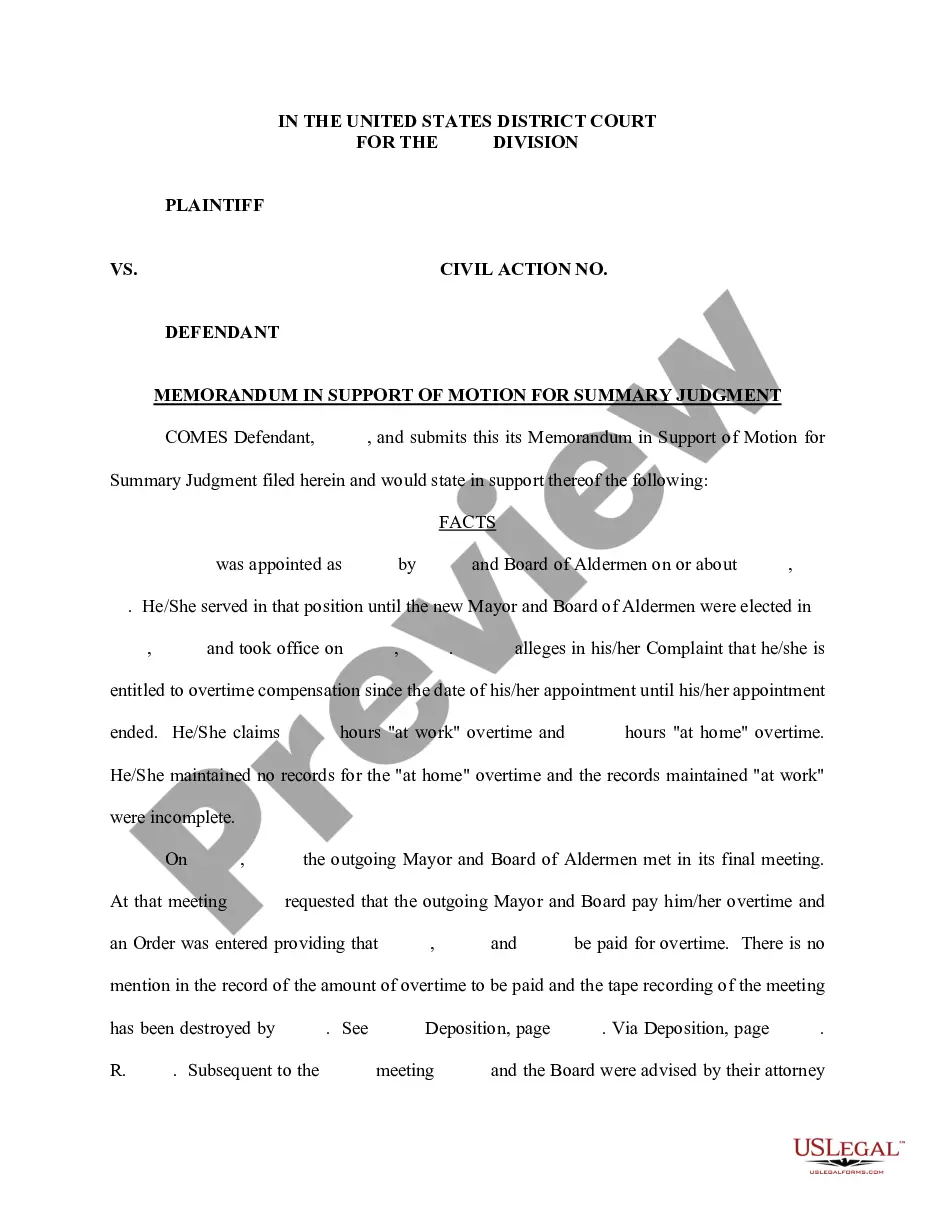
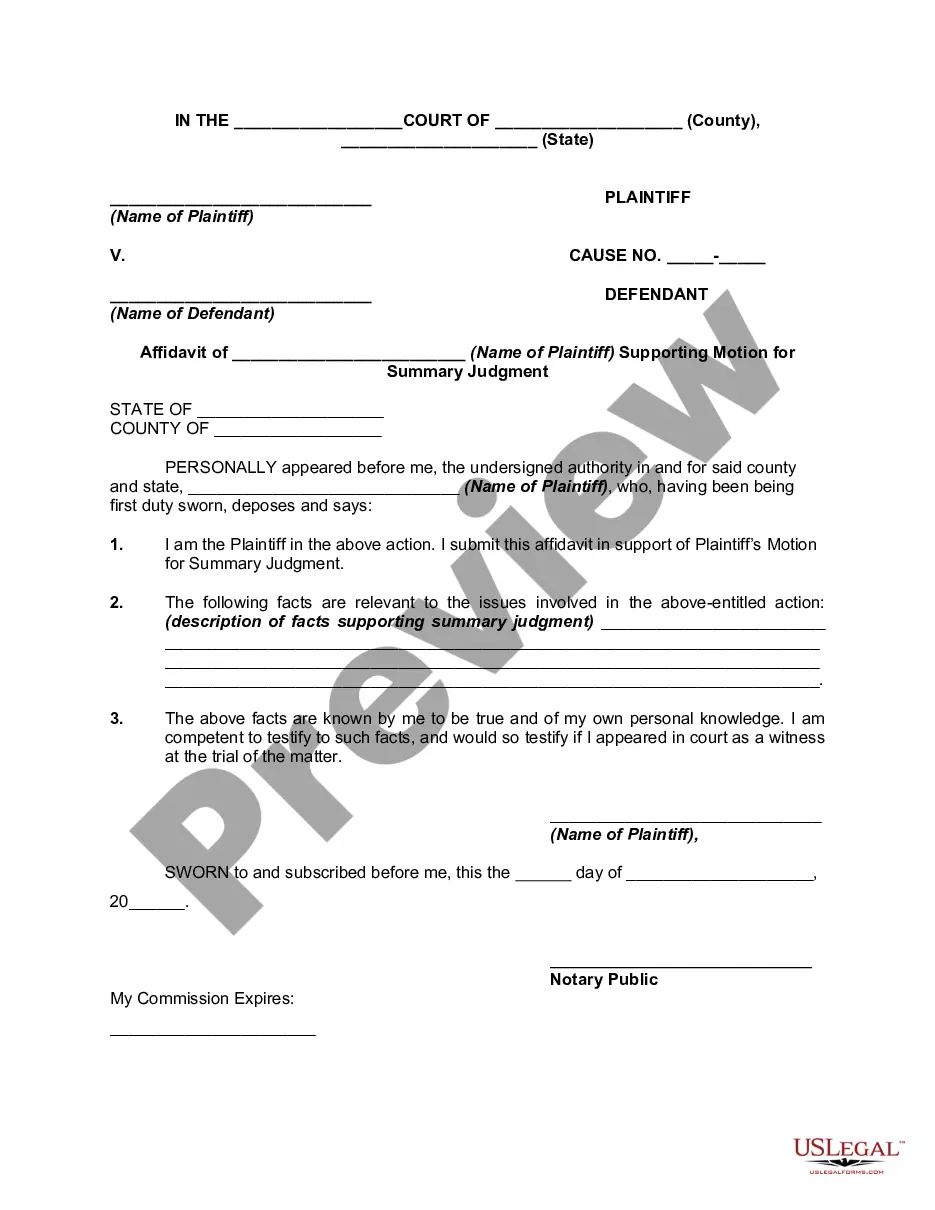
The Brief in Support of Motion for Summary Judgment is a legal document used to request a court to rule in favor of a party without a full trial. This form is unique as it presents arguments and evidence that demonstrate the absence of any genuine dispute of material fact, contrasting with other pleadings that might involve different procedural stages. By utilizing this form, you streamline the motion process and clarify your position effectively.
Main sections of this form
- Introduction: States the purpose of the motion and brief submission.
- Factual Background: Outlines relevant facts that support the request for summary judgment.
- Legal Standard: Specifies the legal criteria necessary for granting summary judgment.
- Argument: Provides a detailed legal argument supporting the motion.
- Conclusion: Summarizes the request for the court's judgment and any associated relief sought.

Common use cases
This form is typically used in civil cases where one party believes there is no serious dispute regarding the facts of the case. It is particularly useful when the evidence is clear and decisive. Common scenarios might include disputes over contractual obligations, property disputes, or any case where a party seeks to avoid the time and expense of a trial due to a lack of conflicting evidence.
Intended users of this form
- Attorneys representing clients in civil litigation.
- Individuals who are self-representing in court and handling their own legal matters.
- Parties involved in lawsuits looking to expedite resolution through summary judgment.
How to complete this form
- Identify the parties involved in the litigation.
- Provide a clear statement of the relevant facts supporting the motion.
- Outline the legal standards that apply to the motion.
- Craft detailed arguments to justify the request for summary judgment.
- Conclude with a strong statement of the relief sought from the court.
Does this form need to be notarized?
This form does not typically require notarization unless specified by local law. It is important to check state-specific rules regarding notarization to ensure compliance.
Get your form ready online
Our built-in tools help you complete, sign, share, and store your documents in one place.
Make edits, fill in missing information, and update formatting in US Legal Forms—just like you would in MS Word.
Download a copy, print it, send it by email, or mail it via USPS—whatever works best for your next step.
Sign and collect signatures with our SignNow integration. Send to multiple recipients, set reminders, and more. Go Premium to unlock E-Sign.
If this form requires notarization, complete it online through a secure video call—no need to meet a notary in person or wait for an appointment.
We protect your documents and personal data by following strict security and privacy standards.

Make edits, fill in missing information, and update formatting in US Legal Forms—just like you would in MS Word.

Download a copy, print it, send it by email, or mail it via USPS—whatever works best for your next step.

Sign and collect signatures with our SignNow integration. Send to multiple recipients, set reminders, and more. Go Premium to unlock E-Sign.

If this form requires notarization, complete it online through a secure video call—no need to meet a notary in person or wait for an appointment.

We protect your documents and personal data by following strict security and privacy standards.
Common mistakes to avoid
- Failing to include all relevant factual details that could impact the judgment.
- Neglecting to cite the correct legal standards applicable in the jurisdiction.
- Not addressing potential counterarguments that may arise from the opposing party.
- Using overly complex language that obscures clarity and precision.
Advantages of online completion
- Convenient downloadable format allows for quick access and completion.
- Editability enables users to tailor the document to their specific case needs.
- Reliability of forms drafted by licensed attorneys ensures compliance with legal standards.
Legal use & context
- This form is legally binding once submitted to the court.
- It should be used in compliance with Mississippiâs court rules regarding motions.
- Improper use or failure to support claims may jeopardize the motion.
Summary of main points
- The Brief in Support of Motion for Summary Judgment is crucial for expediting certain civil cases.
- It is essential to accurately detail undisputed facts and relevant legal arguments.
- Ensuring compliance with state-specific requirements is necessary for successful use.
Looking for another form?

Form popularity
FAQ
Completely resolve a case (e.g., entry of judgment for plaintiff or defendants) Completely resolve a claim. Completely determine the status of a particular party. Resolve a particular claim's application to a particular party. Establish a fact or ruling applicable to the case as it is further adjudicated.
The motion must include a separate "Notice of Motion" which includes a brief summary of the nature of the motion, the deadline for filing a response, and if there is a hearing, the date, time, and location of the hearing.
Rule 56 of the Federal Rules of Civil Procedure governs summary judgment for federal courts. Under Rule 56, in order to succeed in a motion for summary judgment, a movant must show 1) that there is no genuine dispute as to any material fact, and 2) that the movant is entitled to judgment as a matter of law.
Attack the Legal Argument. The first place to look for a weakness in your opponent's motion is at their legal argument. Attack the Evidence. Attack the Separate Statement. Consider Whether Your Opponent's Motion Meets its Burden. Consider Seeking a Continuance to Conduct More Discovery. Conclusion.
Check a judge's standing orders before filing. Although Rule 56 does not prohibit successive summary judgment motions,15 some judges limit a party to a single summary judgment motion.
A summary judgement occurs when, in a civil case, one party wants to move to a court decision without a trial. That only happens however, when the two parties agree to the critical facts of the issue, and the law allows summary judgement based on the undisputed facts at hand.
A motion asking the court to issue summary judgment on at least one claim.Typically, the motion must show that no genuine issue of material fact exists, and that the opposing party loses on that claim even if all its allegations are accepted as true.
Motions filed, the percent of cases with motions granted in whole or in part, and the percent of cases terminated by summary judgment. The percentage of cases with summary judgment motions, averaged across the six courts in the study, has increased from approximately 12% in 1975, to 17% in 1985, to 19% in 1988.