Mississippi Order Denying Summary Judgment
What is this form?
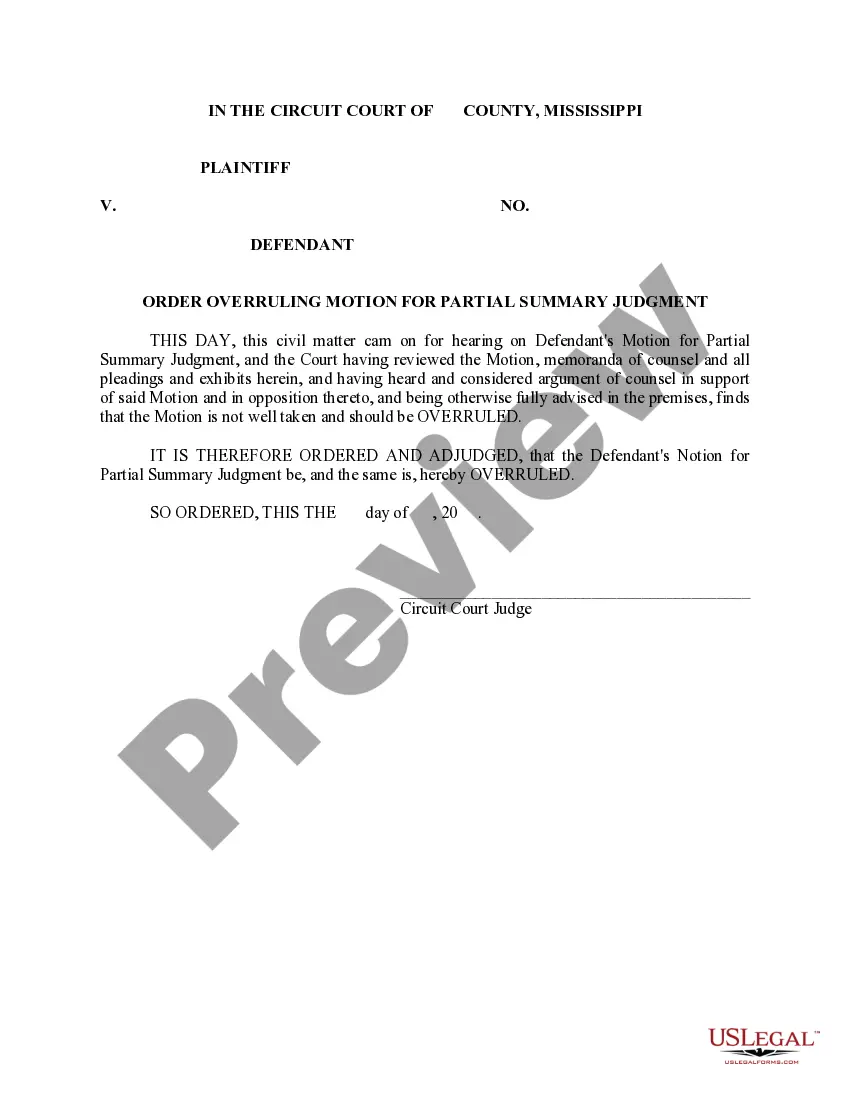
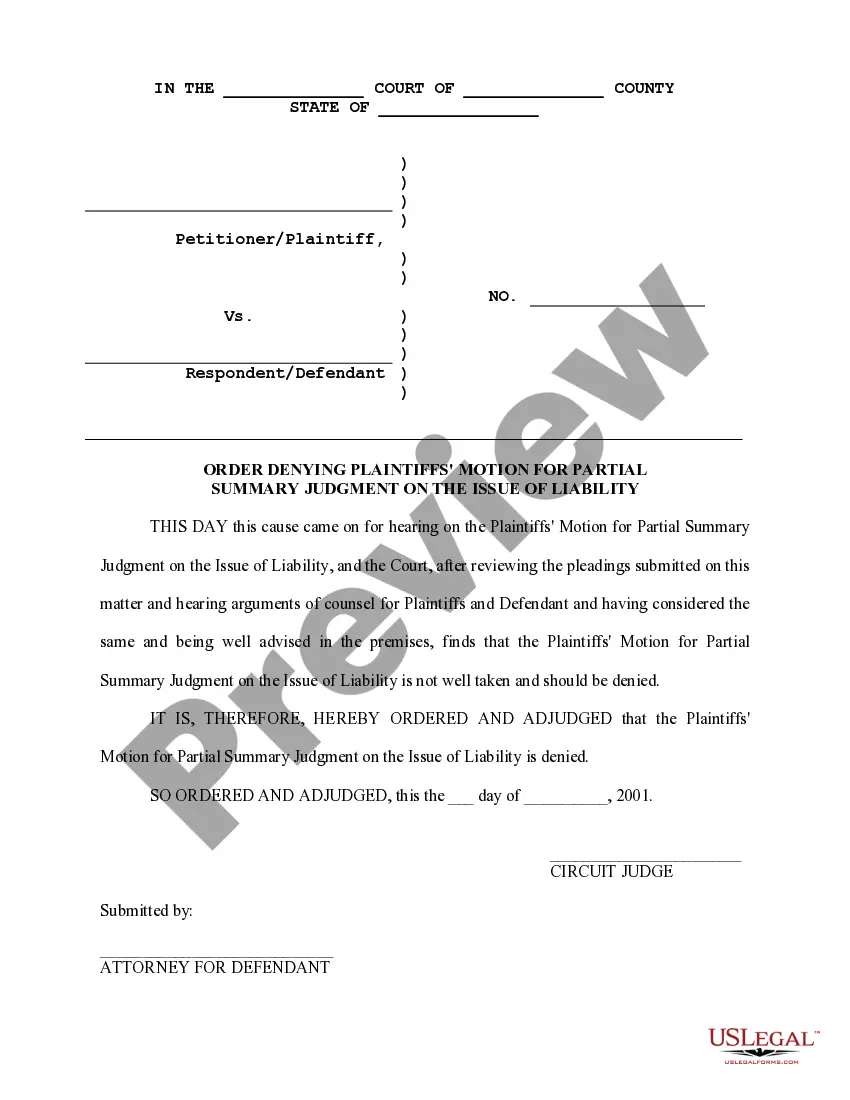
The Order Denying Summary Judgment is a legal document used in court proceedings to formally reject a motion for summary judgment. This order is issued by a judge when they decide that one or more material facts of a case remain contested and therefore require a full trial for resolution. Understanding this order is essential for litigants who wish to navigate their case effectively, as it clarifies the court's position regarding the request for summary judgment and establishes the need for further proceedings.
Form components explained
- Date of the order
- Case title and number
- Details of the motion being denied
- Judge's name and signature
- Statement regarding factual disputes and the need for trial

When to use this form
This form should be used when a party has filed a motion for summary judgment, asserting that there are no genuine issues of material fact, and the court finds that there are indeed disputes that need to be examined at trial. It is relevant in civil litigation cases where the parties wish to resolve issues through quicker legal proceedings but must ultimately proceed to trial based on the court's discretion.
Who should use this form
- Attorneys representing clients in civil litigation cases
- Pro se litigants who require a structured approach to contest summary judgment motions
- Court officials tasked with drafting or entering orders
Instructions for completing this form
- Identify and enter the case title and number at the beginning of the order.
- Specify the date when the order is issued.
- Clearly state the motion for summary judgment that is being denied.
- Include the judge's name and signature block for official recognition.
- Concisely summarize the rationale for denying the motion, highlighting any disputed material facts.
Does this document require notarization?
Notarization is not commonly needed for this form. However, certain documents or local rules may make it necessary. Our notarization service, powered by Notarize, allows you to finalize it securely online anytime, day or night.
Get your form ready online
Our built-in tools help you complete, sign, share, and store your documents in one place.
Make edits, fill in missing information, and update formatting in US Legal Forms—just like you would in MS Word.
Download a copy, print it, send it by email, or mail it via USPS—whatever works best for your next step.
Sign and collect signatures with our SignNow integration. Send to multiple recipients, set reminders, and more. Go Premium to unlock E-Sign.
If this form requires notarization, complete it online through a secure video call—no need to meet a notary in person or wait for an appointment.
We protect your documents and personal data by following strict security and privacy standards.

Make edits, fill in missing information, and update formatting in US Legal Forms—just like you would in MS Word.

Download a copy, print it, send it by email, or mail it via USPS—whatever works best for your next step.

Sign and collect signatures with our SignNow integration. Send to multiple recipients, set reminders, and more. Go Premium to unlock E-Sign.

If this form requires notarization, complete it online through a secure video call—no need to meet a notary in person or wait for an appointment.

We protect your documents and personal data by following strict security and privacy standards.
Common mistakes
- Failing to properly format the case title and number.
- Neglecting to include the necessary signature of the judge.
- Using vague language when describing the reasons for denial.
- Not referencing all the parties involved in the motion.
Advantages of online completion
- Convenient access to templates drafted by licensed attorneys.
- Easy editing to adapt the form to specific case circumstances.
- Reduced risk of errors with professionally designed formats.
- Quick downloads for immediate use in your legal proceedings.
Looking for another form?


Form popularity
FAQ
When a motion for summary judgment is denied, the nonmoving party achieves a form of premium that enables a case to settle for an additional amount. Put simply, the settlement value of a case increases when a motion for summary judgment is denied.
If a defendant refuses to produce documents or witnesses for depositions, you can oppose the summary-judgment motion by submitting your declaration and showing that facts essential to justify your opposition may exist but cannot for reasons stated be presented to the court.
The moving party has the initial burden to show that summary judgment is proper even if the moving party would not have the BURDEN OF PROOF at trial. The court generally examines the evidence presented with the motion in the light most favorable to the opposing party.
Attack the Legal Argument. The first place to look for a weakness in your opponent's motion is at their legal argument. Attack the Evidence. Attack the Separate Statement. Consider Whether Your Opponent's Motion Meets its Burden. Consider Seeking a Continuance to Conduct More Discovery. Conclusion.
The key to defeating a motion for summary judgment is to show the court that there are still facts in dispute. Summary judgment is only appropriate if none of the facts are disputed.
An order granting summary judgment determines the parties' rights, but it is not appealable.
If the motion is granted, the judgment on the issue or case is deemed to be a final judgment from which a party may seek an appeal. The court of appeal can reverse the grant of summary judgment and reinstate the claim in the lower court. However, this is rarely done and most summary judgments are upheld on appeal.