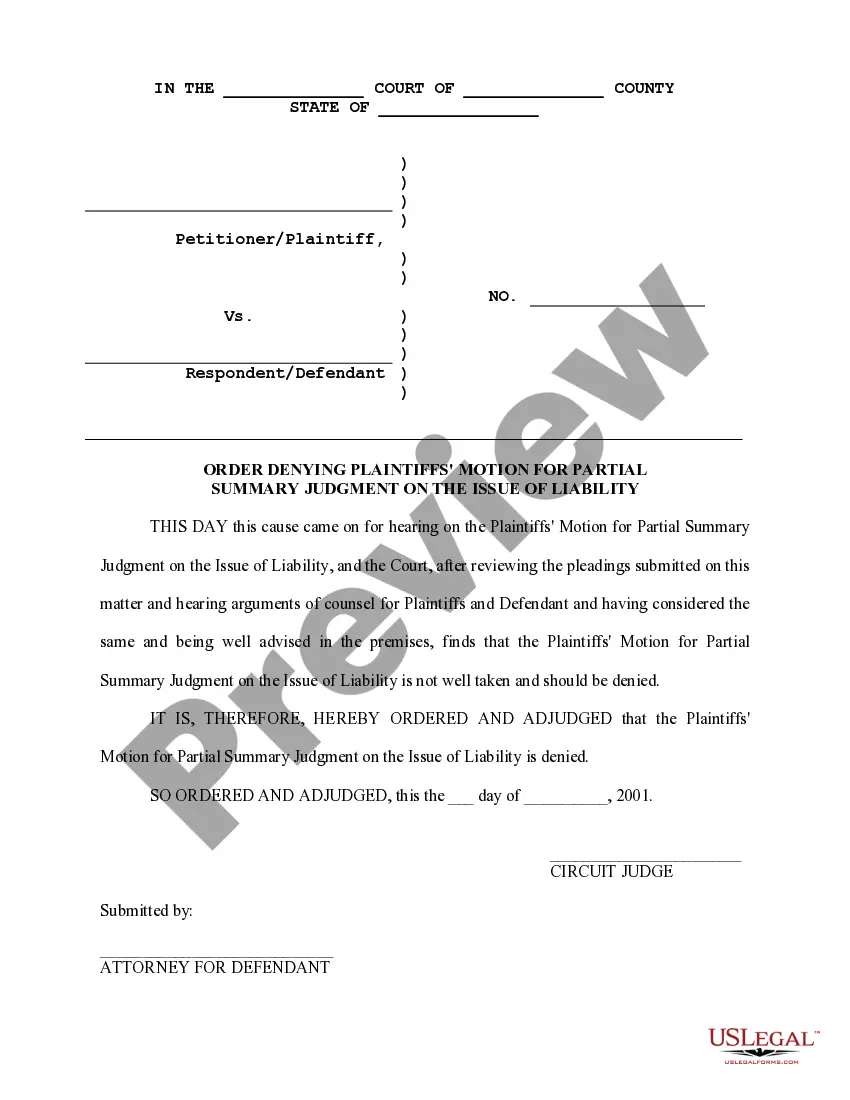
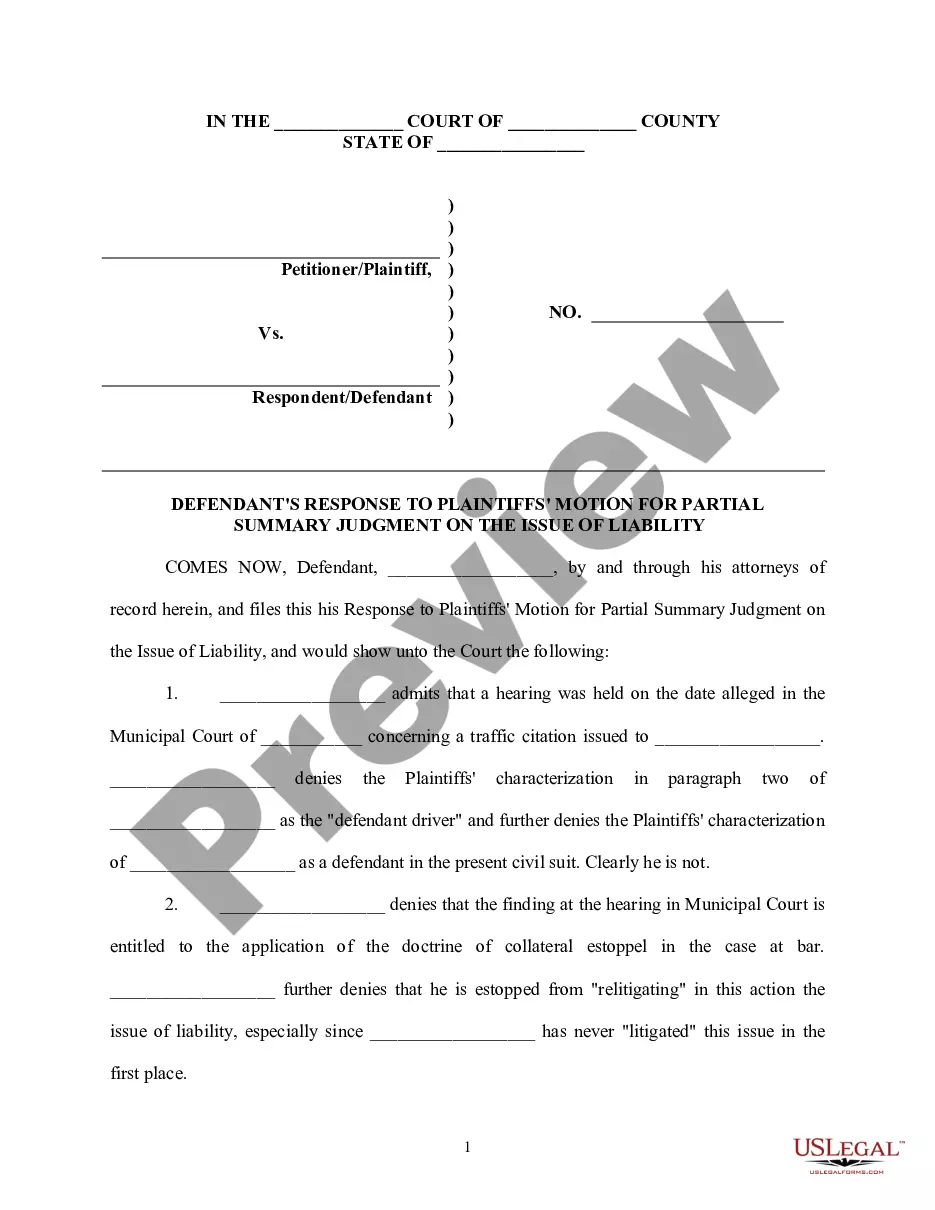
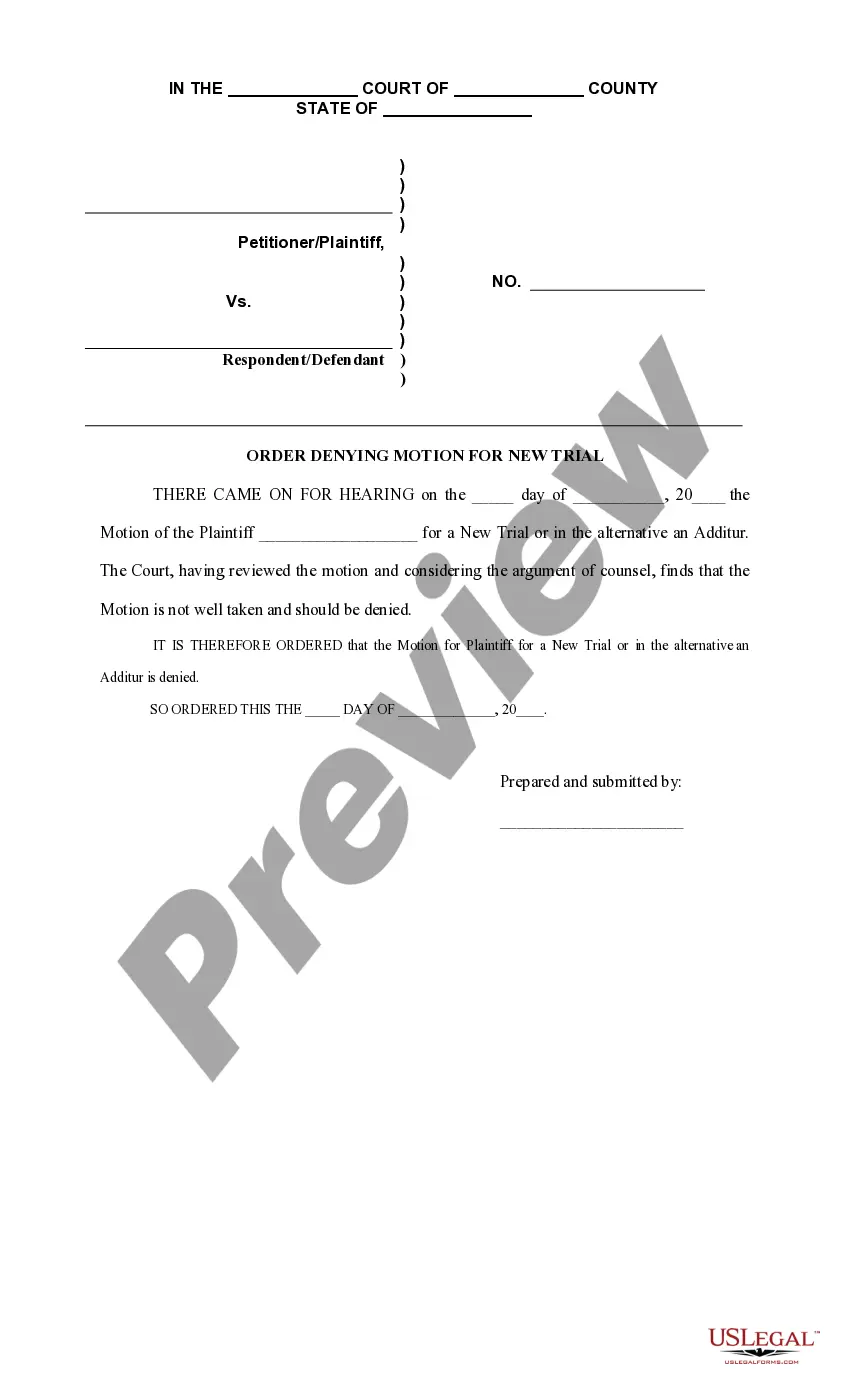
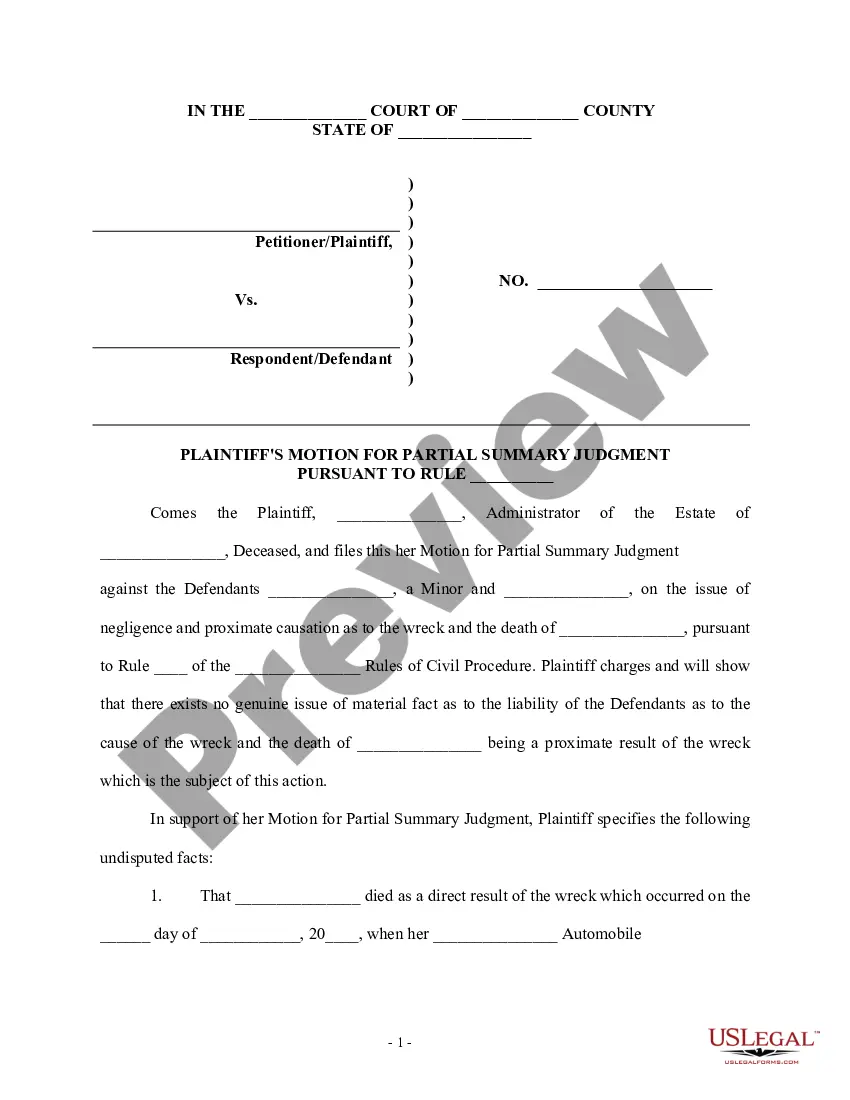
Order Denying Plaintiff's Motion for Partial Summary Judgment on the Issue of Liability
Understanding this form
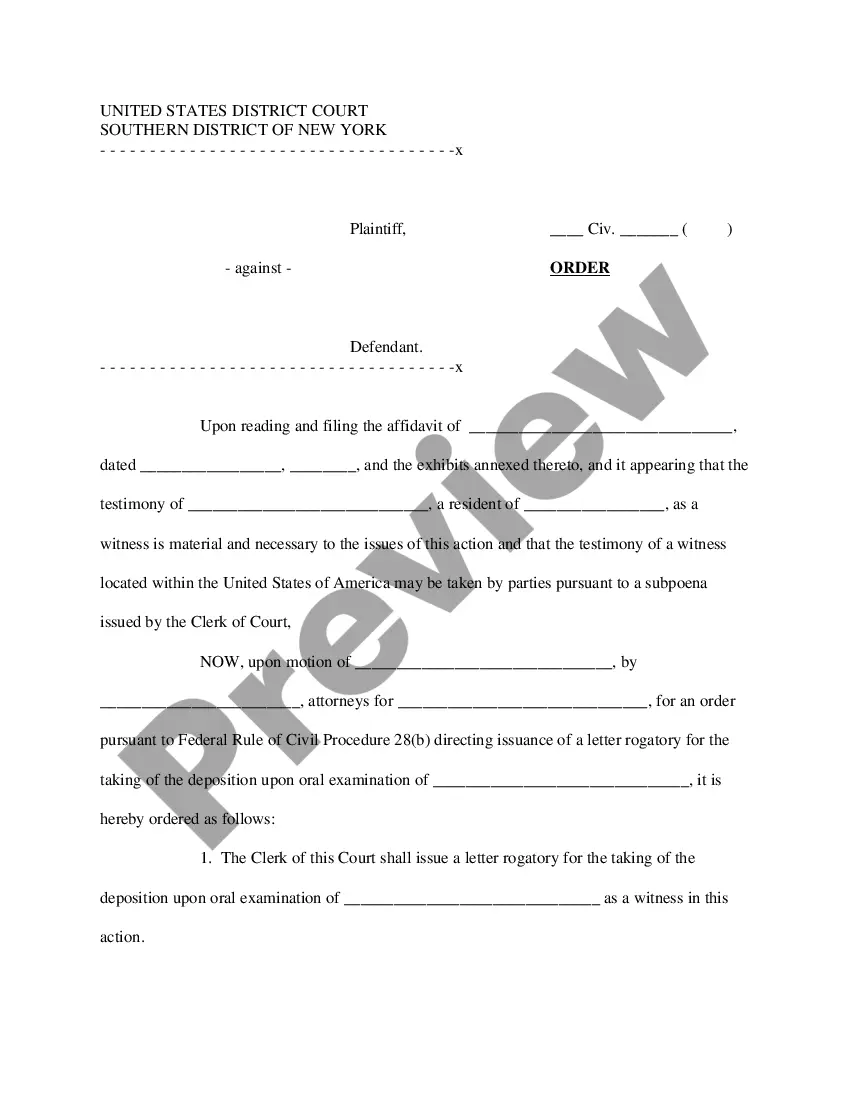
The Order Denying Plaintiff's Motion for Partial Summary Judgment on the Issue of Liability is a legal document used in personal injury cases, particularly those involving automobile accidents. This form officially denies the plaintiff's request for a ruling that they are not liable for the injuries claimed. It differs from similar forms by focusing specifically on the issue of liability rather than other aspects of the case, such as damages or causation.
Key components of this form
- Order and Judgment: Declares the denial of the plaintiff's motion for partial summary judgment.
- Date Line: Space to indicate the date the order is issued.
- Signature Line: Area for the signature of the presiding Circuit Judge.
- Attorney Information: Section for the name and designation of the attorney representing the defendant.
Situations where this form applies
This form is utilized when a plaintiff has filed a motion for partial summary judgment, seeking an official determination that they are not liable in a personal injury lawsuit. It is necessary to deny such a motion to ensure the case continues to trial, allowing for a complete examination of the facts and evidence.
Who needs this form
This form is intended for:
- Plaintiffs in personal injury cases seeking to understand the outcome of their motion for partial summary judgment.
- Defendants wanting to respond formally to the plaintiff's motion.
- Attorneys representing either party in a personal injury case who need to document the court's decision.
Instructions for completing this form
- Fill in the date on which the order is issued.
- Ensure the presiding Circuit Judge signs the document.
- Insert the name and title of the attorney representing the defendant in the designated area.
- Review the order to ensure all details are correct before submitting it to the court.
Is notarization required?
Notarization is generally not required for this form. However, certain states or situations might demand it. You can complete notarization online through US Legal Forms, powered by Notarize, using a verified video call available anytime.
Get your form ready online
Our built-in tools help you complete, sign, share, and store your documents in one place.
Make edits, fill in missing information, and update formatting in US Legal Forms—just like you would in MS Word.
Download a copy, print it, send it by email, or mail it via USPS—whatever works best for your next step.
Sign and collect signatures with our SignNow integration. Send to multiple recipients, set reminders, and more. Go Premium to unlock E-Sign.
If this form requires notarization, complete it online through a secure video call—no need to meet a notary in person or wait for an appointment.
We protect your documents and personal data by following strict security and privacy standards.

Make edits, fill in missing information, and update formatting in US Legal Forms—just like you would in MS Word.

Download a copy, print it, send it by email, or mail it via USPS—whatever works best for your next step.

Sign and collect signatures with our SignNow integration. Send to multiple recipients, set reminders, and more. Go Premium to unlock E-Sign.

If this form requires notarization, complete it online through a secure video call—no need to meet a notary in person or wait for an appointment.

We protect your documents and personal data by following strict security and privacy standards.
Typical mistakes to avoid
- Neglecting to date the order, which can lead to confusion about the timeline of the case.
- Forgetting to include the attorney's information, resulting in an incomplete record.
- Failing to obtain the judge's signature, which is essential for the order's validity.
Why complete this form online
- Quick and easy access to downloadable templates drafted by licensed attorneys.
- Editable format allows for customization to meet specific case requirements.
- Time-saving option to avoid delays in court proceedings by having a ready-to-use document.
Legal use & context
- This form is enforceable as a court order once signed by the designated judge.
- Denial of partial summary judgment does not equate to a ruling on the merits of the case; it simply allows the lawsuit to proceed.
- Understanding the implications of this order is critical for both parties in preparing for trial.
Summary of main points
- The form is essential for documenting the denial of a plaintiff's motion in liability cases.
- It ensures proper legal procedures are followed in personal injury litigation.
- Correct completion and filing of this form help maintain the integrity of the case timeline.
Looking for another form?




Form popularity
FAQ
If the motion is granted, the judgment on the issue or case is deemed to be a final judgment from which a party may seek an appeal. The court of appeal can reverse the grant of summary judgment and reinstate the claim in the lower court. However, this is rarely done and most summary judgments are upheld on appeal.
A response must be in writing and include the same supporting documents as a motion for summary judgment. The opposition to the motion for summary judgment should also include a statement of facts showing the dispute and supporting documents.
Partial summary judgment," as used in' this comment, refers to the granting of judgment on a portion of a single claim. It is not used to refer to the granting of judgment on a single claim where more than one claim is presented in a case.
In a non-precedential opinion addressing the issue of appellate jurisdiction, the U.S. Court of Appeals for the Federal Circuit dismissed an appeal of a lower court's denial of two of plaintiff's motions for summary judgment, finding that a denial of summary judgment is not a final judgment.
A procedural device used during civil litigation to promptly and expeditiously dispose of a case without a trial.For example, a court might grant partial summary judgment in a personal injury case on the issue of liability. A trial would still be necessary to determine the amount of damages.
N. a court order ruling that no factual issues remain to be tried and therefore a cause of action or all causes of action in a complaint can be decided upon certain facts without trial.
Attack the Legal Argument. The first place to look for a weakness in your opponent's motion is at their legal argument. Attack the Evidence. Attack the Separate Statement. Consider Whether Your Opponent's Motion Meets its Burden. Consider Seeking a Continuance to Conduct More Discovery. Conclusion.
Your three options following the court's grant of summary judgment or summary adjudication to the defense. This article explores the benefits and best practices of three options following the grant of summary judgment or summary adjudication: (1) a new-trial motion, (2) a writ, and (3) an appeal.
When a motion for summary judgment is denied, the nonmoving party achieves a form of premium that enables a case to settle for an additional amount. Put simply, the settlement value of a case increases when a motion for summary judgment is denied.