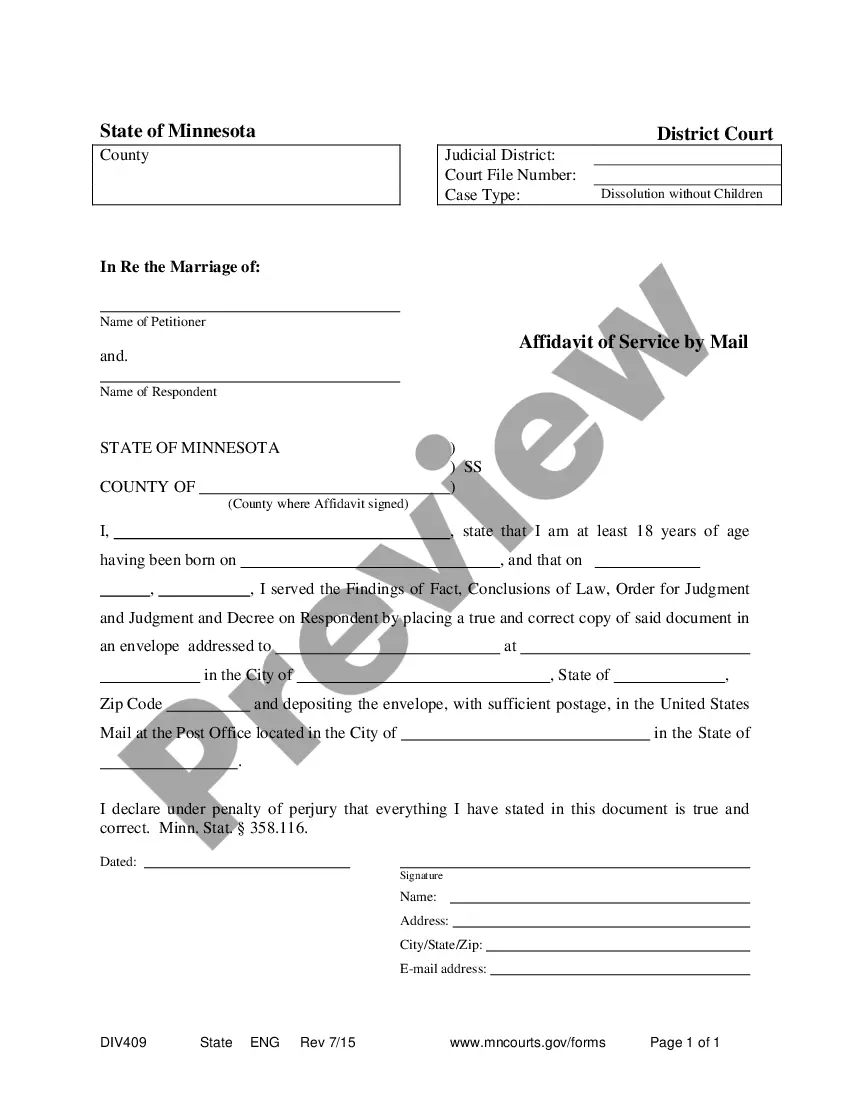
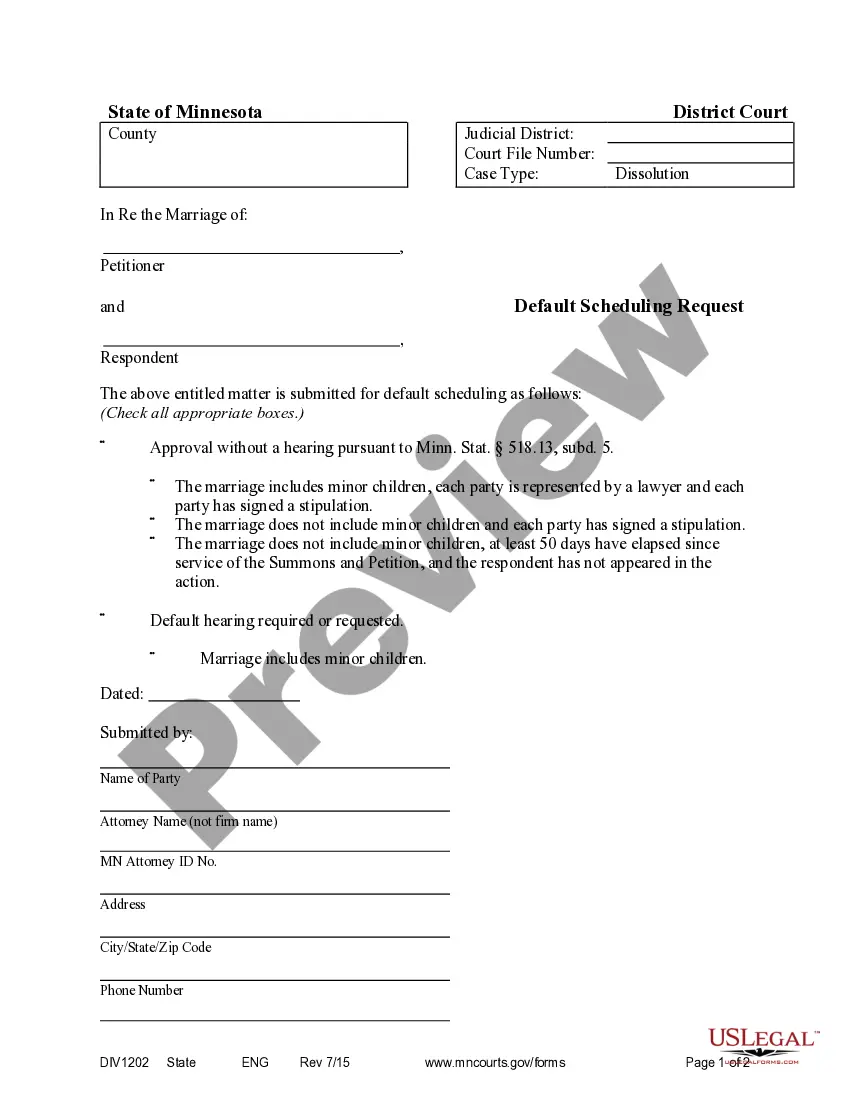
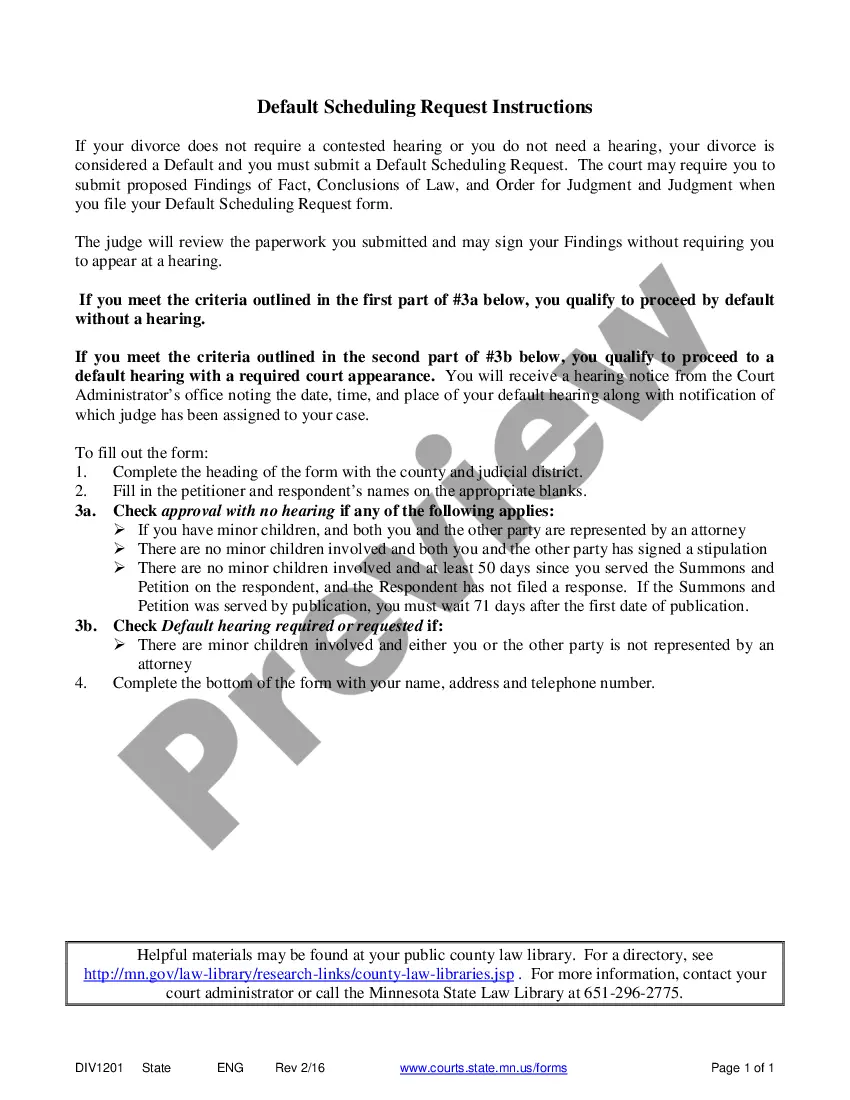
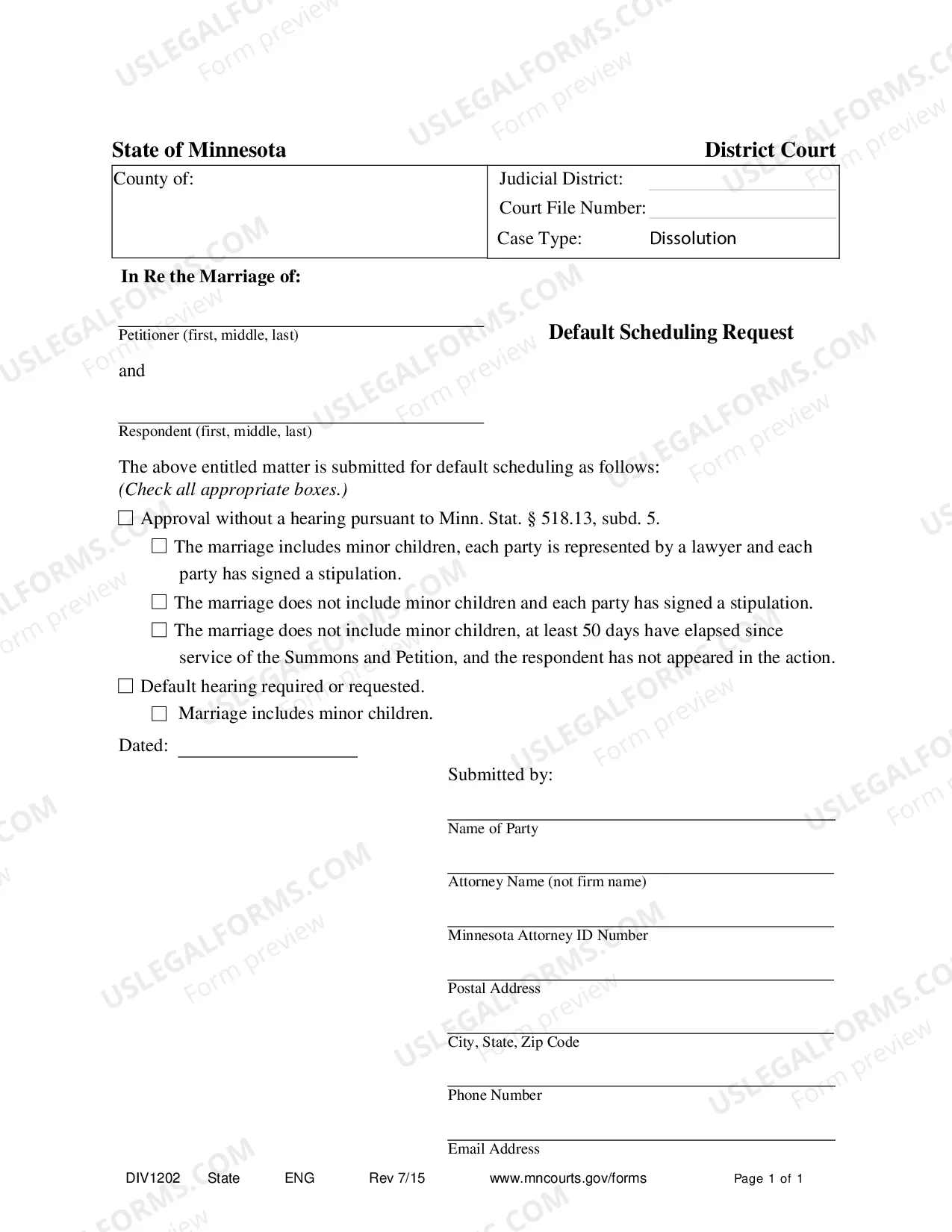
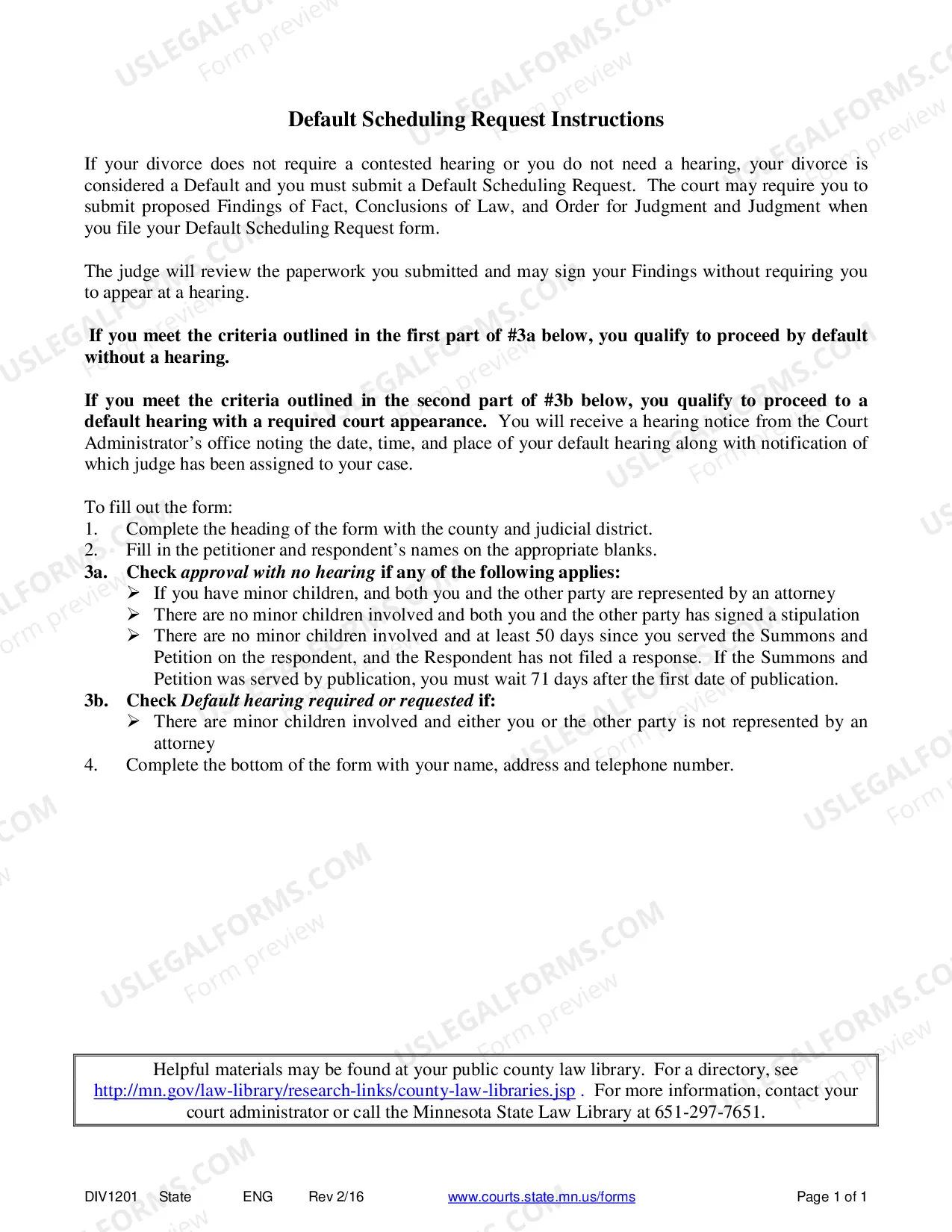
This is an official Minnesota court form for use in a divorce case, a Default Scheduling Request. USLF amends and updates these forms as is required by Minnesota Statutes and Law.
Minnesota Default Scheduling Request
Instant download
This website is not affiliated with any governmental entity
Public form
Description
Get your form ready online
Our built-in tools help you complete, sign, share, and store your documents in one place.
Built-in online Word editor
Make edits, fill in missing information, and update formatting in US Legal Forms—just like you would in MS Word.
Export easily
Download a copy, print it, send it by email, or mail it via USPS—whatever works best for your next step.
E-sign your document
Sign and collect signatures with our SignNow integration. Send to multiple recipients, set reminders, and more. Go Premium to unlock E-Sign.
Notarize online 24/7
If this form requires notarization, complete it online through a secure video call—no need to meet a notary in person or wait for an appointment.
Store your document securely
We protect your documents and personal data by following strict security and privacy standards.

Make edits, fill in missing information, and update formatting in US Legal Forms—just like you would in MS Word.

Download a copy, print it, send it by email, or mail it via USPS—whatever works best for your next step.

Sign and collect signatures with our SignNow integration. Send to multiple recipients, set reminders, and more. Go Premium to unlock E-Sign.

If this form requires notarization, complete it online through a secure video call—no need to meet a notary in person or wait for an appointment.

We protect your documents and personal data by following strict security and privacy standards.
Looking for another form?
How to fill out Minnesota Default Scheduling Request?
Access any type from 85,000 legitimate documents including Minnesota Default Scheduling Request online with US Legal Forms. Each template is created and revised by state-certified legal professionals.
If you possess a subscription, Log In. Once you are on the form’s page, click the Download button and navigate to My documents to retrieve it.
If you haven’t subscribed yet, follow the guidelines listed below.
With US Legal Forms, you will consistently have swift access to the appropriate downloadable template. The platform provides forms and categorizes them to enhance your search experience. Utilize US Legal Forms to acquire your Minnesota Default Scheduling Request swiftly and effortlessly.
- Verify the state-specific criteria for the Minnesota Default Scheduling Request you wish to utilize.
- Browse the description and preview the template.
- Once you are confident that the sample meets your needs, click on Buy Now.
- Select a subscription plan that genuinely fits your financial plan.
- Establish a personal account.
- Make payment using one of two suitable methods: by credit card or through PayPal.
- Choose a format to download the document in; two options are available (PDF or Word).
- Download the file to the My documents tab.
- As soon as your reusable template is downloaded, print it or save it to your device.
Form popularity
FAQ
Rule 69 in Minnesota addresses the enforcement of judgments and outlines procedures for obtaining satisfaction of those judgments. This rule is essential for parties seeking to assert their rights effectively following a court ruling. When making a Minnesota Default Scheduling Request, familiarity with Rule 69 will help individuals navigate the complexities of judgment enforcement.
The rule of civil procedure 69 in Minnesota outlines the methods for executing judgments. It provides a framework for creditors to seek enforcement of their rights after a judgment is entered. For those looking to file a Minnesota Default Scheduling Request, understanding this rule is crucial for ensuring that the enforcement process is handled correctly and efficiently.
Rule 68 in Minnesota relates to offers of judgment, encouraging parties to settle disputes before trial. This rule allows a party to make a formal offer, and if the other party rejects it and fails to achieve a better outcome at trial, they may face penalty costs. Utilizing a Minnesota Default Scheduling Request in conjunction with Rule 68 can promote timely resolutions and save both parties time and resources.
Rule 69, as it pertains to civil procedure in Minnesota, focuses on the enforcement of judgments. This rule allows parties to seek assistance from the court to ensure compliance with court orders. When filing a Minnesota Default Scheduling Request, understanding Rule 69 can help individuals navigate enforcement actions effectively.
The rule of practice 521 in Minnesota governs the scheduling and management of default proceedings. It outlines the steps necessary for filing a Minnesota Default Scheduling Request, ensuring that parties involved follow a structured process. By adhering to this rule, individuals and legal professionals can facilitate smoother court processes and reduce potential delays.
Filing a motion for default means you are asking the court to rule in your favor because the opposing party has not responded to your complaint. This action can expedite your case and lead to a default judgment. However, it is essential to understand the implications of this motion for your legal standing. A Minnesota Default Scheduling Request can provide you with the necessary steps to file effectively.
A motion for default in Minnesota is a formal request made by the plaintiff when the defendant fails to respond to the complaint within the specified timeframe. This motion can lead to a default judgment being issued against the defendant. It is a critical step for plaintiffs seeking resolution in their favor. If you find yourself in this situation, a Minnesota Default Scheduling Request can help you take appropriate action.
To respond to a motion for default, you should file an answer or a motion to vacate the default judgment with the court. It is important to act quickly, as there are typically time limits for your response. Providing a valid reason for your failure to respond initially can strengthen your case. Utilizing a Minnesota Default Scheduling Request can guide you through this process.
Rule 77.04 in Minnesota governs the procedures related to default judgments and scheduling requests. It outlines the necessary steps to follow when a party fails to respond to a complaint. Understanding this rule can help you navigate the legal process more effectively. If you're facing a default situation, consider a Minnesota Default Scheduling Request to ensure your rights are protected.
Once a default is issued, the plaintiff may seek a default judgment, which could lead to further legal actions against you. The court may award damages based solely on the plaintiff's claims, without your input. It is crucial to take action promptly to avoid unfavorable outcomes. Submitting a Minnesota Default Scheduling Request can be an effective way to respond.