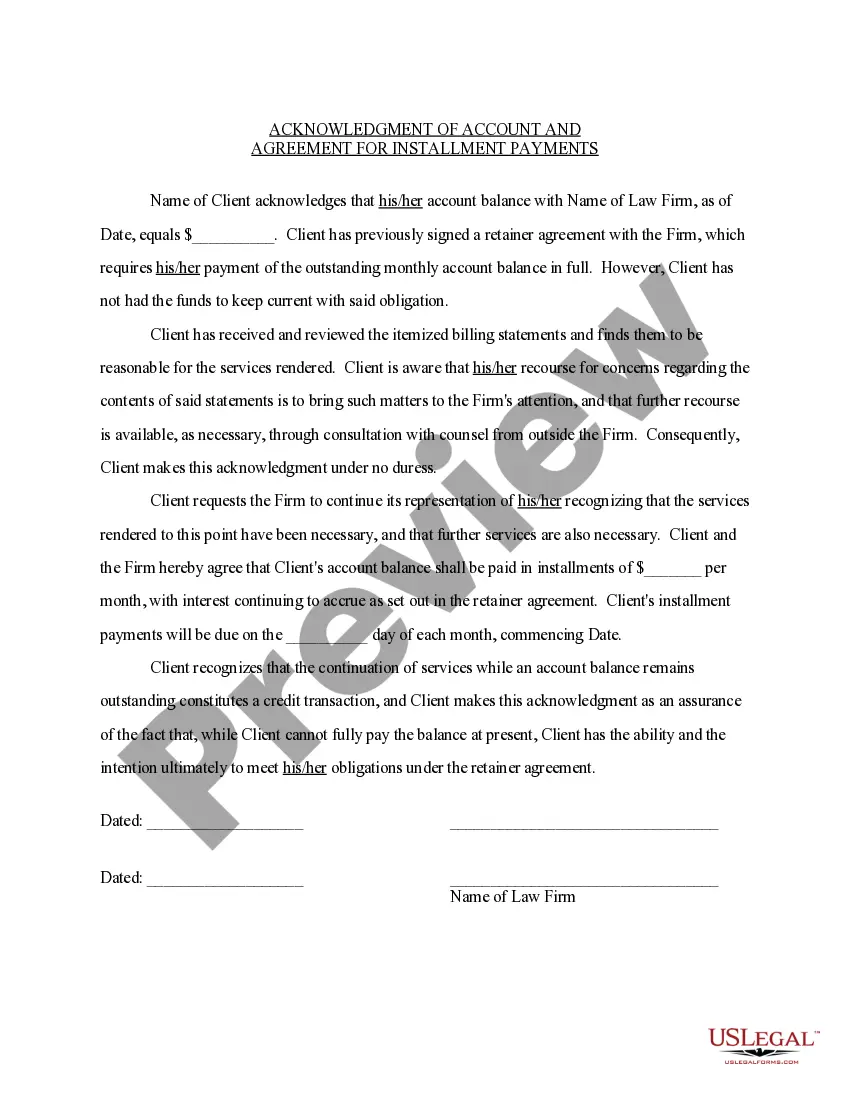
Minnesota Client Acknowledgment of Past-Due Account and Agreement for Installment Payments with Law Firm
Overview of this form
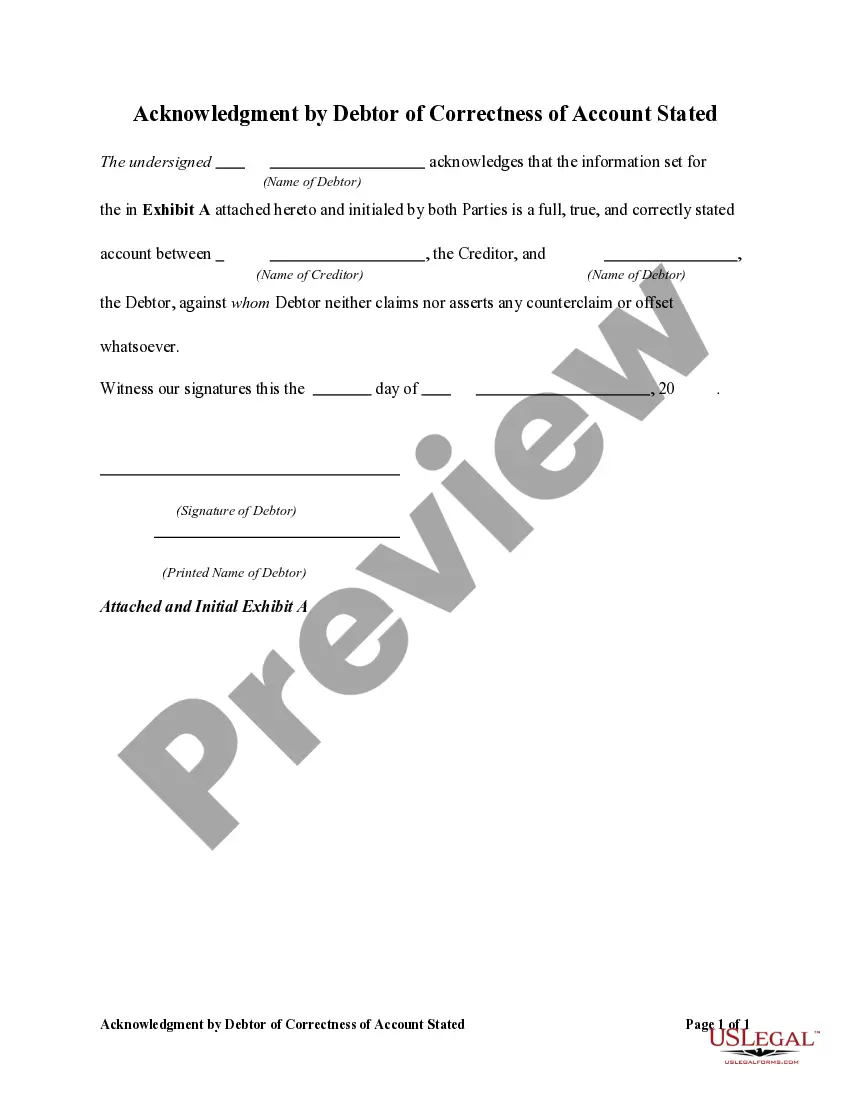
The Client Acknowledgment of Past-Due Account and Agreement for Installment Payments with Law Firm is a legal document that confirms a client's outstanding account balance with their law firm and sets out a plan for installment payments. This form helps clients formally acknowledge their debt while allowing them to continue receiving legal services. By using this agreement, clients and law firms can establish a clear payment schedule to manage outstanding fees in a supportive manner.
Form components explained
- Name of the client and law firm.
- Current account balance and date of acknowledgment.
- Details of the retainer agreement and acknowledgment of past-due obligations.
- Agreement on installment payment amounts and due dates.
- Clause regarding interest accrual as per the retainer agreement.
- Signatures of the client and law firm representative along with the date.
When to use this document
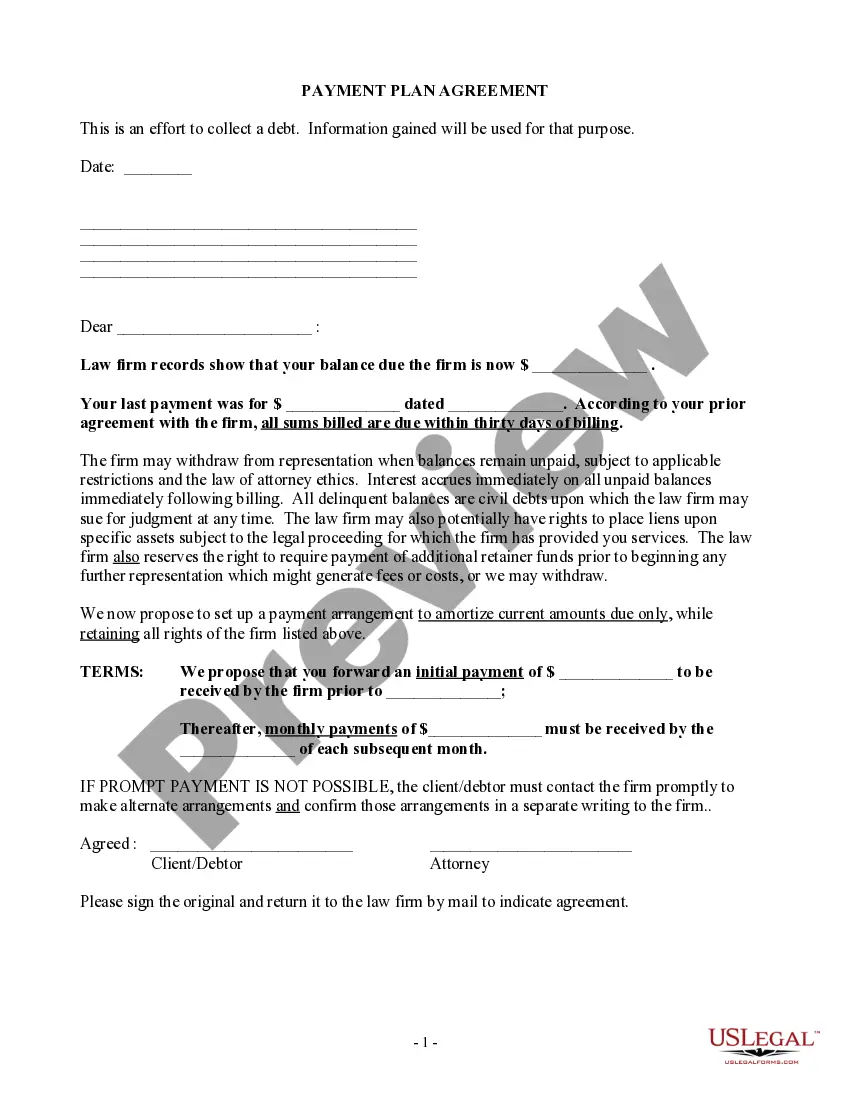
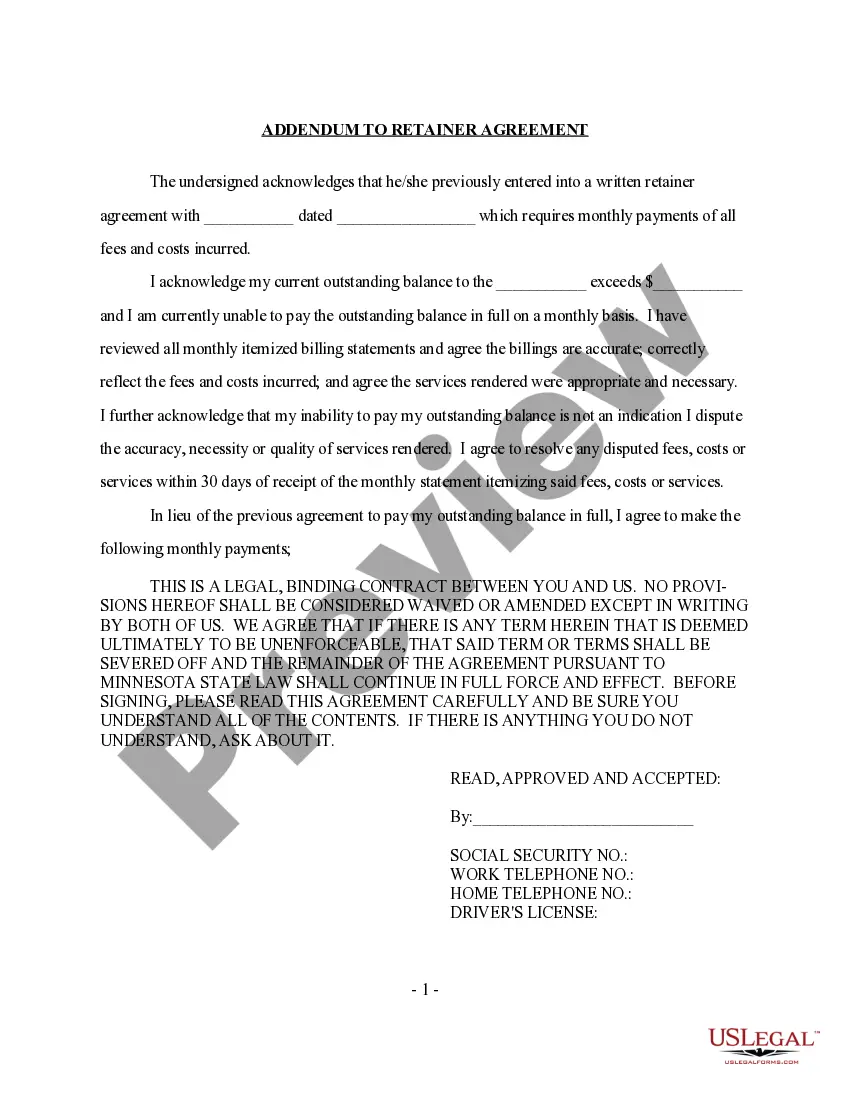
This form is useful when a client has an outstanding balance with their law firm but cannot pay the full amount immediately. It is suitable for situations where the client wishes to continue receiving legal representation while agreeing to pay the debt in manageable installments. The document ensures that both parties understand the terms of the agreement and the responsibilities involved.
Who needs this form
- Clients who have an overdue balance with their law firm.
- Individuals needing to formalize a payment plan with their legal representative.
- Anyone looking to clarify obligations while continuing legal services.
- Law firms seeking a structured approach to collect overdue payments while maintaining client relationships.
Completing this form step by step
- Identify the parties by filling in the name of the client and the law firm.
- Enter the current account balance and the date of acknowledgment.
- Review the retainer agreement and acknowledge understanding of past-due obligations.
- Specify the amount of each installment and set a due date for payments.
- Ensure both parties sign and date the form to finalize the agreement.
Is notarization required?
Notarization is generally not required for this form. However, certain states or situations might demand it. You can complete notarization online through US Legal Forms, powered by Notarize, using a verified video call available anytime.
Get your form ready online
Our built-in tools help you complete, sign, share, and store your documents in one place.
Make edits, fill in missing information, and update formatting in US Legal Forms—just like you would in MS Word.
Download a copy, print it, send it by email, or mail it via USPS—whatever works best for your next step.
Sign and collect signatures with our SignNow integration. Send to multiple recipients, set reminders, and more. Go Premium to unlock E-Sign.
If this form requires notarization, complete it online through a secure video call—no need to meet a notary in person or wait for an appointment.
We protect your documents and personal data by following strict security and privacy standards.

Make edits, fill in missing information, and update formatting in US Legal Forms—just like you would in MS Word.

Download a copy, print it, send it by email, or mail it via USPS—whatever works best for your next step.

Sign and collect signatures with our SignNow integration. Send to multiple recipients, set reminders, and more. Go Premium to unlock E-Sign.

If this form requires notarization, complete it online through a secure video call—no need to meet a notary in person or wait for an appointment.

We protect your documents and personal data by following strict security and privacy standards.
Common mistakes to avoid
- Failing to specify the installment payment amount clearly.
- Not including the due date for payments.
- Overlooking the need for both parties to sign the document.
- Neglecting to review the retainer agreement's terms before acknowledgment.
- Not keeping a copy of the signed agreement for personal records.
Why use this form online
- Convenience of downloading and filling out the form from anywhere.
- Easy editing to tailor the document to specific needs or circumstances.
- Reliable content drafted by licensed attorneys to ensure legal compliance.
Legal use & context
- This acknowledgment form serves as a binding agreement between the client and the law firm.
- It is crucial for maintaining legal representation while resolving outstanding debts.
- Failure to comply with the agreed payment terms may affect the client's legal standing and services.
Main things to remember
- The form formalizes an acknowledgment of a past-due account and sets up a payment plan.
- It helps clients manage their debt while maintaining legal support.
- Ensuring signatures and clear payment terms can prevent misunderstandings.
Glossary of terms used in this form
- Retainer agreement: A contract outlining the terms of service and payment between a client and law firm.
- Installment payments: Payments made regularly, usually monthly, toward a debt or obligation.
- Account balance: The total amount of money owed by the client to the law firm.
Looking for another form?

Form popularity
FAQ
In Minnesota, a debt generally becomes uncollectible after six years, which is the statute of limitations for most types of debts. This means that creditors have a limited time to pursue collection efforts before they lose their legal right to enforce the debt. However, it is important to note that certain actions can reset this timeline. By understanding the Minnesota Client Acknowledgment of Past-Due Account and Agreement for Installment Payments with Law Firm, you can explore your options and create a plan to manage or resolve your debts promptly.
To make a payment plan legally binding, you must draft it in writing, clearly stating the terms and conditions agreed upon by both parties. Include essential details such as payment amounts, due dates, and consequences for non-payment. By utilizing the Minnesota Client Acknowledgment of Past-Due Account and Agreement for Installment Payments with Law Firm, you can ensure that your payment plan meets legal standards and protects both parties' interests.
To write a simple payment agreement, state the debtor's name, the amount owed, and the payment schedule in clear language. Include any conditions, such as late fees or interest rates, and ensure both parties sign the document. The Minnesota Client Acknowledgment of Past-Due Account and Agreement for Installment Payments with Law Firm can serve as a useful template to simplify this process, ensuring all necessary elements are included.
A debt acknowledgment and repayment agreement is a formal document where a debtor confirms the existence of a debt and agrees to a repayment plan. This document outlines the specific terms for repayment, including amounts and timelines. By integrating the Minnesota Client Acknowledgment of Past-Due Account and Agreement for Installment Payments with Law Firm, you can create a clear, enforceable agreement that benefits both parties.
Writing a simple legal agreement involves defining the parties involved, stating the purpose of the agreement, and outlining specific terms and conditions. Be sure to include details such as payment amounts, timelines, and any penalties for late payments. Utilizing the Minnesota Client Acknowledgment of Past-Due Account and Agreement for Installment Payments with Law Firm can streamline this process, ensuring you cover all necessary aspects of your agreement.
To write a legal payment agreement, start by clearly outlining the terms of the payment, including the total amount owed, payment schedule, and any interest rates. Incorporate both parties' details and ensure you include the Minnesota Client Acknowledgment of Past-Due Account and Agreement for Installment Payments with Law Firm as part of the document. This clarity helps both parties understand their obligations and provides a solid foundation for the agreement.
The 7 7 7 rule for collections refers to a strategy where a creditor attempts to collect a debt within seven days of the due date, followed by another contact seven days later, and a final attempt seven days after that. This method helps maintain communication with the client regarding the Minnesota Client Acknowledgment of Past-Due Account and Agreement for Installment Payments with Law Firm. By following this structure, you enhance your chances of resolving outstanding debts effectively.