Minnesota Order for Writ of Prohibition
Overview of this form
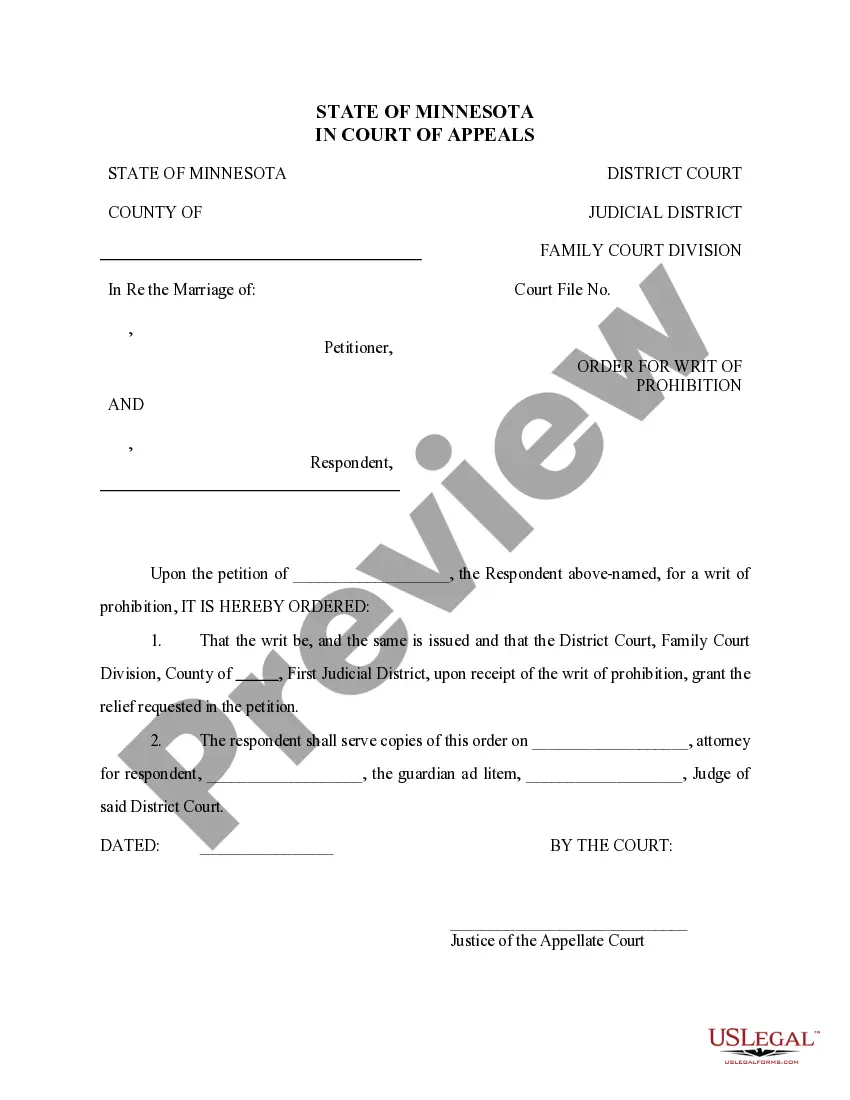
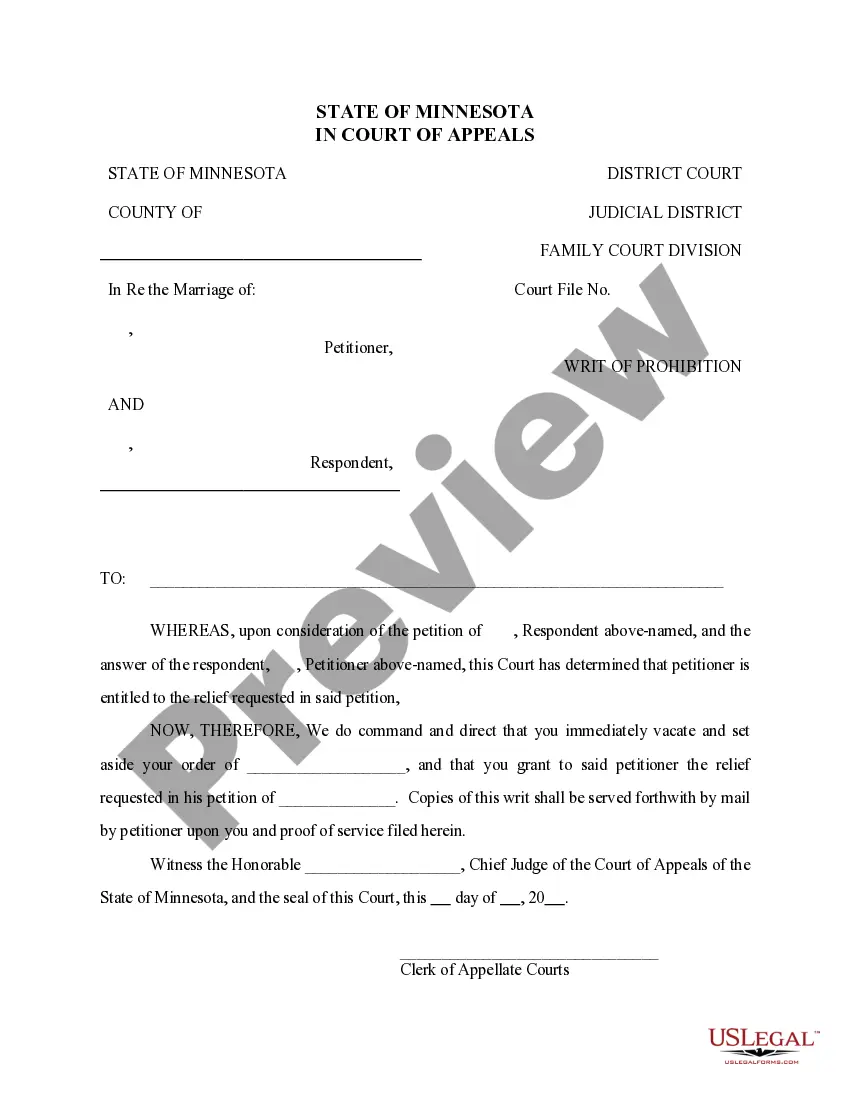
The Order for Writ of Prohibition is a legal document issued by an appellate court that reverses a decision of a lower court. This form is crucial for seeking relief when a lower court has made a ruling that may exceed its jurisdiction or violate legal principles. Unlike other forms of legal remedies, the writ of prohibition specifically requests that the higher court intervene to prevent the enforcement of the lower court's order.
What’s included in this form
- The name of the petitioner: identifies who is requesting the writ.
- The name of the respondent: specifies the party affected by the lower court's decision.
- Date of the order: indicates when the writ is issued.
- Signature line for the justice: provides a space for the judge's signature, confirming the order.
When to use this form
This form is used when a party believes that a lower court has made an erroneous decision that exceeds its authority or violates the law. It is appropriate in situations where there is a need for immediate judicial intervention to prevent harm caused by the enforcement of that decision.
Who should use this form
- Individuals or entities involved in a legal proceeding where a lower court's decision is being contested.
- Attorneys representing clients who require a writ of prohibition to challenge a ruling.
- Parties seeking to prevent unlawful actions stemming from a lower court's order.
Instructions for completing this form
- Identify the petitioner and fill in their name in the designated space.
- Enter the name of the respondent to whom the writ is directed.
- Insert the date on which the order is being granted.
- Provide space for the justice of the appellate court to sign the document.
Does this form need to be notarized?
In most cases, this form does not require notarization. However, some jurisdictions or signing circumstances might. US Legal Forms offers online notarization powered by Notarize, accessible 24/7 for a quick, remote process.
Get your form ready online
Our built-in tools help you complete, sign, share, and store your documents in one place.
Make edits, fill in missing information, and update formatting in US Legal Forms—just like you would in MS Word.
Download a copy, print it, send it by email, or mail it via USPS—whatever works best for your next step.
Sign and collect signatures with our SignNow integration. Send to multiple recipients, set reminders, and more. Go Premium to unlock E-Sign.
If this form requires notarization, complete it online through a secure video call—no need to meet a notary in person or wait for an appointment.
We protect your documents and personal data by following strict security and privacy standards.

Make edits, fill in missing information, and update formatting in US Legal Forms—just like you would in MS Word.

Download a copy, print it, send it by email, or mail it via USPS—whatever works best for your next step.

Sign and collect signatures with our SignNow integration. Send to multiple recipients, set reminders, and more. Go Premium to unlock E-Sign.

If this form requires notarization, complete it online through a secure video call—no need to meet a notary in person or wait for an appointment.

We protect your documents and personal data by following strict security and privacy standards.
Typical mistakes to avoid
- Failing to clearly identify both the petitioner and the respondent.
- Leaving the date field blank or improperly filled.
- Not ensuring that the form is signed by the appropriate judicial authority.
Benefits of completing this form online
- Convenient access to the form from anywhere, saving time and effort.
- The ability to easily edit and customize the form to fit specific needs.
- Reliability and professionalism of forms drafted by licensed attorneys.
Quick recap
- An Order for Writ of Prohibition prevents a lower court from making an unauthorized ruling.
- It is vital to accurately fill out and obtain necessary signatures to ensure the writ's enforceability.
- This form can be customized for use across multiple jurisdictions, reflecting specific local rules.
Looking for another form?
Form popularity
FAQ
Rule 69 in Minnesota pertains to the enforcement of judgments through writs of execution. This rule specifies the procedures for collecting debts owed as a result of a court judgment. Understanding Rule 69 is crucial for anyone looking to enforce a judgment effectively. The US Legal platform can provide you with the necessary forms and detailed instructions to help you through this process.
Rule of Practice 521 in Minnesota governs the issuance of writs, including the Minnesota Order for Writ of Prohibition. This rule outlines the procedures and requirements for obtaining such writs, ensuring that parties understand their rights and obligations. Familiarizing yourself with this rule can clarify the steps needed for effective legal action. Resources available on the US Legal platform can assist you in navigating these regulations.
A writ of prohibition is a legal order that prevents a lower court from proceeding with a case that exceeds its jurisdiction. This writ acts as a check on judicial authority, ensuring that legal boundaries are respected. If you believe a lower court is overstepping its powers, you can petition for a Minnesota Order for Writ of Prohibition. This action helps maintain the integrity of the judicial process.
To request a writ of execution in Minnesota, you must first obtain a judgment from the court. After securing the judgment, you can file a request for the writ with the court clerk. It's essential to include relevant details such as the case number and the amount owed. For a smoother process, consider using the US Legal platform, which provides forms and guidance tailored for Minnesota Order for Writ of Prohibition.
Issuing a writ of prohibition requires establishing that the lower court is about to exceed its jurisdiction or is acting in a manner that is clearly unlawful. It is also necessary to demonstrate that there is no other adequate remedy to resolve the issue at hand. If you find yourself in this situation, considering a Minnesota Order for Writ of Prohibition may provide a viable solution.
The grounds for a prohibition writ typically include showing that the lower court is acting without jurisdiction, that there is no adequate remedy at law, and that the party requesting the writ will suffer irreparable harm. Such grounds are essential for successfully obtaining a Minnesota Order for Writ of Prohibition. Consulting with a professional can help clarify your specific situation.
The primary purpose of a writ of prohibition is to stop a lower court or authority from acting outside its legal authority. This legal tool ensures that individuals are not subjected to unlawful decisions or actions. If you believe a decision is unjust, seeking a Minnesota Order for Writ of Prohibition could be a crucial step in your legal strategy.
The five main types of writs of prohibition include those against inferior courts, administrative agencies, legislative bodies, public officials, and private entities acting under state authority. Each writ serves to prevent these entities from exceeding their jurisdiction or acting unlawfully. If you face a legal obstacle, exploring a Minnesota Order for Writ of Prohibition can help protect your rights.
A writ of mandate is issued when a lower court or government agency fails to perform a duty required by law. Grounds for this writ include the absence of another adequate legal remedy and the presence of a clear right to the relief sought. If you find yourself needing to challenge an unlawful act, a Minnesota Order for Writ of Prohibition may also be applicable.
Rule 609 in Minnesota pertains to the admissibility of prior convictions as evidence in court. This rule outlines how and when a person’s previous criminal history can be introduced during a trial. Understanding this rule is crucial when preparing for legal proceedings, especially when considering a Minnesota Order for Writ of Prohibition.