Copyright - Validity - Copyright Notice - Pre-Berne Convention Implementation Act - Alternate Version
About this form
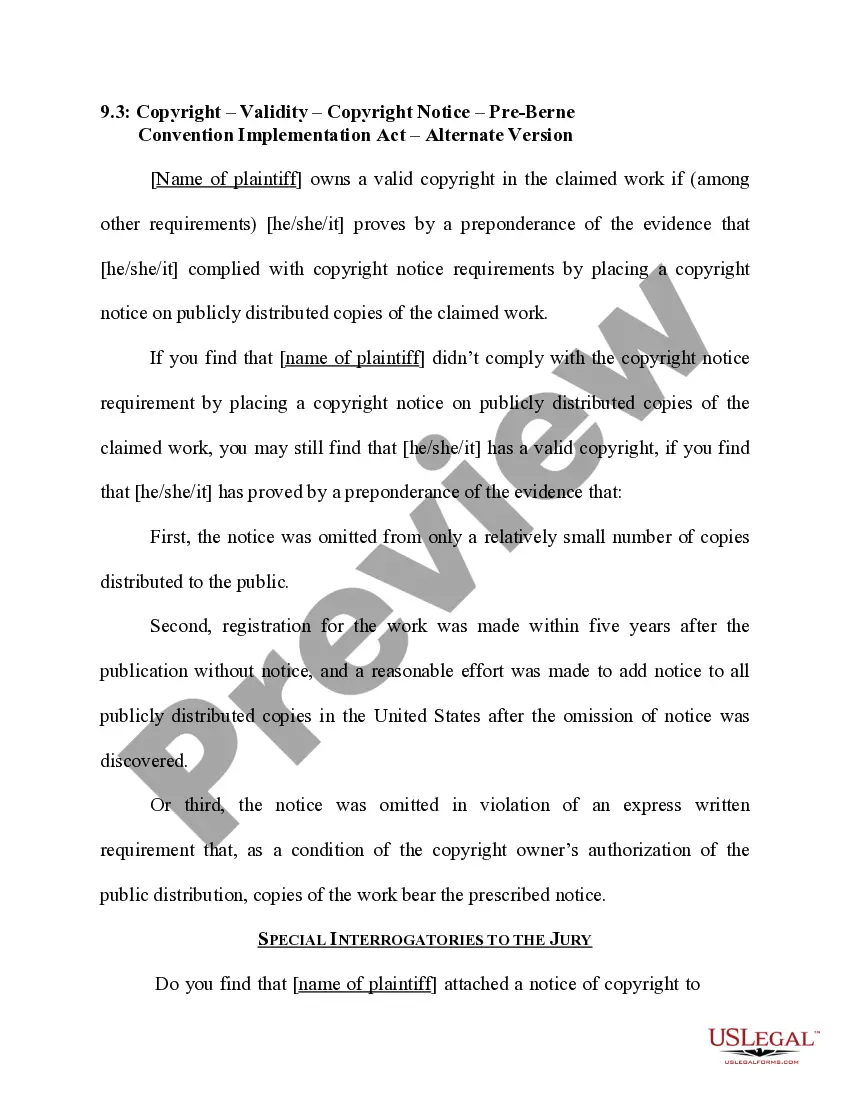
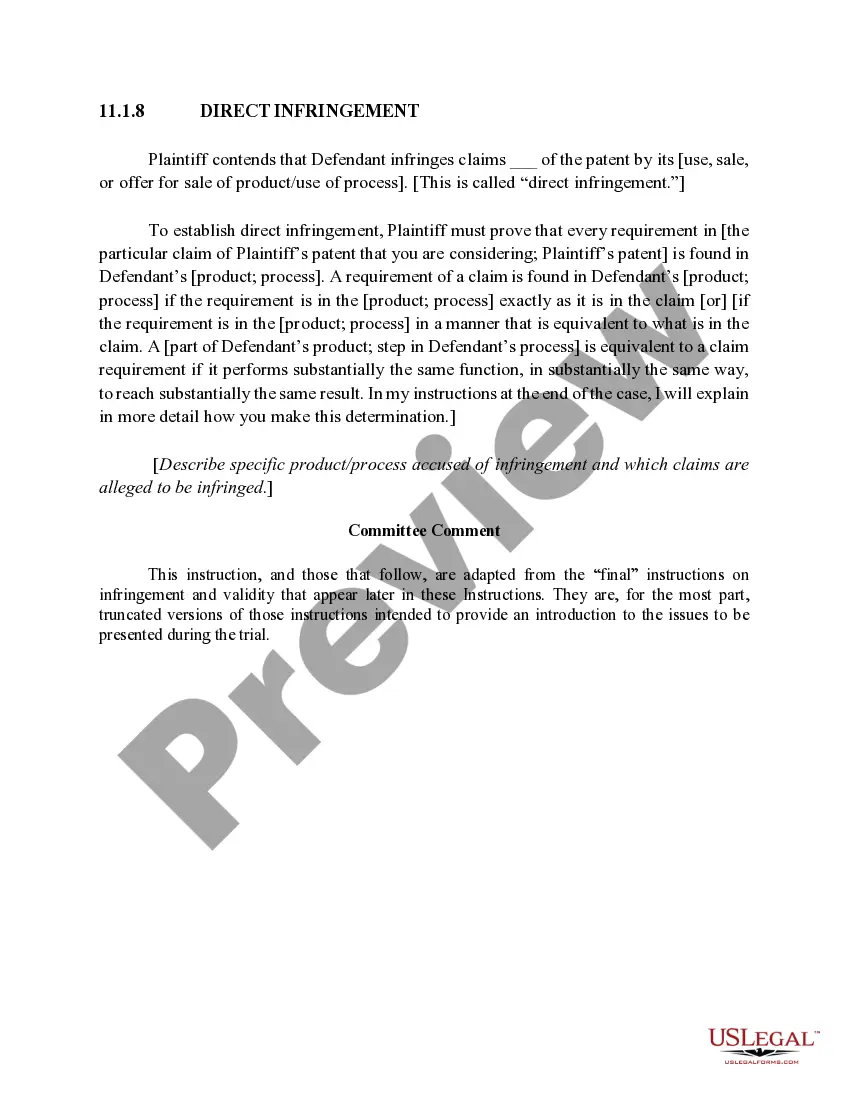
This form is a Copyright Notice template tailored to meet requirements under the Pre-Berne Convention Implementation Act. It serves to establish ownership of a copyright and validate it by demonstrating compliance with notice requirements. Unlike other copyright forms, this template specifically addresses variations in compliance with past legislation for copyright protection, helping plaintiffs assert their rights effectively in copyright infringement cases.
Key parts of this document
- Describes the requirements for proving a valid copyright notice.
- Specifies criteria that allow for a valid copyright despite omissions in notice.
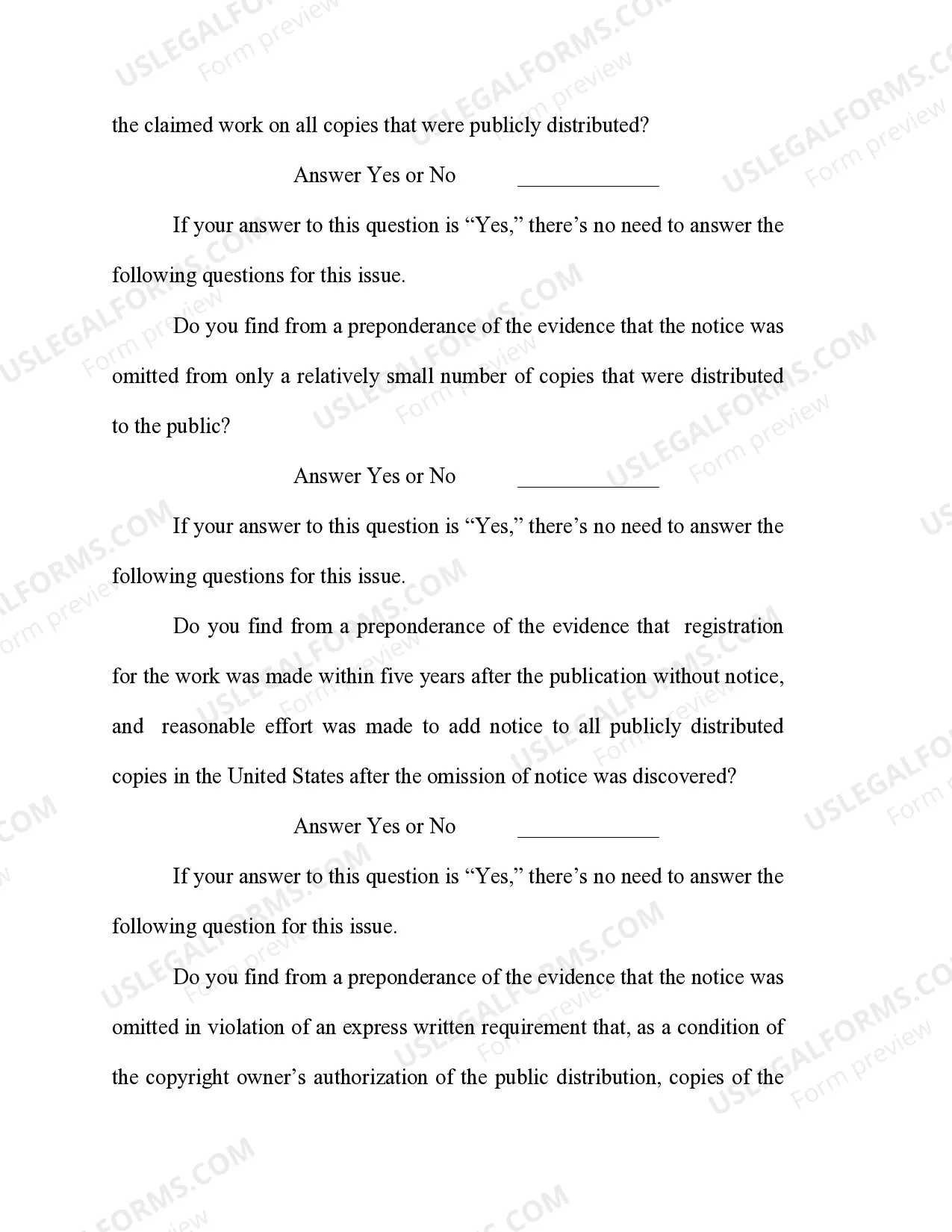
- Includes special interrogatories for jury consideration regarding notice compliance.
- Outlines the plaintiff's burden of proof to establish copyright validity.
When to use this form
This form is used when a copyright owner needs to prove the validity of their copyright, particularly in cases where proper notice may not have been consistently applied. It's beneficial in scenarios involving copyright infringement claims where there's a dispute about the ownership or validity of the copyright, especially for works distributed before certain notice requirements were standardized.
Who can use this document
- Copyright owners seeking to assert their rights in infringement cases.
- Attorneys representing clients involved in copyright disputes.
- Individuals or organizations that have created original works and need to clarify their copyright claims.
Instructions for completing this form
- Identify the name of the plaintiff claiming copyright ownership.
- Clearly state the work involved and its intended distribution.
- Document whether a copyright notice was placed on all copies distributed.
- Clarify any instances of omitted notices and detail steps taken to rectify them.
- Prepare answers for the jury's special interrogatories included in the form.
Notarization guidance
Notarization is not commonly needed for this form. However, certain documents or local rules may make it necessary. Our notarization service, powered by Notarize, allows you to finalize it securely online anytime, day or night.
Get your form ready online
Our built-in tools help you complete, sign, share, and store your documents in one place.
Make edits, fill in missing information, and update formatting in US Legal Forms—just like you would in MS Word.
Download a copy, print it, send it by email, or mail it via USPS—whatever works best for your next step.
Sign and collect signatures with our SignNow integration. Send to multiple recipients, set reminders, and more. Go Premium to unlock E-Sign.
If this form requires notarization, complete it online through a secure video call—no need to meet a notary in person or wait for an appointment.
We protect your documents and personal data by following strict security and privacy standards.

Make edits, fill in missing information, and update formatting in US Legal Forms—just like you would in MS Word.

Download a copy, print it, send it by email, or mail it via USPS—whatever works best for your next step.

Sign and collect signatures with our SignNow integration. Send to multiple recipients, set reminders, and more. Go Premium to unlock E-Sign.

If this form requires notarization, complete it online through a secure video call—no need to meet a notary in person or wait for an appointment.

We protect your documents and personal data by following strict security and privacy standards.
Mistakes to watch out for
- Failing to include the copyright notice on distributed copies.
- Not registering the work within the appropriate timeframe after publication.
- Misunderstanding the requirements for proving notice omissions.
Why complete this form online
- Convenient access to the form anytime from anywhere.
- Easy customization for specific copyright claims and scenarios.
- Reliable resources drafted by licensed attorneys to ensure legal compliance.
Looking for another form?


Form popularity
FAQ
Prior to 1989 including a copyright notice on a copyrighted work was required under U.S. law, but that is no longer the case. Although copyright notice is no longer required, a copyright owner would be wise to include a copyright notice because it prevents an infringer from raising a defense of innocent infringement.
The copyright notice generally consists of three elements: The symbol © (the letter C in a circle), or the word "Copyright" or the abbreviation "Copr."; The year of first publication of the work; and. The name of the owner of copyright in the work.
The 1976 Copyright Act carried over the system in the 1909 Copyright Act for computing copyright duration for works protected by federal statute before January 1, 1978, with one major change: the length of the renewal term was increased to 47 years.
The 1909 act also included the first compulsory mechanical license, allowing the reproduction of a musical composition without the consent of the copyright owner provided the person adhered to the provisions of the license.
You can search through copyright files by visiting the Copyright Office at .copyright.gov/records (see Figure 2, below). All copyright information is located in the Public Catalog (click ?Search Public Catalog?) which contains information about works registered since January 1978.
The Copyright Act of 1976 is a United States copyright law and remains the primary basis of copyright law in the United States, as amended by several later enacted copyright provisions.
A major revision of the US Copyright Act was completed in 1909. The bill broadened the scope of categories protected to include all works of authorship, and extended the term of protection to 28 years with a possible renewal of 28.
The 1976 Act extended federal copyright protection to all works, both published and unpublished, once they are fixed in a tangible form. The term of copyright protection for new works was greatly altered, from a term of years with a renewal period, to the life of the author plus fifty years.